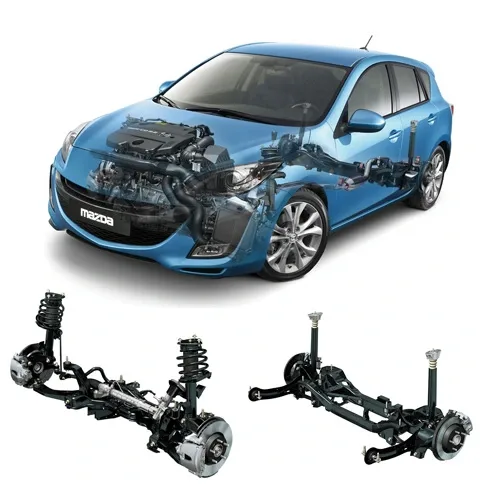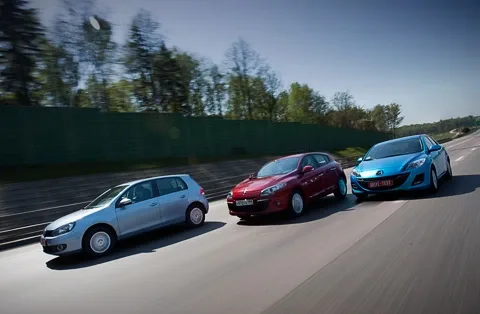
But both in the city and on the suburban highway, the Mazda pleases with its balanced character. The car confidently holds a straight line and doesn't get lost in corners. If the driver suddenly overestimates their abilities, the safety electronics and reliable brakes will be there to help.
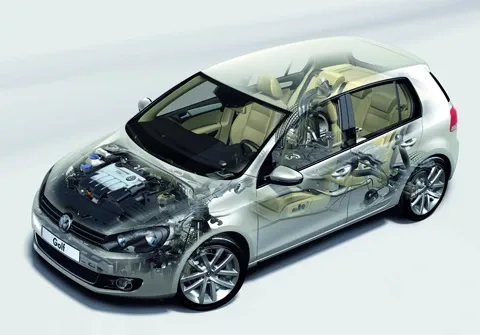
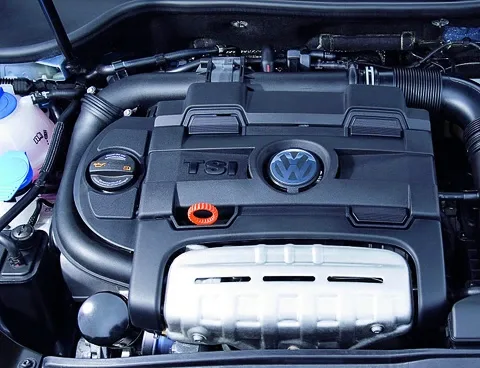
The Golf is a completely different matter. In the city, it breathes down the Mazda's neck, though on short straights it finds it a bit hard to overtake it. But once you get out onto open roads—and it's gone. The Volkswagen in one go passes both the Mazda and the truck in front of it. The TSI turbo engine has practically neither turbo lag nor explosive surge. It pulls evenly across the entire rev range, honestly delivering 122 horses from one and a half liters of displacement. The preselective DSG "robot" is tuned more delicately than the Mazda's four-speed automatic. In sport mode, it's almost as quick as the Japanese in shift speed, but in "Drive" it pleases with smooth, almost imperceptible gear changes.
The Golf's handling is honed to near perfection. The Germans clearly polished the car's behavior with an eye on possible side effects, unlike Mazda. Therefore, the Golf drives without its former sharpness, but academically precise and sometimes even boring. On corner entry, it tends to straighten the arc; on lift-off, it shifts inward. A real textbook, not a car. The only thing we didn't like was the steering wheel becoming excessively heavy with increasing lateral loads. And its ability to outdo the Mazda in responsiveness is likely hindered by the modest 195/65 R15 tires. The Golf's chassis clearly begs for wider, lower-profile wheels.
But thanks to the high tire profile, the Golf doesn't notice ruts and swallows small bumps perfectly. The brakes are German-tenacious and informative. The tires are almost silent in the cabin. Overall, the Golf is the quietest car in our quartet. The engine is audible just enough for information. Urban noise is heavily muffled. The Mazda, though losing to the Volkswagen, also made a big step forward in comfort. The new "three" has become noticeably quieter—not for nothing is its aerodynamics more efficient than its predecessor's. The overall noise level is a bit high, and the body resonates unpleasantly on bumps, as if you're sitting in a steel drum. But the Japanese managed to quell local noise sources. For example, the rear arches are silent, although previously sand drummed on them without a twinge of conscience.
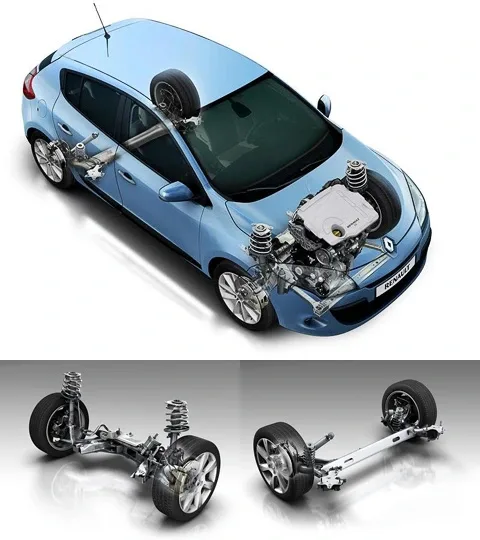
In the Renault, it's almost as quiet as in the Golf. But that's where the similarity with the German on the road ends. While the Volkswagen confidently darts along the highway, the Megane's driver doesn't even think about such maneuvers. The 1.6 engine produces 106 horses—one more than the Mazda. But it doesn't pull at all! The Megane can't accelerate without downshifting—it simply lacks torque. And when the four-speed automatic does engage a lower gear, the engine roars, but dynamics don't increase. After a couple of seconds, the gearbox kicks back up, and the attack fades. "I honestly tried," the Megane seems to say. It's inconvenient, and sometimes dangerous.
Outside the city, let's say, you can simply cross overtaking off the Megane's menu by an act of will. But what about in the metropolis? With such sluggish thrust, it's hard to make a maneuver without hindering others. Merging into traffic from an acceleration lane, the Megane can only do so with the pedal to the floor. Moreover, after lifting off the gas, the car continues to accelerate for another second. Against this backdrop, even the Megane's somewhat incomprehensible steering wheel doesn't seem out of the ordinary, although the subtle connection with the car in sharp corners disappears entirely.
But the Megane has a trump card that neither Volkswagen nor especially Mazda can beat — superb ride smoothness. The indifference with which the French car dispatches road imperfections can be held up as an example not only to the participants of this test, but also to many SUVs. The Megane's all-devouring suspension means you don't have to think at all about what surface you're driving on. The Volkswagen's chassis does not forgive such familiarity. Large potholes are best avoided or at least slowed down for, otherwise you'll get a harsh jolt with a corresponding sound. Although minor road ripples do not hinder comfort. The stiffest, as expected, was the Mazda3. Jolts at joints and impacts on medium bumps still come as a bonus to the eager handling.
The slowest, most inhibited and anti-driver Megane is not allowed to be written off as an outsider by its enormous comfort advantage and price. While the improved-in-every-way Mazda3 starts at 619 thousand rubles, the fully loaded Megane is only 55 thousand more expensive. And in the base Authentique version it starts from 559,500. Tempting!
The Mazda3 is not the simpleton it used to be. Owners of the Japanese car are now not so afraid of broken Russian roads, and on good winding highways the "three" still delivers maximum driving fun for the money. Plus to the excitement — the most spacious cabin at a reasonable price of 679 thousand rubles for a well-equipped car with an automatic.
For the three-door Volkswagen Golf assembled near Kaluga with the old 102-horsepower engine and manual, dealers ask a hefty 612 thousand rubles. And a car like ours — with a five-door body, 1.4 turbo engine and seven-speed DSG — is 64 thousand more expensive than a similar Mazda. But, in our opinion, this is a fair price for the best car in the class. No matter how pleasant it is for us to talk about chemistry in relations with the Mazda, the physics of the Golf is stronger. Sympathy for this car is clearly measured in millimeters, degrees, kilograms and rubles. Harmony of consumer and driving qualities. Well, competitors, tighter, even tighter!
| Model | Mazda3 1.6 AT | Volkswagen Golf 1.4 TSI | Renault Megane |
|---|---|---|---|
| Body | |||
| Body type | hatchback | hatchback | hatchback |
| Number of doors/seats | 5/5 | 5/5 | 5/5 |
| Length, mm | 4460 | 4199 | 4295 |
| Width, mm | 1755 | 1786 | 1808 |
| Height, mm | 1470 | 1479 | 1471 |
| Wheelbase, mm | 2640 | 2578 | 2641 |
| Front/rear track, mm | 1535/1520 | 1540/1513 | 1546/1547 |
| Curb weight, kg | 1255 | 1316 | 1280 |
| Gross weight, kg | 1770 | 1850 | 1755 |
| Trunk volume, l | 340–1360 | 350–1305 | 368–1125 |
| Engine | |||
| Type | petrol | petrol, with direct fuel injection and turbocharging | petrol |
| Location | front, transverse | front, transverse | front, transverse |
| Number and arrangement of cylinders | 4, in-line | 4, in-line | 4, in-line |
| Number of valves | 16 | 16 | 16 |
| Displacement, cm3 | 1598 | 1390 | 1598 |
| Max. power, hp/rpm | 105/6000 | 122/5000 | 106/6000 |
| Max. torque, N•m/rpm | 145/4000 | 200/1500–4000 | 145/4250 |
| Transmission | |||
| Gearbox | automatic four-speed | robotic, seven-speed | automatic four-speed |
| Drive | front | front | front |
| Chassis | |||
| Front suspension | independent, spring, McPherson | independent, spring, McPherson | independent, spring, McPherson |
| Rear suspension | independent, spring, multi-link | independent, spring, multi-link | semi-independent, spring |
| Front brakes | ventilated disc | ventilated disc | ventilated disc |
| Rear brakes | disc | disc | disc |
| Tires | 205/55 R16 | 195/65 R15 | 205/60 R16 |
| Ground clearance, mm | 155 | n/a | n/a |
| Performance characteristics | |||
| Maximum speed, km/h | 173 | 200 | 180 |
| Acceleration time 0-100 km/h, s | 13.1 | 9.5 | 13.9 |
| Fuel consumption, l/100 km | |||
| — urban cycle | 10.1 | 7.7 | 10.6 |
| — suburban cycle | 6.0 | 5.0 | 5.8 |
| — combined cycle | 7.5 | 6.0 | 7.5 |
| Toxicity standard | Euro-4 | Euro-5 | Euro-4 |
| Fuel tank capacity, l | 55 | 55 | 60 |
| Fuel | AI-95 | AI-95 | AI-95 |
| Base trim | Mazda3 1.6 AT (Touring Plus) | Renault Megane (Dynamique) | Volkswagen Golf VI (Trendline) |
|---|---|---|---|
| Front airbags | + | + | + |
| Side airbags | + | + | + |
| Inflatable "curtains" | + | + | + |
| Isofix child seat anchors | + | + | + |
| Driver's knee airbag | - | - | + |
| ABS | + | + | + |
| Dynamic stability control | + | - | - |
| Automatic transmission | + | + | + |
| Power steering | + | + | + |
| Fog lights | + | + | - |
| Rain sensor | - | + | - |
| Rear wiper | + | + | + |
| Light sensor | + | + | + |
| Rear parking sensors | + | - | - |
| On-board computer | + | + | + |
| Air conditioning | - | - | + |
| Dual-zone climate control | + | + | - |
| Key card | - | + | - |
| Multifunction steering wheel | + | + | - |
| Steering column with tilt and reach adjustment | + | + | + |
| Heated and power-adjustable exterior mirrors | + | + | + |
| Front seat height adjustment | - | + | - |
| Driver's seat height adjustment | + | - | + |
| Split-folding rear seats | + | + | + |
| Heated front seats | + | + | - |
| CD player with MP3 support | + | + | - |
| Immobilizer | + | + | + |
| Alloy wheels | + | + | - |
| Additional equipment of the test car | |||
| Metallic paint | + | + | + |
| Dynamic stability control | + | - | - |
| Bi-xenon headlights | + | - | - |
| Heated windshield | + | - | - |
| Rain sensor | + | - | - |
| Cruise control | + | - | - |
| Tinted windows | + | - | - |
| Fog lights | - | - | + |
| Five-door body | - | - | + |
| Tire pressure monitoring indicator | - | - | + |
| Climate control | - | - | + |
| Multifunction steering wheel | - | - | + |
| CD player with MP3 support | - | - | + |
| Alarm | - | - | + |
| Suspension for bad roads | - | - | + |
| Winter package | - | - | + |
| Xenon low-beam headlights | - | + | - |
| 3D Sound audio system | - | + | - |
| Base trim price | 739,000 | 674,500 | 773,000 |
| Price of tested car | 827,000 | 731,000 | 893,040 |