
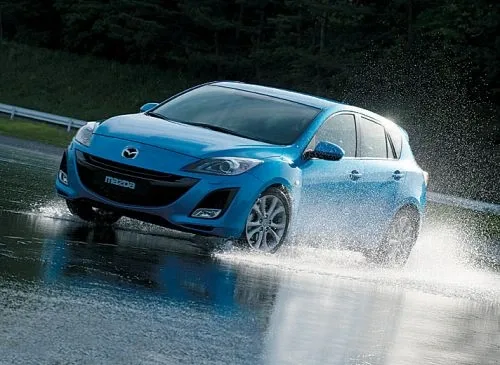
The car that was awaited with such impatience has arrived. We are talking about the new Mazda3. In Russia, the previous generation of the "three" was in tremendous demand — over the five years the model was produced at the Hiroshima plant, 100,000 customers chose it. Interestingly, Germany, which took second place, lagged behind Russia by 10,000 units.
Time will tell how successful the new model will be. But, apparently, Mazda believes in good sales and even turned to higher powers for support. The model's debut was held on the Spanish island of Mallorca, in the chapel of one of the old families. We will find out how effective this move was after sales start. In the meantime, let's try to figure out the new model ourselves.
The appearance of the new Mazda3 evokes mixed feelings. On the one hand, you see familiar features, on the other — the car is perceived differently, freshly. This is roughly what a woman looks like after a visit to a cosmetologist. Seriously speaking, the designers managed to preserve the image loved by hundreds of thousands of drivers worldwide, while organically adding new details to it. It's funny that the "three", when viewed from different angles, resembles either the "six", the CX-7, or the MX-5. Skillfully combining details from different models, the artists created a cohesive image in which the Mazda family is unmistakably recognizable.
Most changes affected the front part. Now it resembles a smiling face. Fog lights are built into the black cells of the grille on the sides of the bumper, and the narrow headlights reveal the car's origin. The idea that it's time to make cars in the Japanese style was voiced by the Mazda6 designer. In the current model, this idea was developed. The side profile strongly resembles the CX-7 crossover and last year's Mazda2. The rear part changed minimally, except that the lights became completely new.
In the cabin, they decided not to experiment. The interior almost entirely moved over from the older "six". Even the ventilation deflectors repeat its scheme: round on the sides, rectangular in the center. Some will consider this a drawback. But there is also a plus: the interior from the "six" added solidity to the "three", which it previously lacked. And it's not just about the design. The body has become larger — the car has increased in length and height. At the same time, the weight decreased by 15 kg. Savings were achieved by increasing the share of high-strength steel (–11 kg), the two-beam design of the dashboard (–2 kg), refining the rear suspension geometry and abandoning the central stiffness element (–0.7 kg), plus other measures.
The engine range has not changed: 1.6 L with 105 hp and 2 L with 150 hp. The younger unit was slightly refined: in the combined cycle, it now consumes 6.3 L per 100 km — 0.6 L less than before. The older engine remains the same in dynamics and consumption. Diesel versions, including the new 2.2-liter turbodiesel, will still not be available in Russia. Experts say that our fuel for such engines is like sulfuric acid.
For the first drive, we took a hatchback with a 1.6 L engine and a manual. We immediately get into a series of sharp turns for which Mallorca is famous. At the end of winter, strong winds are not uncommon here. But inside the car, there is a feeling that the weather has improved. What happened was what fans of the brand had long been waiting for: the "three" became noticeably quieter than its predecessor. The credit belongs to aerodynamics. The noise of the oncoming airflow is minimized — at a speed of 100 km/h and a side wind of 5 m/s, it does not exceed 59 dB.
Handling was tested on the same winding roads. There are no fundamental changes. The suspension remains the same in design, but it has been recalibrated. The car has become softer and more comfortable. Fans of sporty driving will surely say that the car has been ruined, made "neither fish nor fowl". Possibly. But in megacities, where the majority of "matryoshkas" live, it is rarely possible to test the racing character. At the same time, comfort did not spoil the handling. The body has become stiffer in high-load areas — this is felt. Russian buyers will be able to appreciate the new model closer to the end of summer or the beginning of autumn.
Four round-the-world trips
Pre-production Mazda3 samples covered 175,000 kilometers in 30,000 hours of testing. This is comparable to four round-the-world trips. No model from the Hiroshima manufacturer has been tested so thoroughly. In addition to the Japanese Miyoshi proving ground, prototypes were sent to Europe — to test them on the roads where the "threes" will have to drive. After the checks, the cars were disassembled down to the last screw and every part was checked. Defective ones were replaced, and testing continued until all indicators became excellent.
Love it or leave it
The instrument wells have been slightly changed, but the style of the previous model is preserved. Recognizable.
The navigation system from Mazda may one day reach Russia as well. We wait.
The trunk holds 340 L — that's 40 L less if the Bose audio system is installed. Quite enough.
Driving
The sharpness of handling has slightly decreased.
Interior
The glossy black plastic is gone. The front seats have received pronounced lateral support, even in the base trim.
Comfort
The new "three" has become more comfortable thanks to softer suspension settings.
Safety
The Mazda is equipped with a blind spot monitoring system and adaptive headlights that turn the headlights up to 15° following the bends of the road.
Price
Not announced yet.
Pros and cons
+ The previous concept is preserved, interesting design details have appeared, good lateral support for the front seats.
- Softer suspension and controversial front bumper design.
Make and model - Mazda3
Dimensions - 4460x2002x1755 mm
Engine - petrol, 1999 cm3, 150 hp/6500 rpm
Transmission - automatic, 5-speed
Dynamics - max 205 km/h; 10.6 s to 100 km/h
Competitors - VW Golf, Toyota Auris, Opel Astra, Peugeot 308
Our opinion
The fresh "three" dispelled the fears of brand fans who worried that the manufacturer would completely abandon its previous philosophy. We see a familiar Mazda3, but in a new, attractive guise. The chassis has become noticeably more comfortable. At the same time, the level of comfort has increased, and for everyday city use, this is much more important than some speculative sportiness.
© 5 Koleso