
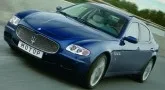
The engine “from Ferrari,” a robotic Duo Select gearbox where shift speed is the top priority, a transaxle layout with the gearbox moved to the rear axle for perfect weight distribution, a stiff suspension, and a sharp steering wheel — you'll agree, quite a radical set for a luxury sedan. And there's also the Sport GT version, which we got acquainted with last fall — it then won a comparative test, beating the Audi S8.
However, in the key American market for Maserati, the overly pronounced sporty character, which compromised comfort, held back sales of this luxury sedan. Many wealthy buyers are quite satisfied with the unique appearance of the “four-door,” its elegant interior, and the melodious engine. But the “jerky” gearbox only annoyed them. Credit must be given: the company tried throughout production to improve the Duo Select's operation algorithm and achieved some results. But if you compare this gearbox with an “automatic,” even the most ordinary one, it clearly loses in smoothness.
And so the idea of an “automatic” Quattroporte was born — in the end, the model received a six-speed ZF transmission. We tested the result of this modernization on the Exclusive GT version. Externally, the car with the “automatic” is no different from the regular Quattroporte. But inside, on the modified tunnel between the front seats, instead of the small Dual Select joystick, there's now an elegant full-fledged automatic transmission selector. On the slot along which the selector moves, I didn't find a groove for sport mode. It turned out that in Maserati, it's activated by a separate button on the center console, and this automatically activates the sport settings of the active shock absorbers.
The Quattroporte Automatic also has a changed weight distribution. Previously, 47% of the weight was on the front axle; now it's 49%. Did this affect the car's behavior? It would seem that such a shift in weight balance shouldn't have serious consequences. But two days of driving the new Automatic Exclusive GT showed: there are consequences, and quite noticeable ones.
Perhaps the suspension settings of the “exclusive” version also played a role. Even in sport mode of the shock absorbers, the car rides very smoothly. Passengers are pleased. And what about the driver? The driver feels that the front end has become heavier — at least, that's the impression I got. The Quattroporte responds less readily to steering wheel movements (including small angles) and is less eager to dive into corners. In general, the Automatic Exclusive GT takes better care of the passenger's interests than the regular Quattroporte, but worse — of the driver's interests. Or you could say it this way: the Quattroporte aimed at North America gained in comfort at the expense of the sporty component. That's exactly what the creators were aiming for. The car became heavier and slower (acceleration to 100 km/h — minus 0.4 seconds, top speed — minus 9 km/h). But throttle control became convenient. The gearbox shifts up and down quickly, transmitting torque to the rear wheels almost without interruption.
True fans of the legendary Italian brand need not be sad: the version with the “automatic” merely complements the model range; the Duo Select is still in service. Moreover, the real Quattroporte is cheaper than the Automatic version.
PRICES AND TRIM LEVELS
Prices for the Quattroporte Automatic start at ?149300 — that's how much the base version costs. The car tested in the comfortable Exclusive GT Automatic variant is the most expensive, priced at ?166300. For the sporty Sport GT variant, the dealer asks ?161300.