
The first car of the head of the Lifan Group concern was a Lada. The 75-year-old Yin Mingshan forgot the modification. He only remembers that the car was red, without air conditioning, and broke down strictly once every six months. Now the boss of Lifan rides in the back seat of an Audi A8. His life path is considered the embodiment of the Chinese dream: from a dissident and small entrepreneur to a major influential businessman. The motorcycle repair workshop founded by Mingshan in 1992 with nine employees is now the third-largest car exporter in China. Mr. Mingshan invited journalists to his native Chongqing, to the company's headquarters and factory, to tell how and thanks to which models Lifan will increase its share in our market from one to two percent.
Yin Mingshan dreamed from childhood that China, flooded with foreign goods in the 1940s, would become a strong exporter. It came true. The head of Lifan ranks 187th on the list of the richest Chinese, wears a general secretary-style tunic, and, they say, has finally found common ground with the Communist Party. He intends to bequeath his empire to his daughter. There is also a son, who works at Lifan and collects supercars, but is not suitable for the boss role.
A brief note. Lifan came to Russia in 2007, only two years after starting its own car production, signing a contract with the Avtomir group and Derways company. Since May 2012, the plant in Cherkessk has switched from SKD large-knockdown assembly to a full CKD cycle. The head of Lifan calls Derways nothing less than first love, which cannot be betrayed. Although... Mingshan does not rule out that his charges will build their own plant in Russia, where there will be no models of other brands, as is currently the case at Derways.
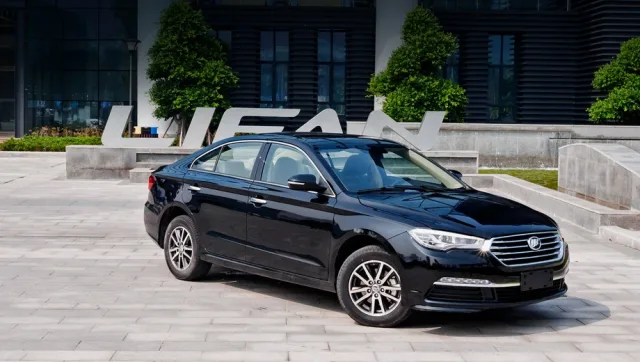
While the Russian bestseller of Lifan, the Solano sedan, recently acquired a CVT, its Chinese "twin" — the "six hundred twentieth" — underwent a serious restyling. We almost accidentally met the updated model on Lifan's territory. It now has a different index — 630. It will appear here in 2014.
Currently, in our country, there are four models on the assembly line and on sale: the Solano sedan (Lifan 620), the X60 crossover, the Breez sedan and hatchback (Lifan 520), and the compact Smily (Lifan 320). Last year, the Chinese finished with a figure of 20,544 cars sold, maintaining, as in 2011, the status of the most popular Chinese brand in Russia. Of the sold cars, 15,108 were Solano, 3,853 Smily, and 1,420 the crossover.
The sad Smily, a Mini for the poor, works as a Lifan security service car in the permanently smog-covered Chongqing. This is a pre-restyling version. For some time, it was the most popular model of the brand in Russia.
Lifan's future products up to 2017 are planned as follows. On a small platform with a wheelbase of 2400–2600 mm, the Chinese intend to build a crossover, a micro-crossover, and a hatchback. All of them are assigned engines with a displacement of 1.0–1.5 liters. On the medium "cart" (base 2600–2700 mm), a pair of minivans, two crossovers, a hatch, and a sedan will be built. These will be given 1.5–1.8 engines, as well as turbocharged 1.2 and 1.4 engines. With a wheelbase over 2700 mm, the platform is considered large. It is assigned exactly the same set of models as the medium one, only the engines should be "bigger": 1.8–2.4 plus turbo engines 1.4 and 2.0. The fourth "cart" is intended for rear-wheel-drive minibuses; we will not dwell on it.
It is hard to look at the updated Smily with its little engine (90 hp, 115 N•m), as well as its predecessor, without tears.
We were introduced to Lifan's premiere schedule in China. This year, the company rolled out the updated Solano (Lifan 630), the restyled Smily (330), the new Breeze (530), and a certain van. (It is easy to notice that the digital designation of the models has added a ten.) In 2014, sedans with numbers 650 and 820, the compact crossover X50, and a minivan will debut. In 2015, the "six hundred sixtieth" sedan and a whole brood of crossovers will see the light: X40, X55, X66, X80. In 2016, the X70, station wagons based on the 620 and 720 models will be born, and the Breeze will undergo a restyling. In 2017: new 720, 530, a van, and the 820 station wagon. There is also this news — some models (720, 820, X70, X80) will be equipped with ESP!
The "eight hundred twentieth" sedan is the most decent of everything Lifan has today. We managed to peek at some characteristics. Length — 4865 mm, width — 1835, height — 1480 mm. Wheelbase — 2775 mm. Curb weight — 1433 kg, gross — 1808 kg. It is equipped with 1.8, 2.0, 2.4 engines, a five-speed manual or six-speed automatic. With the junior engine (133 hp, 168 N•m), the sedan accelerates to 100 km/h in 15.8 seconds and reaches a top speed of 179.4 km/h.
The interior of the Lifan 820 sedan is not final. The Chinese forbade filming it, promising to provide "official spy photos." And they never sent them — they changed their minds. Since they deceived us, we publish an unofficial super-spy shot.
The calendar of Lifan's further expansion in Russia looks like this. In December of this year, the current flagship model of the brand — the D-class sedan Lifan 720 — will arrive. Here it will get the name Cebrium and an estimated price from 500,000 rubles. In March 2014, the new Breeze will appear. In April, the X60 will acquire an "automatic." In June, the updated Smily with a CVT will be brought. It is also possible that the company will soon decide to supply minibuses, small trucks, and various motorcycle equipment to us.
The Lifan Cebrium sedan is boldly classified by the Chinese as business class. It is built on a modernized Solano platform: McPherson struts in front, a torsion beam in the rear. The Cebrium is assigned a 1.8 "four" (133 hp, 168 N•m) and a five-speed manual. Russian prices, ideally, start from 550 thousand rubles.
It was possible to photograph the interior of the Cebrium — exactly this interior will come to Russia. It was forbidden to touch the films, papers, and other debris.
Lifan is betting on crossovers. The only crossover in the lineup, the X60, will become all-wheel drive at the beginning of 2015. This was not planned at all, but since Russians need a 4 x 4 option, the Chinese will do it. The multi-disc clutch is planned to be purchased from the Koreans at Hyundai. Partners are being sought for work on a dual "wet" clutch. Turbo engines and new gearboxes will be purchased from Europeans. In any case, new members of the "X family" — the X50, X70, and X80 crossovers — will be all-wheel drive from birth. In the fall of 2014, at the Moscow International Automobile Salon, Lifan will show all possible new items. What you definitely should not expect from the brand is diesel cars: heavy fuel is bad in China, and the demand for cars running on it is minimal.
The Lifan X50 crossover is still very raw. Lifan even tried to stop photographing its exterior. It did not work. But they did not allow photographing the rather interesting interior.
The Chinese are used to accusations of borrowing technical and design solutions. They respond: we opened our research center with six hundred employees (90% of them engineers), we have 1,479 registered trademarks and 7,207 patents worldwide, we received dozens of certificates — both European E-mark and American DOT with EPA. So we live, honestly, they say.
The Lifan 820 sedan will come to our country no earlier than 2015–2016. Before that, it must pass Euro NCAP tests for five stars and comply with the Euro-6 eco-standard: the Chinese really believe in this. And they name an approximate price in Russia — 600–650 thousand rubles.
Currently, Lifan owns 20 plants, with more than 16 thousand people on staff. They produce about 500 thousand units of product per year. 300 thousand of this volume are cars sold in 70 countries. The remaining goods are purchased by 160 states. 45–50% of products go for export. The Chinese also diligently send people abroad: engineers are sent for internships to America, Europe, and Taiwan. Expats are seemingly welcomed, including Russian designers.
Lifan managers do not rule out the creation of sub-brands — new brands for cars more expensive and of higher quality than the Cebrium.
By the way, Yin Mingshan spoke separately about car design. We, he says, are still looking for a suitable style for ourselves, trying to create "our own gene," negotiating with Italians. And not with just anyone, but with the masters who drew the Bugatti Veyron. They say they (presumably the Italdesign studio) have already come to Chongqing twice, and soon we will go to them on a return visit!
The factory workers arranged a touching meeting. Here it is, the Chinese answer to the eternal Russian question "what to do?".
They gave a tour of the plant in Chongqing, where four thousand people produce 200,000 cars a year. Everyone was given helmets, the same red ones as the workers. It reminded me that at a similar Kia plant in Korea, everyone, guests and hosts, walk with uncovered heads. And nothing. Well, yes, Soviet traditions prevail in capitalist China. From the threshold of the enterprise, the yellow hammer and sickle on a red background, honor boards, banners, and other "glory to the CPSU" began to catch the eye.
Lifan employees silently led us through the plant and showed us the stamping, welding, and assembly shops.
If at the Korean automobile plant half of all labor falls on the shoulders of robots, then at the Chinese one absolutely everything is done by people. And since they have to assemble cars manually and the tools are quite primitive, there are a large number of workers at every workplace. For example, several guys are busy only with stacking hoods. Many people walk around with rags and wipe things down. There are unexpectedly many girls working alongside men in the workshops.
At first glance, it seems that cars at the Lifan plant are made of foil. A touch test confirms this version: as expected, cheap cars are made of low-quality and low-strength materials. The results of manual assembly also leave much to be desired.
The overall impression of the plant is clean but poor. Colleagues who visited this enterprise in 2011 noted that nothing has changed. Neither for the better nor for the worse. At the exit from the workshop, our Russian-speaking Chinese escort handed out tiny badges with the inscription Lifan. He explained that this is sports paraphernalia: the company sponsors the local football club Chongqing Lifan, which plays in the Chinese First League. Well, how are they doing? — we ask. He smirks: badly!
All roads on the factory territory are densely lined with brand-new Lifans in two rows. It's not just a parking shortage. Mostly these are units where something went wrong. They are queuing up for defect elimination.
Calling the 40-minute circling on a patch of land a "test drive of the updated Lifan model range" doesn't quite fit. It was assumed that this time would be enough not only to drive but also to shoot something with a camera. On the other hand, a longer test in open space would have been too much for the prototypes. Even here they stalled...
The Chinese diversified the cramped carousel with a drive over artificial bumps, and that was a bold move: the battered suspensions nearly fell out of the cars. And various fasteners did scatter on the concrete. Overall, the cars presented no surprises: plain Chinese auto industry, as it is. Against the general background, the Lifan 820 sedan seemed a step forward: one can talk about its handling and noise insulation, some comfort. It also falls apart, but that's forgivable for a prototype.
As soon as a colleague braked sharply in the "eight twenty," the overhead console dropped on him.
Interestingly, Lifan is not even in the top twenty in domestic market sales. In China, few people drive locally produced cars, even though they cost next to nothing. Mr. Minshan also prefers foreign cars. By the way, wasn't the author of the Lifan logo inspired by Lada? The Chinese boats look very much like the VAZ boat.
According to the AEB Automobile Manufacturers Committee for 10 months of this year, Lifan lost the "sales" leadership in Russia to Geely: the latter sold 22,074 cars in Russia against Lifan's 21,945. Another member of the Big Chinese Three, Chery, is still far behind the pair of competitors — 16,486 units sold.
And Minshan's cars themselves are in many ways similar to Togliatti's. Cheap and angry, they "sail at full sail," as the meaning of the word Lifan dictates, to the undemanding buyer with limited means. It looks like Chinese revenge for the export of Ladas. And what? A familiar Korean once said: the Japanese are cunning, and the Chinese are evil.
Behind the scenes
It so happened that all recent business trips led me to places with names starting with "K." Karelia, Korea, China, Krasnodar Krai... Whoever I read this list to, everyone perked up at the same place: "Oh, China!" So it makes sense to have an extended "behind the scenes" section. I visited Lifan in October and spent almost a week in the country. The memory card of my camera and iPhone were packed to the brim with gigabytes. This resulted in four videos.
Breakfast in Chongqing took place at McDonald's, which, of course, has its own Chinese peculiarities. I declined food and went for a walk around the neighborhood. It's hot and humid. The first thing you notice is the smog. It's always and everywhere, and houses of incredible height drown in it. Where there's no smog, there's haze, or they're together. The second is the noise of horns. Drivers honk for any reason or no reason. They often just signal their presence on the road with beeping. The third quirk is dining tables with a rotating central part. Food passes between the participants of the meal like on a carousel. We encountered such tables several times. After a tiring flight (we flew to Chongqing via Helsinki!), we were offered to rest in a nice spa center with a pond and palm trees. Interestingly, around this paradise corner there is a gloomy, dirty, and poor area. Upon returning to Chongqing, we visited a multi-story shopping center styled after ancient architecture. And in the evening, we boarded a steamer and began a three-day voyage along the Yangtze River.
Early the next morning, our ship arrived in Fengdu — the so-called ghost city, which has the gates of hell. The tour guide said: we are going to hell. In a sense, she didn't lie. There's a crush like in the underworld, with traders on every corner. Visiting Fengdu is definitely worth it, but many artifacts smell of new construction, and if you stray from the beaten path and look around a corner, you'll see the same Buddhist statues lying broken among the garbage... When we returned to the ship and looked around, we realized we were traveling with German pensioners and that the ship's crew would entertain passengers with amateur performances all the way. In the evening, the waiters and cleaners put on a very decent concert with dances in national costumes.
A new day — a new excursion. This time without leaving the ship. At seven in the morning, the vessel passed Qutang, one of the Three Gorges, which are considered a Chinese wonder of the world. Forested mountains resembling giant moss clusters, caves in picturesque cliffs — beautiful. At 9 a.m., we passed the second gorge, called Wu. At noon, we transferred to a smaller vessel and headed to Shennong, a tributary of the Yangtze. At the landing stage, another transfer, and now we're being taken on traditional Chinese rowing boats. At some point, the rowers jump ashore and turn into burlaks. They say in the old days boats were pulled exactly the same way, only naked. Soon a race begins. The German pensioners got younger and stronger rowers, and their boat overtakes ours... But our guide girl can sing and performs an ancient rowers' song. However, the German boat, which had fallen behind at the turn, overtakes again, and the surroundings are filled with a song in Russian: "The proud 'Varyag' does not surrender to the enemy"!
Our vessel passes a five-step flight of locks. Each step lowered the ship by 30 m. Locking is a majestic, mesmerizing sight. Especially in the dark. The evening gala concert of the crew included dragon dances, magic tricks, and much more. The guys do everything well except the instrumental ensemble. In the morning, we arrived at the Three Gorges Dam — the most powerful (22,500 MW) hydroelectric power station in the world. The dam's length is 2,309 m, height — 185 m. Due to the haze (or smog), it's hard to see the dam; it gets lost in the veil like a hedgehog in the fog... Then the ship carried us to the city of Yichang, from where we flew to Beijing. We reached the Chinese capital late in the evening and left it at dawn — we couldn't see anything. Overall, the trip was excellent and unforgettable, but everyone returned home to Moscow with great eagerness. If you plan to go to China, remember — you need to bargain everywhere. You can knock the price down by 4-5 times, or even more. Thank you for your attention.