
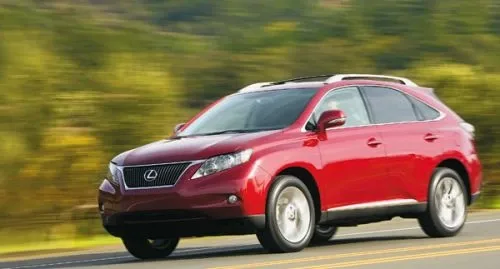
In the spring of 2009, the premiere test drive of the new Lexus RX 350 took place in California's Napa Valley. A symbolic location for the debut: this region is the largest winemaking center in the US, where Europe seems to have been transported to the American West. Here, among the vineyards, the line between the Old and New World blurs, which allowed us to also compare the European and American versions of the crossover. And, to our delight, the comparison was not in favor of the "American."
A Step into the Future
The first thing that catches the eye is the innovation: on the lower part of the center console sits a joystick that controls the onboard computer and navigation. Its operating principle resembles a computer mouse with force feedback and the cursor "sticking" to active elements. To avoid accidentally touching the controls while driving, the buttons are placed on the side edges of the regulator — they are now activated by the thumb, not by pressing the head itself.
Cursor control quickly becomes intuitive: the joystick is symmetrical, so both the driver and front passenger can easily access the audio system, climate control, navigation, and vehicle settings. The resemblance to gaming controllers is so strong that one can't help but wonder: isn't the next step installing full-fledged driving simulators in cars as onboard computers become more powerful?
America, as is well known, is populated by immigrants. Under the star-spangled shell, a longing for the historical homeland keeps breaking through. Napa Valley is a clear example: dozens of wineries are scattered here like pieces of Champagne, Tuscany, or Rioja. Local producers proudly talk about their wines, although the history of these estates spans only a few decades, and the bouquet often tastes sour compared to French varieties. The five million tourists who visit annually, however, don't care — they seek a connection to their roots. In this green valley, America and Europe truly merge.
The first acquaintance with the car, as usual, is visual. The RX 350 has clearly gotten younger: narrowed headlights, round fog lights tucked into neat recesses — all this freshens the look. But calling the newcomer a beauty is hard. The massive "cheekbones" and the monstrous angle of attack of the lower plane of the short front overhang get in the way. Such a design would allow tackling steep slopes, but for a Lexus, this is clearly not its profile. Rather, it's a nod to aerodynamics: together with underbody panels that laminarize the airflow beneath the car, the new overhang provides a class-leading drag coefficient of just 0.32.
The car has become more spacious both outside and inside. The increase over the previous model is 15 mm in height, 30 mm in length, and 40 mm in width, while the cabin has expanded by 52 mm. But the main thing is not the numbers, but the change in interior styling. The bulky symmetrical forms have been replaced by an asymmetrical layout with a slanted console and that very joystick. The instrument panel, divided into two sections, has become noticeably more functional. And the information display, built for the first time on organic LEDs, is perfectly readable even from the passenger seat.
A small but pleasant detail: the automatic seat retraction system when the engine is turned off itself raises the steering wheel to the upper position and slides the seat back 50 mm, making exit easier. You get back in, press the "start" button — and everything returns to its place. Let's go!
On paper, the refinements to the good old 2GR-FE engine look formal: power increased by only 1 hp (277 vs. 276), torque by 4 Nm (346 vs. 342). But optimization of the valve mechanism, variable-geometry intake, new injectors with ultra-fine spray, and the third-generation intelligent variable valve timing system have produced a tangible effect. Across almost the entire operating range, the engine has become more responsive, especially noticeable in the 10–15 Nm gain in the 2300–5400 rpm zone.
The weak point of the second-generation RX was the all-wheel-drive system. In the new RX 350, torque distribution is managed by an active system with a range from 100:0 to 50:50. This improved traction and stability, and also helped save fuel. Here, the RX 350 is a record holder among its classmates: just 10.6 L per 100 km in the combined cycle. The new 6-speed automatic transmission, replacing the 5-speed, also contributes.
However, on the mountain serpentines of Napa, you forget about fuel economy — only on descents does the instrument panel occasionally blink a green ECO indicator. What matters more here is something else: during dynamic driving, the gearbox skips gears, dropping from 6th directly to 3rd or from 4th to 2nd when braking. There is no trace of the former melancholy when cornering. The new double-wishbone rear suspension, adaptive electric power steering, and a body whose rigidity has increased by 50% have transformed the unwieldy second-generation RX into a completely different vehicle. It flies through curves precisely, without excessive body roll or yaw. Even the extra 100 kg the car gained during modernization is practically unnoticeable. The VDIM system, if it intervenes, does so extremely delicately — you only learn of its operation from the hysterical beeping of the warning indicator.
It is here that the difference between the American and European versions emerges. In the US, VDIM will be an option, not standard, and the suspension for the American market is tuned much softer. Switching to the "American," you immediately feel the difference: the stability control without VDIM roughly yanks the car back, and the body noticeably leans in corners. In short, the same story as with the local wine: it seems the same, but it "tastes sour." However, for Americans, this is exactly the ideal premium crossover — a Lexus "on soft paws." Arguing with them about whose version is better is like disputing the quality of Napa wines. Fortunately, we have our own RX and our own European wines.
Specifications
Make and model – Lexus RX 350
Dimensions – 4770/1885/1685 mm
Engine – petrol, 3456 cm3, 277 hp/6200 rpm
Transmission – automatic, 6-speed
Performance – max 200 km/h; 8.0 s to 100 km/h
Competitors – BMW X5, Mercedes-Benz M-class, Volvo XC90
Convenient
Touch sensors in the front door handles have replaced the usual buttons on the lock.
Useful
The side-view camera significantly simplifies parking and maneuvering the crossover.
Practical
Using the selector on the right steering wheel spoke, you can adjust individual vehicle functions.
Advantages and Disadvantages
+ Economical fuel consumption, excellent handling, a rich set of electronic systems.
– Some options are unavailable for the Russian market; instead of a full-size spare, there's a temporary spare.
Driving
Road behavior and dynamics are almost flawless for this class. The integrated dynamic management system acts very delicately and does not interfere with the driver.
Interior
The interior looks more modest than some rivals, but it is thoughtfully designed down to the smallest detail. Innovative details — the joystick for controlling the onboard computer and the organic LED display — add style and enhance convenience.
Comfort
Due to the pursuit of improved handling, the RX has become slightly stiffer, but sound insulation has noticeably improved: additional pads have appeared in the wheel arches and under the underbody panels.
Safety
Ten airbags, including knee protection for the driver and front passenger.
Price
Not yet announced.
Our Opinion
In an era of financial crisis, new models become an important way to attract buyers. The RX 350 has noticeably improved in handling and fuel economy, and innovative electronics enhance this advantage. All this could well lure some customers away from direct competitors to Lexus.