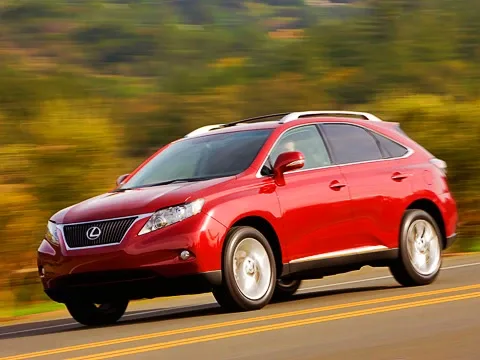
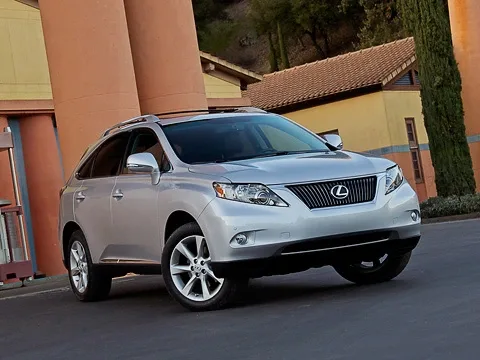
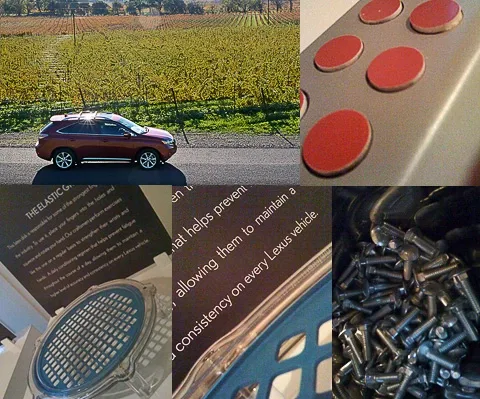
And there are some more hieroglyphs on me — and the Japanese are already running their fingers over the fabric. Whispering among themselves. Fu-ku-i-ken. It turns out Fukui is a little-known prefecture on the coast of the Sea of Japan. A capital of 200,000 residents, ancient castles that miraculously survived American bombings, and a nuclear power plant that feeds Osaka and Kyoto. And also — the birthplace of Akira Kasamatsu, deputy chief designer of the new Lexus RX 350 crossover.
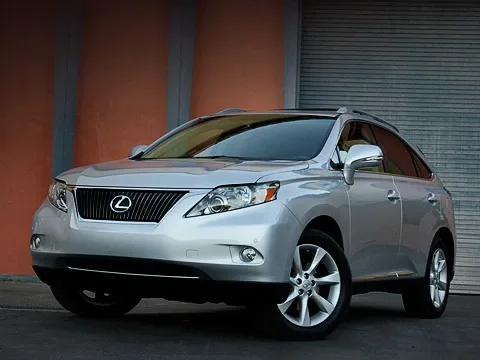
This is the all-wheel-drive top model in almost European specification. With large wheels, reinforced brakes, and a stiffer suspension. In America, you can also buy such an RX — like with a sport package. But neither in Europe nor in Russia will they offer the comfortable American version — it's not homologated. Sales of the new "er-iks" will begin in spring.
What a pleasant coincidence! Kasamatsu-san smiles broadly, and I'm already waving my recorder in front of his nose. Like, what design features account for such a controversial design of the new car? The deputy chief, without blinking, replies: there are none! The platform hasn't changed much; they met the environmental and fuel consumption requirements through a modernized engine and the abandonment of permanent all-wheel drive. No functional puzzles were set for the designers.

Akira Kasamatsu everywhere walks with a black plastic bag — in it should be a sausage sandwich and a "triangle" of kefir. But for answers to the trickiest questions, Kasamatsu-san doesn't reach into the bag. The current deputy chief participated in the development of the "two hundredth" Land Cruiser. His specialty is chassis.
They were required to do one thing: make it solid and intricate. And to understand why it turned out the way it did, you need to remember what the Lexus principle of L-finesse actually means. Because, I know from myself, at the associative level there's terrible confusion with this "el-finesse." Remember the GS sedan! After it, it seems that L means lightness. And the flagship LS seems to offer a different interpretation: L is luxury? The huge LX — and that's already large. But if large suits the new RX 350 crossover quite well, then where's the lightness here? And the car isn't bursting with luxury either — especially in the base trim.
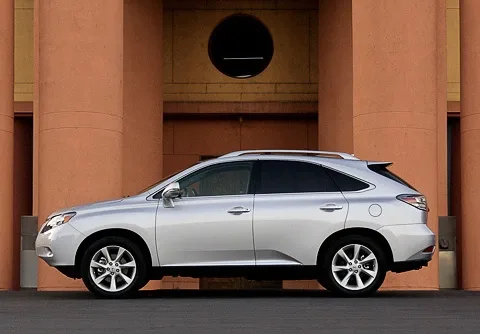
Lexus, like no other brand, reverently follows the wishes of focus groups. Especially when it comes to the brand's locomotive, which accounts for almost 40% of sales. The new RX 350 is exactly what potential customers wanted it to be. This design is from the depths of consumer masses. And that means just a few months will pass — and everyone will get used to it. Look at the RX in profile more often...
It's all wrong: L means leading edge. And this is the edge that the Japanese try to stay on; it can stick out from anywhere. In this case, being on the edge means doing something complex without any technical necessity. The new RX, if you will, is a kind of technological showing off. Kasamatsu-san explains to me how exactly Toyota bends fingers in the L-finesse style while we smoke in the sun near some rural garage with parked one-and-a-half-ton trucks.
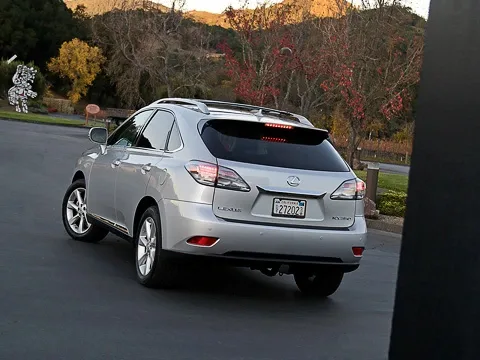
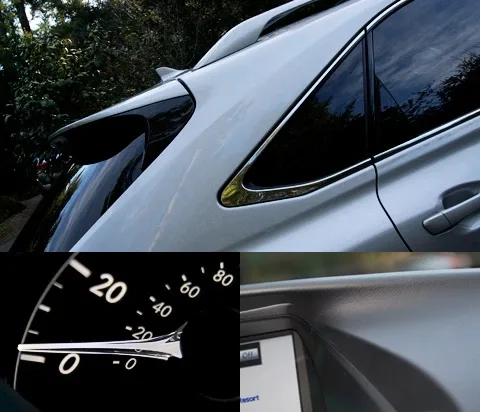
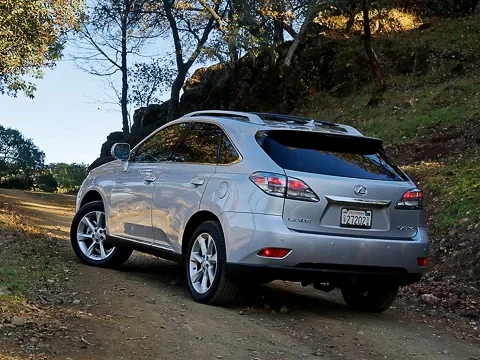
— You see, Mikha-san, — the Japanese amusingly swallows the ending of my name, — this falling rib on the rear pillar? It's not a straight line, as it might seem at first glance, but a convex one. And the upper edge of the rear window, on the contrary, is slightly concave. If you don't know — you'd never pay attention, but you look and feel some kind of vagueness.
— I feel the vagueness, Akira-san! It's unclear — why this play of lines. Surely they don't carry some functional load? They organize air flows or play on the rigidity of the pillar.
— No, just for beauty. And who, besides Toyota, can afford such a thing? In such details, imperceptibly affecting the subconscious, L-finesse hides. Now look along the side — does the complex relief catch the eye? And in the cabin: the inner surface of the visor above the display imperceptibly becomes the outer one. And how do you like this intersection of two lines forming the central console, and the instrument needles twisted like a screw?
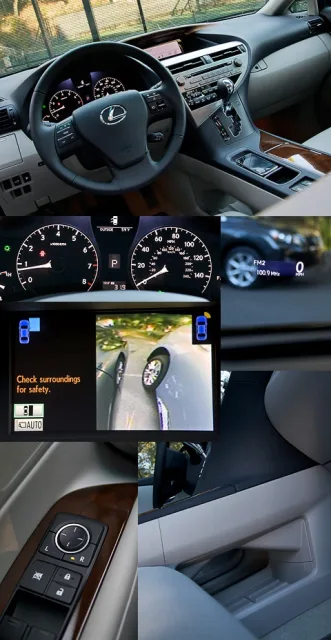
- In the cabin, you won't find fabric upholstery — only leather. And the rare wooden panels are pieces of the same log. But such an interior would best suit the base front-wheel-drive version: the plastic parts match the monochrome display.
- The steering wheel rim is either fully leather (in the photo) or, as usual, with slippery wooden inserts. Beautiful, but impractical.
- Top versions have two cameras in the latest fashion: rear and side view. The latter is mounted in the right mirror. But Lexus doesn't provide a surround view.
- The windshield can project current speed, navigation prompts, audio system and adaptive cruise control status, as well as warning signals from the Pre Crash system.
- The Japanese have prepared three trim options: to the already familiar black and gray-black (in the photo) schemes, a beige-black one — Ivory — has been added. Two types of leather: coarser and thinner.
- It's interesting how the "er-iks" solved the problem of dirty sills. The Japanese made them fake — the doors reach the very bottom edge of the body.
And in my opinion, the main plus of the new interior is a unified style. Previously it was eclectic, but now everything down to the last button corresponds to some common idea. The plastic of the front panel is soft and whimsical: in two clear eyes of the optitronic scales, something looks at me, hiding a wide lollipop of climate control behind its cheek. On the chin — a winding groove of the gear selector. The central tunnel is thrown as a high bridge over the tray for small items: the driver's and passenger's zones are separated — the steering wheel rim is either fully leather (in the photo) or, as usual, with slippery wooden inserts...

Only all-wheel-drive modifications with navigation, cameras, and a large color display (on the left) will reach Russia. And in America, relatively cheap front-wheel-drive models with a "non-complex" VSC stabilization system, 18-inch wheels, and a simple monochrome display in the cabin will still be in demand.

No matter how Japanese the Lexus RX 350 may seem, it's still an "American" to the core. With a parking "scissors" and comic inscriptions on the cup holders: "Just a cup holder."
The high seating position is comfortable, although the seats are flat. In your hands — the usual Lexus steering wheel with overly wide spokes, so that it's hard to grip "quarter to three." Forward visibility is acceptable, rear — zero. The rear-view camera doesn't provide trajectory hints, the Mark Levinson audio system doesn't play the lower midrange. Everything is harmonious — and equally a solid four. Everything says: this is the most mass-market Lexus. The tactile sensations from the plastic are on the verge of mass-market goods. But Lexus not only writes in Russian — it's been taught to recognize voice commands in the language of Dostoevsky! Too bad the pre-production cars are strictly English-speaking.
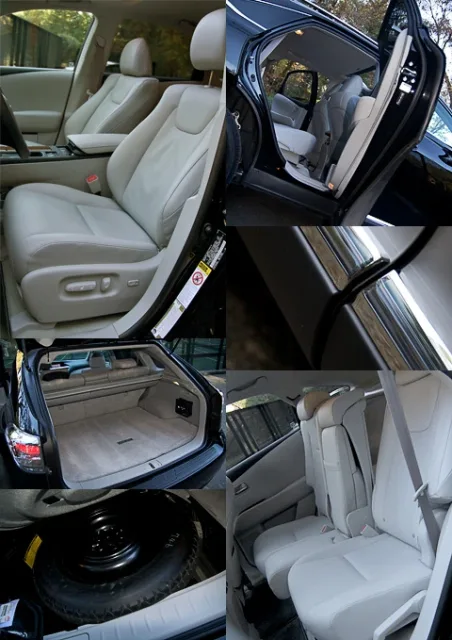
- Front seats — with heating, ventilation, and memory for three positions. The rear sofa moves and folds in parts, and the backrest angle is also adjustable. The fifth door is with a servo drive, and under the trunk floor is a narrow spare wheel. For Russia, they promise a full-size spare wheel.
- It's interesting how the "er-iks" solved the problem of dirty sills. The Japanese made them fake — the doors reach the very bottom edge of the body.
I select a destination in the navigation system menu: to move Kasamatsu-san from breakfast to a coffee stop. The deputy chief asked to be my passenger — an honor and a rare stroke of luck! We'll talk on the way about chassis settings with the new rear multi-link. Why there are no active shock absorbers in the suspension, why they abandoned pneumatic supports on European modifications... But why did he bring an interpreter? I look in the mirror as the elderly Japanese woman moves her "half" of the rear sofa and stretches out, reclining the backrest — poor woman! The navigation "mouse" in my hand trembled in confirmation of the last command. Selector to drive — what does Lexus have besides showing off?
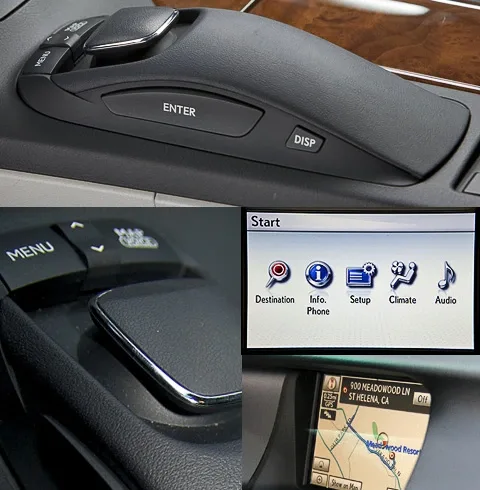
The "mouse" on the central tunnel is a forced solution. The multimedia system screen is now too far from the driver to remain touch-sensitive. The Japanese chose a location more convenient for the eyes than for the hands. In return, they put a "mouse" under the palm, whose "head" is given a return force by a couple of motors when hitting menu "buttons." The feedback level is adjustable! However, operating this thing without looking at the screen is impossible. And that's its biggest drawback, not counting the fact that the office "mouse" is already sick of the target audience.
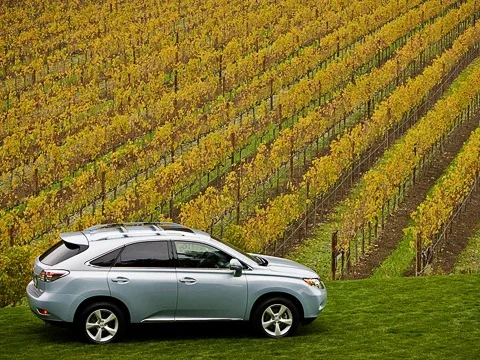
Despite the extra hundred kilograms of mass, the crossover feels confident on the winding roads of California's Napa. It's hard to believe that an electric power steering is installed here: the effort on the steering wheel grows smoothly and proportionally to the steering angle, and the front wheels transmit information through the "wooden" steering wheel. Body rolls are present, but they do not interfere with a quick response to the driver's actions — it's no surprise, because the body rigidity has increased by one and a half times, and the suspension has become noticeably stiffer.
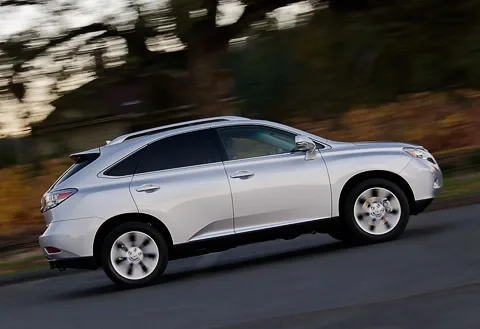
Inside the cabin at speed, it's quiet enough to hear the sighs of the interpreter who is suffering in the back. The main noise comes from the tires, the wind is less audible. The aerodynamics of the body are good: the drag coefficient is 0.32. During acceleration, the engine raises its voice, but its sound is now a pleasure to hear.
At the corner entry, the Lexus slightly understeers, trying to overcome inertia, and then, leaning on the outer "Bridgestone," confidently traces an arc with neutral handling. The new rear suspension is a real success! No extra steering corrections are needed: in constant-radius corners, the RX requires just one steering input. You won't be able to overdo the speed at the entry: the stability control intervenes early. This is a typical trait of all Lexus models: in extreme modes, it's impossible to tell who is in control — the driver or the electronics.
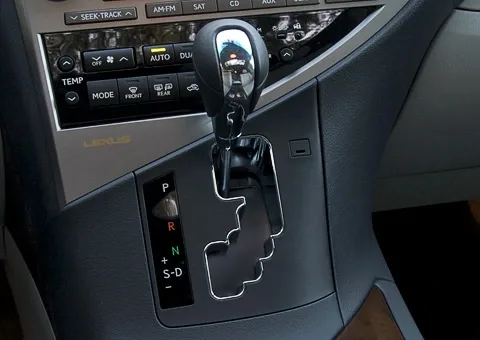
S mode on the "automatic" is a sequential mode. There's no talk of sportiness: the gearbox shifts in any direction when reaching the rev limiter or after a kick-down. Sometimes shifts happen without any apparent reason.
Precise control of the trajectory with the gas pedal is hindered by the sluggish throttle response and overly cautious traction control. Moreover, the new six-speed automatic refuses to downshift one gear at a time. Although the 277-horsepower V6 3.5 with a modernized intake and variable valve timing on both shafts literally begs to drop just one gear! And how it begs — with a noble baritone with a pleasant rasp. The engine's voice is loud, on the edge of discomfort, but it honestly delivers its eight seconds to 100 km/h.
Despite its showy image, the RX encourages active driving, sharp accelerations, and hooliganism on the road (the interpreter in the rearview mirror has already turned green and gone quiet). The "er-iks" didn't used to do that. Moreover, this audacity doesn't require any effort from the driver — whether on the highway or on narrow switchbacks. Driving the Lexus is as easy as flipping through playlists on a connected iPod via the new mouse-like controller. It's just that the handling, unlike the menu, doesn't glitch.
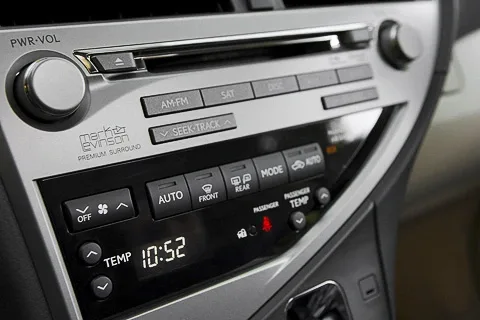
The top-end Mark Levinson Premium Surround audio system in the RX has four fewer speakers than in the LS sedan. The same technologies are used, but the Reference in the flagship sounds noticeably neater and more detailed.
The ride smoothness of the "er-iks," as before, directly depends on speed. When Mr. Kasamatsu's interpreter finally got motion sickness, the Lexus started to shake. A familiar story. It shakes, but at least it doesn't thump like before. I remember it was for the unworthy sounds that I criticized the air suspension of the previous generation. It seems they listened to our comments — and simply abandoned air suspension in Europe. I took a short ride in a car with the soft American suspension, which is not available in Russia: it allows some rocking, but it's noticeably more comfortable.
And what about all-wheel drive? Mr. Kasamatsu warns: don't expect miracles from the coupling in the rear-wheel drive. It engages at the slightest slip of the front axle, but it can't pre-distribute torque during braking or in a corner. On asphalt, the moment of its engagement is almost imperceptible. If only there were snow... The VDIM system (the name, by the way, is not entirely honest: real VDIM can steer, but the RX cannot) deactivated at start activates itself as soon as the crossover gains speed — the rear doesn't swing out. And the flat, ruler-straight dirt roads of California's vineyards don't lend themselves to rally antics.
Local winemakers, by the way, complain: visiting French accuse them of an overly mathematical approach. They say Americans don't understand wine — they only dream of deriving a formula for the perfect taste. And the Yankees themselves give pompous tours of the cellars and talk about thirty, fifty, and even hundred-year business histories. I also joke about them, but I drink California chardonnay — and I like it. In the prestigious restaurants of San Francisco, out of the thirty most expensive wines, only a couple are French. The rest are local.
Isn't that a parallel with Lexus? How many premium competitors of Lexus made it into the top five most reliable in America? None. In Europe, Lexus with its arithmetic essence is also not taken seriously. But overseas, it's a full-fledged premium brand — and the best-selling one. So, from a market perspective, are both Lexus and the winemakers from Napa right?
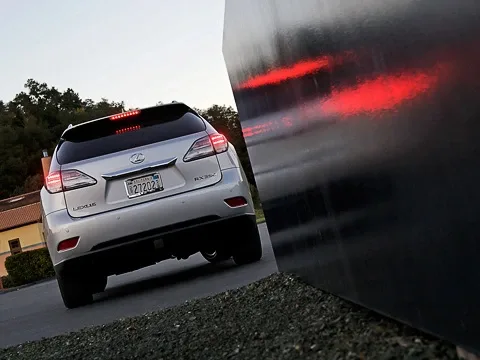
The fact that the Japanese spent so much time on the design and focus groups is evidenced by this: the final exterior was approved only a year and a half before the launch of the pilot batch. And the RX was in development for almost four years!
Don't you like the looks of the new "er-iks"? But let's be honest: the world's first premium crossover was never a beauty. Over two generations, its image crystallized into something more or less harmonious, although personally, I never thought this direction was promising.
The main thing is that the controversial design of the new RX 350 has become a landmark moment. Whether it's good or bad — we no longer have the Lexus that tried its best to imitate others. This is a Lexus with an element of surprise. Even if this element is sometimes far-fetched and contrived. Here it's convex, there it's concave — some kind of technological obscurantism! But there's a spark in it that this synthetic brand so lacked. The ugly car breathed life into the term L-finesse for me: it should be understood not as leadership in competition, but as the definition of the edge beyond which the brand's originality begins. Where its spirituality begins.
Technical specifications
| Specifications | Lexus RX 350 |
| Body |
| Number of doors/seats | 5/5 |
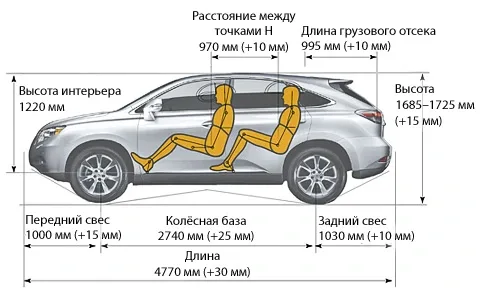
| Length, mm | 4770 |
| Width, mm | 1885 |
| Height, mm | 1685–1720 |
| Wheelbase, mm | 2740 |
| Front/rear track, mm | 1630/1620 |
| Curb weight, kg | 1975–2085 |
| Gross weight, kg | 2545 |
| Trunk volume, l | 446 |
| Engine |
| Type | petrol, with distributed injection |
| Location | front, transverse |
| Number and arrangement of cylinders | 6, V-shaped |
| Number of valves | 24 |
| Displacement, cm3 | 3456 |
| Max power, hp/rpm | 277/6200 |
| Max torque, Nm/rpm | 346/4700 |
| Transmission |
| Gearbox | automatic, six-speed |
| Drive | front/all-wheel |
| Chassis |
| Front suspension | independent, spring, multi-link |
| Rear suspension | independent, spring, double-wishbone |
| Front brakes | disc, ventilated |
| Rear brakes | disc, ventilated |
| Ground clearance, mm | 180 |
| Turning diameter, m | 11.4 |
| Performance characteristics |
| Maximum speed, km/h | 200 |
| Acceleration time 0–100 km/h, s | 8 |
| Fuel consumption, l/100 km |
| urban cycle | 14.3 |
| extra-urban cycle | 8.4 |
| combined cycle | 10.6 |
| Emission standard | Euro-4 |
| Fuel tank capacity, l | 72 |
| Fuel | AI-95 |
Preliminary trim levels of the Lexus RX 350 crossover in Russia
Basic equipment (Executive version) - Front airbags
- Front and rear side airbags
- Inflatable "curtains"
- Knee airbags
- Active headrests for front seats
- Pre Crash safety system
- ABS
- VDIM dynamic stability control
- Electric power steering
- Multifunction steering wheel
- Immobilizer
- Remote Touch interface
- Power-folding and heated side mirrors
- Front and rear power windows
Here is the revised test-drive text of the Lexus RX 350 in accordance with your requirements.
***
Technology
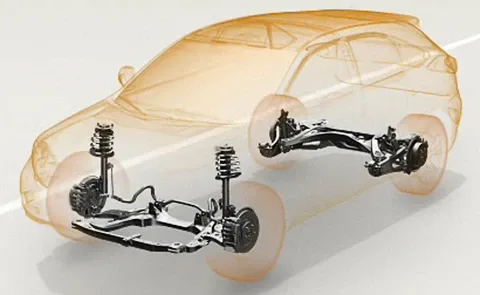
Engineers thoroughly reworked the platform of the "RX". Everything located behind the B-pillar, including the new rear multi-link suspension, was designed from scratch. The front suspension also did not remain untouched: new control arms, struts, and stiffer springs appeared here, as well as a new subframe with different mounting points. Such a set will no longer fit the Japanese Harrier, which will live in parallel with the new model for some time. These developments will also be useful for future projects. Which ones exactly — Kasamatsu-san just silently taps off the ash.
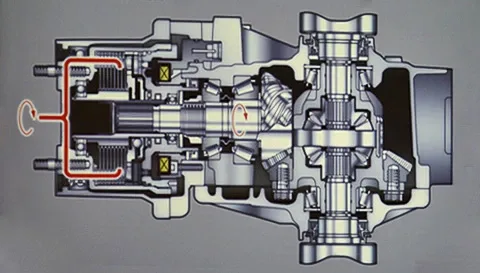
Instead of a viscous coupling, an electromagnetic clutch from JTEKT now handles the connection of the rear axle. This allowed the heavier crossover to maintain its previous fuel efficiency and also unify the versions. In normal mode, it is essentially a front-wheel-drive car, and the clutch locks only at the slightest slip of the front wheels.
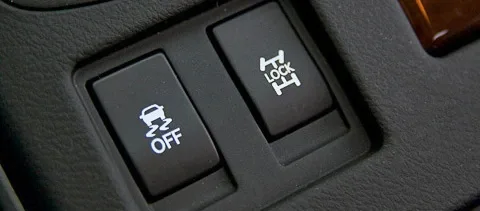
Full engagement of the friction plates takes only 20 milliseconds. If desired, the clutch can be locked forcibly using a button on the center tunnel, but after reaching a speed of 40 km/h, the electronics will release the clutch itself.
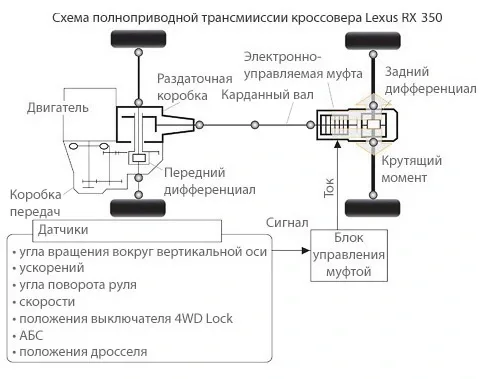
The transmission "brains" monitor the steering wheel position and accelerator pedal, and also take into account data from yaw rate sensors to determine the required degree of locking. However, the clutch does not interfere with the operation of the VDIM dynamic stabilization system. The only exception is starting with the accelerator fully depressed, when torque is pre-transferred to the rear.
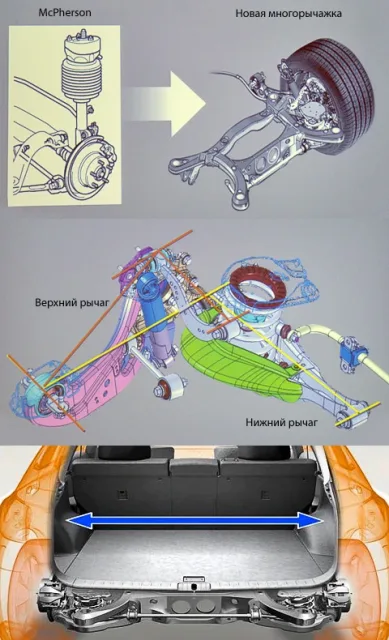
The new rear multi-link suspension has become stiffer in torsion and noticeably faster in response to lateral loads than the previous McPherson strut design. A bonus is the compactness of the unit, thanks to which a little more free space appeared in the trunk.
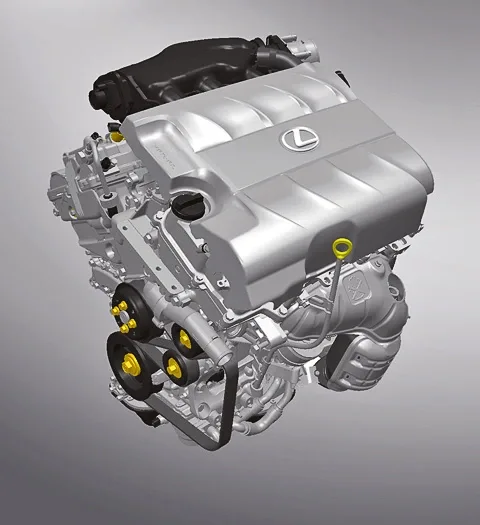
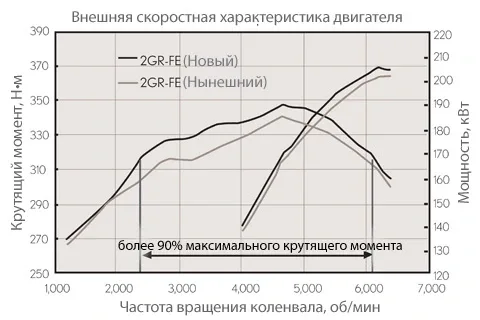
The aluminum "six" 3.5 (index 2GR-FE) with port injection in its latest iteration received a slightly higher torque — 346 N•m, available in a wider range. The engine acquired thin valve stems, camshafts optimized for roller tappets, an aluminum intake manifold with a motorized flap, and a new stainless steel exhaust system. The generator pulley is now connected to the rotor through an additional clutch, which reduces inertial losses. The result is a five percent reduction in CO2 emissions and the same fuel consumption in the combined cycle: 10.6 liters per 100 km, despite the increased weight.
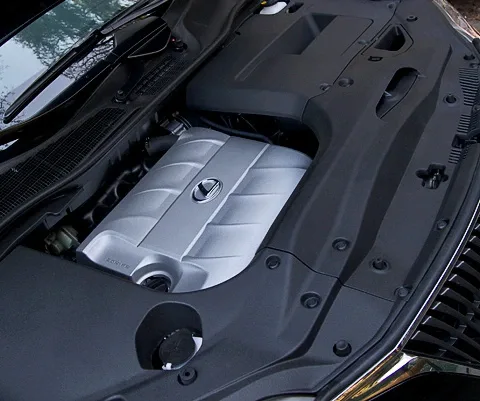
Everything under the hood is hidden by a decorative cover. Draping the engine compartment with such a "blanket" turned out to be cheaper than bringing the appearance of the units to aesthetic perfection. And with an ugly engine, it would no longer be a Lexus.

The keyless entry system allows you to lock the car with a simple touch to a special rib on the upper part of the door handle.
Safety
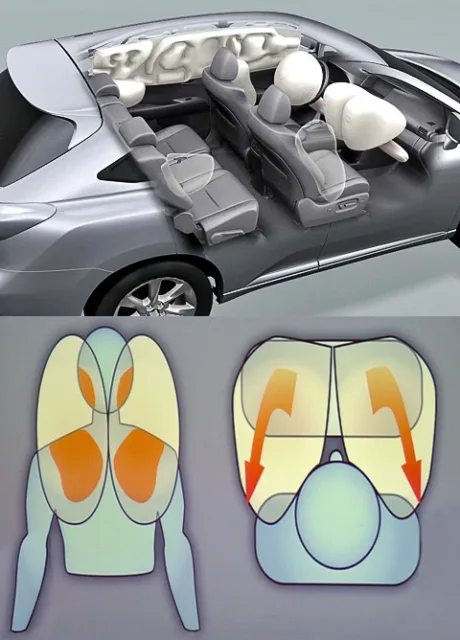
In the body's load-bearing structure, the share of high-strength steels now reaches 42%. The weight gain is the result of "training" for safety. Even in the base version, there are ten airbags. Moreover, the passenger airbag is for the first time made of two parts: according to the Japanese, this design is softer for the chest and face, which will be especially appreciated by glasses wearers.

Active headrests of the front seats in a rear-end collision are designed to protect the spine from whiplash injury.
History (Robert Yesenov)
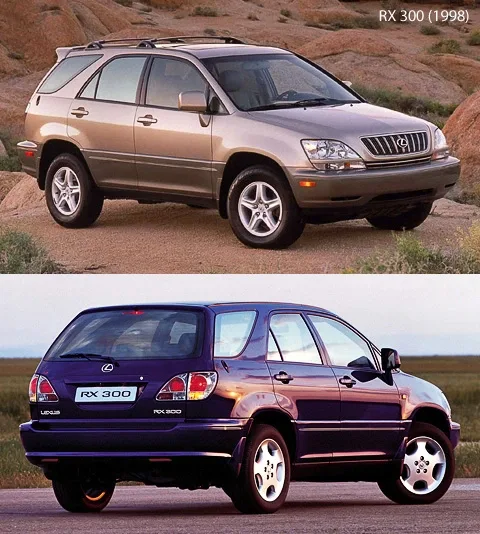
Lexus RX is the brand's debut crossover and the founder of the class of mid-size premium crossovers. The car, released in 1998, was created specifically for the American market. Restrained appearance, impeccable quality and reliability, generous equipment, and reasonable prices ensured sales of more than 360 thousand cars over five years. Under the hood was a V6 3.0 with 220 hp paired with a four-speed automatic. In 2000, the RX 300 officially launched in Europe, where it sold about 15 thousand units until 2003. On the domestic Japanese market, Lexus had a right-hand-drive twin, the Toyota Harrier, but with less powerful engines — "fours" 2.2 and 2.4.
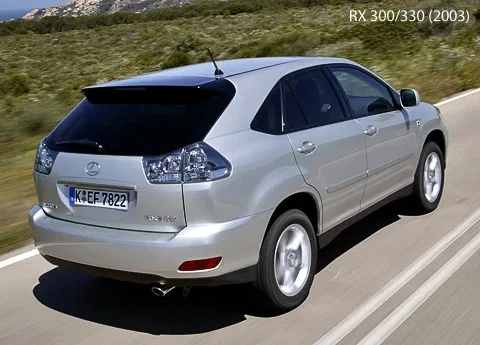
The second-generation RX, released in 2003, did not lose its bestseller status. In the USA, about 100 thousand buyers were found annually. Europeans received the new model simultaneously with Americans, but with a different engine: in the States it was the RX 330 with a V6 3.3 (230 hp), and in Europe — the RX 300 with a 203-horsepower "six".
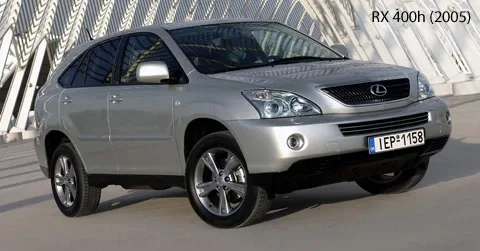
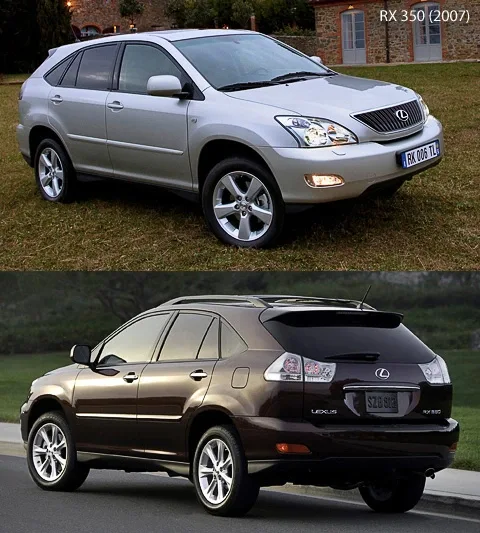
In 2005, the lineup was supplemented by the RX400h hybrid with a power plant of 276 hp and a slightly updated appearance. Two years later, the RX 300/330 versions underwent a restyling, receiving a common index — RX 350 (V6 3.5, 277 hp).
Over ten years, the total production of the Lexus RX exceeded one million. A tenth of these cars settled in Europe, of which 23 thousand — in Russia since 2003. And these are only official figures, because the RX has been loved by "gray" dealers from the very beginning. The current RX is an excellent high-speed cruiser. The new model is of the same breed.
Behind the scenes
Visual simulators of production culture. Try to distinguish ten shades of red — the Lexus quality control department can do it. Try to blindly take exactly five bolts out of a glass — and a Toyota worker can do it. The elastic mesh is a special expander for training finger dexterity. A success simulator.
Perhaps California wineries are no more than a century and a half old, and they are all obsessed with the perfect drink. But even here they know: on each of the thousands of plots there is its own soil, and a barrel made of toasted French oak can still present a surprise. And then another hurricane can draw a line under the efforts of local agronomists.