BODY VS FRAME
I remember how a BMW X5 once amazed me. In the forest, we came across a logging track, and it just accelerated and flew over it on the move — thanks to the flat bottom and powerful engine. But the diesel Land Cruiser following behind puffed laboriously and solidly sat on its belly. But let's not talk about them. Let's take a Volvo XC90 with a 4.4-liter petrol V8 as the 'soft-roader', and from the SUV camp, we'll roll out a Lexus LX570 with a 5.7-liter engine. A great pair, especially considering that both types of cars live with a modern city dweller only because he's zombified by advertising. The Volvo XC90 is a crossover through and through: unibody construction, independent suspensions all around, and no low range in the transfer case. But it has a powerful engine and decent geometric off-road capability — the approach angle reaches 28 degrees. Only the long wheelbase is concerning, which can easily cause you to sit on your belly on sharp terrain changes. And it's also annoying that ESP can't be turned off — you have to choose straight trajectories and forget about active steering. The Lexus LX570 is a classic SUV: body-on-frame construction, solid rear axle, and low-range gearing. Plus, a very powerful engine and two killer options: hydropneumatic suspension that raises the approach angle to 31 degrees, and a crawl control system that works like cruise control for off-road. Don't forget the large suspension travel with excellent articulation, which practically eliminates wheel lifting.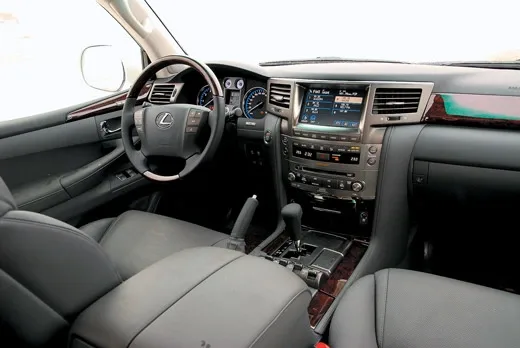
How many times have I stared at this interior and still couldn't form a final opinion. Colleagues say it looks like an American truck – so be it
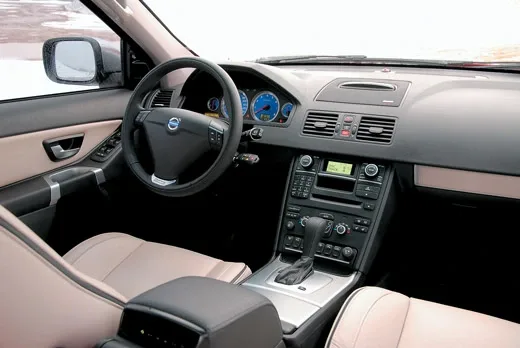
A simple, clear, and precise control panel. Just as it should be. True, you have to reach for some buttons
ON A LEAKY RAFT
Before the test, we did nothing but argue. Logically, a lighter crossover with good geometry should handle rough terrain more easily and freely than a heavy SUV. But inside each of us sat some mystical protest against the 'soft-roader' brethren. After all, an SUV touches the deepest strings of the soul, and the Russian person's craving for it is irresistible, even if all its off-road capabilities are not used even 20%. In the end, the editorial team agreed that for the average driver, the main argument in this dispute should not be off-road capability — it heavily depends on the driver's skill, and some work miracles even with single-wheel drive — but endurance. In the classic, old-school execution, an SUV is akin to a truck: the frame and solid axle are a guarantee of great strength. This is felt perfectly on frozen mud. The Lexus LX570 drives confidently, maintaining smoothness. Impacts from the ground are first absorbed by high-profile tires, then the frame, and only then, already much weakened, reach the body — the driver barely notices them.

• The approach angle can be easily increased to 31 degrees with hydropneumatic suspension
• The departure angle is small – only 23 degrees. This, of course, hinders off-road
• The departure angle is small – only 23 degrees. This, of course, hinders off-road
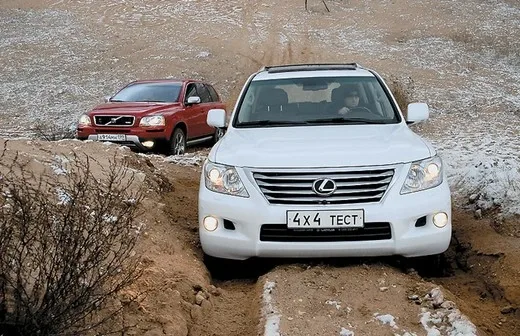
In ruts, the SUV feels more confident than the 'soft-roader', but if it does get stuck, it'll sink deeper


• Volvo's geometric off-road capability is limited not by the front overhang but by the long wheelbase
• Bigger trunk – longer rear overhang. Capacity outweighs off-road capability
• Bigger trunk – longer rear overhang. Capacity outweighs off-road capability
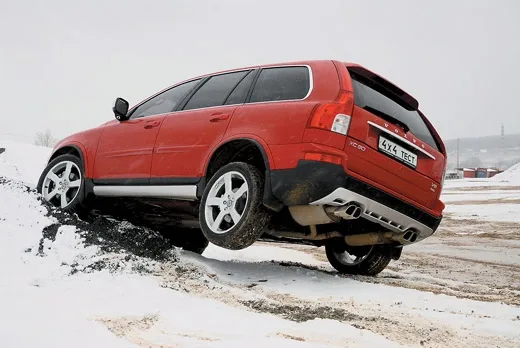
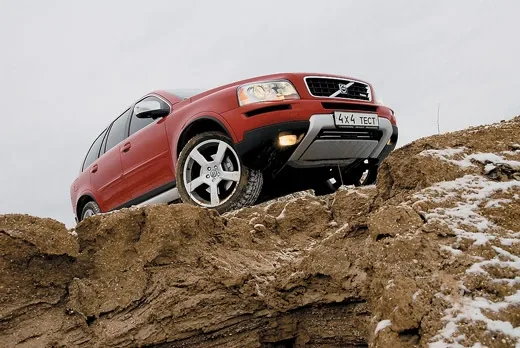
The Volvo feels uneasy on frozen ground. It endures but pleads: 'Give me high-profile tires. I can't shake on these slicks anymore. Or at least slow down – don't you feel sorry for me?'
SPECS: LEXUS LX570


SPECS: VOLVO XC90


RURAL TRANSPORT?
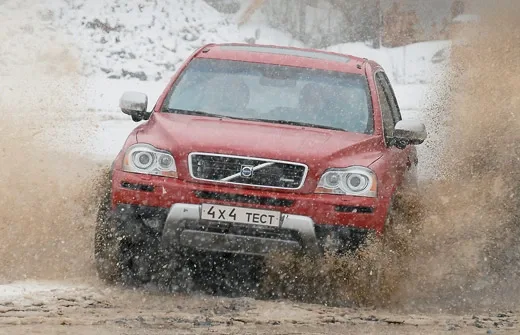
The confidence that an SUV instills off-road is deceptive. It seems you can drive like a sheriff — turning the wheel with one hand while flicking cigar ash with the other. Like hell you will! On asphalt at speed, you'll only stay calm by gripping the wheel with both hands and bulging your eyes with tension. Many people live in this state for years. Look at the traffic flow — and you'll see people who don't even notice how long ago and irrevocably this transformation happened to them. From the perspective of a sane person (and there are almost none left), the Lexus LX570 is typical rural transport for a millionaire state farm director, to carry him across fields and dirt roads. If anyone thinks otherwise, they're just an amateur or have never compared this SUV with other cars. The 'soft-roader' Volvo XC90 with a V8 engine, not yielding to it in dynamics, comfort, or finish, seriously surpasses it in handling and directional stability. The Volvo is good not only in the city and on the highway, where it's much easier, but also on light off-road. Although at the word 'off-road', I again want to talk about the Lexus. It's not afraid of anything. You don't need to creep across a field, looking around and feeling the path. It tells its owner: 'Floor it!' Off-road, this car is delightful. But I don't know a single person who uses the LX570 for its intended purpose. From morning to night, these beautiful SUVs for some reason plow Moscow asphalt, and then sleep in garages. A girl buys a Lexus to feel more confident, or a banker to look more solid. Does any of them know how the crawl control system works and why it's even on this car?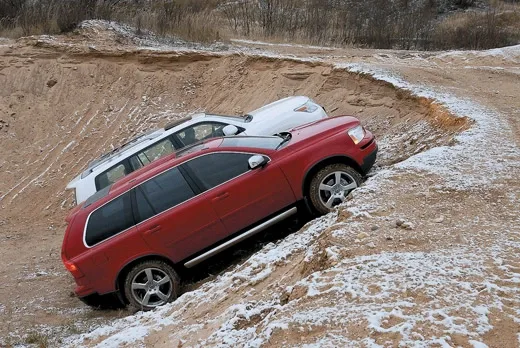
SHOWING OFF OR BRAKES?
As good as the Lexus is, in this rap battle, the Volvo wins. The XC90 has almost as much pomp, but the driving pleasure on asphalt is incomparably greater. Overtaking, long curves, and lane changes in dense traffic — all this comes noticeably easier to the 'Swede'. Its brakes, unlike the competitor's, work predictably and clearly. After the Volvo, getting behind the wheel of the universal Lexus SUV is completely unappealing. And this is despite the fact that the 'Swede' is not a benchmark in its segment. So, before looking down on 'soft-roaders', you should think carefully.