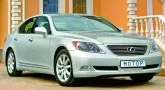
When the third generation of the large sedan from Japan hit the market, many critics immediately dubbed it a copy of the famous "hundredth" from competitors. But Toyota, together with its luxury division Lexus, did not stand still and now presents the new LS, which completely dispels these suspicions. Now no one will dare to reproach this model for lacking its own style or borrowing others' ideas — the LS looks absolutely original.
Let me remind you that the Lexus philosophy called L-finesse implies perfection in everything. To be fair, it is worth noting: while applying advanced technologies within this concept, the manufacturer manages to maintain quite reasonable prices, especially given the quality of the product. But let's get back to the LS. Is the new Lexus sedan really as flawless as the brand's ideology promises?
The sedan has become larger — it has added 15 mm in length, 45 mm in width, and 45 mm to the wheelbase, but visually this is imperceptible thanks to the lightweight silhouette. The body shimmers with smooth lines, and the styling is so expressive that it seems the LS is rushing forward even when standing still.
Japanese engineers approached every body detail with special care. For example, the chrome trim of the windows is made solid — not a single joint! Moreover, the chrome is polished by hand, which is why its shine is so delicate. The front headlights are also framed in chrome, and the polycarbonate lenses were hand-finished. The paintwork is impeccable — double hand-polishing technology was used here.
The manufacturer assures that the Lexus LS has the lowest noise and vibration levels in its class, as well as record torsional rigidity — 30% higher than its predecessor. But the build quality is even more evident: the gaps between body panels are minimal. And the claimed drag coefficient of just 0.26 causes genuine surprise.
I open the massive door, close it slightly — and the soft-close mechanism gently pulls it shut. Inside, it's a true kingdom of wood, leather, quality plastic, and magnificent sound. The LS can be equipped with the best audio system in its class (as an option) — Mark Levinson Reference Surround. 19 speakers reproduce sound with a power of 450 W.
However, even the standard 10 speakers will delight any music lover. If you turn off the music, complete silence reigns in the cabin. Even at high speed on the highway, you can whisper. To hear the engine, you have to listen carefully — the rich baritone only breaks through at high revs. It's easy to check the quality of sound insulation: just open the window a crack, and a cacophony of city sounds bursts into the cabin. The contrast is impressive.
The climate control system promptly responds to temperature changes associated with passenger seating — an infrared sensor on the ceiling monitors fluctuations in six zones, including four passenger seats. A simple example: if you get into the LS from the cold, the flow of warm air in your zone instantly intensifies. In the back, you'll warm up even faster — additional air vents are installed in the ceiling there.
The LS is very cozy inside, with the interior styled in calm classicism. The high center console and the window line shield you from the outside bustle. The trim materials are beyond reproach, as is the assembly. The gaps between parts have decreased by more than half compared to the previous model and are sometimes just 0.5 mm. Electric drives are installed everywhere possible. All seats are equipped with ventilation, but massage is only available in the long-wheelbase version.
The car's high status is confirmed by many small details. For example, all electric motors operate at the same volume and even in the same key; compartment lids open at the same speed and equally smoothly. The lighting of different cabin zones turns on sequentially and only when needed. And the buttons on the center console have different feedback: the stiffest ones are for the driving safety systems.
The ergonomics of the driver's seat raised no complaints — everything is at hand, and no difficulties arise upon first encounter with the car. Moreover, the multimedia system monitor supports touch screen, which significantly simplifies interaction. Behind the multi-layer noise and vibration insulation hides a new 4.6-liter V8 — a true hub of high technology (it should be noted that such solutions are everywhere in the LS 460). The engine's power is 35% higher than its predecessor's, and torque is 10–30% higher across the entire operating range. The cylinder block is cast from aluminum alloy, and the camshafts are hollow.
Here, a variable valve timing system on intake and exhaust, Dual VVT-I, is used, and its drive is electric. Even more interesting is the D-4S injection system. Each cylinder has two injectors: one in the combustion chamber, the other in the intake port. Thanks to this, the engine combines the advantages of direct and port injection, hence better elasticity and fuel efficiency. At idle, only direct injection operates. At low and medium revs, both injectors are engaged. And when revving "to the redline," only direct injection is activated again, ensuring more complete combustion and additional cylinder cooling.
The engine runs smoothly, revs instantly, and provides the car with decent acceleration. Here, of course, we should also thank the eight-speed automatic transmission (plus reverse gear). No other automatic in passenger cars today has this many gears. At the same time, the gearbox is comparable in size to the previous LS's six-speed automatic, weighs only 10% more, but can handle 22% more torque.
The "automatic" works flawlessly. Shifts occur without jerks or delays in any mode. The gear ratios are closely spaced, so there's always enough thrust. If you need more, just press the gas pedal slightly, and the gearbox instantly drops a couple of gears, followed by impressive acceleration. The gearbox also knows how to imperceptibly engage "neutral" when stopped, even if the selector is in Drive.
The manufacturer claims that shift speed has increased by 41% compared to the previous LS and is 0.35 seconds. And if we compare not with the previous generation, but with current competitors? Here, the Lexus LS is also ahead. Neither the 7G-tronic from Mercedes-Benz nor the standard six-speed "automatics" from Audi and BMW can boast such performance. By the way, the eight-speed scheme is very relevant now. ZF recently announced its intention to produce such an "automatic," and many automakers will surely adopt its gearbox.
Behind the wheel of the LS, you truly relax. The air suspension with adjustable dampers (AVS) and the ability to change ground clearance handles any road profile superbly. If you switch the suspension to comfort mode, the car relaxes, and responses become less transparent. You drive as if floating above the road. However, rear-seat passengers don't care about this at all — comfort is what matters to them.
If you switch to sport mode, you won't feel any radical changes in the suspension's operation — it doesn't become outright stiff. The car's behavior just becomes noticeably more precise and focused. The suspension copes excellently with the rolls of the huge body. For example, in a corner with the sport setting, the difference in operation between the outer and inner dampers increases by 20%. In the LS 460, you can confidently attack bends and derive real pleasure from the process. In motion, this giant sedan feels like a thoroughbred Gran Turismo coupe — and has nothing in common with a "sofa on wheels." The new LS handles both sporty exercises and executive duties impeccably.
The car's dynamics are truly impressive. Acceleration from standstill to 100 km/h takes 5.7 seconds. The overtaking burst from 80 to 120 km/h is just 4.7 seconds. And the quarter mile is covered in 13.8 seconds — a respectable figure.
The steering uses a variable gear ratio system. This is a development of the idea first tried on the GS sedan. At low speed, the steering wheel makes 2.5 turns from lock to lock, but on the highway this figure can increase to 3.6. Unlike BMW's Active Steering system, Lexus's solution works absolutely imperceptibly for the driver. If the person behind the wheel doesn't know that the gear ratio is constantly changing, they are unlikely to notice it.
All systems of the Lexus LS responsible for movement are subordinated to one main one — VDIM. It cannot be turned off. VDIM imperceptibly steers the wheels, controls traction, and brakes individual wheels. It acts so unobtrusively that if you don't deliberately provoke the car into difficult situations, you won't even realize that the system is constantly monitoring your actions.
The Lexus LS 460 maximally unloads the driver. The car adapts to you, as if reading your desires — becoming either comfortable or dynamic, heating or cooling the cabin. The electronics with which the LS is packed work in complete harmony with each other, and together with design solutions create an environment maximally friendly to humans. This is exactly what the creators were aiming for.
PRICES AND TRIM LEVELS
The Lexus LS 460 is offered with only one engine — a 4.6-liter V8 paired with an 8-speed automatic transmission. Standard equipment includes front, side, and knee airbags for the driver and front passenger, ABS, BA, traction control (TRC), vehicle stability control (VSC), integrated vehicle dynamics management (VDIM), electronically controlled braking (ECB), adaptive variable suspension (AVS), height control (AHC), full power accessories, dual-zone climate control, cruise control, leather interior, power-adjustable front seats with ventilation (driver's seat with memory), audio system with 10 speakers and 6-disc CD changer, multifunction steering wheel, color touchscreen display, Bluetooth, adaptive bi-xenon headlights, alloy wheels R18, central locking with smart-key system, rain sensor, front and rear parking sensors, power-closing doors and trunk lid.
There are also optional equipment packages. Depending on the trim, the price of the LS 460 can range from $112,700 to $130,700. The long-wheelbase version costs from $120,300 to $150,100.