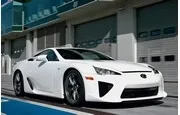
What soundtrack best suits aggressive driving in a supercar that roars at full power around a racing circuit? Of course, only real heavy rock! That is why, before the long-awaited meeting with the Lexus LF-A at the Nürburgring, I had to stop by a music store for a collection of Deep Purple hits...
Lexus LF-A is the result of nine years of painstaking work — even the global financial crisis could not stop the project from reaching the assembly line. The planned production run of 500 units is a drop in the ocean, which is why wealthy fans of the brand will have to wait quite a while for their turn. The factory produces no more than twenty cars per month.
The car features truly futuristic solutions: the body is 65 percent carbon fiber, and the remaining 35 percent is aluminum alloys. Engineers worked hard to lighten all components: the brake mechanisms received carbon-ceramic discs that hold heat better and each weighs 5 kg less than a steel counterpart. In curb weight, the car weighs 1480 kg.
The layout is classic — engine at the front, rear-wheel drive. To achieve ideal mass distribution (48 percent on the front axle and 52 on the rear), the gearbox was combined with the final drive into a single unit (transaxle layout, familiar from Porsche 924, 944, and 928) and connected to the engine with a massive tube through which the driveshaft passes. The 73-liter fuel tank and battery are placed within the wheelbase.
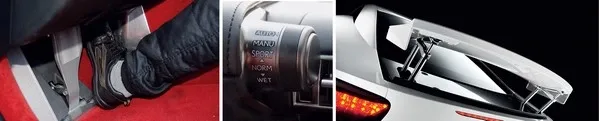
AERODYNAMIC ACTIVITY
The rear wing extends when speed exceeds 80 km/h, shifting the point of downforce generation closer to the rear. This noticeably improves stability at high speeds.
THE MAIN BET IS ON REVS
The naturally aspirated V10 was created specifically for this supercar and is a concentrated embodiment of racing technology. From a displacement of 4.8 liters, engineers extracted 560 horsepower at 8700 rpm, with a redline of 9000 rpm. No turbos — just extreme engine revving. Compression ratio 12:1, dry sump lubrication system that fears no crazy G-forces, minimal internal friction, and a piston group made of titanium and magnesium — these are just a brief list of the power unit's features. From idle to maximum 9000 rpm, the engine revs up in an incredible 0.6 seconds!
Solid torque provides excellent thrust across the entire range, so a six-speed transmission with a single clutch is quite sufficient. To fully realize the potential, a self-locking differential is installed in the final drive.
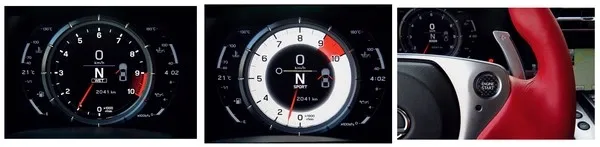
MAIN INSTRUMENT
The tachometer is the most important element on the panel. Its backlight changes depending on the selected driving mode.
ALONG A FORMULA TRAJECTORY
Before the actual run at the Nürburgring, in addition to standard press releases, we were given memos with detailed descriptions of every button and switch on the panel and steering wheel of the Lexus LF-A. This turned out to be not at all superfluous.
For example, you don't immediately realize that the transmission selector is a round washer on the front panel. It has Auto, Sport, Normal, and Wet (for rain) positions, and all modes except Auto provide manual gear shifting via paddle shifters. A separate small dial allows adjusting the gearshift speed.
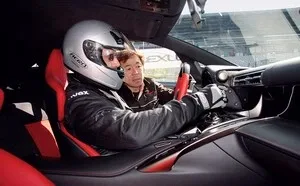
This is reminded by a Lexus team engineer crouching next to the open door while you, already in a racing suit and strapped into the anatomical seat, prepare to head out onto the Grand Prix circuit. The adjacent seat is empty. You might ask, did they really trust you to drive such a fast and insanely expensive car on your own right away? They trust, but not without a check: before being allowed into the LF-A, you had to do several familiarization laps on a Lexus IS-F with an instructor.
 |  |
RACING "KITCHEN"
The pit lane, garages, mechanics, race schedule — all this sporting atmosphere stirs and makes the heart beat faster. The main thing is not to forget that you are at a car test, not in a fight for the best lap time. The briefing before the exit is an absolutely necessary procedure: it is impossible to figure out all the intricacies of the LF-A on your own in five minutes.
I am learning the track, and the instructor comments on my actions. After receiving a couple of tips, I move into the cockpit of the main character and leave the pit lane. First, I set the selector to Auto mode — I need to "get into the groove."
The very first accelerations, braking, and cornering make it clear: the Lexus LF-A offers speeds and G-forces of a completely different order than any "hot" civilian cars.
You can brake before a turn much later and much more aggressively: during deceleration, the car does not wander, and when exiting the arc with throttle, you have to hold your head with effort to resist centrifugal force.
No doubts about the "sufficiency" of the engine arise — at fully depressed accelerator, I could only drive on three sections of the circuit. On two of them, speed confidently exceeds 200 km/h, and on the last third of the starting straight, cold sweat on my forehead makes me frantically think whether I will have time to slow down before the sharp turn, the entry of which is hidden behind a crest on a descent.
In Auto mode, driving becomes boring due to too thoughtful shifts (this mode is clearly for comfortable city driving). I switch to Manual-Sport. A completely different matter! Gears change crisply, almost instantly, and exactly when I want them to.
The LF-A's chassis provides excellent grip. The suspension works precisely and without excessive stiffness, and specially developed Bridgestone tires have excellent grip and predictable behavior. I try to exit a turn more boldly, deliberately overdoing the throttle, and the stability system (smart one!) calmly allows the car to slide in a controlled drift. It turns out that you don't need to turn it off at all, except perhaps for completely crazy drifting.
NOTES AND SCALES
The sound the Lexus LF-A makes is a separate symphony, which engineers worked on specifically, tuning not only the exhaust system but also the air intakes and internal body cavities. In a helmet, most sounds are muffled, and you don't have time for that while driving on a real track. Outside, though, the full range is heard. During acceleration, characteristic "Formula" notes flash by — and this is no coincidence. If someone hesitates and doesn't press the right paddle under the steering wheel in time when the tachometer needle hits the red zone, the engine growls displeasedly, and the automatic system with a loud clatter shifts the gear itself...
It's a pity that in Russia today there is simply nowhere to drive such supercars, nowhere to feel all the delight of their speed capabilities. All that remains is to hope that someday a Formula-1-level track will appear near Moscow, and the Lexus LF-A will be able to show all its power.
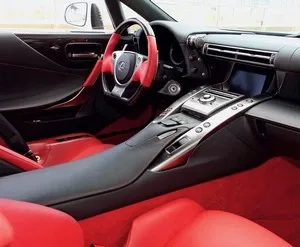 | RED AND BLACK
The LF-A's interior features noble materials in an aggressive color scheme. Ergonomics are fine, except for the mode selector, which distracts attention to the monitor. Ferrari's "manettino" switch is more convenient. |
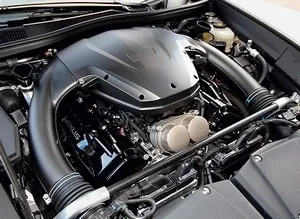 | ECO-BEAST
The V10 engine specially created for the LF-A is comparable in size to a compact V8 and in weight to a V6. Its supercar power fits within Euro-5 environmental standards. |
MANUFACTURER DATA
ENGINE
4805 cm3, petrol, V10,
560 hp at 8700 rpm,
480 Nm at 6800 rpm
TRANSMISSION
robot, 6 gears, rear-wheel drive
DYNAMICS
max speed — 325 km/h,
0–100 km/h acceleration time — 3.7 s
DIMENSIONS (mm)
length — 4505
width — 1895
height — 1220
wheelbase — 2605