
Lexus IS 250. Bruce Willis's Blue Dream. Endless Search for Perfection
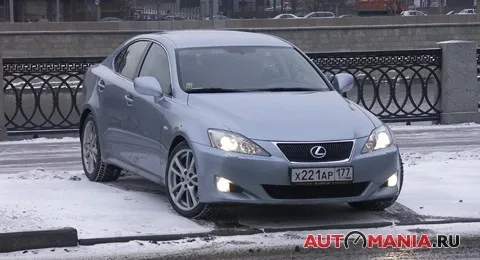
The pursuit of perfection is like searching for Atlantis or the Nibelung treasure: a fascinating endeavor, but almost hopeless. For me, the ideal car is primarily an honest ratio of price to what you get for it. So that you don't later suffer pangs of conscience over wasted money. For a long time, my benchmark was the Lexus GS 430 — I considered it almost the pinnacle of engineering thought. But, as Bruce Willis's character said in "The Fifth Element," it is "perfect," only the price tag of over 85 thousand dollars makes you think.
What if we look at the younger brother — the IS 250? How much does it cost, and how well do its real talents match the advertising picture? I remember how colleagues from two respected car magazines, returning from the Italian presentation, almost unanimously put the IS 250 on their covers. So there's something to grab onto. Let me not lag behind either — let's look, touch, and try it.
What doesn't this car have! Bi-xenon headlights, automatic rain and light sensors, mirrors that lower themselves when reverse gear is engaged, a high-class audio system with 13 speakers, seats upholstered in suede (this material is called ECSAI), 18-inch wheels on low-profile tires, parking sensors all around, electrochromic mirrors, keyless engine start with a button, a sport mode with paddle shifters, and a very smart onboard computer. Plus a design that simply takes your breath away. I'll keep quiet about how it all drives for now — the car is just standing still at the moment. Colleagues from the editorial office, looking over my shoulder, ask to start the engine. No problem. I start it — and silence. Neither outside nor inside the cabin is a sound heard. Then I remembered the GS 430: if that one costs close to 85 thousand, then this one, with a 2.5-liter engine producing 208 hp, should be no less than 60-65. After all, it's a Lexus. The most compact member of the family could well become the most spirited and sought-after. It's positioned as a competitor to the Audi A4, Mercedes C-Class, and BMW 3 Series, but in price, it seems to put everyone on their backs. Believe it or not, none of those present guessed the real price, like in the game "Price of Luck" on NTV. So the prize of a conditional 100 dollars stayed with me. The base Comfort trim costs not 60 thousand at all, but only 41,600 dollars, and the richest Luxury — 49,700.
Compare for yourself: an Audi A4 with a 2.4-liter engine will cost 54 thousand, a BMW 325 — 45 thousand, and a Mercedes C-Class — about 50. But believe me, even for that money you won't get what the Lexus has. Neither suede Alcantara, nor 18-inch wheels, nor an audio system with 13 speakers, nor 10 airbags (including knee ones), and certainly not the driving pleasure that only a Lexus gives.
I engage reverse — the mirrors obediently lower, the display switches to parking sensors. No problem. I drive into the narrowest opening, where even an "Oka" would be afraid to go. Now let's try to turn around. On a two-lane street — elementary. No worse than a Mercedes. Well, now pedal to the metal, while the track allows — full speed ahead. In less than half a minute, the speedometer already shows 140. Absolute silence in the cabin — this is even dangerous, the speed is completely unnoticeable. Pure bliss from a car you don't want to get out of, feeling homey comfort. It's time to recall where it all began.
Lexus appeared in 1989 as Toyota's premium project, created specifically for the North American market. Toyota was then famous for its reliability and affordability, but Americans wanted more — luxury. Thus Lexus was born, meaning "luxury," "elegance," "exclusivity." A couple of years later, the company began creating its own model range, independent of Toyota. For example, the previous IS was sold in Japan as the luxury "Toyota Altezza." In the US, it appeared in 2000 under the name IS200 — the smallest and most youthful. If the average age of a Lexus buyer in America is 52-58 years, for the IS it was only 29. I, of course, have long passed fifty, but if I had the funds now, I would take this very car without hesitation. And it's not even about the 13 speakers and 10 airbags, but solely for how it drives. The door panel and massive center tunnel tightly embrace the driver, creating the feeling of sitting in a fighter cockpit. Even in the Russian frost, the cabin warms up in minutes, and the feeling of home comfort, reliability, and security is so strong that you don't want to go outside at all. You want to live here and even sleep.
Moreover, you can sleep (passengers, not the driver, of course) right while moving. The noise level in the cabin at idle does not exceed 4 decibels, and at a speed of about 180 km/h — 8. This has never been seen anywhere else. As has a car with a drag coefficient of 0.27, and a front airbag with two chambers.
The suspension (double-wishbone at the front and five-link at the rear) is, of course, stiffer than the GS's, but it's precisely this that gives the IS 250 in the "sport" version a truly fighting character. Especially in corners. Audi and BMW also take a back seat here.
The most interesting option is the "sport" modification in the maximum trim with 18-inch wheels. The Luxury will be slightly more expensive — 49,700 dollars, but you get a cabin trimmed with natural maple wood, hand-finished by the same craftsmen who create Yamaha musical instruments. Speaking of music: the IS 250 features a Mark Levinson system — the most elite and perfect in sound of all that have been devised for cars to date. And don't forget the 13 speakers.
Technical specifications:
| Dimensions (mm) | 4575x1800x1440 |
| Wheelbase (mm) | 2730 |
| Engine displacement (cm3) | 2500 |
| Power (hp) | 208 |
| Curb weight (kg) | 1560 |
| Max speed (km/h) | 225 |
| Acceleration 0-100 km/h (s) | 8.1 |
| Tires ("sport" version) | 225/40 R 18 |
| Average fuel consumption (l/100 km) | 11.6-12.5 |
| Price of the tested car (rubles) | 1,145,000 |
Dmitry Shavyrin, photo by Sergey Ivanov
We thank Toyota Motor Rus for providing the car for the test.
Source – AUTOMANIA.RU