

The new Lexus IS 250 has just hit the Russian market, and it's a serious statement in the premium compact sedan segment.
Our introduction to the car takes place in Italy, near Rome. The mountain on the horizon is certainly not Mount Fuji, but the analogy suggests itself. Meeting the new Lexus in a country where European traditions are felt especially keenly is no coincidence. Each of the new model's competitors has its own history. Only one who, while following its own path, manages to keep pace with the rest of the "life guard" can become a full member of this circle. And the current generation of Lexus makes this step more confidently than ever.
Just take your eyes off the asphalt of the test track and, gliding over the Lexus IS bodies resembling frozen mercury, look higher and further — at that very Mount Fuji. The ancient mountain is girdled with clouds and looks impregnable, which only fuels the desire to head toward it. The summit is hidden in haze: you can't see it without walking the entire path from the foot...
The IS 250 is the second model embodying the Lexus L-finesse design philosophy after the current GS. In the appearance of the new car, it's almost impossible to discern the features of its predecessor. The current car seems heavier and more solid. At the same time, it is distinctive. It lacks the lightness and undeniable beauty of the previous model, but a unique mood has emerged, creating an image inherent only to Lexus: even without the "L" badges, the car's origin is beyond doubt.
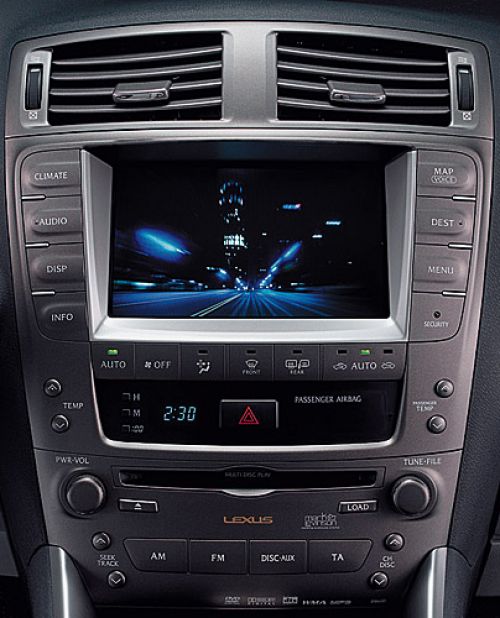
Lexus IS 250
As is clear from the numeric index, under the hood sits a 2.5-liter engine. This is a modern V6 with 208 hp; in Russia, the car will be sold only with this engine and a six-speed automatic. There's no desire to grumble about the lack of a manual for two reasons: the automatic is excellent, and the car itself doesn't invite fuss.
The cabin is quiet. Excellent sound insulation and an aerodynamically "polished" body do their job: external sounds barely penetrate inside. Silence is also aided by innovations like sound-insulating windshield and sound-absorbing sun visors. We've already seen similar materials in the Lexus GS interior trim. I liked the sound atmosphere in the IS even more: there's no uncompromising refinement and complete suppression of sound reflections as in the GS. We're used to natural reverberation, and in the IS the environment is more natural, and therefore comfortable. It's thanks to the cabin acoustics that all 13 speakers of the standard Mark Levinson finally "sounded" and revealed their capabilities: they not only "surprise" the spectrum analyzer but can also touch the listener's soul.
Highway driving left a mixed impression. On one hand — silence, a comfortable seat, and smooth engine thrust. On the other — a strange feeling of "emptiness" in the steering wheel near the center. When driving along a long arc, the "empty" sector remains and only shifts with the new steering wheel position. Unsurprisingly, the car constantly requires small steering corrections when driving straight or on gentle arcs. However, once you pass this zone in a more intense maneuver, the steering wheel fills with quality reactive force.
The IS is equipped with the VDIM (Vehicle Dynamic Integrated Management) stability system. This is a complex of control electronics that integrates operations with brakes, engine, and steering. That this is a new-generation system became clear on the special slippery surface of the test track, whose grip roughly corresponds to driving on summer tires over packed snow. Under such conditions, VDIM allows the car to slide within very wide limits. Moreover, the new IS's stability system works so smoothly that not everyone can feel its intervention. The ABS rattle and sharp engine cutbacks that accompanied active safety electronics just yesterday are a thing of the past...
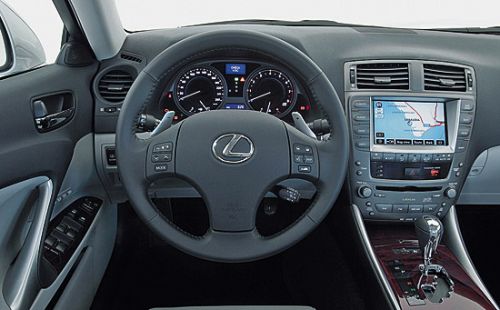
Lexus IS 250
The first time I drove off the slippery area, I thought the gas pedal was pressed down by the floor mat: my right foot was already in the air, but the engine kept holding elevated revs. On the second attempt, it repeated... Traction now protects the driver on slippery surfaces not only from excessive throttle input but also from locking the drive wheels when lifting off too abruptly: the electronics keep the throttle open just enough to prevent drive-wheel slip during engine braking.
This is an extremely useful function! Especially for cars with automatics, since you can't depress the clutch in a sticky situation, and not every driver can "catch" the right revs with the throttle during a high-speed moment of stress.
The suspension, quite comfortable by European standards, is nonetheless dense enough not to wallow in a limit corner on asphalt if the driver wants to enjoy the Lexus in that way. Excellent monotube shock absorbers, a double-wishbone front and a clever rear design, a rigid body — all this allows the Lexus to deliver plenty of pleasure on a winding road. Still, extremes are not in this car's character: most likely, many will find the turn-in in most situations insufficient, throttle responses delayed, and seats lacking lateral support. These can't be counted as drawbacks due to the harmony of the overall qualities: the car is simply "tuned" for other conditions and says so confidently.
Comfort, convenience, space, and freedom at the driver's seat, excellent music without the annoying background of engine whine — under such conditions, both city trips and long high-speed journeys become pleasant. The interesting function of programming the illumination point of the light rings on the speedometer and tachometer dials will most likely serve not as a shift light for the tachometer but as a reminder of speed limits: the IS 250 goes willingly and easily at speeds prohibited everywhere except Germany's autobahns, making such forgetfulness likely.
Let's return to the main point: Lexus cars from the very beginning demonstrated excellent technical level and the highest reliability qualities. The new generation of cars has also gained the distinctiveness so necessary in the segment of prestigious cars. Its own handwriting and its own "gait." Enough self-confidence and a well-"tuned" scale of values accepted in society to speak with the old-timers on equal terms and make its own statements.
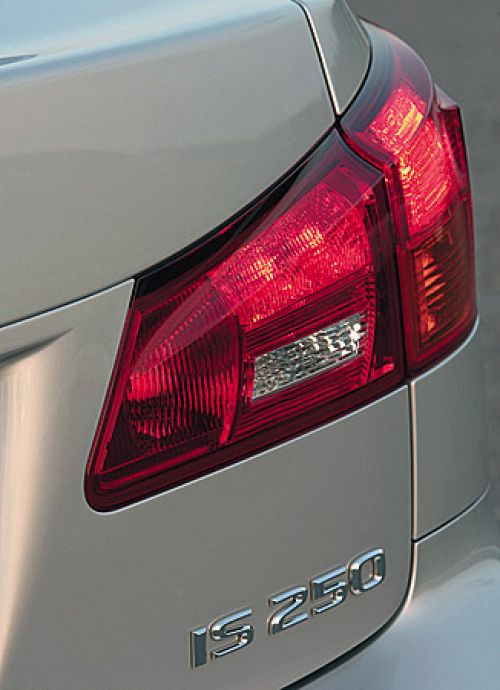
Lexus IS 250
Cars with suspensions untouched by European tuning will be supplied to Russia, and differences in trim levels will only concern the traditional restrictions for officially supplied Lexus models on the use of radio frequencies for the proprietary adaptive cruise control radar and the Pre-Crash Safety system. Also absent will be the navigation system and the structurally linked rear-view camera.
Prices for the Lexus IS 250 in Russia range from $41,600 for the Comfort trim to $49,700 (Premium).
Advantages and disadvantages
+ Quality, ergonomics, style, automatic transmission operation, "honest" manual mode of the automatic, acoustics, VDIM.
– Lack of display for the Russian version, lateral support of seats.
Technical specifications of Lexus IS 250
Body — sedan
Number of seats — 5
Curb weight, kg — 1560
Gross weight, kg — 2045
Dimensions (length/width/height), mm — 4575/1800/1440
Wheelbase, mm — 2730
Trunk volume, l — 378
Maximum speed, km/h — 225
Fuel consumption, l/100 km:
- city cycle — 12.7
- highway — 7
- combined — 9.1
Engine:
- type — gasoline, V6, 24-valve
- displacement, cm3 — 2500
- power, hp at rpm — 208/6400
- torque, Nm at rpm — 252/4800
Transmission — automatic, 6-speed
Tire size — 235/70R17
Suspension:
- front — double-wishbone
- rear — multi-link
Brakes:
- front/rear — disc, ventilated
Price, $ — from 41,600
January 27, 2006
© 5 Koleso