
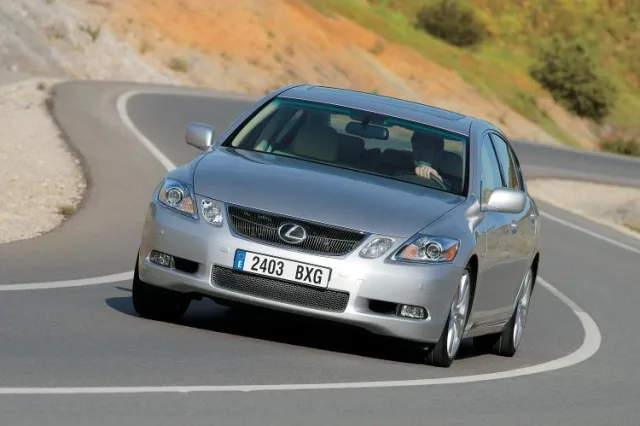
Humanity has long learned to generate electricity from water, sun, and wind, and now — also from a car. The new Lexus GS 450h sedan with a hybrid system can carefully collect energy during braking, store it in a 288-volt battery, and then use it to assist the gasoline engine during acceleration. In addition, this hybrid's arsenal includes the world's first production two-stage electromechanical CVT, a unique injection system with both port and direct fuel delivery... And astonishing silence in the cabin.
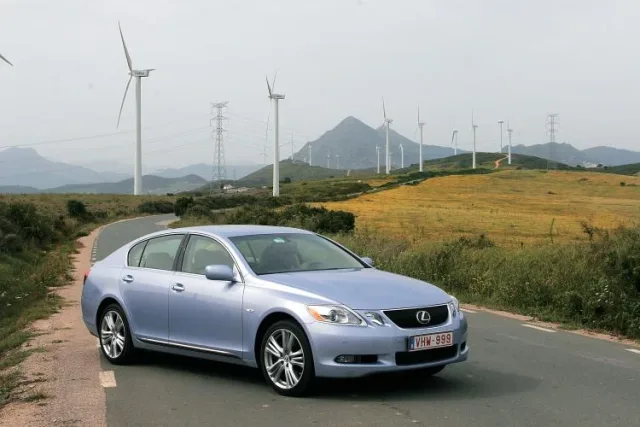
 Add the 296 hp of the new Lexus's gasoline V6 and the power of the electric motor integrated into the transmission (147 kW, or 200 hp), and you get... Almost 500 horsepower — like a BMW M5!
But in reality, you can't simply add them up — just as you can't pull yourself out of a swamp by your own hair. That's the essence of the HSD (Hybrid Synergy Drive) system: the electric motor and gasoline engine are connected to the wheels via a planetary gear, to which a separate generator is also connected. The clever "synergistic" interaction of all four components ultimately yields 345 hp — and allows for completely eliminating the gearbox!
I had never driven hybrids before, and before traveling to Spain for the test of the Lexus GS 450h sedan, I was skeptical. Such a complex system cannot work without flaws! After all, the "synergy" both shuts off the gasoline engine during braking and starts it during acceleration... Moreover, the GS 450h's hybrid transmission incorporates an additional two-stage gear: only thanks to it was HSD able to fit into a housing the size of a conventional automatic transmission.
 |  |  |
| The hybrid Lexus is equipped to the highest standard: a color rear-view camera, a DVD changer with 5.1 Surround Sound... | The display shows a diagram of the powertrain's operation. At this moment, the engine is turning the drive wheels and the generator, which charges the battery and powers the traction electric motor running in parallel | And this is the regeneration mode — during deceleration, the battery is charged, and the engine is off |
 |  |  |
| The minute-by-minute fuel consumption graph clearly demonstrates energy savings: each blue square means 50 W added to the battery reserve | Under the steering wheel is a joystick for controlling the adaptive cruise control | Auxiliary buttons are on the flip-down panel |
 |  | |
| Suspension stiffness changes automatically or via the Sport/Comfort button | Instead of a tachometer — an indicator of the combined power of both engines |
And how does all this work?
Imperceptibly! No delays, no jerks...
First, after pressing the Start button, it's still quiet in the cabin — instead of the starter sound, you see the word "ready" light up on the instrument panel. You press the gas — and the Lexus moves off silently, on the electric motor. On electricity alone, the GS 450h can travel up to two kilometers without exceeding 40 km/h. You lower the windows — and instead of the usual engine hum, you hear birds and the rustle of leaves.
Fantastic!
Moreover, all systems, including climate control, operate normally at this moment. After all, both the power steering and the air conditioning compressor on the GS 450h are electrically driven.
 |  | |
| The Lexus GS 450h retains the classic layout: engine longitudinally at the front, drive wheels — rear. But under the hood, a voltage converter block is additionally installed, and behind the rear seat backrest — a traction battery (Ni-MH). And Toyota's proprietary electromechanical CVT HSD (Hybrid Synergy Drive) with an additional two-stage planetary gear was successfully housed in a conventional automatic transmission casing. Weight distribution across axles — 50:50 | External speed characteristics of the engines | |
The GS 450h engine is the world's first to combine port and direct injection. Each cylinder has two injectors. One, as usual, sprays fuel into the intake manifold (at 4 atm pressure), the second — directly into the combustion chamber (130 atm). According to the creators, this allows combining the advantages of both fuel delivery schemes, reducing emissions and fuel consumption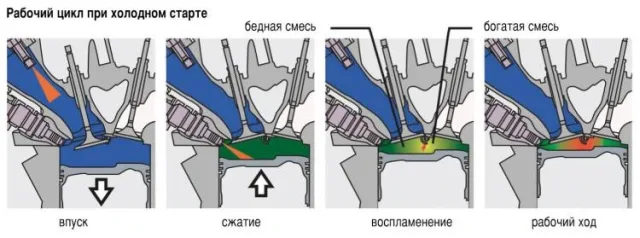
During cold start, fuel is delivered both into the intake manifold (on the intake stroke) and later, on the compression stroke, directly into the cylinder. The second phase enriches the mixture, improving starting and accelerating the warm-up of catalytic converters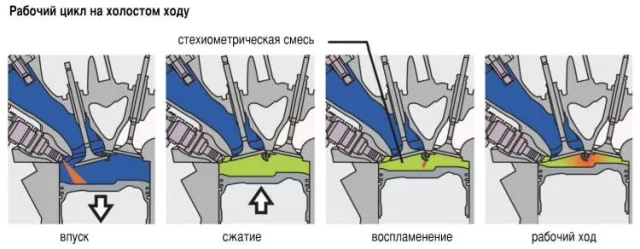
At idle, only the direct injection injectors operate, but on the intake stroke 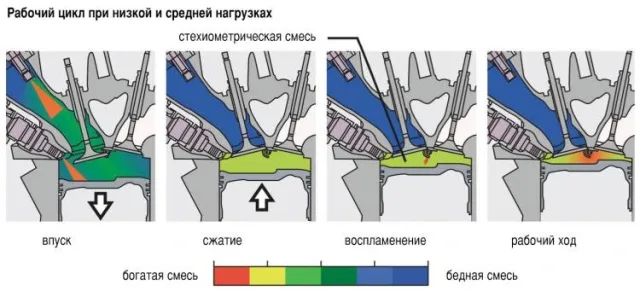
At medium loads, on the intake stroke, both injectors are engaged — fuel is sprayed both into the port and into the combustion chamber, which improves mixing with air and optimizes combustion processes
 |  | |
| This diagram explains the operating principle of the electromechanical transmission. The engine, generator, and wheel drive are connected by a simple planetary gear. By adjusting the load on the generator (the sun gear of the "planetary"), you can smoothly change the rotation speed of the drive wheels (connected to the ring gear), driven by the gasoline engine (the carrier). The electric motor is also connected to the ring gear — but through a two-stage planetary gear, which up to 90 km/h, using friction clutch 1, provides a reduction gear ratio of 3.9; at high speed, engaging friction clutch 2 changes the ratio to 1.9 | This is what the "internals" of the electromechanical CVT look like: generator (1), planetary gear (2), traction electric motor (3), two-stage gear (4) | |
When the battery charge runs low or the driver presses the gas harder, the gasoline engine starts almost imperceptibly. Acceleration is smooth. You don't feel the moment when, at 90 km/h, the electromechanical CVT shifts to "overdrive." It's as if in the tunnel between the seats — not a complex interweaving of gears and electric motors, but a regular CVT.
And the acceleration dynamics are respectable — if the specs are to be believed, the Lexus GS 450h reaches 100 km/h in 5.9 seconds. That's 0.2 seconds faster than the 283-hp GS 430 with a 4.3L V8. This is precisely what the GS 450h index hints at — the electric motor endows the hybrid sedan with the dynamics of a car with a 4.5L V8.
Even beyond 200 km/h, the Lexus responds quite lively to the gas pedal. And what silence! If during acceleration the engine is still barely audible, during deceleration it goes completely silent — it stalls both figuratively and literally. Meanwhile, the generator integrated into the transmission charges the battery — you can monitor the charge level via the diagram on the instrument panel. A few long descents — and a "full bucket" of electricity!
The batteries, however, also deplete rapidly. Just a couple of overtakes on an incline — and only half the scale remains on the screen. A few more trucks along the way — and... no, you won't be able to fully drain the battery. There's always an emergency reserve left — one division on the indicator.
However, with a half-empty battery, the dynamics are no longer the same — then the car is driven only by the petrol engine, a three-litre V6 with a displacement of 3.5 litres. By the way, in the GS 450h version this engine is also unusual — with "dual" injection. Each cylinder has two injectors: one sprays fuel into the intake manifold, the second — directly into the cylinder. That is, it combines port and direct injection!
In corners, the hybrid Lexus holds up well: reactions are smooth, body roll is moderate, and it can be further reduced by switching the suspension with electronically controlled monotube shock absorbers to Sport mode. But this Lexus is far from true sportiness — it's not very pleasant to have fun on a mountain road. Perhaps the active electric power steering VGRS (Variable Gear Ratio Steering) is to blame. The idea seems sound: at low speeds the steering is quite "sharp" — 2.7 turns lock-to-lock, and with increasing speed the steering becomes "calmer" (up to 3.7 turns) so that you don't strain on the highway. That's all true, but... on a narrow mountain road, electronic intervention is confusing. In cars with conventional steering, hands quickly get used to a certain sensitivity and "automatically" turn the wheel to the required angle. But in the electronics-packed Lexus, you never know what sensitivity the system has chosen at any given moment, and in a corner you constantly have to correct the steering, adapting to the changeable nature of VGRS.
The considerable kerb weight also takes its toll. Yes, the electrical components of Toyota hybrids are becoming lighter. For example, the voltage converter unit on the RX 400h crossover weighs 35 kg and takes up 30 litres of volume, while on the GS 450h sedan it has "slimmed down" to 20 kg and 11 litres — about the same as a standard 12-volt battery. The sedan's traction battery, with the same capacity, has become 9 kg lighter. But it still weighs 61 kg. And the total mass of all electrical equipment reaches two hundredweight, and as a result, the almost two-tonne Lexus GS 450h is 200 kg heavier than the petrol GS 430!
Moreover, the traction battery is located behind the rear seat backs — it not only "eats up" a third of the boot, reducing it from 430 to 280 litres, but also eliminates the possibility of transforming the interior. There isn't even a ski hatch.
And what is the service life of Panasonic nickel-metal hydride batteries, especially in cold weather? And what happens if they do discharge?
— We have already accumulated extensive statistics on the operation of our hybrids, — says Gerald Killman from Toyota's hybrid vehicle development department. — Prius batteries used in the USA easily last 300 thousand miles, and in the harsh Scandinavian climate they withstand 300 thousand km. So we believe they last as long as the car itself. The traction battery requires no maintenance. And even if it does discharge, the GS 450h sedan has a regular 12-volt battery in the boot — it will ensure an "emergency" start of the petrol engine…
By the way, the top-class hybrid sedan LS 600h is also "frost-resistant" — it will appear in Russia in 2007. Will Toyota have diesel hybrids? After all, if you combine the advantages of diesel with electric traction, you get a super-economical and super-eco-friendly car, right?
— Such models already exist, — says Killman. — Hybrid trucks Toyota Dyna and Hino Ranger are sold on the domestic Japanese market. But we are not yet planning to produce a passenger diesel hybrid — such a powertrain simply cannot provide the proper level of comfort. High compression ratio is not only a source of extra noise and vibration, but also increased resistance when starting the engine. And in a hybrid, such starts happen constantly…
Comfort — yes, that is the strongest side of the GS 450h sedan. Comfort and efficiency. After a test run along mountain serpentines near Malaga, the on-board computer showed 12 l/100 km. Approximately the same amount in such conditions would be "drunk" by any compact hatchback with a two-litre "four". And the Lexus GS 450h is an E-class sedan, burdened with all conceivable amenities: xenon adaptive headlights, a powerful (330 W) Mark Levinson audio system with DVD player and 5.1 Surround Sound, ventilated seats. Moreover, all this luxury is standard equipment. And the Lexus GS 450h will cost $78,500 in Russia — $3,400 cheaper than the Lexus GS 430!
By the way, the hybrid Lexus RX 400h is in demand here — about 500 cars have been sold in a year, which is approximately 14% of the total sales volume of RX series crossovers. And the GS 450h sedan definitely has every chance to surpass this success.
Lexus GS 450h (manufacturer's data)
| Body type | 4-door sedan |
| Number of seats | 5 |
| Dimensions, mm | |
| length | 4835 |
| width | 1820 |
| height | 1430 |
| wheelbase | 2850 |
| track front/rear | 1540/1545 |
| Boot volume, l | 280 |
| Curb weight, kg | 1930 |
| Gross weight, kg | 2355 |
| Drag coefficient | 0.27 |
| Main engine | petrol, with dual fuel injection system |
| Location | front, longitudinal |
| Number and arrangement of cylinders | 6, V-shaped |
| Displacement, cm3 | 3456 |
| Compression ratio | 11.8:1 |
| Number of valves | 24 |
| Maximum power, hp/kW/rpm | 296/218/6400 |
| Maximum torque, Nm/rpm | 368/4800 |
| Electric motor | synchronous, AC |
| Voltage, V | 650 |
| Maximum power, hp/kW | 200/147 |
| Maximum torque, Nm | 275 |
| Generator | synchronous, AC |
| Voltage, V | 650 |
| Battery | nickel-metal hydride |
| Voltage, V | 288 |
| Capacity, Ah | 6.5 |
| Transmission | two-stage motor-reducer |
| Gear ratios | |
| I | 3.9 |
| II | 1.9 |
| final drive | 3.267 |
| Drive | rear-wheel drive |
| Front suspension | independent, coil spring, double wishbone |
| Rear suspension | independent, coil spring, multi-link |
| Front brakes | disc, ventilated |
| Rear brakes | disc, ventilated |
| Tires | 245/40 R18 |
| Maximum speed, km/h | 250 |
| Acceleration time 0—100 km/h, s | 5.9 |
| Fuel consumption, l/100 km | |
| urban cycle | 9.2 |
| extra-urban cycle | 7.2 |
| combined cycle | 7.9 |
| Fuel tank capacity, l | 65 |
| Fuel | petrol AI-95 |