
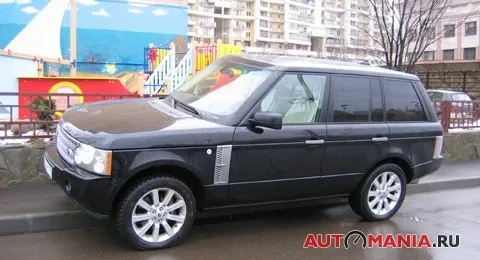
Range Rover Vogue and Supercharged. Luxury suits them
To gauge how many millionaires are in the capital, it's enough to come to the center — say, to the intersection of Okhotny Ryad with Tverskaya — and stand there for half an hour. Count how many premium SUVs with a price tag from 3 million rubles pass by during that time, and it will become clear how many wealthy people we have.
For the purity of the experiment, let's discard models cheaper than three million — Infiniti QX56, VW Touareg, Cadillac Escalade, BMW X5. Even the Lexus LX470 doesn't reach that amount. Forget about the Volvo XC90 and the new Chevrolet Tahoe too — they're clearly not competitors in this list.
Now about the leaders. First place goes to the legendary Mercedes G-Class — from 3,510,000 to 4,893,000 rubles. The GL-Class of the same brand lags by only 186 thousand: its range is from 3,324,000 to 3,706,500 rubles. The new Toyota Land Cruiser 200 costs from 3,120,000 (the upper limit is unknown). The Audi Q7, Mercedes M-Class, and Porsche Cayenne in base versions don't reach the "three million" mark, but their top trims are impressive: 4,700,500, 4,462,500, and 4,336,000 rubles respectively.
Our today's heroes fit confidently into this row — the Range Rover Vogue with a diesel and the Range Rover Supercharged with a petrol engine. The RR brand (not to be confused with Rolls-Royce) holds a spot in the top five with a price range from 3,100,000 to 4,000,000 rubles.
Returning to "external observation": it's the Range Rover from Land Rover that is the absolute leader on Moscow streets among luxury SUVs. Why do people with above-average wealth choose it? Let's not recall the ascetic Defender (we've already written about it) or the handsome Discovery — let's move straight to our heroes.
So, today on the podium is Russia's best-selling crossover — the Range Rover. 12,606 cars in 2007 and doubled sales compared to 2006 — a figure that speaks for itself, especially given the price.
Design
It would seem there's nothing revolutionary about it. It's as conservative as Britain itself and has changed little since the 70s-80s. The same boxy body, almost vertical rear with a huge window that instantly gets dirty at the slightest rain or dust. Huge side windows — like in an aquarium. But on the road, there's no other car like the RR, and it's this uniqueness that attracts buyers.
Moreover, the Range Rover is not only the most technologically advanced but also the best-equipped SUV in the luxury segment. No one has yet managed to offer such a level of equipment as standard, not for an extra charge. Rain sensors, heating and ventilation for all four seats, four-zone climate control, navigation, adaptive headlights, parking sensors all around with a color rear-view camera — this is also found in competitors. But heated windshield, heated steering wheel, DVD players in headrests with the ability to watch different movies for the right and left passengers via headphones, control of the onboard computer via "touch screen" (all functions — radio, CD, TV, phone — available with a touch of a finger on the 7-inch screen) in one package you won't find anywhere else. The control is simple and logical: to set an FM station, just dial the frequency and confirm "OK" on the screen. You can even do this at a traffic light without taking your eyes off the road. And the sound is a separate story. It's handled by 16 Hi-End Harman/Kardon Logic 7 speakers with 710 watts of power. Even FM radio sounds like you're in the center of a concert hall. And with DVD — the quality is such that in an apartment with very good audio equipment, you'd have to try hard to achieve something similar. The sound alone is worth over 5 "grand".
Comfort and handling
Thanks to the high "command" seating position, the driver fully controls the road and feels the dimensions perfectly, despite the long flat hood (in Hummer style) under which a V8 rumbles. Parking, lane changes, narrow streets — all this is no problem from the first day behind the wheel. The RR handles perfectly. Difficulties arise only during U-turns — the turning circle is a bit large even considering the large dimensions.
The driver's seating, in my opinion, is maximally comfortable. The left elbow rests on the wide "windowsill" — the door handle, the right on the armrest above the central glovebox. Plus a comfortable seat — you feel at home in your favorite armchair. Except in front of you is not a TV, but a steering wheel with adjustment in two planes. In winter, you can heat it so your delicate hands don't get cold.
A newcomer accustomed to simpler cars might be confused by the abundance of buttons: 23 on the central console, 6 climate control knobs (plus two more in the back for passengers), 10 buttons on the steering wheel, and an air suspension control block behind the automatic transmission lever, closer to the driver's leg. Don't be scared: you can figure it out even without the thick manual. After 10-15 minutes, you get used to the console, and it no longer seems complicated. Any button is duplicated on the "touch screen", as are the onboard computer readings — they're visible both under the instrument scale and on the central screen. But there's no, for example, current fuel consumption (in kick down mode), compass, which is in American SUVs, trip mileage, or time behind the wheel. Apparently, the creators deemed it unimportant.
Safety and comfort are provided by 9 airbags (one is a knee airbag). The built-in Webasto (activated from up to 100 meters with a second key fob) allows you to warm the cabin or cool it without leaving home. In the evening, you set the temperature — in the morning, from the balcony or window, you turn it "on", and hot air flows into the cabin. The engine doesn't start, but the oil warms up, and even at -25°C, the car is ready to dash in the same second. You can even not approach the key fobs — just set the time for heating or cooling to turn on.
The Range Rover also has a unique option that we haven't seen in any competitor. It's the VentureCam system: a small green remote and 16(!) video cameras (one as standard). If there's one camera, you can mount it on the right side of the body or glass and monitor the movement — this allows you to squeeze into the narrowest gap without assistance, without scratching the side.
By buying 15 more cameras, you get a whole security system. Mini-cameras are installed in the garage, on the property of a country house, or inside the house. The image from each (at a distance of up to 30 meters) can be viewed in real time — to make sure that neither in the garage nor in the house are you awaited by uninvited guests. Given the crime situation and that owners of such cars are clearly not poor — a very useful thing.
The touchscreen display adds comfort off-road too. It shows current settings of the engine, transmission, and chassis, helping to choose the best mode for difficult sections. In on-line mode, the system shows the selected gear, the position of each wheel, and the direction of the front ones.
Engines
One after another, we had the Vogue with a 3.6-liter V8 diesel with two turbos and the Supercharged with a supercharged 4.2 V8 producing 396 hp. Externally, the cars are almost indistinguishable — except for the grille and side gills on the Supercharged, which supply more air to the cabin. But in motion, the difference is noticeable.
The diesel with 275 hp pulls excellently across the entire range, delivering a crazy 640 Nm at 2000 rpm. Of course, it's not the Audi 4.2 turbodiesel with 326 hp and 760 Nm at 1800 rpm, but it's still impressive. With such an engine, the two-ton car accelerates to 100 km/h in 9.2 seconds and reaches a maximum of 200 km/h. The new diesel is free of vibrations and excess noise — the Volvo XC90 with a diesel is significantly noisier.
The most significant advantage of the TDV8 engine is that it has no timing belt — like the fuel pump, it's driven by a chain. And another curious fact: the Range Rover with a diesel currently remains the only car in the world with protection against erroneous refueling. After all, pouring diesel into a petrol tank or vice versa is not so rare, especially when a distracted novice is behind the wheel or the car is someone else's — out of habit, you pull up to a familiar pump. Engineers built the protection right into the upper part of the filler neck, and it physically prevents mixing up the fuel. A petrol nozzle, being thinner, sinks deeper into the neck, catches a latch, which releases a spring-loaded valve that blocks the filler opening. If the nozzle doesn't match in diameter, the flap drive activates, and the shut-off valve works as if the tank is already full.
Calling the diesel consumption economical is hard. Even foreign journalists call any Land Rover "a car for trips from gas station to service" behind its back. With the claimed 11.3 liters per hundred, the onboard computer over three days of testing consistently showed from 13.2 to 14.5 liters.
With the nearly four-hundred-horsepower engine, the picture changes dramatically. Acceleration to 100 km/h takes only 7.5 seconds — that's truly impressive. True, the appetite in such a mode grows to 19.5 liters per hundred. My personal minimum during the test was 16.7 liters. This is certainly less than any Bavarian SUV, but more than a petrol Audi Q7 4.2. So, when choosing the Supercharged, be prepared to stop at the gas station every 500 kilometers, filling the 105-liter tank with 95-octane petrol. The diesel version on a full tank easily covers about 900 kilometers — though, it's still less than the Audi Q7 with a three-liter turbodiesel, which travels 1200 kilometers on one tank.
Costs
In addition to the operating expenses mentioned above, you'll also have to fork out for maintenance: a standard hour at the station costs 3,100 rubles, and visits for scheduled maintenance are needed every 10,000 kilometers.
Disadvantages
Overall, the car leaves an impression of being flawless, and I found no serious drawbacks. The only thing that is slightly alarming is the excessive abundance of electronics. It is usually the Achilles' heel, as electronic systems are the most likely to fail. However, even the base version already has a mass of options that the main competitors in the luxury SUV class lack. What I didn't like were the rear wipers: their mechanism is on top rather than at the bottom, so the glass is cleaned poorly. Also, there is no auto-dimming function for the rearview mirror. But these are minor issues. Overall, it is very expensive and very stylish. With the diesel engine, it is simply an ideal luxury car.
Specifications
(in parentheses — RR with diesel engine)
| Dimensions (mm) | 4972 x 2034 x 1903 |
| Curb weight (kg) |
2,687 (2,717) |
| Gross weight (kg) |
3,100 (3,200) |
| Displacement (cc) | 4,197 (3,630) |
| Power (hp) | 396 (271) |
| Max torque (Nm/rpm) | 560/3500 (640/2000) |
| Top speed (km/h) |
210 (200) |
| Tires | 265/60 R 19 |
| Average fuel consumption (l/100 km) | 16.5 (11.8) |
| Acceleration 0-100 km/h (s) |
7.5 (9.2) |
| Fording depth (mm) |
700 |
| Turning circle (m) |
12.7 |
| Ground clearance (normal / off-road) (mm) | 225 / 275 |
| Price (RUB) |
from 3,100,000 to 4,000,000 |
We thank Jaguar Land Rover Russia for providing the test vehicles.
Source – AUTOMANIA.RU