
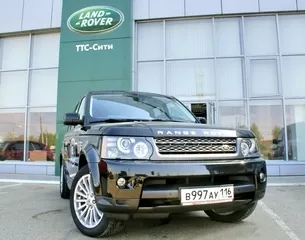
I have sixteen years of driving experience, and during that time I've tried a lot of cars, from domestic to imported. Now I drive a Toyota Corolla, covering about a hundred thousand kilometers a year. I don't even know where to start talking about the Range Rover Sport—my emotions are just overwhelming! The car turned out to be above all my expectations. I used to think that body-on-frame SUVs are stiff, clumsy, and unwieldy, but now I realize how wrong I was. Moreover, after the test, I got into my Corolla and involuntarily started comparing. I found no drawbacks in the Sport at all. It manages to combine the smoothness of sedans, the off-road capability of true SUVs, and the dynamics of sports cars.
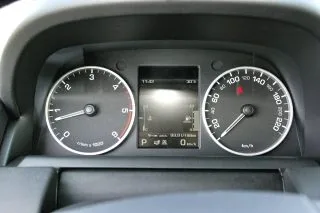
There is one deceptive moment related to acceleration dynamics. If you don't watch the speedometer needle (which, by the way, is duplicated by a digital display), it seems that the car accelerates sluggishly. But that's exactly until you glance at the instruments. In reality, the car shoots to a hundred in 11 seconds, even though there were four of us in the cabin. The speed is absolutely not felt, and you need to constantly monitor it without losing vigilance. That's what happened to me: I got carried away with speed, didn't notice a camera, and flew past it. In general, the car accelerates easily up to 180 km/h, and at the same time feels very confident and stable on the road.
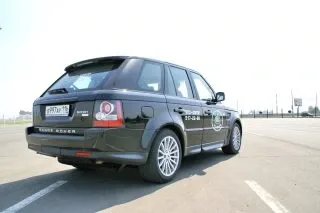
 In our test modes, the fuel consumption turned out to be quite interesting—we fit into 14.6 liters per hundred. The Sport passes the slalom at a speed of 70–75 km/h. A little higher—and the car no longer has time to return to the required gates. There is an electronic anti-rollover system in the arsenal that monitors rolls, speed, and other parameters. The electronics really work: with each of my attempts to send the car into a skid or provoke a rollover, it clearly activated at the moment when one of the wheels began to lift off the ground, instantly muffling the fervor of the herd of horses under the hood.
The "hill descent control" function impressed me a lot. I would compare it to a roller coaster. You press one button—and a fascinating action begins: first, the car decisively rushes down a very steep slope that we chose ourselves, it takes your breath away, and only by a miracle do you restrain the instinct of self-preservation not to press the brake. And then—a miracle! The car slows down and comfortably descends the steep slope. Climbing the same hill is just as effortless if you switch the gearbox to manual mode in first gear.
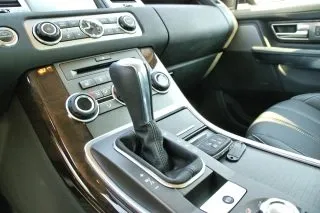 The sound insulation in the car is amazing: nothing creaks, squeaks, or rattles. The interior trim materials are very high quality. Everything looks harmonious, the instruments are conveniently located, easy to read, and accessible.
In conclusion, I'll say: this car is simply a "JET," and it fully justifies the "SPORT" badge. For those who are considering it but still doubting, I advise: take it without hesitation!
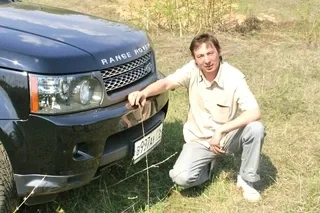 After we had our fill of driving the Disco 4, it was simply impossible to ignore the RR Sport. Especially since in this version the updates turned out to be much deeper and more exciting. I'll start in order. The first thing that catches your eye is the lighting—now it's fully LED. The radiator grille has acquired a new shape, and the side air intakes have turned from simple decorative trims into working elements. The legendary Terrain Response system was not left aside either: "sand" and Dynamic Response modes were added for more dynamic driving. I'll quote the official Land Rover website: "The Adaptive Dynamics adaptive suspension control system provides a comfortable ride on rough roads. More than 500 times per second, the system analyzes information about the vehicle's behavior, road surface, and other driving conditions. Based on this data, it continuously adjusts the suspension operation of each wheel, minimizing discomfort when driving even over potholes, ruts, and tree roots, which allows the full potential of the long-travel suspension to be realized. In addition, it provides improved vehicle control during cornering and braking at high speed." Well, let's see how it all works in real life, not on paper.
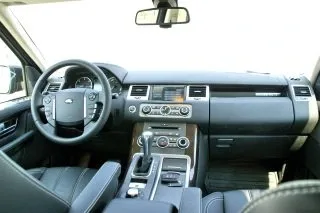
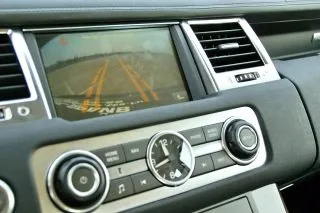
The interior has become noticeably more luxurious and comfortable. The instrument panel received white markings on the speedometer and tachometer scales—in the best sports traditions. As in the Disco 4, a TFT screen has appeared here, displaying key information: air suspension height, HDC mode, cruise control and automatic transmission settings, as well as the selected Terrain Response mode. All data is displayed clearly and is readable without problems even in bright sun, which cannot be said about the instruments on the center console.
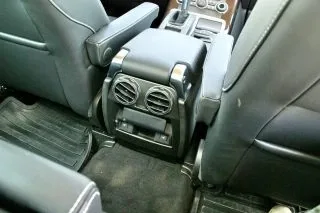
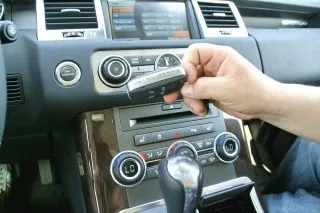 The fact is that the console has an incline, and at a certain position of the sun it becomes unclear, for example, whether the air conditioner is working. It would seem a trifle, but I focused on it, and I'll explain why later. But the 7-inch high-resolution touchscreen on the center panel does not create such problems. It controls many systems, including the entertainment complex with a DVD player for rear passengers. We, of course, wanted to try it out. The analog clock under the display was very pleasing—it looks laconic and evokes associations with military equipment. And, by the way, I understood where this feeling comes from—the seating position here is "commander-style," as before.
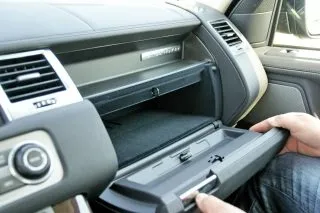
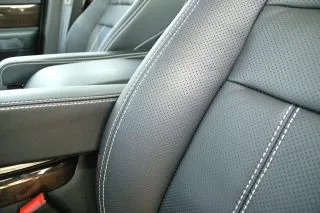 Visibility is excellent, and the square hood helps you quickly feel the dimensions and gain confidence before the trials. We don't plan any extreme driving: light off-road (the weather is dry and warm, there's simply nowhere to find mud) and the obligatory "slalom" with a 30-meter step for such a car. After completing all the paperwork, we merrily head to the site.
It feels like you're sitting in a cockpit: seats with lateral support, the incline of the front console, the position of the automatic transmission lever, and the steering wheel with paddle shifters—everything contributes to this. The site is a stone's throw away, so I didn't adjust anything and drove in standard mode. At the site, I was especially impressed by the sound of the car rushing past. The eight-cylinder diesel with two turbos through two exhaust pipes emitted such rolling bass that it gave me goosebumps. This powerful baritone will leave no one indifferent. It's a pity that the manufacturer has to restrain it due to norms and requirements—I'd like it louder.
The "slalom" was not a surprise for me: the car, as expected, performed excellently, despite its impressive weight and high center of gravity. With the stability control system turned off, the car willingly dives into the gates. It's clear that even in the off state, the system only pushes back the intervention threshold, but still monitors the driver, allowing a little hooliganism. But with the system on, the car seems to steer itself through the turn, but at the same time it brakes.
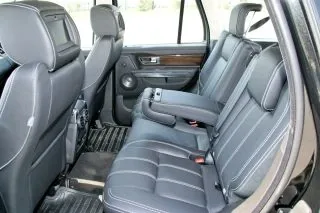
 My record on the "slalom" is about 72 km/h in Dynamic Response mode, Sport position on the automatic transmission, and with stability control turned off. Compared to the Disco 4 (impressions of which are still fresh, although comparing them is incorrect), this car enters corners much more willingly and rolls less. Such a fighting character on the "slalom" should, in theory, affect comfort, especially on bumpy roads. Let's check how right I am.
Roman, who seemed to get maximum pleasure from what was happening, tried to "overcome" the car. He spun it and tried to break it into a skid, he even thought he had lifted a wheel off the ground, but no—it didn't work. The car remained imperturbable and eventually "wore out" the opponent. It's curious why after a 360-degree turn the car "rears up": it almost fully rises on the air suspension, and then, like a steam locomotive, with a sigh, lowers down. By the way, the air suspension works very quickly—it instantly raises and just as swiftly lowers the body, but I learned about this later, off-road.
After the site, following tradition, we head to the highway, and from there—to the off-road (if we find any). Every car has its own element, and for this one—it's the highway.
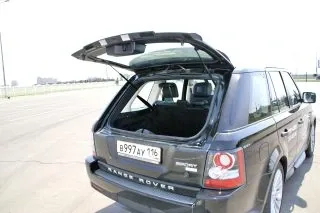
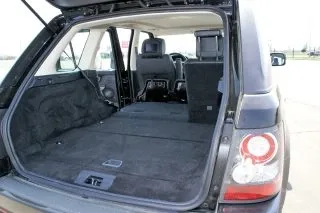 It's not for nothing that it's classified as Gran Turismo, where speed and driving pleasure are the main things. The "track" mode was liked by everyone without exception, and everyone unanimously noted the car's amazing ability to "steal speed." You press the pedal — the acceleration seems sluggish, but you glance at the speedometer — and, oh horror, it's already 140 km/h. When did that happen? Unclear. This speaks to excellent sound insulation and a sense of the car's solidity. The gearbox shifts very smoothly, and switching to "S" mode affects ride smoothness more than dynamics. Although we did this operation together with enabling Dynamic Response mode. Activating these two modes makes the suspension noticeably more energy-intensive and resilient, and it handles small bumps more effectively. Compared to the standard mode, it becomes short-travel. In normal mode, the car rocks more over bumps, and impacts are felt more strongly, especially by rear passengers.
Throughout the journey, rear passengers complained about the stiffness of the suspension, and my assumptions on the test site were partially confirmed. Why partially? Because the adaptive suspension system 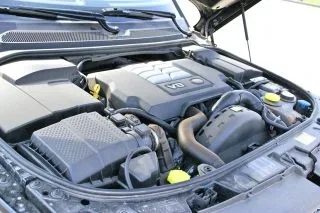 Adaptive Dynamics works. It really changes the density of the shock absorbers depending on the surface, and it's very noticeable. Looking ahead, I'll say: on the way back, I sat in the back myself — it's fine there, I don't understand what people were complaining about.
As I expected, we didn't find any mud, but we did get plenty of driving on a very steep slope. It was breathtaking when the car, like a cat clinging with its claws, carefully slid down. It's a pity that photos don't convey this. No less impressive was Andrey's (the third test-drive participant) ascent up the same slope. He stopped three-quarters of the way up and started moving uphill without wheel spin or the slightest hesitation — great! Overall, this machine is in no way inferior to the Disco 4 off-road; the only thing it loses in is less ground clearance, not to mention the structurally rigid integrated body.
We also did the wheel hanging: the rear left wheel was completely in the air, and the car was practically lying with its sill on a mound. The situation seemed difficult, but the RR Sport had its own opinion. It calmly drove off without a second's delay, and the settings were standard, only Dynamic Response was disabled. And it climbed the hill without a run-up, like a tank, without visible wheel spin (I'm seeing this for the first time — other SUVs required a run-up in this spot).
As I said, I spent the return trip in the back seat. The stiffness that was bothersome at first disappeared somewhere — either the body got used to it, or the car adjusted, which is unlikely. Even someone fell asleep on the way, lulled by the silence and comfort. One thing bothered me, which I mentioned at the beginning: the air conditioner in the climate control system coped poorly with its task. Most likely, it's a malfunction — you need to check the freon level; it shouldn't be like this.
Overall, the picture is clear: the car is for satisfying almost any ambitions — both a pilot of a low-flying aircraft, and a tanker-all-terrain driver, and just a successful business person.