
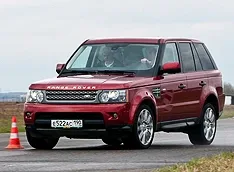
He really is handsome! A true macho, harmoniously combining ruggedness and well-groomed appearance. His physique is impeccable, and his expressive gaze is memorable for a long time. No, I'm not talking about a Hollywood star, but about the updated Range Rover Sport Supercharged 2010 model year, which I was entrusted with for a test drive.
Meeting the Star
When a dealership employee handed me the keys to the burgundy RRS S/C parked at the entrance, a smile appeared on my face by itself. The press release stated that "Range Rover Sport 2010 is the most dynamic car in Land Rover's history." After such words, I couldn't wait to get behind the wheel and experience this very high dynamics firsthand.
It should be noted that externally, the new model does not differ much from its predecessor. The main changes are hidden under the hood: instead of the previous 4.2-liter unit, a 5-liter V8 with an improved supercharger is installed here, producing 510 horsepower. According to the technical specifications, the engine meets Euro-5 standards, accelerates the car to 225 km/h, and consumes from 10.7 liters of gasoline on the highway and up to 21.8 liters in the urban cycle.
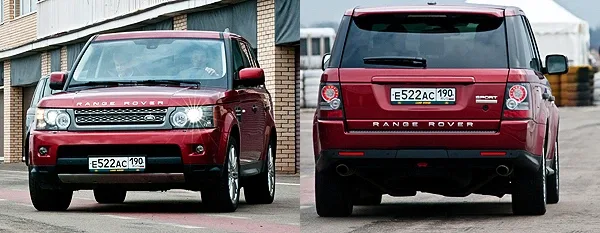
He is a true macho, everything about him is in moderation — both ruggedness and well-groomed appearance.
Since its debut, the Range Rover Sport has blended so organically into the urban landscape that it seems it has always been there. In fact, the model is just over five years old. The concept called Range Stormer debuted at the Detroit Auto Show in 2004, and a year later, the production version of this luxurious British SUV was shown there, becoming the fifth model in the brand's lineup.
The interior, as befits a Range Rover, is made with quality, thoughtfulness, and expense. Compared to the previous generation, there is more premium leather here, improved driver's seat ergonomics, and a new multimedia system with a 7-inch touchscreen. Essentially, the Range Rover is a car for those who adore Jaguar interiors but prefer to sit higher and easily overcome curbs.
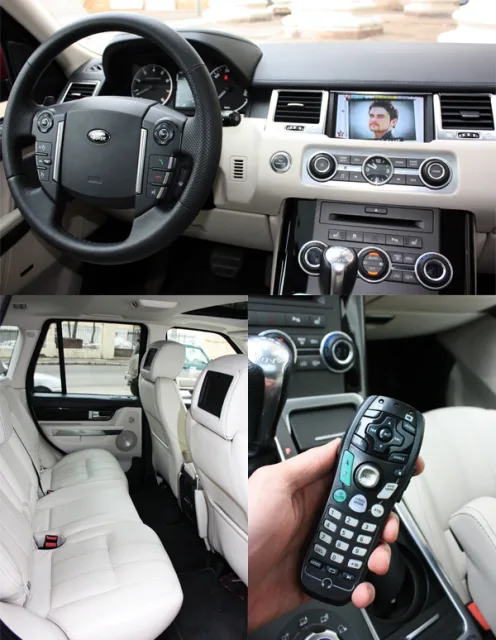
Inside, there is now more leather, improved driver's seat ergonomics, and a new infotainment system with a 7-inch touchscreen display
Riding the Core
I put the hefty key, resembling an expensive mobile phone, into my jeans pocket, settled into the seat, and started the engine with the Start button. The engine growled, reminding me of the power I was dealing with. As I began to pull out of the dealership parking lot and lightly pressed the gas, the car jerked sharply. "Wow, that's something!" flashed through my mind. It became clear: when parking, it's better to forget about the right pedal altogether.
Then I got onto the empty Leningradka and... took off. There's no other way to describe the feeling when a body-on-frame SUV weighing 2.7 tons accelerates like a decent sports car. The speedometer needle reaches 100 km/h (more precisely, 60 mph, since in the first batch of RRS 2010 for Russia, the instrument panel is marked in miles) in 6.2 seconds. In practice, it seems capable of more. The main thing is that you absolutely don't want to drive this car calmly. Even without the mood to race, some Cayenne or X5, noticing the Supercharged badge, will surely start provoking. In the city, it's better not to test its dynamics to the fullest — you'll be safer. But outside the city, it's just right. Without thinking twice, I headed to test this herd of 510 "horses" on the race track in Myachkovo.
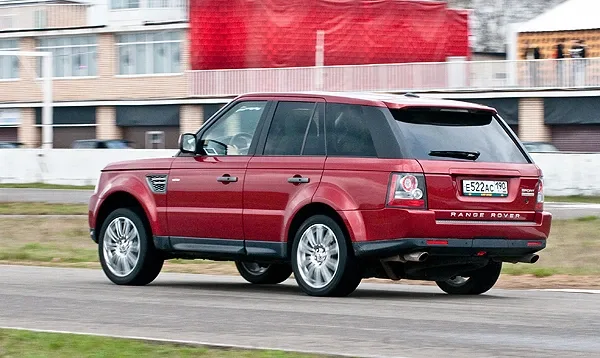
When you press the gas pedal, the RRS squats on the rear axle and shoots forward
On the track, I floor the pedal, and the "Range," as if redistributing all its weight, squats on the rear and shoots forward. The instrument needles fly up. Driving in a straight line in this car is an incredibly thrilling activity: it takes your breath away from the engine's roar and how its mass seems to ignore air resistance. The updated six-speed "automatic" shifts gears smoothly, and in the mechanical CommandShift mode with paddle shifters, the car becomes even more responsive.
But that's on a straight line — in corners, especially sharp ones, it noticeably rolls. In principle, for a car of this size, that's expected, but since a sporty character is claimed... The manufacturer equipped the new Sport with many stabilization and stability systems. One of them, Dynamic Response, according to the press release, "ensures confident cornering and minimizes roll, guaranteeing high handling and comfort." However, I recall last year's incident: at the presentation of the updated Land Rover lineup, a journalist sped up the Sport and flipped it onto its roof in a corner. Everyone in the car — both driver and passengers — got off with a slight fright, hanging on their seatbelts, but the car required serious repairs. A true confirmation of the saying about a foolish head. Power and speed are wonderful, but don't forget that you're driving a vehicle that is far from a sports coupe in its dimensions. By the way, fuel consumption with "pedal to the metal" reaches about 25 liters per hundred.
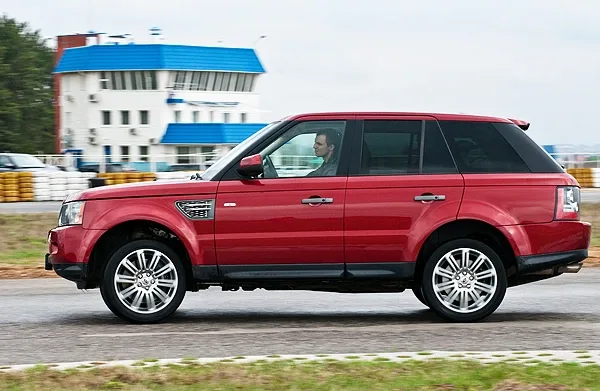
In corners, especially sharp ones, it rolls noticeably
The braking system with enlarged discs, developed jointly with Brembo, develops excellent force and easily stops this "steed" at full gallop. The main thing is to hold on tight!
Athlete or Businessman?
It's curious what percentage of Range Rover Sport owners actually use it as an SUV. For example, when the Japanese presented the new Nissan Patrol in the Emirates, they calculated that owners of their "off-roaders" spend less than 11% of their driving time in the mud. It's no secret that expensive SUVs today are bought primarily for status and prestige. Much like wealthy people wear professional diver's watches worth several thousand euros without ever scuba diving.
Surprisingly, regarding off-road qualities, this winter the Range Rover Sport S/C showed one of the best results on the Land Rover Experience track near Dmitrov. Where others hopelessly got stuck, it, thanks to its considerable power, simply flew on low-profile 20-inch wheels through snowdrifts and snowy ruts, ignoring any obstacles.
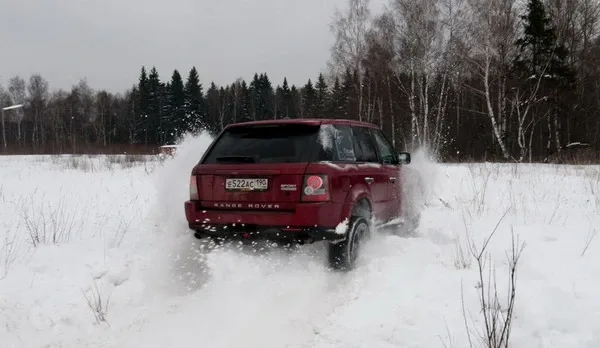
On the Land Rover Experience track this winter, the RRS S/C on its low-profile 20-inch wheels raced through snowdrifts and snowy ruts
Traditionally Metropolitan Range
Muscovites and guests of the capital have long been unimpressed by supercars whose price is comparable to apartments on the outskirts. Not to mention "Ranges," which there are probably more of in Moscow than in London. Some stand with hazard lights on near nightclubs, others are parked near restaurants and business centers. But against the background of direct competitors, the RRS, in my opinion, looks more intelligent. The X5 or ML have a certain image — they are associated with security for high-ranking officials or with Russian criminality, which is often the same thing. The RR Sport among this company seems to me a car for more creative and educated people. Of course, there are exceptions, and nothing personal, as a Brit would say, hoping not to offend anyone.
By the way, the Range Rover Sport S/C is also more attractive in price — 3,440 thousand rubles. The closest classmates BMW X5 xDrive50i and MB ML 500 4Matic cost 3,718 and 3,500 thousand rubles, respectively. But the Porsche Cayenne Turbo with similar equipment will cost as much as 6,380 thousand rubles.
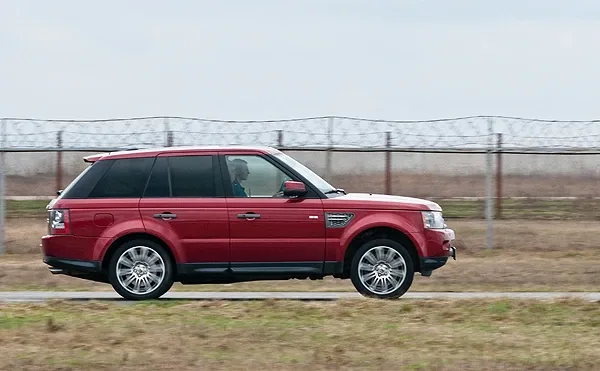
On a straight line, the Range Rover Sport best shows its explosive character
It's just that we don't have autobahns, and good roads are few and far between, and traffic cops with radars are always trying to hide behind bushes. As an SUV, hardly anyone will use it, nor as an escort vehicle. One thing remains: to spend time in this wonderful car in traffic jams as thick as old engine oil, using only a hundredth of the potential of its powerful engine.
Grigory Nemirovsky
We thank Jaguar Land Rover Russia represented by Dmitry Kolchanov and personally Yulia Malina for providing the car.
This and other Land Rover vehicles can be purchased from official dealers!