
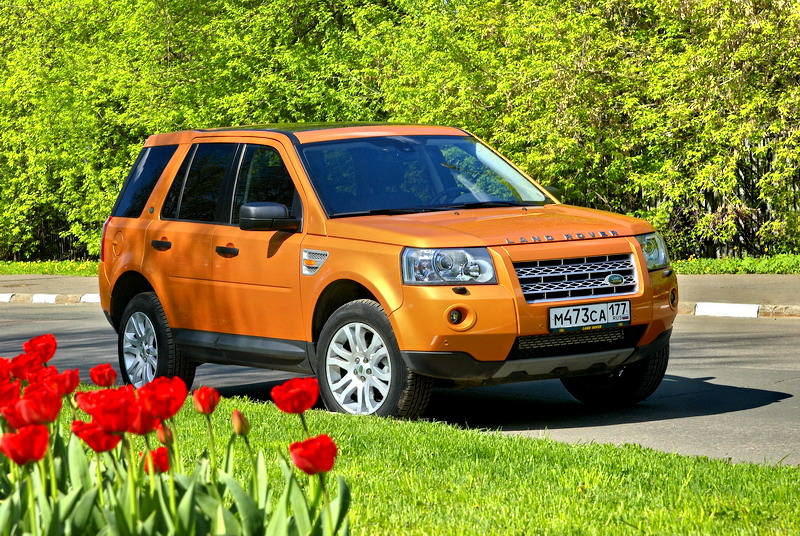
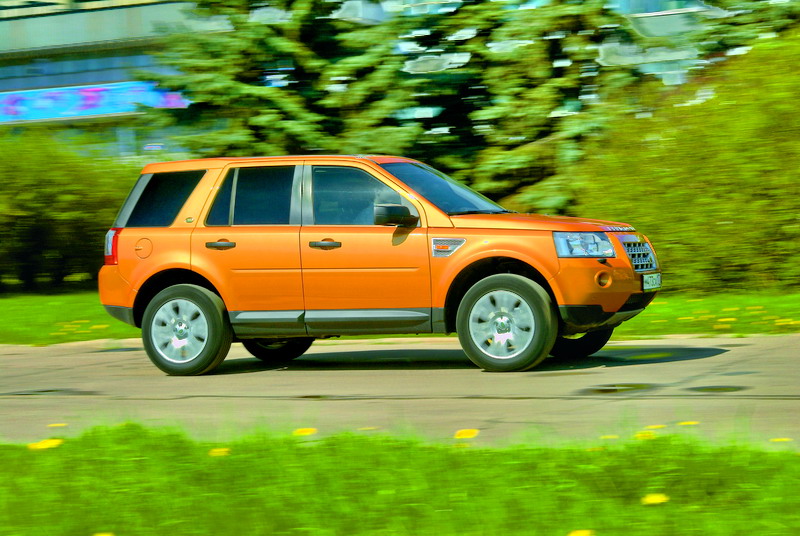
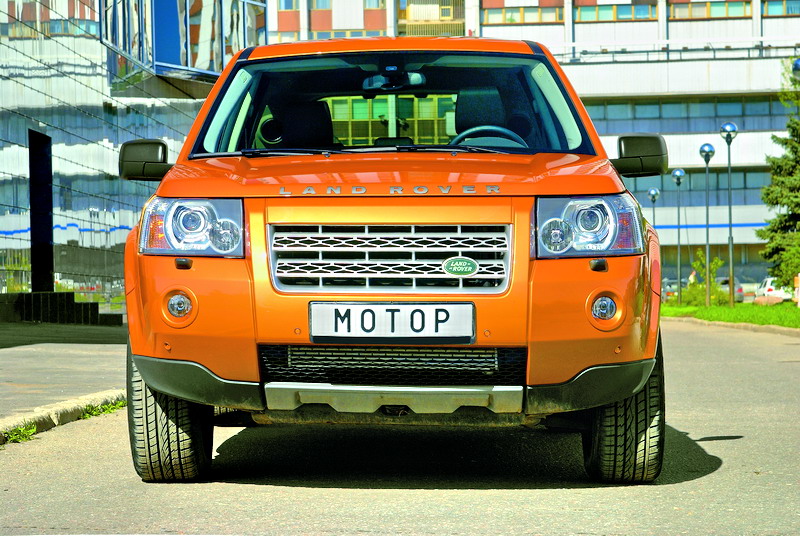
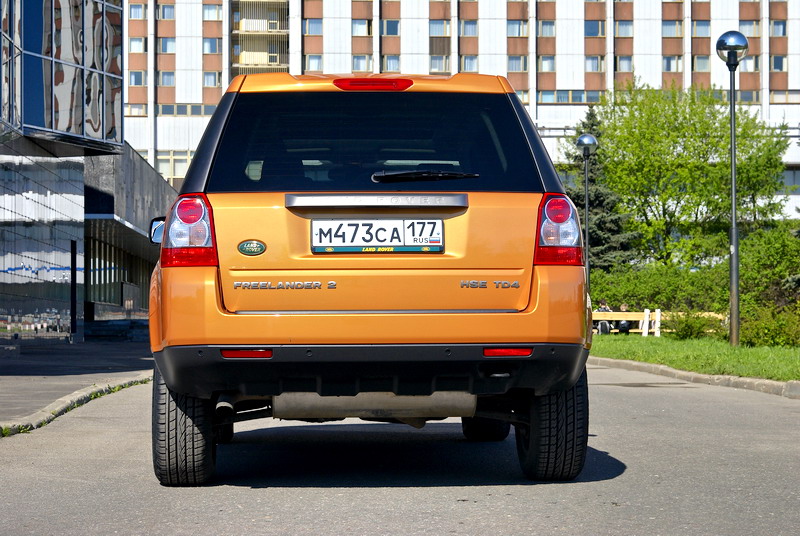
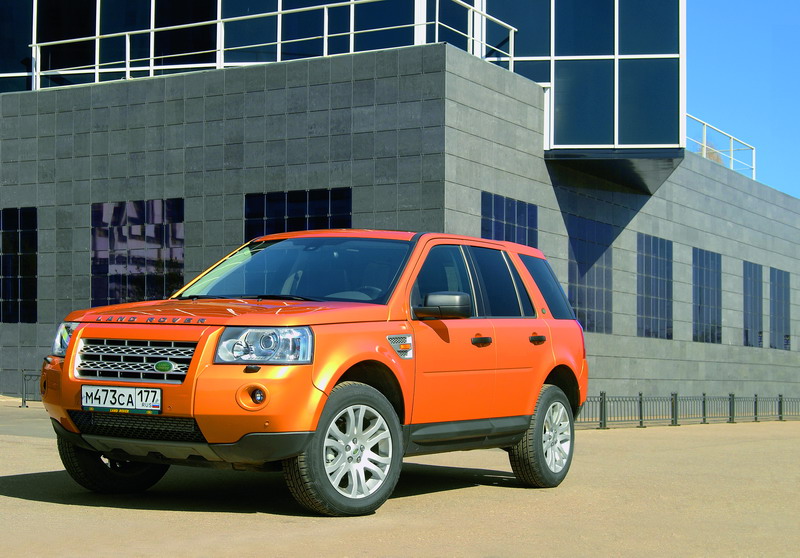
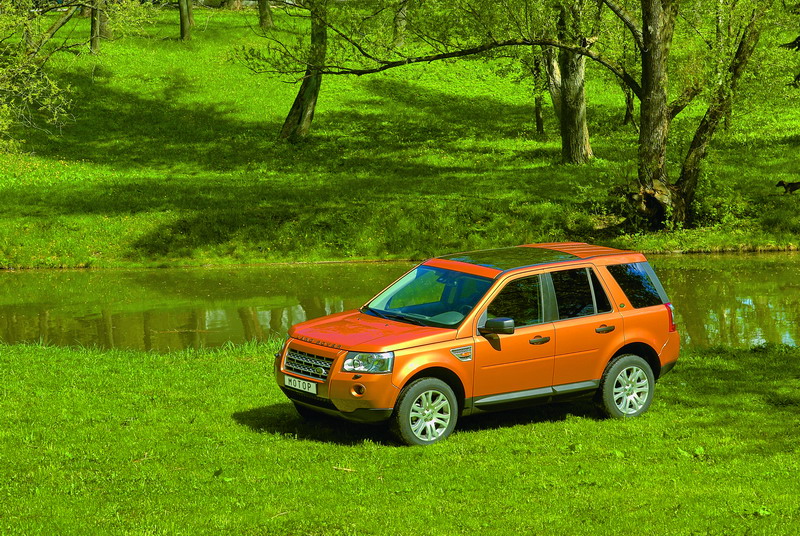
 What do you imagine when you hear the word "SUV"? Surely black, silver, or at worst dark blue. But what about orange? In my opinion, this shade suits the Freelander 2 best of all. It perfectly matches the character and spirit of the new Land Rover. What do you imagine when you hear the word "SUV"? Surely black, silver, or at worst dark blue. But what about orange? In my opinion, this shade suits the Freelander 2 best of all. It perfectly matches the character and spirit of the new Land Rover. But dimensions matter too. The increase in size is noticeable immediately, although the specific figures are only in the technical passport: the car has grown by 50 mm in length, 30 in height, and 110 in width. |
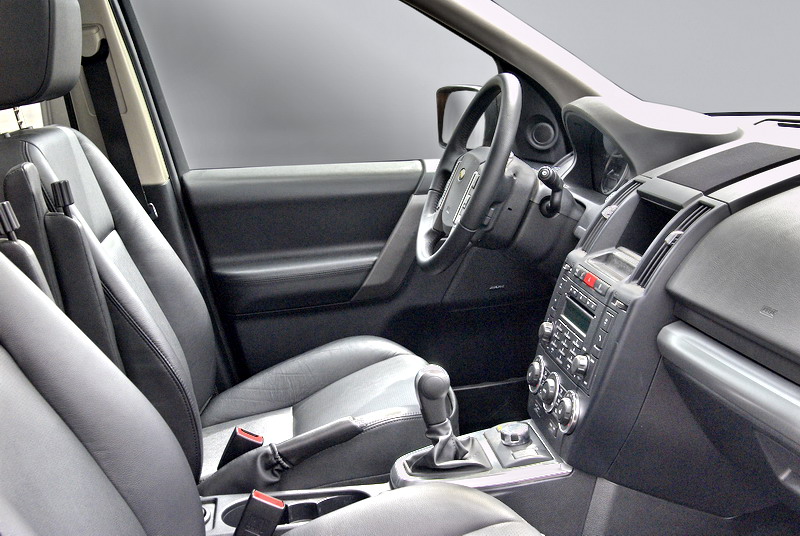
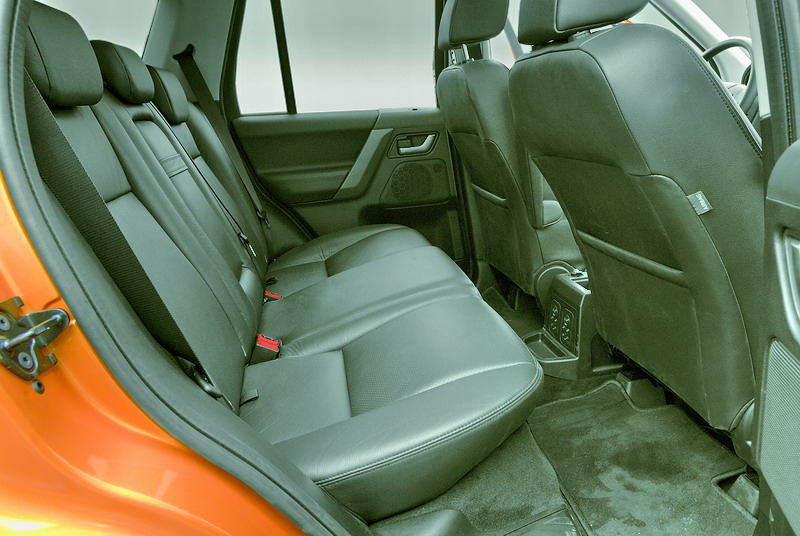
 The main advantages are inside. The cabin has become noticeably more spacious, in all directions. At the driver's seat, you feel unusually free: the seat adjusts within a wide range, and the steering column, in addition to tilt, now also adjusts for reach. The rear bench also has plenty of room — three passengers will be comfortable, and their comfort hardly depends on how the front seats are positioned. The only thing to nitpick is the slippery leather upholstery. But the biggest gain is felt in the trunk: the volume has grown from 546 to 755 liters, and with the rear seats folded, up to 1670 liters instead of the previous 1320. The loading height has also become higher — the spare tire has moved from the tailgate to under the floor. The main advantages are inside. The cabin has become noticeably more spacious, in all directions. At the driver's seat, you feel unusually free: the seat adjusts within a wide range, and the steering column, in addition to tilt, now also adjusts for reach. The rear bench also has plenty of room — three passengers will be comfortable, and their comfort hardly depends on how the front seats are positioned. The only thing to nitpick is the slippery leather upholstery. But the biggest gain is felt in the trunk: the volume has grown from 546 to 755 liters, and with the rear seats folded, up to 1670 liters instead of the previous 1320. The loading height has also become higher — the spare tire has moved from the tailgate to under the floor. |
 In terms of cabin space, the Freelander has almost caught up with its older relatives, and in terms of trim quality and comfort level, it has come very close to them. The soft-touch plastic of the dashboard looks expensive and feels pleasant. Inside, it has become significantly quieter, and the options list now includes a decent Alpine audio system, which, unlike many factory stereos, doesn't try to overwhelm you with heavy bass. The test car also had a Bluetooth headset installed. In terms of cabin space, the Freelander has almost caught up with its older relatives, and in terms of trim quality and comfort level, it has come very close to them. The soft-touch plastic of the dashboard looks expensive and feels pleasant. Inside, it has become significantly quieter, and the options list now includes a decent Alpine audio system, which, unlike many factory stereos, doesn't try to overwhelm you with heavy bass. The test car also had a Bluetooth headset installed. |
 In principle, this car would be quite suitable as a company vehicle for some mid-level official or small business owner. This was confirmed by the driver of one such boss, who approached us during the photo shoot. His only complaint about the test Freelander concerned the engine. He wanted a big gasoline engine, but we had a diesel with only 160 horsepower. The torque, however, is impressive — 400 Nm, but it's concentrated in a narrow rev range. Once I even stalled — right on the tram tracks. Here's what happened: I braked, engaged second gear as usual, added throttle, but didn't watch the tachometer, released the clutch — and the engine stalled. At first, not understanding what had happened, I panicked a bit — the tram was right there! (I immediately recalled an incident at the Freelander 2 presentation in Myachkovo: then, on my car, the electronics shut off in a corner, and I coasted to the roadside by inertia.) But I quickly figured it out, pressed the start button, and drove off. In principle, this car would be quite suitable as a company vehicle for some mid-level official or small business owner. This was confirmed by the driver of one such boss, who approached us during the photo shoot. His only complaint about the test Freelander concerned the engine. He wanted a big gasoline engine, but we had a diesel with only 160 horsepower. The torque, however, is impressive — 400 Nm, but it's concentrated in a narrow rev range. Once I even stalled — right on the tram tracks. Here's what happened: I braked, engaged second gear as usual, added throttle, but didn't watch the tachometer, released the clutch — and the engine stalled. At first, not understanding what had happened, I panicked a bit — the tram was right there! (I immediately recalled an incident at the Freelander 2 presentation in Myachkovo: then, on my car, the electronics shut off in a corner, and I coasted to the roadside by inertia.) But I quickly figured it out, pressed the start button, and drove off. |
 At the lowest revs, the diesel feels sluggish — you need to get used to this quirk. You have to shift more often, trying to keep the needle in the 2000–4000 rpm range. In this range, the engine reveals its solid pulling power — passengers are literally pressed into their seats. But you don't want to constantly "press" them: the 6-speed manual gearbox works vaguely (even though it's short-throw), and the clutch pedal is quite stiff. After switching to my Lancer after the test, for a while I habitually slammed the pedal to the floor — the Freelander's manner had an effect. At the lowest revs, the diesel feels sluggish — you need to get used to this quirk. You have to shift more often, trying to keep the needle in the 2000–4000 rpm range. In this range, the engine reveals its solid pulling power — passengers are literally pressed into their seats. But you don't want to constantly "press" them: the 6-speed manual gearbox works vaguely (even though it's short-throw), and the clutch pedal is quite stiff. After switching to my Lancer after the test, for a while I habitually slammed the pedal to the floor — the Freelander's manner had an effect.The brakes were pleasing. The rather heavy car slows down confidently, and the pedal is informative — you can precisely modulate the force. |
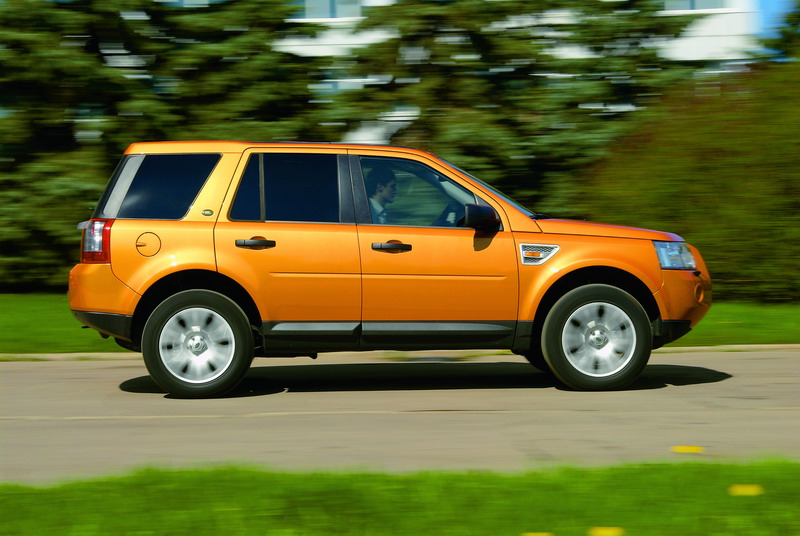 The junior Land Rover behaves smoothly on asphalt, and you don't even feel like provoking it into sharp maneuvers. In behavior on hard surfaces, it is much closer to full-fledged SUVs than to compact crossovers with their "car-like" manners. But it's not all that bad. The steering is light, yet provides enough information about the position of the front wheels. Body roll is present but remains within reasonable limits. The suspension handles bumps excellently — it rarely reminds you of unsprung masses (in this, the Freelander 2 differs greatly from serious SUVs). Overall, the Freelander is the most "asphalt-friendly" and the easiest to drive on hard surfaces in the entire Land Rover lineup. The junior Land Rover behaves smoothly on asphalt, and you don't even feel like provoking it into sharp maneuvers. In behavior on hard surfaces, it is much closer to full-fledged SUVs than to compact crossovers with their "car-like" manners. But it's not all that bad. The steering is light, yet provides enough information about the position of the front wheels. Body roll is present but remains within reasonable limits. The suspension handles bumps excellently — it rarely reminds you of unsprung masses (in this, the Freelander 2 differs greatly from serious SUVs). Overall, the Freelander is the most "asphalt-friendly" and the easiest to drive on hard surfaces in the entire Land Rover lineup. |
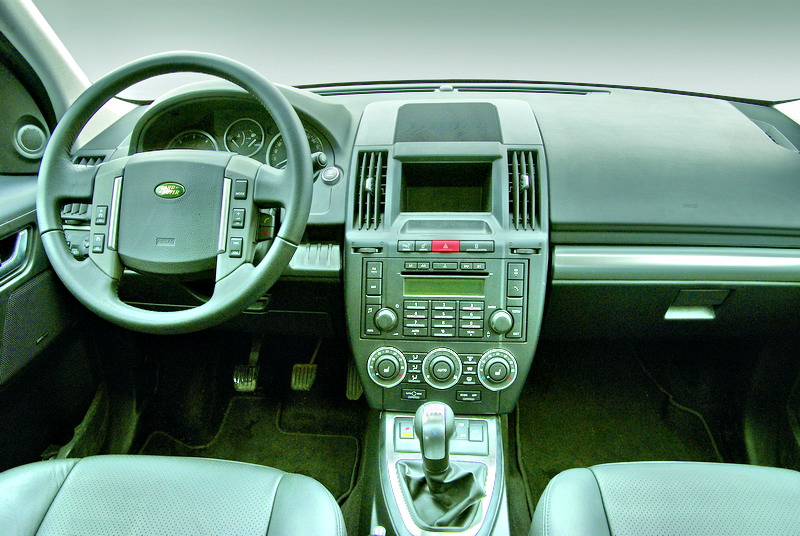 And in the city, this car has clear advantages. The main ones: the energy-intensive suspension easily handles any potholes, huge mirrors make it easy to maneuver in reverse even in tight courtyards, and the high seating position helps you plan maneuvers in traffic in advance. And in the city, this car has clear advantages. The main ones: the energy-intensive suspension easily handles any potholes, huge mirrors make it easy to maneuver in reverse even in tight courtyards, and the high seating position helps you plan maneuvers in traffic in advance.The car is excellently prepared for off-road — from its older brothers it inherited the Terrain Response intelligent all-wheel-drive system with four modes. For asphalt — General Driving, for slippery surfaces — "grass/gravel/snow" (Grass/Gravel/Snow), for mud and ruts — Mud and Ruts, and for sand — Sand. But there's no low-range gear or cross-axle locks here. |
 In standard mode, the Haldex coupling sends no more than 5% of the torque to the rear wheels, but during a sharp start or severe front-wheel slip, the clutch pack compresses up to full lock. I got to try the Mud and Ruts mode: the Freelander 2 crawled very confidently over a rain-soaked dirt road, even though it was shod with regular highway tires. In standard mode, the Haldex coupling sends no more than 5% of the torque to the rear wheels, but during a sharp start or severe front-wheel slip, the clutch pack compresses up to full lock. I got to try the Mud and Ruts mode: the Freelander 2 crawled very confidently over a rain-soaked dirt road, even though it was shod with regular highway tires.Of course, few of the Freelander 2s sold in Russia will see real off-road — there are other models for that. But the knowledge that you're driving a car capable of more than just conquering curbs warms the heart of any owner. |
 PRICES AND TRIM LEVELS OF THE Land Rover Freelander 2 PRICES AND TRIM LEVELS OF THE Land Rover Freelander 2Prices for the new Freelander start at $37,500 — for this amount you can buy the diesel version with a manual gearbox in the base E trim. It includes power windows and heated mirrors, manually controlled climate control, an audio system with CD receiver, iPod connector, and six speakers, as well as ABS, EBD, Cornering Brake Control (CBC), Roll Stability Control (RSC), and Hill Descent Control (HDC). The next trim, S, costs from $40,500. Here you can already choose engines and gearboxes, but the gasoline engine comes only with an automatic transmission. Differences: presence of Terrain Response, parking sensors, rain sensors, and automatic headlight activation. Even richer is the SE trim at $44,000: it differs from the S by the Alpine audio system with nine speakers. The top HSE version — from $55,900 — is additionally equipped with bi-xenon headlights, a 6-disc changer, and leather upholstery. |
 |
 |
 |
 |
 |
 |
 |
Career growth
The cherished addition to its name was perceived by the small Land Rover as a new title, a promotion. And it tries its best to live up to that title.
Test drive photos
Comments
No comments yet. Say the first word.