
Land Rover Freelander. A little one without complexes
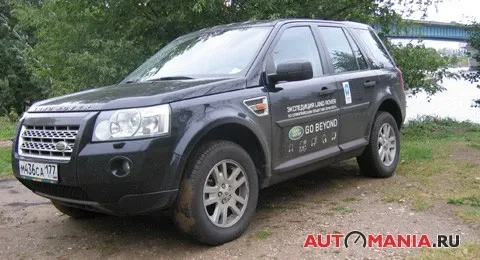
Among the lightweights there are hard workers and toilers. And there are those who aim for the elite of the automotive industry, i.e. - the premium class. Take, for example, the Land Rover Freelander 2 - the youngest representative of the legendary English aristocratic brand. It is beautiful and elegant, like a true London dandy. In every detail of its exterior, some resemblance to its older brothers, the Discovery and Range Rover, can be discerned. Despite the enviable off-road qualities, which will be discussed later, you don't want to get it dirty or drive through mud. The second Freelander is a completely new car with an old name. Its design differs from the first one as much as football differs from hockey.
A number of authoritative automotive publications, when testing this car, compared it with the Mazda CX-7, Mitsubishi Outlander XL, and even the Dodge Nitro. Others, for some reason, with the SsangYong Rexton, KIA Sorento, Chevrolet Captiva, and Jeep Cherokee. Probably, everyone is right in their own way, but I personally got the feeling that the main rivals of the Land Rover Freelander 2 should still be the Nissan X-Trail and Honda CR-V. But, in any case, it should be noted that the Freelander 2 is the most expensive among all the cars listed above. True, it is also the most powerful (3.2 L V6 233 hp), yielding only to the Izhevsk-assembled Sorento.
An external inspection of the car, before setting off, immediately revealed several positive and negative points.
The main plus is the presence of 7 airbags (the seventh is the driver's knee airbag, like on the Toyota Avensis). On the key fob, an additional button was found - it turns on the headlights and interior lighting. It is very convenient at night not only in the forest or on an unlit road, but also on many Moscow streets, where working streetlights are hard to find even in broad daylight. Here you press a button and it's light all around, like daytime. Unusual and extremely convenient - I haven't seen such a function in a long time.
What I didn't like, however, was the lack of front armrests (and, accordingly, the central glove box under them). Also, the low-mounted exhaust muffler running across the body (a similar option is on the Suzuki Grand Vitara and Nissan X-Trail). When reversing off-road, there is a high chance of tearing it off. Somehow, I immediately lost the desire to get into the mud. It turns out - this dandy can travel on Russian local roads only accompanied by more capable older comrades. And only on big holidays.
Many call the Freelander a crossover, but it's hard to agree with that. It's not for nothing that next to the automatic transmission lever there is a joystick with 4 operating modes of the proprietary Land Rover Terrain Response transmission with a Haldex coupling. In normal driving conditions, no more than 50% of the torque is transmitted to the rear wheels. But during sharp acceleration or wheelspin, the friction disc pack compresses up to full locking. And if necessary, it even simulates a differential lock. If desired, you can use the joystick to set modes: grass/gravel, snow, mud ruts, or sand. We still didn't risk testing the Freelander's off-road capability - we didn't want to return this handsome car to the Land Rover Russia test park with a torn-off muffler, although the approach and departure angles, according to the stated specs, are impressive - 31 degrees at the front and 34 degrees at the rear.
On the highway, the SUV feels very confident. It accelerates to 100 km/h in 8.9 seconds. But during sharp turns, it leans heavily and the rear axle slides. The steering confidently helps correct the skid, and the stability system is always on alert. If you want to accelerate a bit faster, you can turn on sport mode, and on the highway use cruise control. There are no complaints about the seats. The front ones have good lateral support, and rear passengers have enough legroom. By the way, rear passengers can plug in headphones and listen to the radio on their own frequency if they are not satisfied with the driver's choice and their musical tastes don't match. The stock head unit with Alpine speakers has settings for 20 fixed FM radio stations. The two speakers on the rear pillars are very well placed, although true music lovers will find something to complain about - the sound in the cabin is not ideal; here the Freelander is far from Audi and its older brother Range Rover. But after all, the Freelander is still a car, not a music center!
I was very pleased with the visibility in the side mirrors. Getting into the car, I didn't even adjust them to myself. The "burdocks" practically eliminate blind spots and won't let you make a wrong maneuver.
The buyer of the Freelander will also like the fact that the spare wheel is in the underfloor space of the trunk, not hanging under the car's bottom, as in most modern SUVs. Less dirt on hands and clothes when changing a wheel.
As for fuel consumption - in urban conditions with traffic jams, it was 12.7 to 13.2 L/100 km on the tested car (according to the passport - 15.8 in the city and 8.6 on the highway). This is a very good indicator for a 2-ton car with a V6 engine producing 232 hp. For comparison, I can say that a Saab 2.0T consumes 17-18 L/100 km in the city, having approximately the same power.
But what I couldn't evaluate during the test days was the operation of the climate control. You get into the car on a cold morning and set the temperature to 19°C. For the first 15-20 minutes, the cabin heats up to about 25 degrees and only then starts cooling down to the set temperature. If you drive the car all day, you'll have to constantly turn the climate control knob, trying to achieve the desired temperature. I wonder how this whole system works in summer? Does it also first turn on the heater and then the air conditioner? That's called - "hello, runny nose and sore throat."
But overall, the Freelander 2 pleased me. It justifies its cost of 1,416,000 rubles (in HSE trim). The most affordable version with a diesel and manual transmission will cost $37,740, and a similar one to the tested - with a 2.2 L diesel 160 hp in HSE trim - $49,030.
We managed to drive the latter a few days later. The HSE trim of the car differed somewhat from the one on the test. The second one was on a manual transmission, with a panoramic sunroof and front armrests. These armrests were absent where they were needed (on the automatic), but here - please. At that, the right (driver's) one - I had to immediately raise it up, as it interfered with shifting the 6-speed short-throw gearbox. The panoramic roof also didn't make the proper impression. It clearly lacks a rigid sunshade; it can't be closed; in bright sun, the car heats up too much, and it's too light inside.
Diesel consumption in urban conditions was 10.9 - 11.6 L, which is a bit much for a 160-hp diesel. For example, an Audi Allroad 3.0 TDI with 266 hp consumes only 9.7 L even in traffic jams.
Overall, if you're not bothered by the acceleration of 11.7 seconds versus 8.7 on petrol, I recommend the diesel version. Its top speed, though, is also lower - only 181 km/h, but in Russia there's nowhere to race anyway - in Moscow and large cities there are traffic jams, and outside them the roads are not conducive to racing.
And finally - when buying a Land Rover, be prepared for the fact that spare parts and maintenance will cost you quite a lot. By these criteria, the car is almost 1.5 times more expensive than the Mitsubishi Outlander and almost 2-2.5 times more than all the competitors mentioned at the beginning.
Technical specifications (petrol version):
| Dimensions (mm) | 4500x1910x1740 |
| Wheelbase (mm) | 2660 |
| Ground clearance (mm) | 220 |
| Trunk volume (L) | 755/1670 |
| Curb weight (kg) | 1770 (2015 in the registration certificate) |
| Gross weight (kg) | 2505 |
| Engine displacement (cm3) | 3192 V6 |
| Power (hp) | 233 |
| Max. torque (Nm/rpm) | 317/3200 |
| Top speed (km/h) | 200 |
| Acceleration to 100 km/h (s) | 8.9 |
| Tires | 215/75 R16 |
| Average fuel consumption (L/100 km) | 8.9 |
| Fuel tank capacity (L) | 70 |
| Fording depth (mm) | 500 |
| Turning circle (m) | 11.4 |
| Petrol | A-95 |
| Price of the tested car (RUB) | 1 416 000 |
Dmitry Shavyrin
We thank the representative office of «Land Rover Jaguar Russia» for the cars provided for the test.
Source – AUTOMANIA.RU