
ROYAL SUV
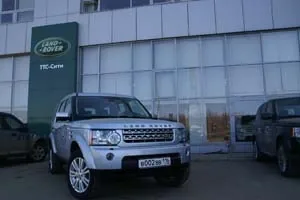
Land Rover Discovery 4
Engine — 3.0 L Diesel
Max power — 245/4000 rpm
Max torque — 600 Nm/2000 rpm
Max speed (km/h) — 180
0-100 km/h — 9.6 sec
Fuel consumption:
City — 11.2
Highway — 8.3
Combined — 9.3
6-speed automatic
Permanent all-wheel drive
Curb weight — 2583 kg
Ground clearance (min) — 170-310 mm
Tires 255/55R19

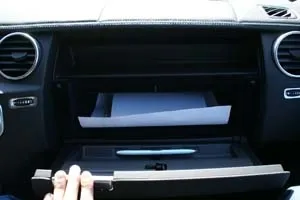
Features:
Electronic air suspension and “Terrain Response” system, actively locking rear differential, autonomous engine heater with remote control, leather interior, dual-zone climate control, security system volume sensors + “keyless entry”, full electric package, driver and front passenger seat adjustment, rain and light sensors, cruise control, multifunction steering wheel, Harman/Karrbon audio system, rearview camera, hard-drive navigation, color touchscreen display, ABS, EBD, EBS, dynamic stability system, active roll mitigation system, electronic parking brake, power-adjustable steering column, 6 airbags, alloy wheels, fog lights, power-folding mirrors, bi-xenon headlights.
Service interval:
12,000 km or 6 months.
Service 1 — $473 (3,781 UAH)
Service 2 — $777 (6,210 UAH)
Service 3 — $473 (3,781 UAH)
Service 4 — $1,688 (13,500 UAH)
Service 5 — $676 (5,400 UAH)
Service 6 — $777 (6,210 UAH)
Service 7 — $473 (3,781 UAH)
Service 8 — $1,688 (13,500 UAH)

Leonid Tsymbalenko,
Lorry Line LLC
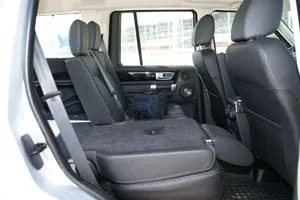
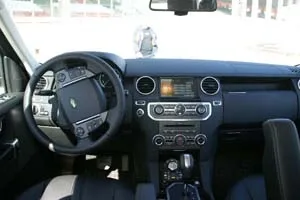
What should an ideal car have? Comfort, spaciousness, safety, agility, the ability to overcome any obstacles? All of this is in the Land Rover Discovery 4. And now I had the opportunity to see for myself whether it would live up to my, frankly, inflated expectations. Somewhere deep down, I had a nagging thought that the new “Disco” would stumble somewhere. So, let's get acquainted. The interior is a sheer pleasure. Expensive materials, neat assembly, a comfortable steering wheel with excellent leather, an instrument panel that pleases the eye and is easy to read. Of course, it couldn't be otherwise. Electronics are packed to the brim, with the latest technology: from light and rain sensors to push-button engine start and an electronic parking brake. I suspect there's a lot more interesting stuff in there. You can't master it all in a short time, but as soon as we pressed various buttons, the car responded with a mysterious hum. The rear bench is not two seats with a “slot” for a third, but three full-fledged seats where a person of any build can sit comfortably. The trunk is also huge — if necessary, you could even park an “Oka” in it.
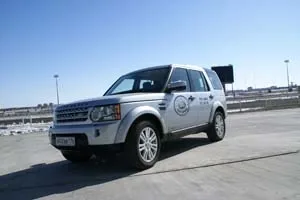
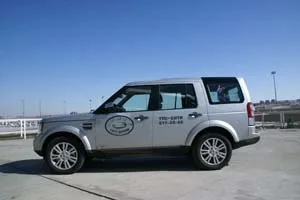
Well, let's go. And then it dawned on me: I'm not just sitting behind the wheel in traffic, I'm sitting on a throne, looking down from above at the fussing little cars below, which end up somewhere at the level of my bumper. At the same time, they all politely give way to me. Driving such a car certainly cultivates a condescending attitude toward minor everyday troubles. It's comfortable to sit: both the seat and the steering wheel adjust over a huge range. On the right is an adjustable armrest, on the left is a wide door trim that's also comfortable to rest your arm on. The silence in the cabin is amazing: I didn't even hear my studded tires scraping on the dry asphalt. Thanks to the huge windows and mirrors, you can see everything around the car. When reversing, the screen displays an image from the camera with dynamic trajectory markings. Of course, 245 “horses” for such a beast is not the limit of dreams, but 600 Nm of torque is serious! So, despite the aerodynamics of a wardrobe, the car accelerates quite briskly — 9.6 seconds to 100 km/h. The six-speed automatic behaves adequately, although I hardly noticed the difference between normal mode and “sport”, but it shifts very smoothly. The brakes deserve a separate song: soft, yet informative and incredibly effective. Maybe there are better ones, but I haven't come across them.
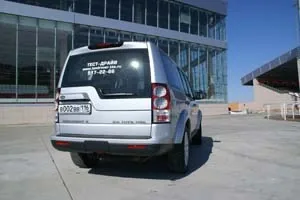
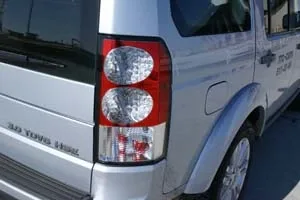
Yes, it's good, no argument. I couldn't even believe it was a real SUV. And since it's an SUV, we need to test it off-road. Although something inside resisted: that's not a king's business... But, as they say, in for a penny, in for a pound. After a long search, we found a suitable steep climb covered with a half-meter layer of dense wet snow. About a third of the way up, there was a rut — someone had already tried but failed. If we get higher, the test can be considered passed. Without thinking twice, I floor the gas... A few meters after the rut, our “Disco” got stuck. The result, of course, is not impressive, but it's still a result. We were about to head down when a dealership representative approached. It turned out we simply couldn't properly explain to the smart car what we wanted. The specialist set the necessary settings and raised the ground clearance to maximum (which, by the way, varies from 170 to 310 mm!). And then our, I'm not afraid to say, tank, spectacularly throwing snow, climbed to the very top. Impossible! Maybe it's a coincidence? We tried again — the same result. The third time was no longer interesting — there was already a beaten path.
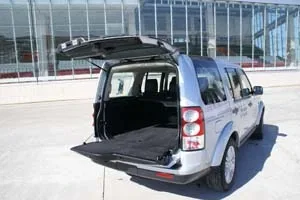
Okay, enough praising. For objectivity, it's worth mentioning the downsides. So, what could I nitpick about... Ah, the navigation is useless — it doesn't know where it's leading. Also, a handle on the front pillar would be nice for easier entry. And someone got the headliner dirty. Nothing else comes to mind.
I deliberately didn't delve into technical details; I hope Alfred and Vadim will tell you more about them. I wanted to convey the emotions that the fourth “Discovery” evokes. And it undoubtedly does. It turned out to be a surprisingly harmonious car. It has all the advantages that can be combined in one vehicle, and precisely in the volume in which they are combined. The characteristic square body is entirely inherited from the “Discovery 3”. But I think that's a plus: the car looks stylish and doesn't get lost among streamlined crossovers. Yes, I've heard that owners of the previous model complained about the electronics. We were promised that all the ailments have been cured in this version. Of course, someone may have complaints, but I think they will be at the level of subjective feelings. Objectively, it's hard to find fault. Even the base price of 2.5 million, I believe, is not a drawback, but simply an honest assessment of what this car is worth. The manufacturer promises a cheaper version by autumn for 1,890 thousand rubles. In the meantime, don't ask yourself if you want such a car. The question is different: are you ready for it.
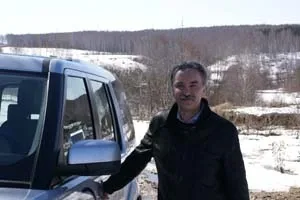
Vadim Sadykov,
“Autoclub-Kazan”
We tested the previous “Discovery” (the third) in December 2006. I highly recommend reading that review on the autoclub-kazan.ru website, because the on-road behavior of the two generations is very similar. I don't consider myself a big expert on Land Rover to list all the differences between the third and the fourth. Overall, if you don't nitpick, the exterior has maintained continuity. The design of the third was so successful that it would have been a sin not to repeat it. Of course, with some improvements. The base remained the same 2.7 turbodiesel. As far as I know, it's now a reliable unit: all the “childhood diseases” were cured during free recall campaigns. But a much more interesting 3.0 turbodiesel has appeared. Compare for yourself. The displacement (relative to 2.7) grew by just over ten percent, but power jumped from 190 to 245 hp! And torque — from 440 to 600 Nm! A beast, not an engine. Although in terms of transport tax, the 2.7 is still more advantageous. There's also a gasoline 5.0 V8 with 375 hp, but in my opinion, the turbodiesel is the best choice for a true SUV.
This time I hesitated whether to go to the test site and check the car's handling at all. After all, dry asphalt, plus fourteen degrees, and studded tires — a so-so combination. But I decided to go. On the site, we set up cones and did a “moose test”. Alfred and Marat from the Kazan School of Higher Driving Skills passed it at speeds under seventy-five, Leonid went slower. But all three of my attempts ended with me flying past the final “gates”. The maneuver at a very low speed is useless, but when you speed up more, you start to doubt the car: the soft suspension causes body roll, and this is clearly felt in corners. Although, honestly, for an SUV, ideal handling is not the most important thing.
I hope Alfred will tell you more about technical details like air suspension and other off-road features. I just want to share my impressions of driving on virgin soil. There was a section of road uphill, covered with snow. Someone before us, clearly not in a car, tried to drive up there and failed. Instead of the usual differential locks, settings like "snow," "rocks," and "mud" come to the rescue here. Alfred chose "snow," engaged second gear on the automatic. And the car calmly crawled up. An important point: you need to press the gas pedal more actively than usual. This contradicts our experience—on loose roads, everyone is used to easing off the gas. But on this Discovery, as on the new Prado, this rule works the opposite way. Alfred drove to the "river," then it was my turn. Descent, climb along the ruts—and it was all routine and even boring. Easy. Where we, journalists, are a bit disappointed by the lack of excitement, the owner will be proud: the car goes everywhere without strain.
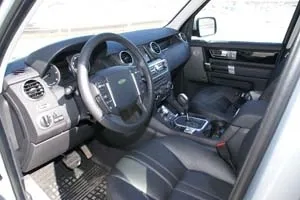
In the city, there were no surprises. There's no desire to drive recklessly in such a car; you drive calmly and solidly, but overtaking a slowpoke in heavy traffic is always easy. You quickly get used to the dimensions of this not-so-small vehicle. The only thing I didn't like was the driver's armrest. At first, it just got in the way. Leonid advised lowering the front part of the seat cushion. I lowered it—it became more comfortable. But only when driving straight and not in a hurry. However, during steering maneuvers, it still interferes. In the end, I just raised it. A simple solution.
The previous, third Discovery, we really liked in our test. The new car retained all its advantages, adding interior comfort and improving the exterior.
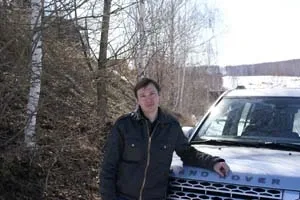
Alfred Mardanov,
"Autoclub-Kazan"
"Cosmos," Marat exhaled when he settled in the cabin to move the car from the office to the site. We had briefly argued before and still decided to give it a test at the proving ground—who knows what to expect from it. As practice showed, not in vain. Talking seriously about the handling of such a beast... you can. You can feel that English engineers did their work. The Discovery passes the "moose test" easily at speeds of 70–75 km/h. If you go faster, the car doesn't have time to return to the right gates, but it doesn't get lost and is easy to keep under control. Vadim and Leonid were cautious, apparently afraid of rolling over, forgetting that there's an electronic system that monitors body roll, speed, and other things.
In danger, it strangles the engine and does everything to prevent tipping over. After driving on smooth asphalt without much fanaticism (this isn't a mess of mud, rocks, and sand), we went to our little proving ground. I was behind the wheel on the short route from the showroom to the hippodrome and already felt the car a bit. You know, it's amazing. And this feeling didn't leave me even when I moved to the back seat. It's somehow calm and peaceful there. Moreover, the heated seats fold in a 35/30/35 ratio, and there's really enough room for three adults. The seats fold into a flat floor, forming... although we've already talked about that. The only thing that confused me was that the folded middle seat didn't become a table with cup holders. Did I want to say something else important? Oh yes, I remembered!

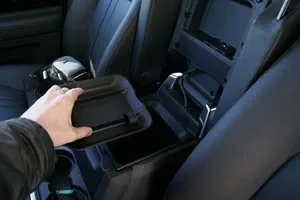
Trends in the automotive industry are depressing now: cars are becoming smooth and similar to each other due to the pursuit of economy and safety. Some kind of household appliance for moving from point A to point B. SUVs are losing their frame and low-range gear, sedans—handling, hatchbacks—their aggression and feistiness. All in favor of comfort and calm. But contrary to this, the Discovery has become a worthy continuation of the "third" sibling. First, its exterior has changed minimally (bravo!)—and yet so that it can be distinguished from the previous model even in the dark. That's a joke! In fact, it's easier to distinguish it in the dark—by the light of the headlights. They're LED! In daylight, it's also visible. I can't even imagine what it could have been like if not like this. The entire Land Rover lineup, you'll agree, is charismatic, and the models echo each other. Second, the interior of the previous Disco had outdated green backlighting, but now—I quote—"cosmos." Bright white backlighting looks modern and stylish. Moreover, even in bright sun, it's clearly visible. Ergonomics are top-notch, nothing to say here.
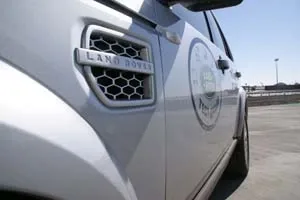
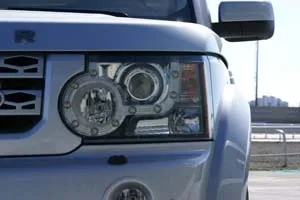
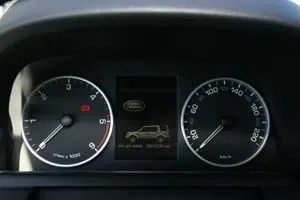
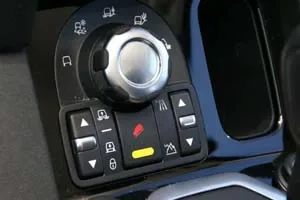
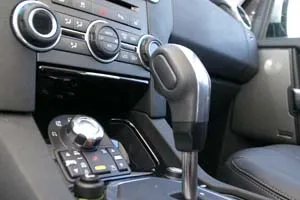
The screen between the speedometer and tachometer shows the activation of various functions—this is very convenient. I especially liked the front wheel angle indicator: it came in handy off-road. Honestly, for the Discovery, this was a light stroll, not off-road trials. I was just worried that my talent for getting the car stuck on flat ground would manifest especially brightly, and we wouldn't even be able to explain where we were if we had to call for help. But nevertheless, we once again confirmed the seriousness of the car. Air suspension, low-range, center differential lock—all for storming off-road. The proprietary Terrain Response system has a new "Sand" mode. All options imply individual settings for throttle response, air suspension operation, locks, etc. I set "snow with ruts," forcibly raised the suspension to maximum. Engaged second gear—and "alga." We passed easily, with a slight hesitation, turned around, and again "alga." There was a ford there; we could have tried it too. In fact, the car is rated to ford water up to 700 mm deep—that's waist-deep for an adult.
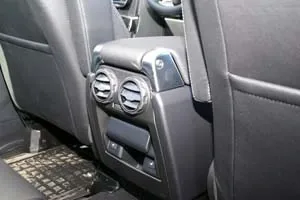
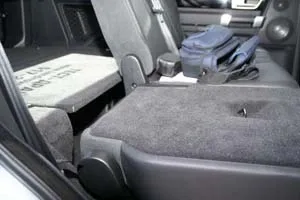
No, we didn't go further into the field, although we really wanted to. The air suspension itself takes the necessary position depending on the driving mode. After our experiments, it became noticeably softer on pseudo-asphalt roads, and on the high-speed section, it even presses the car to the ground. True, on bumps, you still feel impacts on the steering wheel, and rear passengers might also be bothered—the result of the engineers' work towards handling. Plus, the wheels are at least 19-inch radius—low-profile and stiffer. This is a tribute to improved brakes; they increased the size of the brake disc. And it's clear: more powerful three-liter diesels have appeared in the engine lineup. I'll especially note the sound insulation—it has become noticeably better; you feel the engine's work only by the tachometer, no extra sounds penetrate the cabin, nor from studded tires. Aerodynamic noise starts at speeds around 160 km/h.
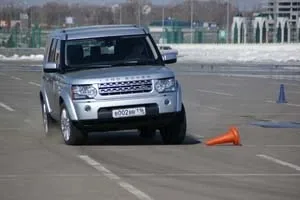
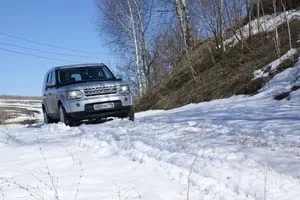
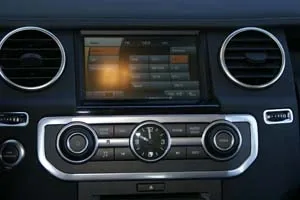
And this despite the fact that its aerodynamics, as Leonid put it, are at the level of a wardrobe. The result is impressive! I'd like to return to the interior separately. It has become noticeably more solid—both in materials and in the quality of the leather itself. The cabin looks luxurious; it's even a pity to bring street dirt on your boots if you've had to walk through slush. The front panel is upholstered in leather with neat, even seams, and this, apparently, is even in the base version with fabric upholstery. But the third row of seats, which is offered with climate control vents for rear passengers, is available exclusively as an option for the leather interior, because these seats themselves are made only of leather (the price is about 85,000 rubles). The central display responds to finger touches and combines a bunch of functions: controlling the Harman/Kardon audio system, the rearview camera image, and navigation.
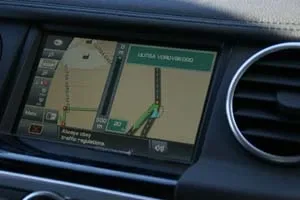
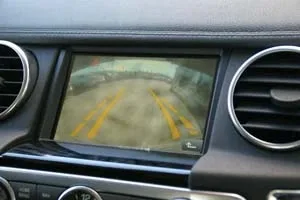
Navigation, frankly, amused us—it seems to be in cahoots with gas stations. It leads to the destination by some roundabout ways, as if deliberately lengthening the route. For now, it operates in test mode and needs time to adapt to our roads. However, future owners shouldn't be afraid of going broke on fuel, even if they have to wander: our average consumption in mixed mode was about 14.5 liters, although you can actually fit into 14 or even less. But I personally don't see the point in saving—for such a beast, if the appetite stays below 20 liters, that's already a reason for joy. Overall, the picture is absolutely clear. In essence, we have the good old Discovery 3, which has outgrown its childhood ailments and is now insured against them forever: the engine has undergone a kind of cardio workout and runs much more stably, and the car itself has received serious comprehensive preparation. It has a modern, luxurious interior, improved sound insulation, tightened handling, an expanded range of engines, and a rich list of options. At the same time, it has become an even more severe and uncompromising fighter than its predecessor.