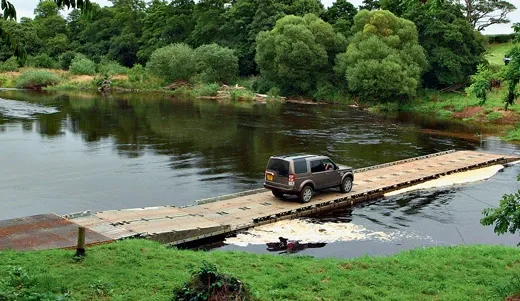
The Land Rover Discovery 4 test took place in Scotland, United Kingdom. The impressions are simply fabulous, even though everyone drives on the opposite side of the road for us. Moreover, now I know exactly how to make the Discovery 4 even better, and why it's impossible.
INSPIRED BY NUMBERS
How can I convey all the charm of the Disco 4 if it's essentially a deep modernization of the previous model? Even outwardly they are so similar that an uninitiated person might easily mistake it for a simple facelift.
Here I'll allow myself a slightly incorrect comparison — purely for clarity. There are men (of course, not gentlemen) who can easily determine a lady's breast size at a glance. An inexperienced person might, say, not distinguish a first size from a second. But a third is already hard to confuse with the previous ones — it's a rather impressive bust. A fourth catches the eye even of those who pretend such things are utterly indifferent to them. It's the same story with the Discovery. Someone who doesn't know may not see the difference between the first and second generations, but the third-generation Disco is recognizable immediately.
And the fourth, though similar to the third, is a completely different story.
In my opinion, Land Rover did everything right. In a difficult time for the auto industry, when others are thinking about simplifying versions, the British are engaged in perfectionism. They refined the Discovery 3 so much that they now rightfully speak of a new generation. Moreover, the external changes are minimal — the lines have become stricter, the front bumper more streamlined. And so that the model isn't confused with its predecessor, they added LED headlights and taillights. In person, this looks truly impressive.
EIGHT LITERS FOR TWO
The cars waiting for us in Edinburgh had new engines: a 3.0-liter diesel with two turbochargers or a 5-liter gasoline V8. I had never driven on left-hand traffic before, so I immediately got behind the right-hand wheel to suppress the beginnings of fear. And already leaving the parking lot, I wondered: which engine did I get? Light, barely noticeable vibrations hinted at diesel. But at idle, the engine was very quiet, and during acceleration the situation didn't change much. It turned out to be diesel after all, a 3.0 with two superchargers and crazy 600 Nm of torque. A very modern, high-tech unit. But to say that the Disco 4 with it flies like the Range Rover Sport with a turbodiesel V8 is not possible. Still, it's a well-mannered, respectable engine: smooth torque across the entire range and, as a result, confident acceleration at any speed. It reaches 100 km/h in 9.6 seconds, which is quite good for a large, heavy vehicle.
THE KEY IS THE TIMBRE
The second new engine, the gasoline V8, seemed more inspiring to me. And it's not even that it accelerates the car to 100 km/h faster — in 7.9 seconds. The thing is the sound: during acceleration, this 5-liter naturally aspirated engine emits a muffled but distinctly audible noble murmur. Yes, this is not the squeal of hundreds of Bavarian piglets, not the howl of a Japanese vacuum cleaner — in the voice of the British V8, you can hear true aristocratic breeding. True, if I had to choose between gasoline and diesel, I'd still take the latter — there's more than enough dynamics, and fuel consumption/range is noticeably less/more. Moreover, the service interval for the V6 TD 3.0 is 25,000 km, and a pre-heater is included in the base configuration, which can't help but please.
In general, one could talk about the new engines of the fourth Discovery for a long time. Their technical description sounds like a poem. For example, the TD V6 3.0 has no fuel return line to the tank because the fuel system supplies exactly as much fuel as needed. The piezo injectors are recessed deep into the block so they don't annoy with clicks at idle. And the V8 is equipped with direct injection, with each injector having several holes — for more efficient atomization. And that's not all. So let's pause and sum up: the new engines give the driver a feeling of deep satisfaction, but not adrenaline. And that's right. Oh, by the way, both engines have auxiliary equipment and drive belts isolated from water ingress.
WANT TO RACE? BUY A SPORT
In the new Discovery, everything is tuned for comfort. The new 6-speed automatic transmission indeed works exceptionally smoothly. Air suspension is now standard, and if you don't opt for the optional 20-inch wheels, the ride will be quite smooth. However, the handling has also been seriously worked on. The braking system has become more effective thanks to larger diameter discs and floating calipers — two-piston in the front and single-piston in the rear. During the test, I braked hard several times to avoid missing a turn, and I was very pleased with them.
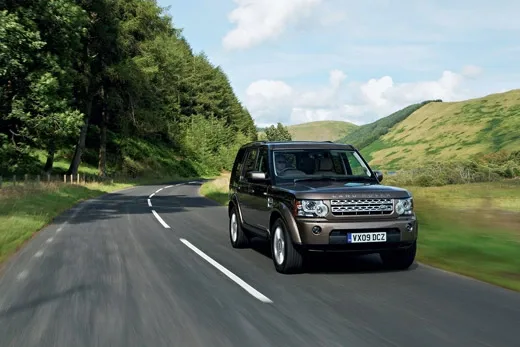
Now about what deserves criticism. Trying to defeat the laws of physics, British engineers fiercely worked their magic on the suspension. They reduced the distance between the roll center of the suspension and the center of gravity of the vehicle (by 42 mm in the front and 62 mm in the rear). They installed a new anti-roll bar, new shock absorbers, and bushings. However, in fast, sharp corners on narrow Scottish roads, the Discovery 4 still leans, reminding: "Buddy, we're not here for this. If you want to race, buy a Range Rover Sport."
Certainly, for an SUV, the leans are not excessive, but now I'm eager to arrange a head-to-head between the Disco 4 and some competitors. I suspect that in corners, one "German" might well beat it.
However, what's more interesting is something else: can anyone compete with the new Discovery off-road.
HIGHER THAN WAIST-DEEP
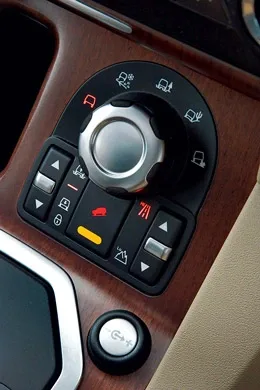
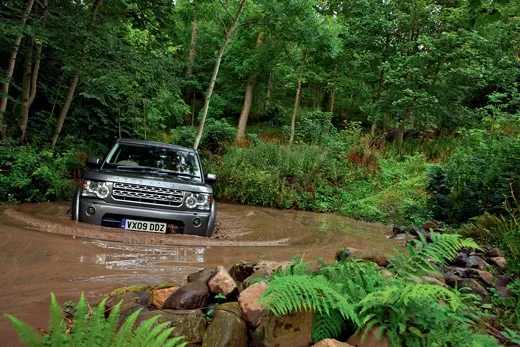
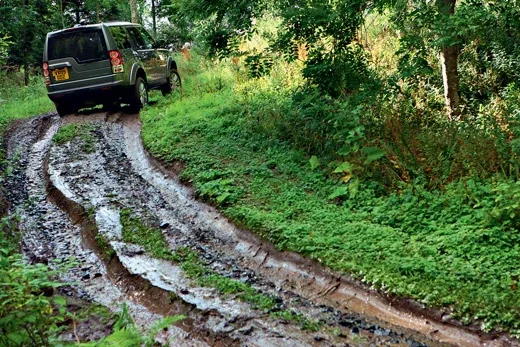
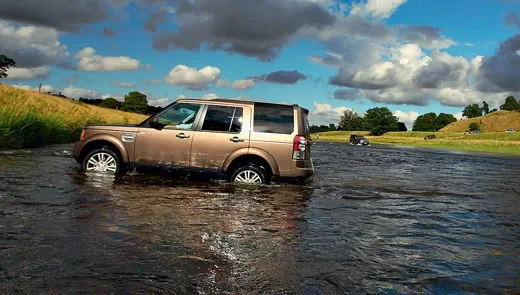
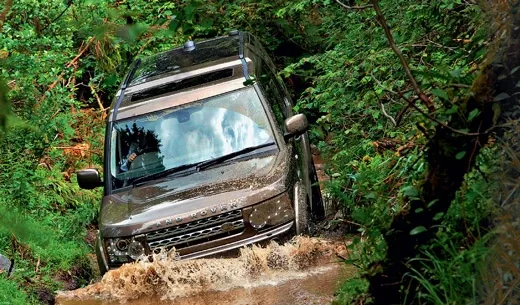
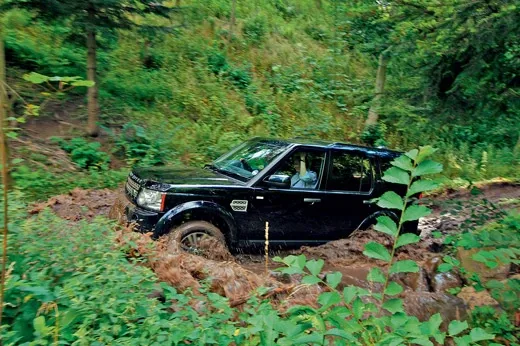
Traditionally for Land Rover, the off-road part of the test was impressive. Notably, the photos don't reflect the scale of the off-roading, and you'll have to take my word for it. Directly during the test, the water in the rivers rose, and the fords were almost up to the hood edge, and many of my not-so-experienced colleagues easily allowed waves to wash over the hood. And nothing, no problems. According to the specs, the wading depth is unprecedentedly large — 700 mm at the maximum air suspension lift level. However, what impressed me most was a deep, already well-worn clay rut with a turn on an incline. I expected at least a slight hesitation from the car, but it went through that spot as if nothing had happened. Moreover, it was shod with highway, asphalt tires. Honestly, after that, the descent down a slippery slope and crawling over a lopsided log bridge with diagonal wheel hanging no longer impressed. Here, though, I must admit that all these tricks could have been done just as successfully by the previous model. Both the independent suspension with air elements and the low-range gear with a 2.93:1 ratio were there before. As well as the off-road electronic system Terrain Response and the Hill Descent Control system. However, the latter two were improved. Let me remind you that Terrain Response, unlike analogues, can operate in different modes — the driver selects them depending on conditions. The degree of allowable wheel slip, accelerator pedal travel, engine control, suspension level — all that is its domain. So, in the current generation, they added another position — "Sand." And the "Rocks/Low Speed" program was improved to minimize the likelihood of rolls when driving over large boulders. Alas, we didn't have sand during our presentation — the Scots have a deficit of that, and I won't lie, I didn't have sufficient opportunity to feel noticeable improvements in the rocks program. But I clearly observed more effective operation of the Hill Descent Control. This system now itself monitors the smoothness of releasing the brake. Because before, how was it? The driver could release the pedal too abruptly before a descent, and before the electronics began to brake the wheels, the car managed to accelerate a bit. Now the computer itself ensures that the downward movement starts smoothly.
TACTILE MEMORY
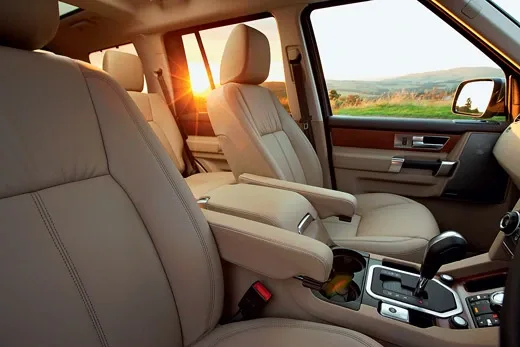
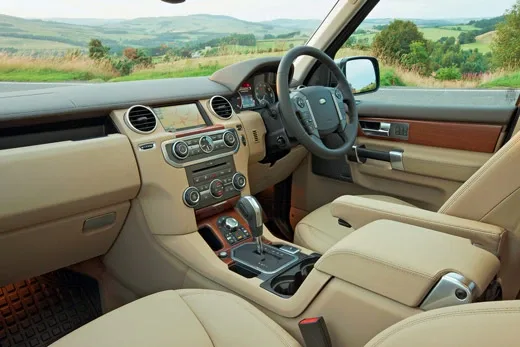
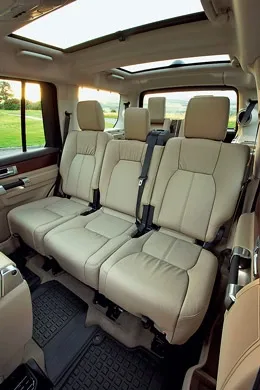
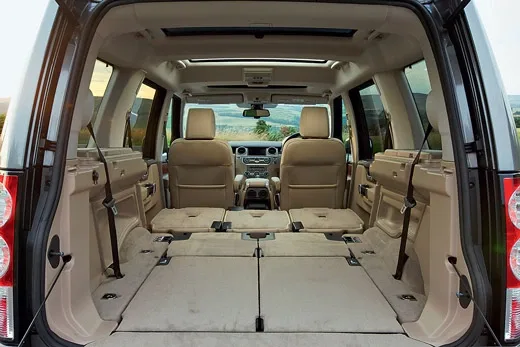
Externally, the fourth Discovery can easily be mistaken for its predecessor, but inside it is a completely different car. The changes affected almost everything: from the seats and dashboard to the center console and trim materials. Jerry McGovern, Land Rover's design director, admitted that this time the team focused on the quality of stitching and surface textures to elevate tactile sensations to a new level. It sounds like big words, but he is absolutely right. The plastic and leather here are of excellent quality. And the nubuck that wraps the steering wheel, I still remember by touch. Moreover, when I'm having a hard time, I recall that such steering wheels exist in nature, and it warms my soul. The interior is truly luxurious, the seating position is high and comfortable, and rear passengers have plenty of room — what more could you want from a cabin? Maybe cargo-carrying convenience? The second row folds flat, in a 35/30/35 split. Need more capacity? For an extra $2,802 (22,410 UAH), the 7 SEAT package is available: two additional seats hide in the trunk floor, and the package also includes air conditioning for the rear rows. However, I honestly don't understand why a luxury car needs seven seats when there's absolutely nowhere to put your belongings. Traveling with a big group on a trip with just hand luggage? Meeting partners at the airport and hiring taxis for their luggage? But since the option remains on the list, apparently someone needs it.