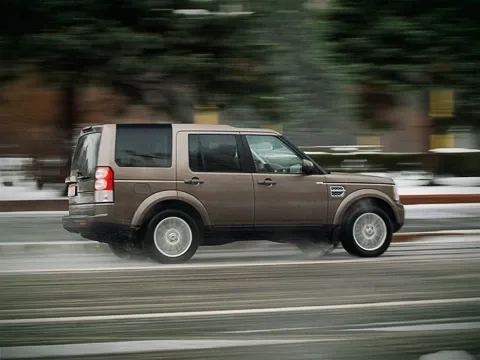
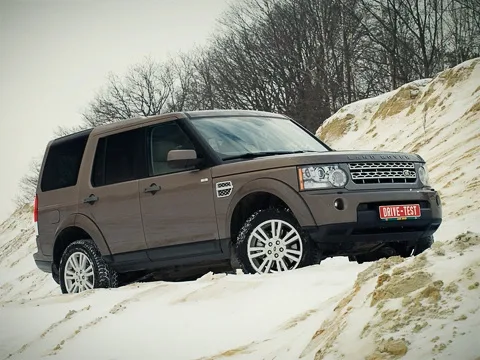
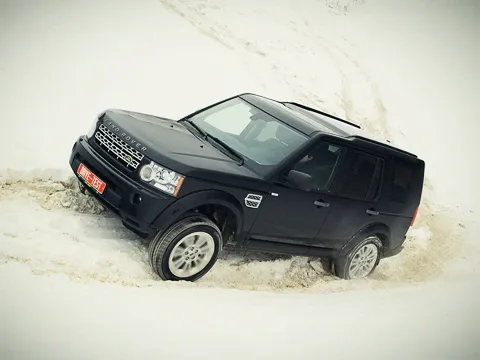
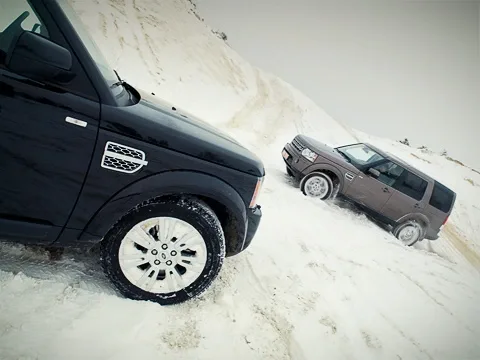
To master all the tricks of British marketing, we decided to test two updated Discovery SUVs at once: one with a five-liter gasoline V8, the second with a three-liter bi-turbo diesel (both engines are also listed as new). We did this to understand how different the sides of one character can be, and as a result, we discovered that we have two completely different cars before us.
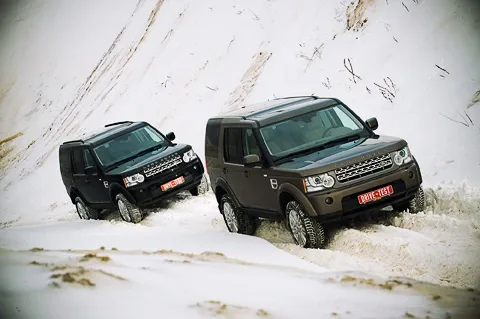
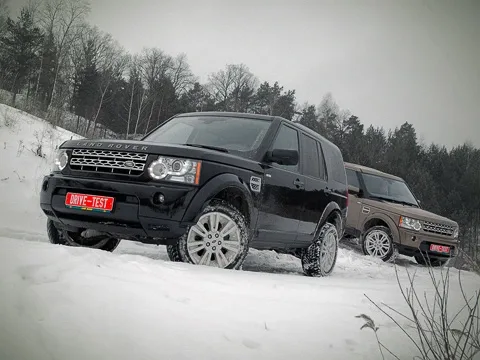
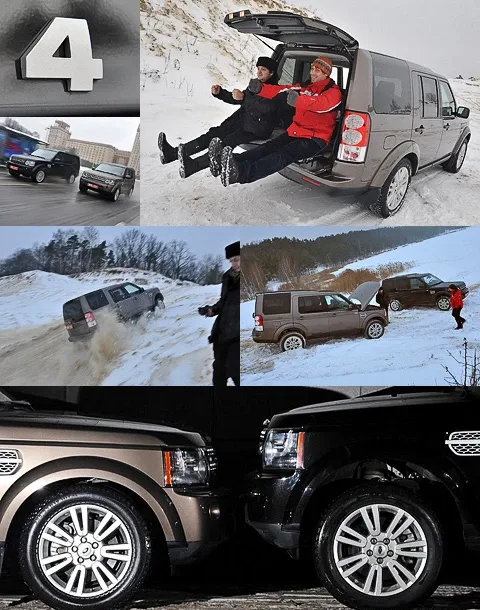
The black Discovery has a gasoline V8 5.0 (375 hp). The beige one is a turbo diesel V6 with 245 hp. Both cars are equipped with a six-speed automatic transmission. Drive is permanent all-wheel drive, with a low range, locking center and rear differentials. Suspension is independent on all wheels.
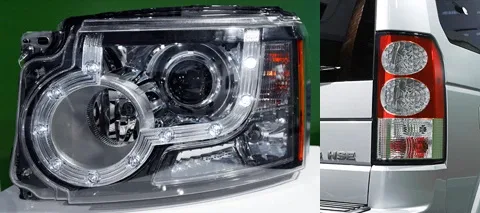
Pushkin's lines come to mind: "Oh, it's not hard to deceive me!.. I myself am glad to be deceived!" At the dealer lot, we seriously confused the facelifted Discovery with the Range. It was dark outside, the car was facing us, and the warm light of the headlights, refracting in the icy drizzle, added an aura of expensive "premiumness" to it. The LED "matryoshka" in the headlights, the cellular structure of the false radiator grille — the British hardly had to strain to give the Disco a new look. All updated elements are removable and completely plastic. Designers get a pass. A beautiful trap. Only now it will be harder for sellers to explain the difference between the Disco and its platform relative, the Range Rover Sport.
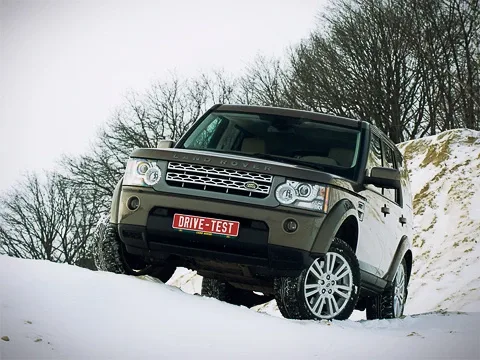
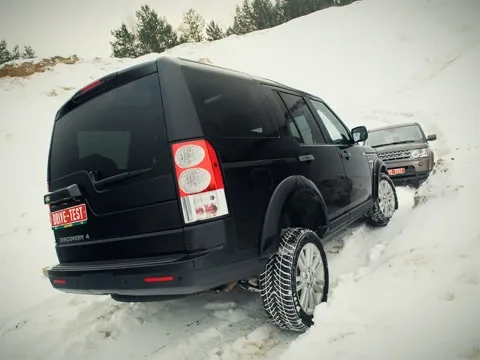
The front of the Discovery has lost its former angularity. The rearview mirrors are now painted in body color, and the front bumper is without decorative painted "fangs." The SUV has become six millimeters shorter. The approach and departure angles have not changed — 37.2 and 28.1 degrees, respectively.
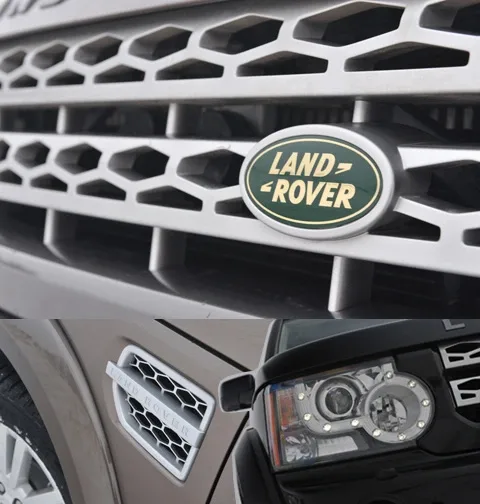
The headlights now have an element that illuminates the road in corners. Ten LEDs work as parking lights. But they don't shine too brightly.
Of the stamped body parts, only the left front fender was replaced. It now also has a decorative air intake (on rich versions of the Disco 3, such a grille was only on the right). But the rear lights are perhaps the only stylistic decision about which we never came to a consensus. Most think the white circles look empty after the facelift. Although the element is not new: similar LED lights were previously offered as an option.
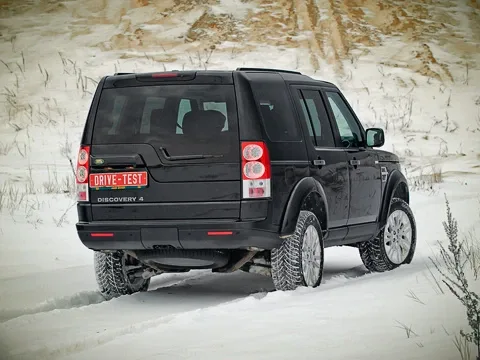
The broken line of the rear door glazing is a forced solution to make a cutout in the lower panel and simplify access to the trunk. A side benefit is better visibility.
The interior is a solid four. Exactly like the generation number. And this is despite the fact that the previous interior barely deserved a three. Only the upper part of the front panel remains from the old one. Everything below pleases the eye. No more clutter of buttons and screens. Everything is logical and orderly. Cheap plastic is also a thing of the past: the center console looks elegant. In a light color scheme, the interior seems airy, and in black — solid.
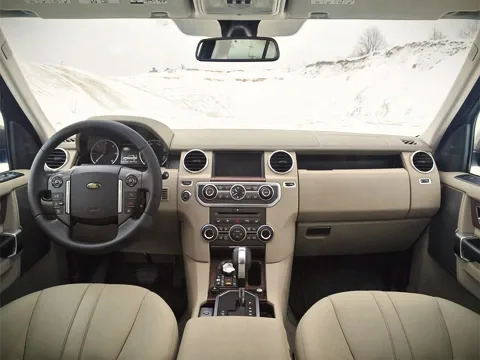
The atmosphere has become stricter and more luxurious. There is less smooth plastic, and wood looks appropriate. The rounded center console is divided into three functional zones: at the top — multimedia, in the middle — a new climate control unit, at the bottom — the Terrain Response system controller.
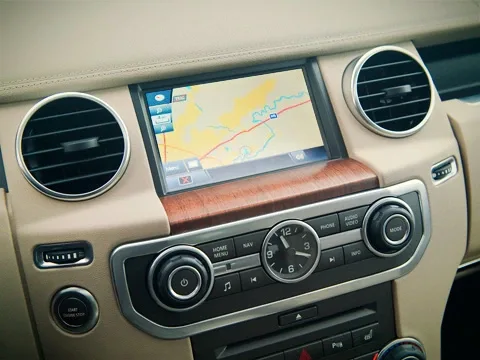
The navigation is quite decent — it correctly shows nearby country roads, cafes, restaurants, and doesn't even shy away from kebab shops. But it is foreign and has quirks. For example, it suggests turning around on Novoryazanka right through the barrier, or suddenly switches to yards.
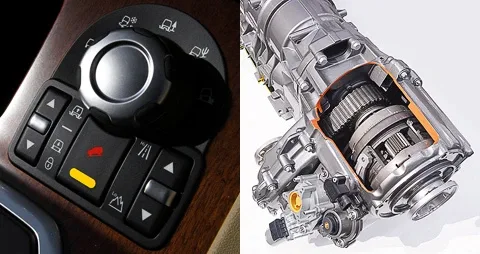
The controller of the automated all-wheel drive system Terrain Response has moved down to the base of the center console: now you don't need to twist your wrist to turn the ergonomic washer or click the air suspension and low range keys. Exactly keys: the old plastic "flags" are gone. It's strange to see such a placement of the off-road control unit in light of the British complaints about Disco customers who are increasingly less likely to leave the asphalt. The unit was placed in the most visible place — are they provoking, or what?

The updated Discovery has the same five off-road programs: "Standard," "Gravel — Snow," "Mud — Ruts," "Sand," and "Rocks." The low range and hill descent control can be activated in any mode. But in "Standard," the central and rear differential locks are unavailable.

The operation of the transmission and chassis is displayed on a color screen. The graphics have become more vivid.
We are not averse to giving in to temptation, but the Disco hasn't shown us everything yet. Literally. Now it's a whole TV studio on wheels! Five external surveillance cameras: two front ones near the license plate and a rear one help the parking sensors. Two side ones, hidden in the mirror housings, make maneuvering in tight spaces easier. This, by the way, is a useful tool off-road too. True, the picture quality strongly depends on the cleanliness of the lenses. Isn't it time to get dirty?
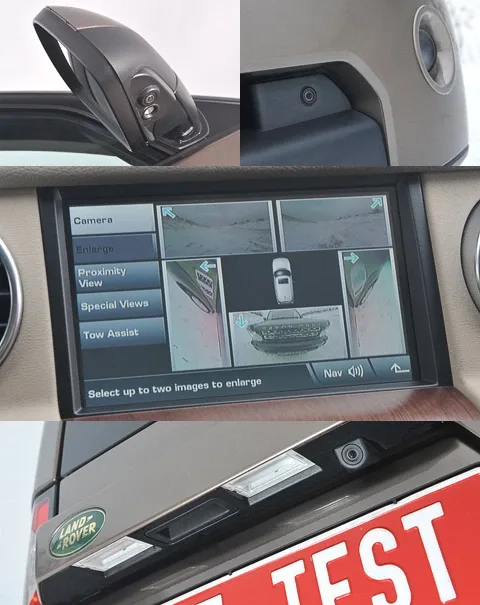
On the "director's console" of the Surround Camera system, you can display the image from any of the five cameras — separately or all at once. The driver can scale the image as they like. A great thing! And most importantly — useful for the owner of an expensive SUV.
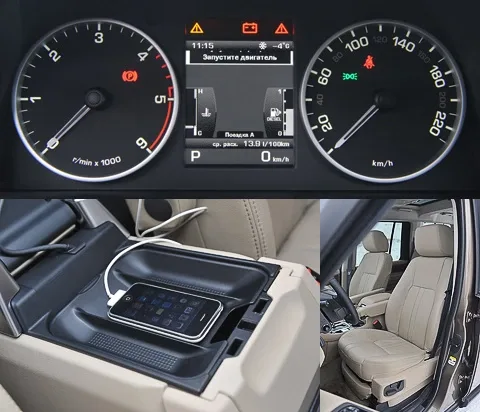
- The monochrome display looks poor against such a background, and the columns of secondary instruments are small. But it is the only one that is Russified. And on the large touchscreen, the information is still in Latin.
- The front seat backs still hold you in corners somehow, but the cushion holds the hips mainly due to the softness of the filler. Also, it is a bit short.
- The plastic tray of the armrest is carefully shaped for a mobile phone, next to it are connectors for external devices. Below is a mini-fridge with a separate button for cold air supply.
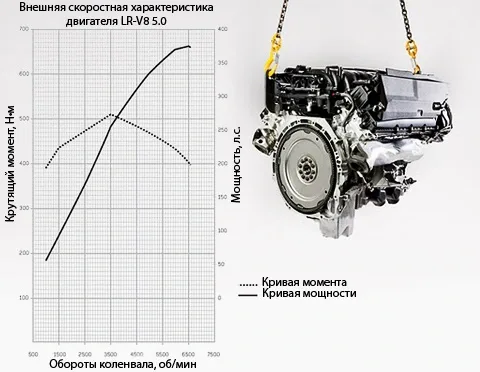
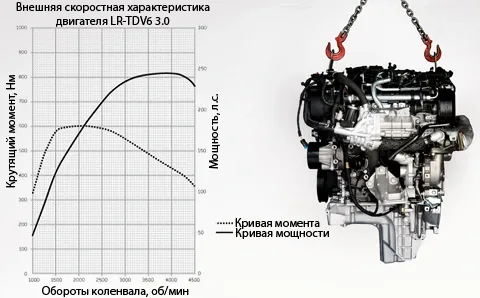
Diesel or gasoline? Choosing is oh so difficult! In the depths of the aluminum "eight" hide 510 newton-meters and 375 horsepower. What could be more convincing than five liters of displacement? Don't rush: the three-liter turbo diesel produces as much as 600 N•m already at 2000 rpm. Such a charge also promises a lot of drive. In addition, an SUV on heavy fuel no longer seems utilitarian.
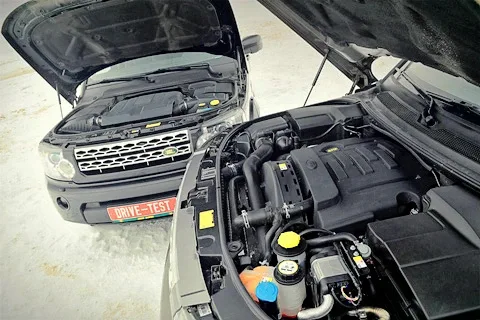
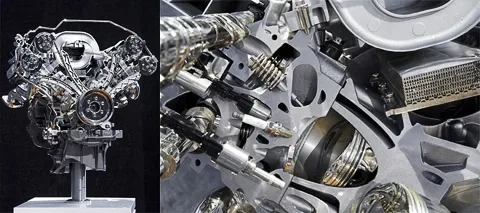
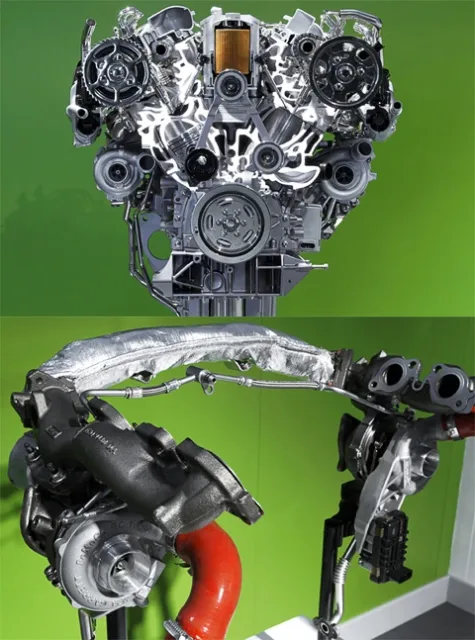
The bi-turbo diesel with parallel-sequential turbocharging (in the foreground) is a joint development of Ford and PSA Peugeot Citroen. It is based on the TDV6 2.7 unit. Despite the additional 300 "cubes," the new engine is ten percent more economical and cleaner than its predecessor. The gasoline engine is an off-road version of the Jaguar engine that is installed on the XF sedans and XK coupes.
At idle, it is completely impossible to determine which Disco this is. In terms of noise and vibration insulation, both versions are on par. But if the soft rustle of the gasoline "eight" is taken for granted, then the even, without harsh notes, whisper of the diesel presses on the ears out of habit. You want to add gas to bring back the feeling of reality into the cabin upholstered with sound-absorbing mats.
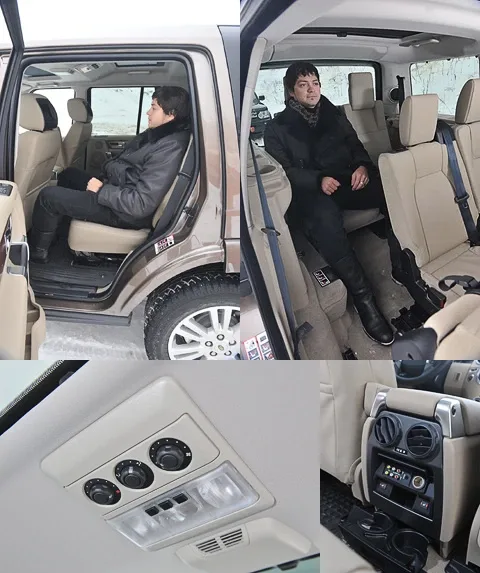
- The Discovery has a lot of space. In the middle row, passengers sit with a decent margin to the backs of the front seats. At their service are line-in inputs for connecting gadgets, cup holders, two-mode seat heating, and a personal microclimate unit, which, unfortunately, is not illuminated in the dark.
- Getting into the third row is uncomfortable and somewhat comical, but two adults of average build can easily fit in the "gallery," even if a long road is ahead.

The Discovery's trunk is well organized. The third-row seats fold flush with the floor, and even the bracket with a soft curtain has several mounting options (for five- and seven-seat cabins). But the seat folding mechanism itself is thought out with a three. To fold down the "gallery" seats, you'll have to work with both hands in an awkward position.
The diesel engine doesn't become more truthful in motion than it is at a standstill. Under load, the Disco's motor can no longer hide its rapid heartbeat. The tense knocking of the high-pressure fuel pump penetrates the cabin. But the thrust is of a completely petrol-like character. Instead of dumping all the torque somewhere in the middle of the range and asking the driver to shift, the new engine pulls almost all the way to the rev limiter.
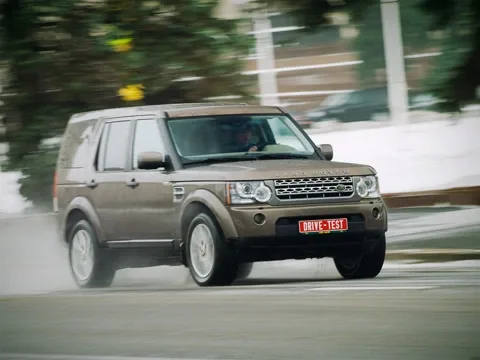
The new-generation bi-turbo diesel surpasses the TDV6 engine in every respect. Power increased by fifty-seven horsepower. Torque increased by one hundred and sixty newton-meters. Peak torque now occurs at 2000 rpm, whereas the previous engine had it at 1900 rpm.
This is a spring, not a car. And its tension can be controlled at any phase of acceleration. Ease off the pressure slightly — the coil begins to compress, accumulating kinetic energy. Press harder — it fires, throwing the car forward. Even with the accelerator pedal fully depressed, the driver's right foot feels the growing resistance in the seemingly unrestrained engine response. What more could one wish for?
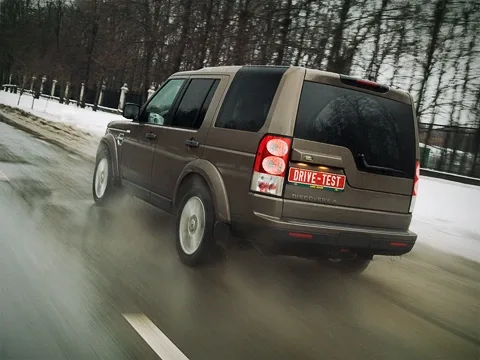
The petrol Disco 4 gained only 12 kg over its predecessor's mass, while the diesel became heavier by as much as 79 kg. But it also became more spirited. Acceleration to 100 km/h now takes 9.6 seconds — 3.1 seconds faster than the previous version with the automatic.
And yet, we weren't waiting a whole week for the petrol Discovery to become available for nothing. Even if its accelerator isn't as responsive, this engine truly begs to be revved to the redline. At high rpm, the intake camshafts present the valves with "power" lobes — and the engine begins to sing. The ballad turns into progressive rock, and the higher the tachometer needle climbs, the more emotion there is in the engine's voice. By five thousand, the V8 is almost shouting, stretching a high note to the limit of seven thousand. At such moments, you thank both the steering with its unobtrusive feedback and the upgraded chassis for now playing in the same rock band with the engine on asphalt. The Discovery's road manners have become more confident.
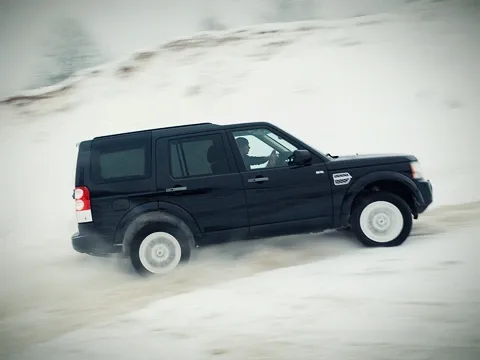
The petrol Discovery is faster than the diesel. In the sprint to 100 km/h, it beats its heavy-fuel sibling by more than one and a half seconds — 7.9 seconds. But managing acceleration here isn't as convenient. The accelerator pedal is overly damped. The lack of pedal feedback is especially acute off-road, where precise throttle modulation is crucial. After lifting off the gas, the car continues to accelerate for a fraction of a second. During that time, the wheels manage an extra revolution and dig in.
The suspension features new shock absorbers, steering knuckles, and stiffer anti-roll bars. Body roll is lower, and comfort has increased. Interestingly, the front brake discs with two-piston calipers have become smaller.
The petrol hangover sets in quickly: the eight-cylinder Discovery will drink 23 liters per 100 km without even flinching. Whoosh — and a full tank of AI-95 flies out the exhaust pipe to a beautiful accompaniment. The diesel Disco, in this regard, is an anti-crisis gift. The tune is simpler, the dynamics more modest, but by and large, it's more than enough. And the main thing is that the fee for the music is only 14 liters per 100 kilometers in similar driving conditions.
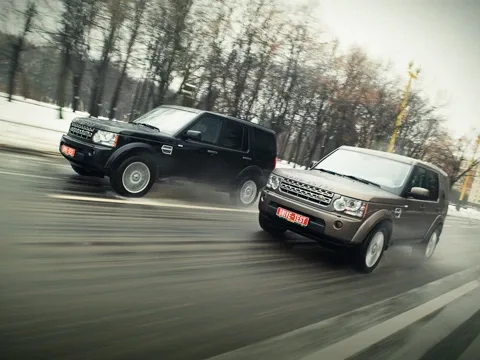
Brothers, but not twins. The petrol Disco is devilishly fast but demands heightened self-control from the driver. The diesel feels livelier, more understandable, and doesn't evoke the sense of disconnect that our second hero is guilty of. The secret of the chemistry could easily be some trifle like a widened by one hundredth of a millimeter orifice in the shock absorber valve. It's just that the petrol car's suspension was slightly "loosened up." But the engineers who selected the diameter of that little hole noticeably diverged the characters of the two variants.
The choice of engine will determine not only the level of running costs for the Disco. The car's "heart" completely changes its character. The petrol one, for all its temperament, feels heavier. And smoother, and more comfortable. And detached. Satiated and rich. Here, not only the throttle response is softer, but also the reaction to steering input. The exhaust note tuning was approached more carefully, as was, in our impression, the cabin sound insulation. And the ride smoothness is slightly better, and the body roll is a bit more. The Disco with the V8 is more suited to long-distance straight-line driving.
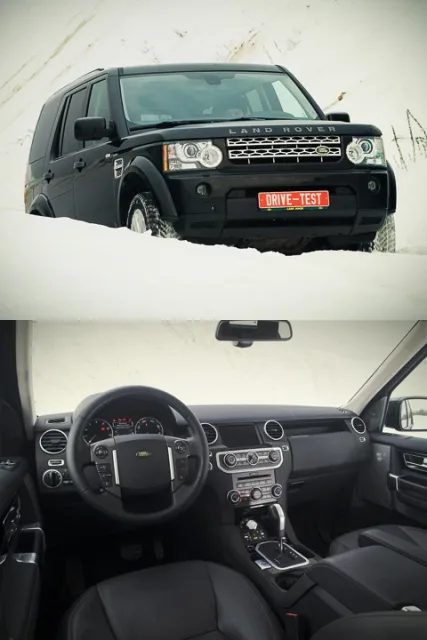
In dark tones, the Discovery appears larger than it actually is. And the gloomy interior has gained weight. Most likely, it's the dark trim that will be in greatest demand — it looks solid.
And the Discovery with the diesel engine consists of nuances. It's a bit noisier here. The mood set by the light interior is supported by both the accelerator and the suspension. In such a car, there are more transitional modes between the "on" and "off" positions. It feels lighter both visually and on the move. The better feedback from all controls gives a sense of a balanced vehicle. Perhaps that's why we preferred the slightly less comfortable and dynamic Disco TDV6.
The automatic here, admittedly, thinks longer, but its slight drowsiness is compensated by the utmost smoothness of shifts. The ZF transmission was slightly strengthened during the car's modernization to handle the increased engine power. It now has a different control program with earlier torque converter lockup. The brakes also underwent revision, but they failed to eliminate the slight free play in the pedal.
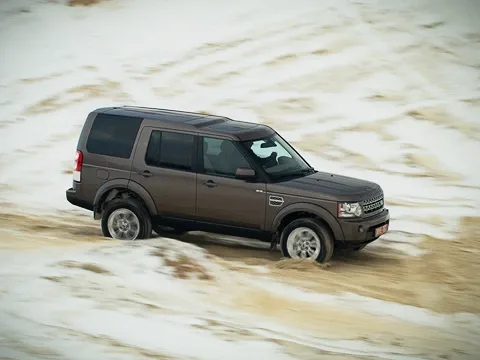
The hill descent control can be activated either manually by pressing the button on the Terrain Response "remote control," or in conjunction with one of the off-road modes. On sand, the electronics stretch out the wheel lock phases, allowing them to pile up soil ahead.
The Discovery's brakes are perhaps the only ones in this car that operate in the real world. Because the steering turns easily, there's almost no body roll in corners for a vehicle with such a high center of mass, and the excellent sound insulation combined with the smooth automatic dulls the sense of self-preservation. It seems this car can handle anything. Only the somewhat stiff left pedal brings you back to reality, dispelling the virtual mindset and reminding you that the Discovery is a fairly large SUV weighing two and a half tons. It's not that the brakes are a weak point of the "fourth" Disco — they just seem like an analog mechanism in the depths of a digital car.
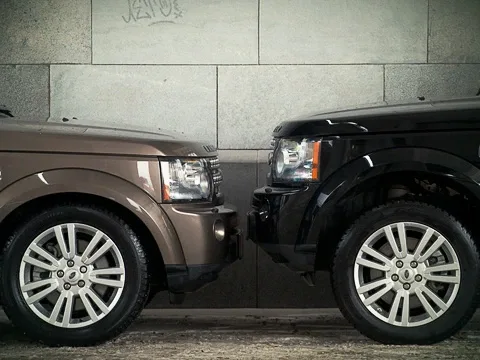
Coil spring suspension is still only fitted to cars with the old 2.7 turbodiesel; the rest have air springs. They lower the body for passenger entry and exit and allow the Disco to stand on tiptoes when tackling off-road terrain. The difference between the extreme body positions is 105 mm.
You won't get such honest information from the suspension. On battered roads, the Discovery glides as if on an air cushion. This, by the way, isn't far from the truth. All four wheels are suspended on electronically controlled air springs. The suspension "swallows" small and medium irregularities, sending only distant signals about the road profile into the cabin. Only hitting a large pothole with a wheel is accompanied by a hard impact. The habit of driving around ordinary potholes behind the wheel of a Discovery quickly fades away.
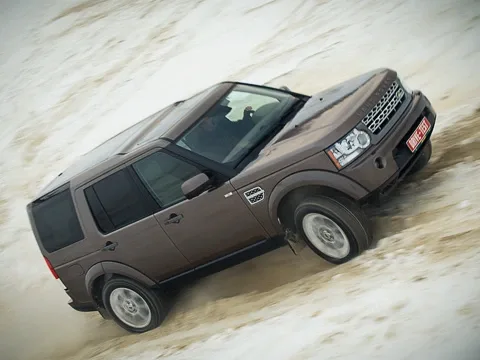
Irregularities are successfully smoothed out by the air suspension provided the body is in the intermediate (road) position. With the suspension raised, the car rides noticeably stiffer.
The Disco relaxes the driver. The car is casually guided with two fingers. Periodically, you scold yourself for carelessness and set the huge dial of the Land Rover steering wheel to ten to two or quarter to three. But after half a minute, the left elbow again drops onto the wide windowsill, and the right hand onto the automatic selector. It's impossible to concentrate. Time to stretch out with some off-roading.
When heading off-road, the Discovery driver is one hundred percent confident in their vehicle's superiority. There's no road that the Terrain Response system can't handle. At hand are five off-road modes, five surround-view cameras, 310 mm of ground clearance (in the highest body position), and two differential locks for emergencies. I'm happy to be deceived myself!
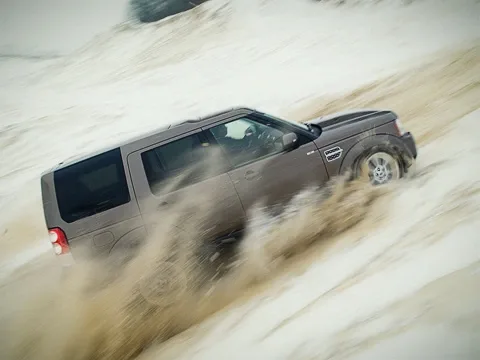
What to choose here: "Snow" or "Sand"? Or maybe switch the "dial" to "Rut" mode and engage low range? Finding the right approach to the advanced all-wheel-drive transmission of the Discovery 4 has to be done by trial and error.
In fact, all this electronic arsenal only gets in the way when the road ends. And what to do if under the wheels there is something in between, not fitting any of the preset scenarios? Say, snow mixed with sand, or a deep rut leading into a long uphill climb. We spent a lot of time trying to find the right algorithm for the smart internals to conquer not the most difficult off-road. No one argues: the Discovery has huge potential, such off-roaders are hard to find! But the system, where everything seems to be laid out on shelves, makes you seriously rack your brains.
Funny enough, in loose snow, the dedicated "Snow" mode performed the worst. The car responds to the throttle with some laziness. The wheels quickly clog up, traction is lost, and that very wheelspin that helps the tread clean itself only occurs with very intense pedal work. You literally have to squeeze everything out of it. In the end, the simplest solution turned out to be switching to "Sand" mode — it is the most responsive and lively, so it suits almost any surface.
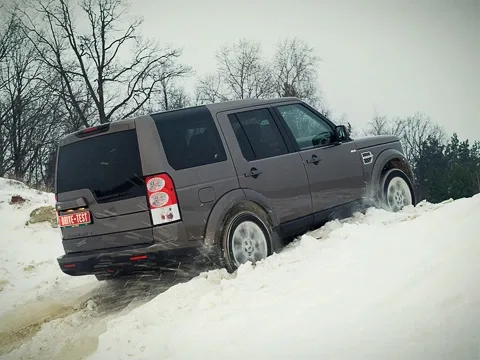
Many off-road assistants will be appreciated by those who get out into nature from time to time. The electronics themselves engage the locks and even know how to simulate rocking, slowly but surely pulling the Disco out of the sand. But experienced off-roaders are unlikely to like it here — you can't fully switch to manual control.
If you don't want to delve into the intricacies of off-roading, you can simply floor the pedal. Of course, if the terrain doesn't promise a rollover. Under traction, the Disco, like Baron Munchausen, pulls itself out by its own hair. It will click the locks, squeak the brakes, and even roll back to surge forward again — while the driver just watches the mechatronics work on the color screen. This reminds me of an old joke: a doctor prescribes a laxative to a patient with insomnia. "And will I be able to sleep?" — the patient doubts. "You won't sleep, but you'll have something to do."
And again, as on asphalt, for off-road adventures we would choose the diesel — it is more understandable and logical. The petrol one here seems out of its element. Although the V8 has plenty of power. However, we won't give a definitive recommendation on which Discovery to take. It's simply impossible to single out one version. Each has its own character that radically changes the perception of both the car itself and everything around it. The diesel Disco easily handles the daily grind; it feels closer to the Volkswagen Touareg — just as democratic, predictable, and easy to communicate with. The V8 version, on the other hand, presses down any road negativity with authority — this Disco already reaches for the Range. In character, but not in price: the petrol Range Rover is almost a million rubles more expensive.
Both versions of the "Briton" are good in their own way. So the advice is one: before buying, be sure to test-drive exactly the modification you like. In no case choose the diesel after riding the petrol, and vice versa! Better yet, try both. Reason will most likely choose the diesel: excellent fuel economy with quite decent dynamics. And the Discovery TDV6 costs noticeably less — from 2.3 million rubles, which is 306 thousand cheaper than the petrol "brother." But the heart, we are sure, will not resist the song of the V-shaped "eight" at high revs. And the solidity of the top version. The main thing, no matter how you look at it, is that the updated Land Rover has become better than its predecessor. It's just that the four in the index seems premature to us.
Technical specifications
| Model | Land Rover Discovery TDV6 | Land Rover Discovery V8 |
| Body |
| Body type | five-door wagon | five-door wagon |
| Number of doors/seats | 5/7 | 5/7 |
| Length, mm | 4829 | 4829 |
| Width, mm | 2022 | 2022 |
| Height, mm | 1887 | 1887 |
| Wheelbase, mm | 2885 | 2885 |
| Front/rear track, mm | 1605/1613 | 1605/1613 |
| Curb weight, kg | 2583 | 2548 |
| Gross weight, kg | 3240 | 3240 |
| Trunk volume, l | 1260 (2558) | 1260 (2558) |
| Engine |
| Type | turbodiesel | petrol, with direct fuel injection |
| Location | front, longitudinal | front, longitudinal |
| Number and arrangement of cylinders | 6, V-shaped | 8, V-shaped |
| Number of valves | 24 | 32 |
| Displacement, cm3 | 2993 | 4999 |
| Max power, hp/rpm | 245/4000 | 375/6500 |
| Max torque, N•m/rpm | 600/2000 | 510/3500 |
| Transmission |
| Gearbox | automatic, six-speed | automatic, six-speed |
| Drive | permanent all-wheel | permanent all-wheel |
| Chassis |
| Front suspension | independent, air, on double wishbones with stabilizer | independent, air, on double wishbones with stabilizer |
| Rear suspension | independent, air, on double wishbones with stabilizer | independent, air, on double wishbones with stabilizer |
| Front brakes | disc, ventilated | disc, ventilated |
| Rear brakes | disc, ventilated | disc, ventilated |
| Max ground clearance, mm | 310 | 310 |
| Performance characteristics |
| Maximum speed, km/h | 180 | 195 |
| Acceleration time 0-100 km/h, s | 9.6 | 7.9 |
| Fuel consumption, l/100 km |
| — urban cycle | 11.2 | 20.3 |
| — suburban cycle | 8.3 | n/a |
| — combined cycle | 9.3 | 13.9 |
| Toxicity standard | Euro-5 | Euro-5 |
| Fuel tank capacity, l | 82.3 | 86.3 |
| Fuel | diesel | AI-95 |
n/a — no data
Trim levels
| Base trim | Land Rover Discovery HSE TDV6 3.0 | Land Rover Discovery HSE V8 5.0 |
| Dynamic stability control | + | + |
| Electromechanical parking brake | + | + |
| Front and side airbags, as well as curtain airbags for driver and front passenger | + | + |
| Curtain airbags for second-row passengers | + | + |
| Front and rear parking sensors | + | + |
| Dual-zone climate control | + | + |
| Cruise control | + | + |
| Heated leather steering wheel | + | + |
| Interior trim with leather, aluminum, and wood | + | + |
| Touchscreen LCD display | + | + |
| Harman Kardon audio system with ten speakers | + | + |
| Bi-xenon headlights | + | + |
| Pre-heater | + | - |
| Integrated hands-free system | + | + |
| Keyless entry function | + | + |
| 19-inch alloy wheels | + | + |
| Full-size spare wheel | + | + |
| Air suspension | + | + |
| Fog lights | + | + |
| Light sensor | + | + |
| Rain sensor | + | + |
| Adaptive headlights | + | + |
| Heated windshield and washer nozzles | + | + |
| Heated front seats | + | + |
| Additional equipment |
| Metallic paint | 8000 | 8000 |
| Exterior enhancement package: body-colored bumpers and wheel arch trim | 12 000 | 12 000 |
| Panoramic roof with electric sunroof | 45 000 | 45 000 |
| Security system with interior motion sensor | 6000 | 6000 |
| Cooled box between front seats | 13 000 | 13 000 |
| Multimedia package: navigation system with hard drive, TV tuner, surround-view camera system | 155 000 | 155 000 |
| Roof rails | - | 10000 |
| Rear-seat entertainment multimedia system: LCD screens in front headrests, headphone set, remote control | 94 000 | 94000 |
| Rear-view camera | 13000 | 13000 |
| Wheel lock bolts | 1000 | 1000 |
| HSE trim price | 2 482 000 | 2 613 000 |
| Price of tested vehicle | 2 829 000 | 2 970 000 |
Technology
Both engines offered in the new Discovery first appeared under the hoods of Jaguar models. The five-liter V8 gasoline engine produces 375 horsepower and 510 newton-meters of torque. Thanks to the special design of the oil pan, the engine easily handles tilts: lateral up to 35 degrees and longitudinal up to 45, without risking oil starvation.
This unit features direct fuel injection at a pressure of 150 atmospheres, plus variable valve timing on all four camshafts. On the intake side, the electronics select one of two cam profiles depending on load: one optimized for maximum power or one for efficiency. The intake manifold is also sophisticated, with variable-length runners. Thanks to all this, the new engine is more environmentally friendly than its predecessor, even though the latter was less powerful.
The three-liter bi-turbo diesel (245 hp, 600 N•m) also received a deeper oil pan than the Jaguar version, ensuring reliable lubrication even in serious off-road conditions.
The diesel's main highlight is its turbocharging scheme, where the turbos operate in parallel-sequential mode. Up to 2700 rpm, a small Garrett M12 compressor feeds air to the cylinders, after which a more powerful Garrett M24 takes over. During hard acceleration at high revs, both compressors work together. This setup provides instant throttle response, moderate fuel consumption, and excellent torque across a wide range. Maximum boost pressure is 2 atmospheres.
- The all-wheel-drive transmission is managed by the Terrain Response controller — essentially its brain, while the transfer case serves as the heart of the system. Torque is transmitted to the front wheels via a Morse chain. The planetary reduction gear is electrically actuated.
- The system's algorithms have been refined. In "Sand" mode, only slight wheelspin is now allowed to prevent the vehicle from digging itself in. In "Rock Crawl" mode, the Discovery can autonomously manage throttle and brakes at speeds up to 5 km/h. Additionally, before descending a hill, the brakes gently hold the vehicle, eliminating the unpleasant nose-dive at the start of the descent.
The intelligent light system automatically turns the high beams on and off based on the road situation. And if the driver brakes hard, the brake lights flash to warn those behind.
History
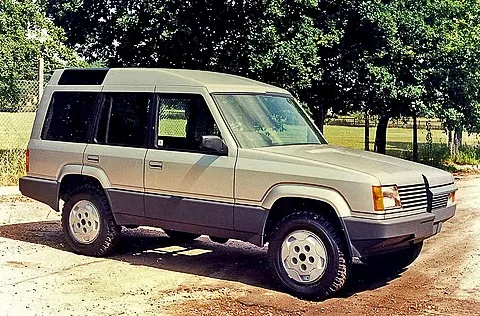
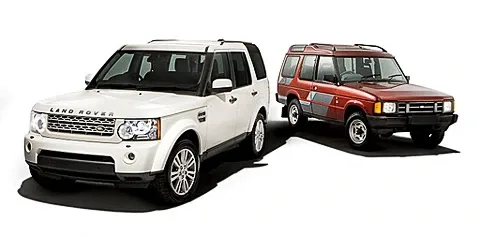
In the mid-1980s, Land Rover, then part of British Leyland, had only two families in its lineup. On one hand, utilitarian off-roaders, direct descendants of the very first 1948 model, sturdy but Spartan. On the other, the luxurious and powerful Range Rover, a true "Rolls-Royce of off-road," but very expensive. To bridge the gap between them, Solihull took on the project of a seven-seat vehicle under the code name Project Jay. Work was approved in August 1987. The photo shows a full-size mock-up with two front-end design options.
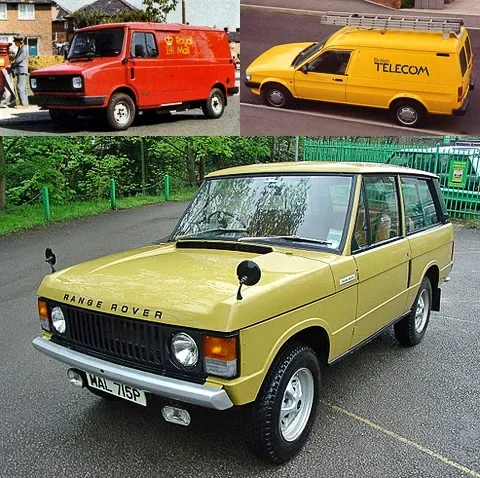
To save time and money, many components were taken from other British Leyland vehicles. The powertrain, frame, transmission, windshield, bulkhead, and doors were borrowed from the Range Rover (bottom in photo). The front square headlights came from the Freight Rover van (top left), and the rear lights from the small Austin Maestro van.
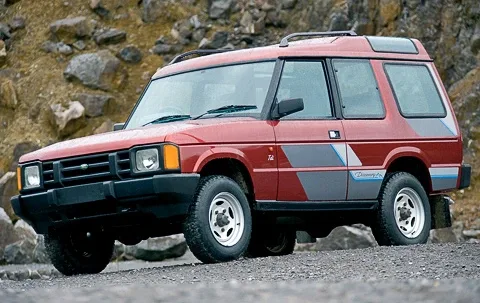
The production vehicle under the name Discovery was shown in Frankfurt in September 1989. By then, the company had already changed owners: in 1988, Rover Group was bought by British Aerospace. The body with aluminum panels on a steel frame had a characteristic step in the roof, providing extra headroom for rear passengers seated higher. Initially, only three-door versions were produced, as Solihull feared competition with the Range Rover. The five-door appeared only a year later.
The "farmer in a tailcoat," as the Discovery was dubbed, was warmly received despite some technical criticisms. The SUV's participation in the Camel Trophy was excellent advertising. Shortcomings were gradually addressed: the finicky Stromberg carburetors gave way to fuel injection within a year. Additionally, as an alternative to the thirsty gasoline V8, a 2.5-liter turbodiesel was introduced.
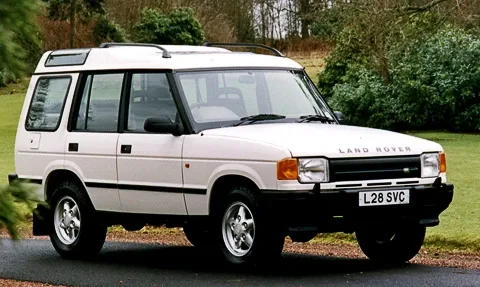
In 1994, the vehicle was updated: headlights became larger, the grille was redesigned, and the interior was reworked. ABS and anti-roll bars were added. The gasoline engine grew to 3.9 liters, a new 2.5 turbodiesel appeared, and the LT77 gearbox was replaced with the more reliable R380. Over nine years, 392,443 units of the first generation were produced. For a few months, the vehicle was even sold as the Honda Crossroad — this happened before Rover Group's transition to BMW, when the British were collaborating with the Japanese.
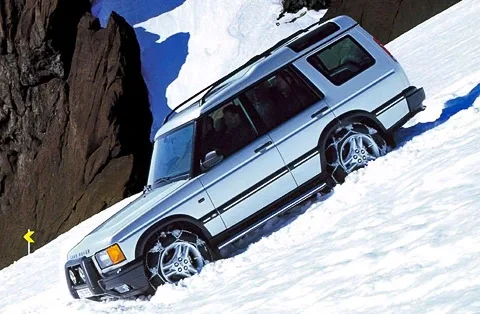
The second generation of the Discovery was presented in 1998. The wheelbase remained the same at 100 inches (2540 mm), but the body became longer and wider. The vehicles featured a hill descent control system, and the suspension learned to combat body roll. Rear air springs helped maintain ground clearance. A total of 278,570 Discovery 2 vehicles were made.
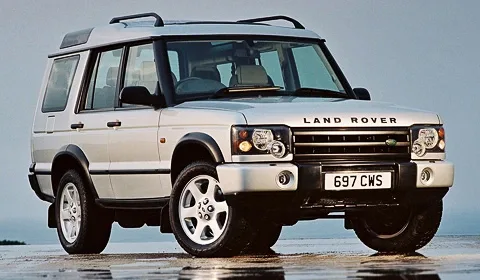
The Disco was last updated in 2003 — such versions are unmistakably recognized by the front lights borrowed from the Range Rover. A familiar detail, wouldn't you agree?
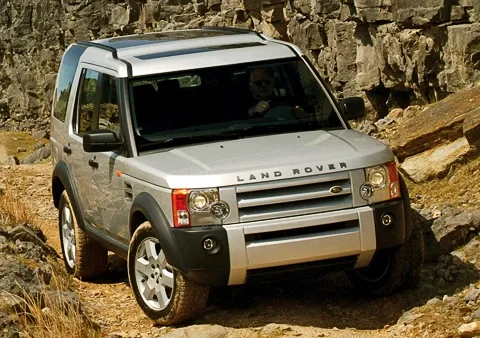
A completely new model came out in 2004, when the brand was managed by Ford. The car became larger and heavier, with only the hood and tailgate remaining aluminum. Externally, the Discovery 3 stood out with smooth sides but retained the recognizable stepped roof. Independent suspensions were mounted to a frame integrated into the body and welded from steel. Under the hood could be a Ford V6 gasoline engine, a Jaguar 4.4-liter V8, or a two-liter turbodiesel. Springs were only for base versions, while air suspension could adjust ground clearance and worked in conjunction with the Terrain Response off-road system. The third Discovery sold worldwide in quantities of 220,057 units.
And the so-called fourth generation was shown in 2009 — again under a new owner! This time, Land Rover came under the management of Indian Tata.
Behind the scenes
Bad weather — is it not an obstacle for testing off-roaders? Not at all! The mud with sharp icy edges was not frozen enough to withstand our Disco party. The crust broke, revealing the wet sand of the quarry. Full reverse! And on the final day of shooting, it also started to rain. But credit must be given to the cars: even those colleagues who usually don't leave the asphalt were captivated by Land Rover's charisma.