
There is a category of people who stubbornly refuse to keep up with the times. They even get warm water for washing by mixing hot and cold right in the sink with a plug. However, what else can you expect from a nation that still lives under a monarchy? Except for a car like the updated LR Defender. True, Land Rover representatives claimed that now this car is not a rugged workhorse, but a fashionable SUV for outdoor enthusiasts. But it sounded uncertain.
DID THEY DRIVE OR NOT?
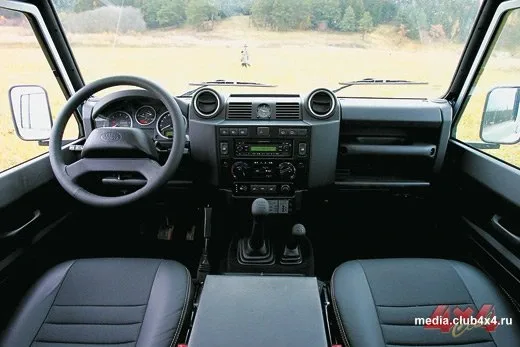
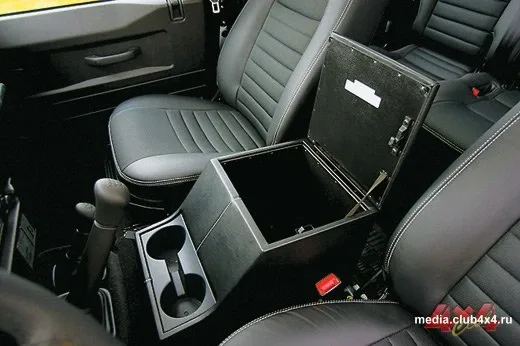
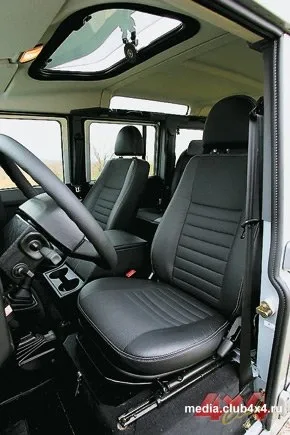
If you are behind the wheel of a Defender for the first time, the ergonomics will surprise you. To get in properly, you need to stand on the step with your back to the door opening, lower yourself onto the seat, and only then bring your legs in. Got them in? Great, let's continue. Here is the classic Command Position — commander's seating. High and upright. Excellent. But! The steering wheel is not directly in front of you — it is shifted to the left. And so are the pedals. It was like that before, and it remains so now. At first, it is slightly shocking, but you quickly get used to it. You just don't need to stick your left elbow out to the side — that's all. Besides, now there is a place to put your left foot, and that alone is a decent achievement. The interior rearview mirror sticks out right in the middle of the windshield, and all you can see in it is the edge of the spare tire and a bit of clouds. Fortunately, it can be removed with one motion. And so on...
If you are familiar with the previous Defender, the interior will pleasantly surprise you. The old one looked absolutely primitive. I am a conservative myself, but not to that extent. But now everything is as it should be. Moderately modern, with a slight military touch. And, pleasingly, a tachometer has finally appeared. And the air conditioner, which used to be located right at the front passenger's feet and was very much in the way, has moved under the hood. The hatches under the windshield, through which you could let oncoming air flow directly into the cabin along with dust and flies, have disappeared. Too bad, it was a fun feature. The seats... To my taste, they were not bad before, and now they have become even better. Although there are only two adjustments: fore-aft and backrest tilt. Some, however, complain that the back gets tired on long trips. So before buying, do sit in it and try it out.
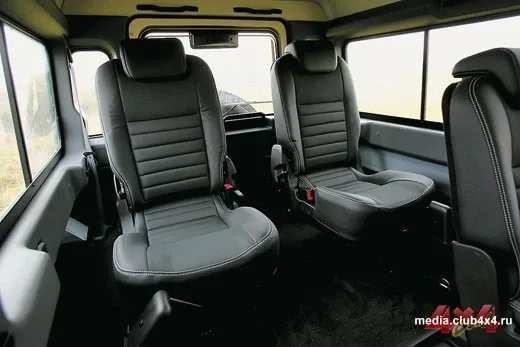
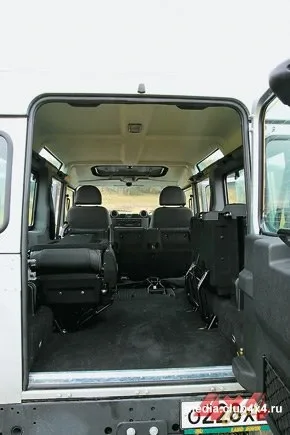
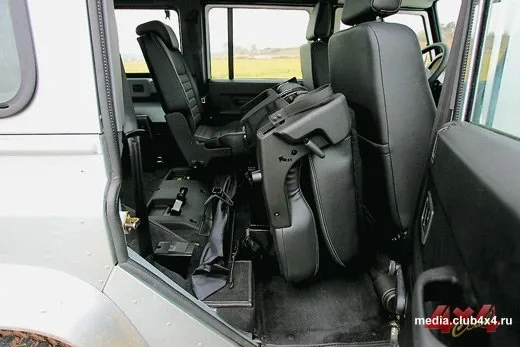
The rear bench backrest is designer, with a wavy top edge. The benches in the cargo area for additional passengers are now gone. Instead, for the Defender 110, as an option ($608 (4,860 UAH)), two additional seats are offered, installed facing forward. They fold and unfold surprisingly easily, and when folded, they hang on the side wall. The same ones are in the Defender 90 as the second row.
What I categorically disliked in the new Defender's interior is the velour on the floor. In the cabin and the cargo area. Very high quality. But absolutely inappropriate in a utilitarian vehicle. Good thing it's black, not light. However, one of the main problems of the "Def" — inefficient ventilation — has finally been solved. Now the heater blows correctly, the cabin warms up quickly, and the windows do not fog up even in heavy rain.
THE HEART OF THE VAN
Structurally, nothing has changed: ladder frame, axles, permanent all-wheel drive with a locking center differential and low range.
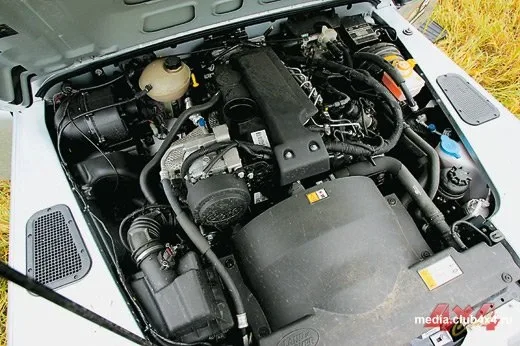
But the engine and gearbox are new. The turbodiesel is based on a "Ford" power unit intended for the Transit series of commercial vans. It is more powerful, torquier, but most importantly, more reliable than the old TD5. But if modern diesels run almost silently at idle, the new Defender does not share that glamour — it clatters at idle just as much as its predecessor. Under load, at 3000 rpm, it is, of course, quieter. But you know what? I like it. That is exactly the voice a brutal SUV should have.
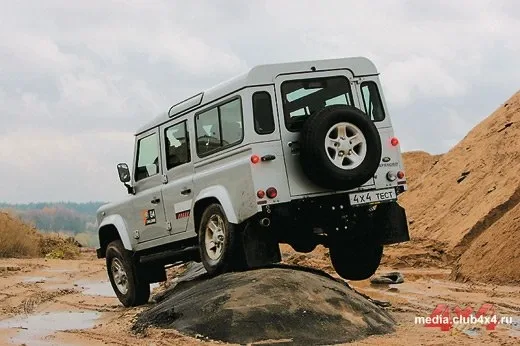

The engine is still very "cold" — it not only does not warm up at idle, it does not reach operating temperature even after an hour of work in conditions of dense ground contact, when airflow from below is completely absent. You may laugh, but I almost froze. I had to wave a shovel while waiting for the rescue team, like a last-ditch navigator, just to warm up. In short, it's a good engine; overheating is not a threat to it.
As for the new 6-speed manual gearbox, it evoked somewhat fewer positive emotions. First gear is too short. And starting in second is still not very convenient. Reverse engages "left and forward" with noticeable resistance to prevent accidental engagement, but my hand is heavy, and I managed to engage reverse instead of first a couple of times, despite having some driving experience. Nevertheless, with the new gearbox, it's better. Thanks to the sixth gear, you can now drive on the highway at 130 km/h, whereas on the predecessor, the cruising mode was 100–110 (of course, both are according to the speedometer).
OVER CURBS AND OVER HILLS
In the city, the pleasure of driving the LR Defender 110 is slightly marred by the huge turning circle. But if you don't make it in one go, you can always drive over a curb regardless of its height. Of course, if you've hit the shoulder, not a parked car. Also, the "Def" is quite respected on the road. Even in traffic jams, when people start to lose their human form, this angular giant sobers many up.
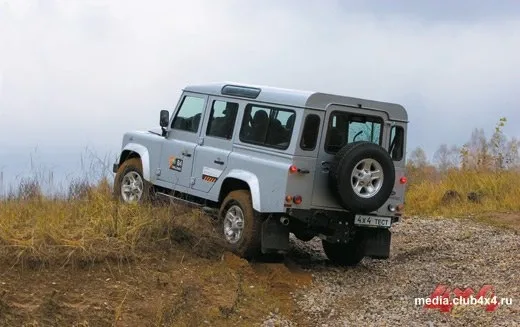
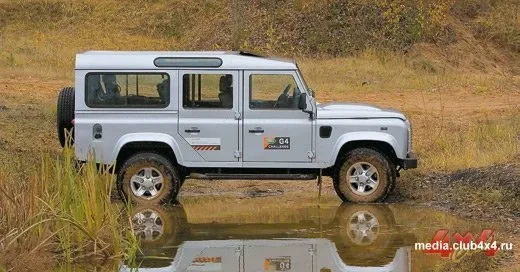
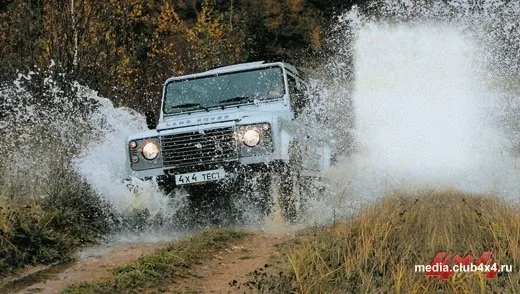
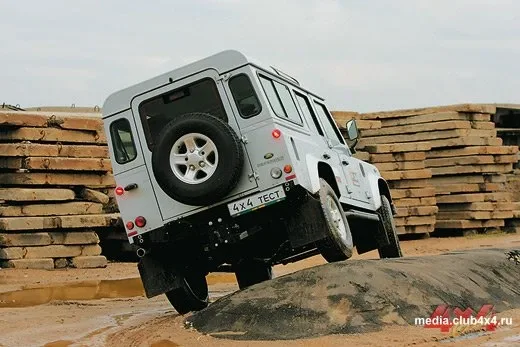
What is the likelihood that an LR Defender owner will leave the asphalt? In my opinion, it approaches 110%. Even if a person chose this model for style reasons, sooner or later it will drag him into the mud by itself. Because the true element of the LR Defender has always been off-road. In this sense, the current generation has brought nothing new. Solid axles. Monstrous suspension travel. Low range with a ratio of 3.269. Approach/departure angles of 50° and 34.5°, respectively. What is missing? Clear and instant engagement of the low range. The system is purely mechanical (which is pleasing), and therefore sometimes it doesn't engage — you push the transfer case lever, and it doesn't go. That means you need to return to high range, drive a couple of meters backward or forward, and try again. The conclusion is simple: low range should be engaged in advance. In my opinion, a car of this class should already have locking differentials as standard equipment. Because when we got stuck on our belly (ten centimeters of dry sand, under it soft clay, we sank immediately, didn't even have time to say "mom"), with lockers we would have had a chance. But as it was, both wheels on the left side were spinning, while the right ones, standing on dry ground, did not participate in the process at all. As a result, we also found out two more things. First, a snapped cable breaks the plastic radiator grille in one go. Of course, we hung a protective jacket on the cable, which is why it flew not into the glass but into the grille. Second, the stock bumpers on the "Def" are steel, but they are not designed for work with a hi-lift jack. That is, I managed to lift the left side of the car, but the bumper also got slightly skewed as a result. So, a protective kit for the Defender is a necessity.
WE DON'T NEED LATERAL
The new generation has a traction stability control system — TSC, Traction Stability Control. It won't help you in the mud (if you prefer electronics to think for you, better buy a Discovery or Freelander), but it can assist when descending a steep hill. It helped us. The spinning wheels were slightly braked. But only slightly. And in general, this thing is clearly designed for fine work on slippery roads.
By the way, about the road. In terms of handling, everything remains the same, and it couldn't be otherwise. On straight sections, the Defender 110 holds its course impeccably, even on uneven asphalt you don't have to correct it with the steering wheel, but in a turn, if the surface is cracked, the car starts to shift slightly. Both the front axle and the rear axle. And what else can you expect from solid axles? But if the 'Def' had independent suspension, pulling it out of the mud would require a helicopter — in deep slush, transverse arms work like anchors. So let it stay as it is — one of the last truly professional off-roaders, a keeper of off-road traditions. Honestly, after driving it, you just want to exclaim: 'God save the Queen, and with her all these quirky Englishmen!'