
Getting Acquainted with the Updated "German": We Go for a Test Drive
Finally, I got the keys to this car. I won't keep you in suspense: I've been waiting for a long time to get behind the wheel and see what has changed after the facelift. The first thing that catches your eye as you approach is the lighting. The LED daytime running light sections make the car's gaze truly aggressive and modern, although the body itself remains the same, familiar from previous versions.
The interior greets you with the smell of quality leather and neatly fitted panels. It's immediately clear that the Germans approached the interior update wisely: the materials feel more pleasant to the touch, and the center console has acquired a new climate control unit. The buttons now press with a more distinct feel, and this is a small detail that adds a sense of premium quality. The seating position is still low and sporty, but visibility hasn't suffered—the pillars don't obstruct, and the mirrors are large.
On the Move: Impressions of Handling
I start the engine. The starter turns the crankshaft in an instant, and the motor begins to work with a barely perceptible rumble. At idle, it's quiet in the cabin, no vibrations. I pull out onto the highway and immediately feel that the suspension has become more composed. On small joints and cracks in the asphalt, the car passes elastically, but large potholes transmit a noticeable shake to the body. Yes, the suspension is stiff, and it's felt on our roads. But in corners, body roll is minimal, and the steering wheel fills with pleasant heaviness—the car literally screws into the arc, and that's captivating.
The acceleration dynamics are impressive. The accelerator pedal is responsive, and even from a standstill, the car starts very briskly, without delays. Overtaking on the highway is easy: just press the gas, and the automatic transmission quickly drops a couple of gears, allowing the engine to rev up to the needed RPMs. I didn't time the claimed 0-100 km/h with a stopwatch, of course, but the sensations fully match the official figures.
Fuel Efficiency and Little Things
The onboard computer is a separate story. It can display a bunch of parameters, from fuel consumption to tire pressure. The average consumption during my trip was about 10 liters per 100 km in mixed driving, which is quite acceptable for such an engine. In traffic jams, the appetite naturally increases, but on the highway with calm driving, you can fit into much more modest numbers.
As for practicality, the trunk pleased with its shape—it's flat and spacious. The loading height is low, so throwing in a heavy suitcase won't be a problem. Rear passengers have enough space, although a tall person in the back will be a bit cramped due to the sloping roof. However, that's the price for a stylish silhouette, and I'm willing to pay it.
Summing up, I can say that the update has benefited the car. It has become a bit more modern on the outside, received a higher-quality interior, and retained the very driver-oriented character for which it is loved. Yes, the stiff suspension and cramped rear row are drawbacks, but for those who value driving pleasure, this car remains one of the most interesting offers in its class.
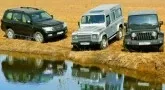
Here they are, all three, standing side by side—three heirs to the legendary Willys. Perhaps only the Wrangler has retained any external kinship with its ancestor. The other two don't look like it at all. However, what else can you expect when so many years have passed! Surely nothing connects them? Let's not rush to conclusions; let's figure it out in order.
I'll note right away: the goal of this test was not a direct comparison of the cars. It's clear that the Land Cruiser stands out from this company. It would be better matched by models of the same class from the same manufacturers, such as the Range Rover and Jeep Grand Cherokee. But we have our own task, so let's begin.
They are very different, and yet there is one trait that unites them. And you know what it is? They reek of "manliness" a mile away! It's almost impossible to imagine a woman behind the wheel of any of them—these are so masculine cars.
Moreover, they are all ugly. Muscular—yes, powerful-looking—also yes, huge—again yes, but... calling them beautiful just doesn't roll off the tongue. The utilitarian genes of the Willys take their toll. However, in this "ugliness" of each, there is its own attractive force.
The Land Cruiser, of course, stands out. The course toward a "luxury SUV" that Toyota took back in the 60s makes itself known. The off-road essence is hidden under a huge body with a comfortable cabin. No diets threaten the "200"—it has seriously "gained weight" and weighs three times more than the military Willys! The body has acquired "fat folds" of wheel arches, a massive "forehead" of the grille, from under which square "eye-headlights" glare, and an impressive "rear." But many people like this sumo wrestler. Especially in our country. We have a special attitude toward the Land Cruiser—it's a fetish car, a greeting from the 90s, when the Land Cruiser and the "six hundredth" symbolized a successful life.
Echoes of those times are still heard. On the road, people shy away from it. Behind the wheel of this mastodon, you feel like the complete master of the situation. And apparently, many of our compatriots want to experience this feeling. How else to explain the more than a year-long queue for this far from cheap car? The Wrangler and Defender attract with something else. These are incredibly charismatic machines! It's as if it's written on their foreheads: "I am history!" And that's true: behind each one is more than half a century of life. You can't confuse them with any other SUV; each has its own family traits.
In the Wrangler's appearance, the Willys is recognizable here and there. Look at this angular body with separate wheel arches, round headlights, and a front bumper protruding forward. Very similar! Even the windshield folds down, and the doors and roof are removable. And the grille is almost the same, only with seven vertical slots instead of nine like the Willys (this is already a signature feature of the Wrangler). Such similarity is not surprising, because Jeep is the "first-line" heir.
As for the Defender, if it resembles the Willys at all, it's only with round headlights and general angularity—but its own, special kind. And there's an explanation for this. When the Wilks brothers created their car, they didn't aim to make it look like a military off-roader externally. They probably didn't think about design at all then. What mattered to them was the internal component. But the shell that the British stretched over the off-road chassis turned out to be very original and interesting. And now, decades later, in times of universal pursuit of aerodynamics, the "cubism" of the Defender's body reminds us that this car seems to be from another world. And in this, it must be admitted, there is some truth.
You open the thin flat door of the "Def," climb up somewhere, and finally plop down on a seat mounted on a square podium. The seats, by the way, unlike the previous generation, have become much more comfortable. But... this is perhaps the most significant change in the cabin. There's also a new instrument panel and a more advanced ventilation system, but otherwise, inside it's still the same Defender—a car "from another world," from the world of anti-ergonomics. The driver, like the pedal assembly, is heavily offset toward the door, leaving the left arm and leg with no place to go. You can stick your elbow out the open window, but you can't put your leg anywhere—you either have to hold it over the clutch pedal or awkwardly place it on the floor.
The seat adjustments are clearly insufficient for a tall person, and steering column adjustment isn't provided at all. And the mirrors need to be adjusted by hand. Remember the last time you did that? In the middle between the front seats is a box with a lid, also an armrest box, made of... plywood! It strongly resembles the "black box" brought out on the show "What? Where? When?" The "music" only plays midrange frequencies, and even those are drowned out by the "heater," which works only on the first speed. And if you drive a bit faster, aerodynamic and transmission noises start to take the lead. And the diesel can't be called quiet by any stretch. Its sound is truly "tractor-like," and it generously transmits its vibrations to all controls. What a "paradise for a masochist." But you can get used to it. And after a while, you feel quite normal, and even start to rejoice. At what? At the fact that you're driving a real "honest" car, without all that modern ergonomic nonsense.
The Land Rover, like a time machine, transports you to times when reliability and off-road capability were paramount, and user convenience was pushed to the very back burner. The soldiers of World War II behind the wheels of their Willys must have been even more uncomfortable—they didn't even have a roof over their heads.
The roof can only be removed on one car from our trio—the Jeep Wrangler. In summer, it's certainly a special thrill to ride without a top, like in a buggy. But we conducted the test in early spring, so we didn't experiment.
The Wrangler, despite being the closest in lineage to the Willys, has gone much further than the Defender in terms of interior space arrangement. Here, there's already a quite modern interior with a fairly standard seating position and controls. It's immediately clear that this generation paid great attention to comfort (relative, of course) and material quality. Twisting the huge "steering wheel" (truly like the Willys), you no longer hit your elbow on the left door, and the front panel is finished with excellent-for-a-Wrangler plastic. But its own "ergonomic quirks" are present here as well.
The power window buttons, like in the "Defender", are located on the center console; the doors without latches constantly need to be held, otherwise they might pinch your leg or arm, and through the gaps between the windshield and the removable roof, air blows in at speed. But overall, the Wrangler is much calmer, quieter, and more modern than its English counterpart. Although it also has that very "other world" feeling, a world of military past. But where it is not felt at all is in the Toyota. Over all these years, the Land Cruiser has moved so far from its roots that an uninitiated person would never guess what car it actually grew out of. The spacious interior of the "two hundred" keeps pace with the times. It has everything inherent in expensive SUVs of the current generation: a comfortable high seating position in luxurious leather seats, "light" pedals and steering wheel, high-quality finishing, signature optitron instrument lighting, 4-zone climate control, an audio system with decent sound, and a touch-screen on the panel with built-in navigation.
All this was not even dreamed of by the other two participants in our test (and, let us remind you, such equipment is available in other, corresponding models from the same manufacturers)! The Land Cruiser's cabin surrounds its occupants with unprecedented comfort, silence, and creates a feeling of security and superiority over other road users that is unattainable for many other cars. This feeling intensifies even more when you press the accelerator. The three-ton colossus takes off with unexpected briskness. The new D-4D turbodiesel gives the Toyota acceleration that both the Defender and the Wrangler can only dream of. Their weak little engines (a 2.4-liter turbodiesel in the Land Rover and a 3.8-liter low-boost gasoline engine in the Jeep) do not differ in such agility, even considering the lower weight of these cars.
On the move, the Land Cruiser amazes with its calmness and insensitivity to various kinds of irregularities. Perhaps this is one of the most comfortable cars in the world. At the same time, the Japanese SUV behaves well on high-speed highways — it responds adequately to the steering wheel and does not lean much during lane changes. This is the merit of the KDSS electronic stabilizer system. However, the "land cruiser" does not stop so willingly; the huge mass takes its toll, and sharp turns are not for it — the high center of gravity cannot be avoided.
The Wrangler is not nearly as good on the freeway. Its pure off-road pedigree is still felt. There is a certain lack of composure in its actions, and the pair of "4-speed automatic transmission and engine" does not work very smoothly. The response to the "gas" is heavily damped, and overtaking has to be planned in advance. Moreover, the steering wheel lives its own life, and on bumps the Jeep slightly shifts by itself — the rear axle makes itself known. Nevertheless, the Wrangler remains a car that can be driven every day, sacrificing a fair amount of the driving feel in favor of originality and image. But its true purpose is to overcome those sections where the road is closed to more civilian SUVs.
The Defender is a separate story. During the test, my colleagues and I more than once had associations with our native "UAZ". And this is not without reason. Driving on asphalt for the Land Rover and its driver is torture. The answer lies in the chassis design — two "axles", leaf spring suspension, a long steering wheel, and spongy brakes do not allow you to control the car in the generally accepted sense of the word.
For example, to depress the clutch (the Defender is the only test participant with a manual transmission; an "automatic" is not provided in principle), you need to apply serious effort. At that moment, it seems you can feel the disc and flywheel engaging. The other two pedals also require masculine strength. A "live" car, a real one, with a minimum of auxiliary mechanisms and systems. This "liveliness" (I would even say "animality") and dislike for the city and asphalt pull the Defender into its native element. There, where it feels like a fish in water. The "Def" wants to quickly show what it was born for, and the Wrangler, and once the Land Cruiser, and that very Willys. It rushes off-road. Well, we could not deny it that pleasure, naturally taking the other two test participants along.
The Meshchera region, sung by Turgenev, received us with characteristic "hospitality". In the Moscow region in early autumn, almost immediately after the snow has melted, you can find a huge number of natural obstacles that will be insurmountable for the vast majority of cars. But our trio are heirs to army off-road vehicles that fought year-round in the most terrible conditions. Therefore, we boldly turn onto a field that has become soggy after winter and break through further — to the bank of the Desna River, abounding in hummocky treacherous bogs.
Without going into the technical details of the all-wheel drive systems of our subjects, I will only say that all cars have a low range in the transmission and a center differential lock. The role of cross-axle locks is performed by electronic systems — after all, it is the 21st century. By the way, the Willys did not have these cross-axle locks, so to some extent, the participants in our test are even better adapted for off-road.
From the very first meters, you understand how far the Land Cruiser has moved away from its ancestor. Its huge mass, impressive dimensions, and poor geometric cross-country ability do not allow it to compete on equal terms with the Defender and Wrangler. Those wet slopes that these two overcome playfully, even without engaging the low range, let alone the center lock, are difficult for the Toyota. Taking these hills with momentum is scary — the soft suspension makes the Land Cruiser nose-dive, and you can easily damage the bumpers or hit the side steps. In a tight pull, the "cruiser" climbs reluctantly; you have to resort to the help of the entire off-road arsenal. But even with it, there is a high risk of beaching the Toyota on its belly almost on flat ground — three tons are three tons; the car simply gets sucked into the mire.
Meanwhile, the Jeep and Land Rover are tearing around the fields like March hares and happily "bathing" in mud baths. They require the low range only for particularly slippery and steep sections. The Land Cruiser stops helplessly on such climbs. But if there is a clean field ahead, the Toyota will fly across it, barely disturbing its occupants. Incredibly energy-intensive and comfortable suspension! The Jeep and Land Rover, which "bucked" on asphalt, can also drive fast across fields, but they toss you around so much that you might hit your head on the ceiling! You have to hold on tight. But can the Land Cruiser fly at full speed over a rut left by a GAZ-66 or, worse, a tractor? Most likely, it will stay there.
But the Wrangler and Defender can! For them, this is a matter of course. They can also calmly cross it, filled with spring slush, in a tight pull. The car is thrown from side to side, clay flies from under the wheels, but in the end, the goal is achieved — you are up to your ears in mud, but already on the other side.
Interestingly, while losing to its rivals in almost all off-road categories, the Land Cruiser performed excellently in diagonal articulation conditions. Here again, the aforementioned KDSS system came to the rescue, which fully "releases" the stabilizers off-road, providing a huge suspension travel and a large axle crossing angle. The Toyota clings to the ground until the last moment, but even after "lifting off", it stubbornly continues to move forward — provided the wheels have enough traction with the surface. The Wrangler and Defender do not have such an advanced system, but even without it, the axles cross very significantly. Even on two wheels, all cars are quite capable of continuing forward motion. In fact, cross-country ability is most limited by geometry, and here the Defender and Wrangler with their short overhangs and impressive ground clearance are invincible.
But still, we managed to "bog down" this pair. Of course, a bad deed is not tricky, but we were interested in what could stop these "off-roaders". We did not go so far as to dip the Land Cruiser into a bog with hummocks sticking out everywhere, but we did test the Jeep and Land Rover. We failed to cross the above-described obstacle in a tight pull even in low range with the lock engaged. Both cars, sitting on their axles, only helplessly spun all four wheels. However, these wheels were shod with quite ordinary tires. Presumably, if the tires had been more "toothy", both would have had a much better chance of escaping captivity on their own. As it was, we had to get out the tow rope and pull each one out in turn. By the way, we did it quite easily. Maybe we chose a "childish" bog? Look at the photos; do you know many cars capable of overcoming such a thing?
Dirty but satisfied, we get back onto the asphalt and head to the nearest car wash, where the appearance of the cars horrifies all the "Karcher and rag" workers. All three cars are covered from head to toe in spring mud, with clumps of hay and grass hanging underneath. It is immediately clear that these three recently had fun on real off-road!
Well, while the cars are being washed, there is time to sum up the results of our test. So, is there anything left of the military army SUV Willys, thanks to which they all once came into being? Although he himself did not participate in our test for quite understandable reasons, even without that, in the case of Jeep and Land Rover, the answer will be unequivocal — of course, yes. Throughout all these 60 years, these two have steadfastly honored the traditions laid down back in the days of World War II. Despite constant modernization, improvements, and the use of modern technologies (to a much lesser extent than on most other modern vehicles), Defender and Wrangler have remained, perhaps, the most conservative cars on the planet (if, of course, you don't count the VAZ rear-wheel-drive "classics") and have retained those qualities that were inherent in the Willys design: reliability, amazing off-road capability, and endurance. In addition, their appearance is characterized by extraordinary charisma, setting them apart from the general flow of cars. They are capable of shattering anyone's ideas about off-road driving, and can move in truly terrible conditions. For this, they are loved, valued, respected, and... bought, sacrificing comfort and handling.
With the Land Cruiser, not everything is so simple. Yes, compared to the vast majority of currently produced four-wheel-drive vehicles, it is very, very good off-road. But still, the Land Cruiser is different, and it is oh so far from the results demonstrated by the other two participants. Toyota back in the 60s actively began to move away from the true off-road theme, ultimately creating a car that became no less famous and legendary than its military relative. During its production, it lost almost everything that Willys was famous for, but acquired many other valuable qualities. Its original task is comfort, respectability, and detachment from the outside world. It's just a pity that most owners of modern Land Cruisers are unlikely to ever remember where their car started. And what it is still capable of.
A Journey into History
World War II and Willys
Let's start with the very Willys off-road vehicle, whose appearance we owe to the American military. By the early 40s of the last century, when World War II was already raging in Europe, the US Army did not have reliable four-wheel-drive transport. Individual experiments like the five Marmon-Herrington 4x4 based on the 1937 Ford or the three open Austins of 1938 don't count.
This situation arose largely because the military department itself could not decide on requirements. But on July 11, 1940, directive TM 9-803 appeared, according to which the army required a "four-wheel-drive general-purpose truck (for transporting passengers, cargo, and weapons weighing a quarter ton) for reconnaissance and other military activities."
Technical parameters were also announced. The "truck" was to have a wheelbase of no more than 80 inches, a track of no more than 47, a fold-down windshield, an engine with a torque of at least 115 Nm, and a curb weight of only 590 kg. 135 (!) US automobile companies were invited to the tender scheduled for July 22, but only three responded — American Bantam Car Company, Ford Motor Company, and Willys-Overland Motors. 49 days were given to create a working prototype, and after 75, 70 test vehicles had to be presented! Only Bantam coped with the task. Its engineers showed the first Blitz Buggy prototype on September 23, and then produced another 70 units, formally winning the tender. But the company's capacity was too small, and its financial situation was deplorable, so Bantam clearly could not supply the entire army. Therefore, specialists from Ford and Willys were brought in for testing. At the insistence of the government, they were even given all the drawings to speed up mass production. In November 1940, pilot Willys Quad and Ford Pygmy joined the Bantam Mk II/BRC-60 tests. Unsurprisingly, the three cars were very similar — the off-roader seemed to exist in three forms. At the same time, the initial weight limit was deemed unrealistic and raised to 980 kg (by the way, Bantam ignored it from the very beginning).
The US military leadership considered all three vehicles suitable and ordered 1,500 units from each company. The models received new indices: Bantam BRC 40, Ford GP ("G" — government, with the letter "P" Ford then designated models with an 80-inch wheelbase), and Willys MA ("M" — military, "A" — model A). In July 1941, it was decided to keep one manufacturer. It became Willys — thanks to the most powerful and cheapest-to-produce engine. It was an inline four-cylinder with a displacement of 2.2 liters, 60 horsepower, torque of 142 Nm, and a very low compression ratio of 6.48:1. For its excellent traction and unpretentiousness, soldiers nicknamed the engine Go Devil. Willys received an order for another 16,000 vehicles, and the abbreviation changed to MB. Bantam production was shut down (about 2,600 units were made in total), but Ford returned with the GPW modification ("W" — under Willys license) in 1942, when Willys could no longer cope with volumes. As a result, over 360 thousand "native" Willys and about 280 thousand "Ford" ones were produced during the war years. A considerable part of the Willys MB (more than 51,000) came to the USSR under Lend-Lease, where it faithfully served our soldiers, and then for many more years traveled our roads, faithfully serving post-war owners.
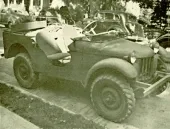 Blitz Buggy
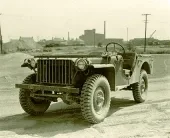 Bantam BRC 40
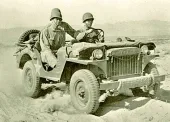 Willys MA
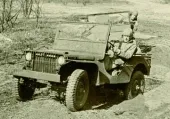 Ford GP
 Willys MB
After the War
When World War II ended, Ford lost interest in such vehicles, but Willys decided to continue. It was then that the letter combination "Jeep" became an official brand and the abbreviation CJ — civilian jeep — appeared. This designated civilian versions of that very army off-road vehicle. Despite the fact that Willys changed owners several times (in 1953 it was bought by Kaiser-Fraizer, in 1963 it became Kaiser-Jeep, and in 1969 it became part of American Motors Co.), the production of CJ versions with serial numbers from 2 to 10 continued until 1987. Naturally, engines, transmissions, bodies, and suspensions changed, but in essence it was still the same Willys — a reliable and indestructible jeep. For some time after the war, purely military versions (M38, M606, M170) also remained on the assembly line. Some of them still serve in the armies of a number of countries.
In 1987, American Motors Co. came under the control of Chrysler. From this moment, a new stage in the history of Willys begins — the CJ is replaced by the Wrangler, one of the participants in today's test. Undoubtedly, it is he who is the "direct heir" of the legendary past and even externally most resembles his ancestor. But let's leave the Jeep Wrangler for later, and for now, let's go back a little and see how Willys left its mark on the automotive industry of countries very far from the USA — Great Britain and Japan.
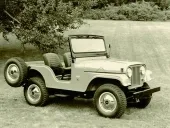 Jeep CJ-5 (1966)
One of the numerous cohort of "civilian jeeps" — Jeep CJ-5 of 1966. Isn't it a Willys?
The English Version
After World War II, British industry was going through hard times. Nevertheless, the Rover company managed to resume production of civilian cars. The government even transferred a large aircraft plant in Solihull to it. But there was a downside to this: on the one hand, huge production capacity, and on the other, it was impossible to load it only with the passenger car models Rover had at the time. The brothers Maurice and Spencer Wilks, who headed the company, understood that a new car was needed. And the elder of them, Maurice, used... guess what? on agricultural work on his estate on the island of Anglesey? That's right — a Willys! According to legend, when Spencer asked his brother what he would do when his off-roader fell apart, he replied: "I'll buy the same one." Then they came up with the idea of creating a car modeled on the Willys, which was later destined to become the first Land Rover.
Steel was in short supply then, so it was decided to weld the chassis elements from steel strips, essentially from scrap iron. The resulting side members and cross members were welded into a ladder-type frame, which became the hallmark of the Land Rover off-roader for many years. The body was made of aluminum — a light and corrosion-resistant material left in abundance from the aircraft industry.
In the autumn of 1947, the first working prototypes appeared, based essentially on the Willys chassis, while the engine and gearbox were borrowed from passenger Rovers. On March 11, 1948, at the automobile exhibition in Amsterdam, the production version was presented — the Land Rover Series I. Thus, this year Land Rover celebrates its 60th anniversary. Land Rover is a long-lived car, a conservative car. Over all these years, only four generations of the model have changed, and the fifth, unfortunately, the last, appeared last year, in 2007. The name Defender came into use after the restyling of the 4th generation in 1990. Before that, the car was called simply — Land Rover, and various numerical indices were added to the name, meaning the wheelbase length in inches. Since ancient times, the long-wheelbase version has been commonly called the station wagon, and the version with an open cargo area — the pick-up.
Over 60 years, more than two million units have been sold worldwide. Land Rover has its own devoted army of fans—people truly attached to this legendary vehicle. They value the 'Def' for its reliability, simplicity, ruggedness, and outstanding off-road talents. Of course, such qualities are indispensable under harsh operating conditions. That's why Land Rover has followed in the footsteps of its ancestor—it serves in the armies of some nations and works in various non-governmental organizations (UN, Red Cross, etc.). Additionally, the Defender is in demand among farmers, rescuers, energy workers, and utility services. But the main bulk of buyers of this 'honest' vehicle are men who love truly active recreation. I don't mean family picnics at the forest edge, but serious off-road adventures. The worse the conditions, the more fully the amazing potential of this all-terrain vehicle is revealed. Land Rover is capable of challenging nature itself! Not long ago, we already tested the short-wheelbase Land Rover Defender 90 of the latest generation. So this time, we decided to test the long-wheelbase version—the 110 Station Wagon. Land Rover Series I (1949–1957)
The first series of Land Rover was produced exclusively in short-wheelbase form. Accordingly, from 1949 to 1954, the number '80' was added to the name, from 1954 to 1957—'86', and from 1957 to 1958, when the wheelbase grew by another two inches—'88'. Four long-wheelbase (107 inches) station wagon variants were made to special order. All were exported to Canada.
Land Rover Series I (1949–1957)
The first series of Land Rover was produced exclusively in short-wheelbase form. Accordingly, from 1949 to 1954, the number '80' was added to the name, from 1954 to 1957—'86', and from 1957 to 1958, when the wheelbase grew by another two inches—'88'. Four long-wheelbase (107 inches) station wagon variants were made to special order. All were exported to Canada.
 Land Rover Series II (1958–1971)
Land Rover Series II was produced from 1958 to 1961, and from 1962 to 1971, the modernized Series IIA modification was produced, in which the headlights 'moved' from the radiator grille to the front fenders. Both versions had a wheelbase of 88 or 107 inches.
Land Rover Series II (1958–1971)
Land Rover Series II was produced from 1958 to 1961, and from 1962 to 1971, the modernized Series IIA modification was produced, in which the headlights 'moved' from the radiator grille to the front fenders. Both versions had a wheelbase of 88 or 107 inches.
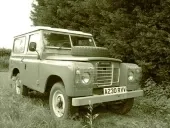 Land Rover Series III (1972–1985)
The third generation of Land Rover was on the assembly line from 1972 to 1985. It can be recognized by its characteristic radiator grille with 'wings'. Wheelbase—88 and 109 inches.
Land Rover Series III (1972–1985)
The third generation of Land Rover was on the assembly line from 1972 to 1985. It can be recognized by its characteristic radiator grille with 'wings'. Wheelbase—88 and 109 inches.
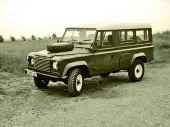 Defender 90, 110, 127 and 130 (1983–2007)
Production of the fourth generation of the model began in 1983. Such a Land Rover is unmistakably recognized by its one-piece windshield (previously it was in two parts). The wheelbase of all versions increased slightly, and modifications with a wheelbase extended to 127 (later to 130) inches also appeared. In 1990, the name Defender appeared, and the spare wheel moved from the hood to the rear door.
Meanwhile in Japan…
The first off-road vehicle created by Toyota in 1942 was called 'AK10'. The idea to build such a vehicle arose when, during the Japanese occupation of the Philippines in 1941, they discovered there the 'Allied' Bantam MkII, which, as we know, was a copy of the Willys, or rather, vice versa. But the AK10 was equipped with a 2.3-liter engine from the Toyota AE and a 3-speed transmission with a low range and a transfer case that had nothing in common with the 'Willys' ones. The AK10 did not become widespread.
And the history of the vehicle now known to us as the Land Cruiser began in 1950 with the start of the Korean War. The American government ordered Toyota to manufacture 100 light off-road vehicles to Willys specifications. Thus, in 1951, the first prototype appeared—the Toyota BJ.
Externally, the BJ resembled the Willys, but in fact its dimensions were larger and its engine more powerful. The Japanese installed their own 3.4-liter engine that developed 85 hp at 3600 rpm and 215 Nm at 1600 rpm. The BJ, like the Willys, had a part-time four-wheel drive system, but there was no low range.
Serial production of the model began in 1953, and in 1954 it got its own name—Land Cruiser. It was invented by Toyota's technical director Hanji Umehara in defiance of the English Land Rover; Umehara really wanted the model's name to be no less sonorous and significant than that of the English competitors.
Over nearly 60 years, new generations and modifications of the Land Cruiser kept appearing. With each of them, the 'Cruiser' moved further away from its military roots and became more and more comfortable. The current 'two-hundredth' model—the tenth interpretation—resembles the uncompromising Willys less than the other two vehicles in our test, but nevertheless, it owes its birth to it and is still capable of a lot off-road.
The modern Land Cruiser 200 became a continuation of the '55–60–80–100' model line. In 1972, during the production of the 40 Series, which lasted from 1960 to 1984, Toyota decided to simultaneously produce a 4-door and more comfortable version of the Land Cruiser on the extended wheelbase of the '40' model. It was assigned the index '55'. From that moment, the bifurcation of the Land Cruiser model range began. Subsequently, development proceeded in two directions: simpler and more utilitarian modifications 70–90–110, and luxury extended versions 60–80–100–200. In 1985, the Land Cruiser 70 was released. A little later, it was given the name Prado, which was also retained for models 90 and 110.
We have already tried and thoroughly studied the Land Cruiser 200 both in the Canary Islands and in Moscow (MOTOR, March 2008), and this time we took it for a test as a distant 'descendant' of the legendary 'great-grandfather' Willys.
Defender 90, 110, 127 and 130 (1983–2007)
Production of the fourth generation of the model began in 1983. Such a Land Rover is unmistakably recognized by its one-piece windshield (previously it was in two parts). The wheelbase of all versions increased slightly, and modifications with a wheelbase extended to 127 (later to 130) inches also appeared. In 1990, the name Defender appeared, and the spare wheel moved from the hood to the rear door.
Meanwhile in Japan…
The first off-road vehicle created by Toyota in 1942 was called 'AK10'. The idea to build such a vehicle arose when, during the Japanese occupation of the Philippines in 1941, they discovered there the 'Allied' Bantam MkII, which, as we know, was a copy of the Willys, or rather, vice versa. But the AK10 was equipped with a 2.3-liter engine from the Toyota AE and a 3-speed transmission with a low range and a transfer case that had nothing in common with the 'Willys' ones. The AK10 did not become widespread.
And the history of the vehicle now known to us as the Land Cruiser began in 1950 with the start of the Korean War. The American government ordered Toyota to manufacture 100 light off-road vehicles to Willys specifications. Thus, in 1951, the first prototype appeared—the Toyota BJ.
Externally, the BJ resembled the Willys, but in fact its dimensions were larger and its engine more powerful. The Japanese installed their own 3.4-liter engine that developed 85 hp at 3600 rpm and 215 Nm at 1600 rpm. The BJ, like the Willys, had a part-time four-wheel drive system, but there was no low range.
Serial production of the model began in 1953, and in 1954 it got its own name—Land Cruiser. It was invented by Toyota's technical director Hanji Umehara in defiance of the English Land Rover; Umehara really wanted the model's name to be no less sonorous and significant than that of the English competitors.
Over nearly 60 years, new generations and modifications of the Land Cruiser kept appearing. With each of them, the 'Cruiser' moved further away from its military roots and became more and more comfortable. The current 'two-hundredth' model—the tenth interpretation—resembles the uncompromising Willys less than the other two vehicles in our test, but nevertheless, it owes its birth to it and is still capable of a lot off-road.
The modern Land Cruiser 200 became a continuation of the '55–60–80–100' model line. In 1972, during the production of the 40 Series, which lasted from 1960 to 1984, Toyota decided to simultaneously produce a 4-door and more comfortable version of the Land Cruiser on the extended wheelbase of the '40' model. It was assigned the index '55'. From that moment, the bifurcation of the Land Cruiser model range began. Subsequently, development proceeded in two directions: simpler and more utilitarian modifications 70–90–110, and luxury extended versions 60–80–100–200. In 1985, the Land Cruiser 70 was released. A little later, it was given the name Prado, which was also retained for models 90 and 110.
We have already tried and thoroughly studied the Land Cruiser 200 both in the Canary Islands and in Moscow (MOTOR, March 2008), and this time we took it for a test as a distant 'descendant' of the legendary 'great-grandfather' Willys.
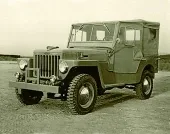 BJ & FJ Series (1951–1955)
The founder of the Land Cruiser family. The Willys is guessed externally, but the 'filling' is its own, Japanese—a 3.4-liter engine, part-time four-wheel drive without a low range in the transmission.
BJ & FJ Series (1951–1955)
The founder of the Land Cruiser family. The Willys is guessed externally, but the 'filling' is its own, Japanese—a 3.4-liter engine, part-time four-wheel drive without a low range in the transmission.
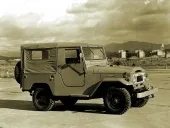 Land Cruiser 20 Series (1955–1960)
The second, much more 'civilized' generation of the model. Already here, Toyota's 'tilt' towards a much more comfortable side than competitors from Land Rover and Jeep becomes noticeable. The engine displacement grew to 3.9 liters (125 hp). The Land Cruiser 20 Series became the first vehicle of the company whose production was established abroad (in Brazil) and the first vehicle exported to Australia.
Land Cruiser 20 Series (1955–1960)
The second, much more 'civilized' generation of the model. Already here, Toyota's 'tilt' towards a much more comfortable side than competitors from Land Rover and Jeep becomes noticeable. The engine displacement grew to 3.9 liters (125 hp). The Land Cruiser 20 Series became the first vehicle of the company whose production was established abroad (in Brazil) and the first vehicle exported to Australia.
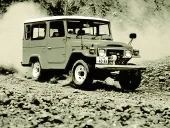 Land Cruiser 40 Series (1960–1984)
The 'Cruiser' finally got a low range in the transmission. The '40' model makes the Land Cruiser known worldwide, sales are growing rapidly. So in 1965, 50,000 Land Cruisers were sold, in 1968—100,000, in 1972—200,000, and in 1973—already 300,000. In 1974, its own 3-liter diesel engine first appeared. Two years later, vehicles began to be equipped with disc brakes for the front wheels.
Land Cruiser 40 Series (1960–1984)
The 'Cruiser' finally got a low range in the transmission. The '40' model makes the Land Cruiser known worldwide, sales are growing rapidly. So in 1965, 50,000 Land Cruisers were sold, in 1968—100,000, in 1972—200,000, and in 1973—already 300,000. In 1974, its own 3-liter diesel engine first appeared. Two years later, vehicles began to be equipped with disc brakes for the front wheels.
 Land Cruiser 55 Series (1967–1980)
Simultaneously with the production of the 40th model, production of the 4-door Land Cruiser 55 on a wheelbase extended to 2710 mm begins. The main goal is export to Australia and North America. It is from this modification that the modern Land Cruiser 200 'grew'.
Land Cruiser 55 Series (1967–1980)
Simultaneously with the production of the 40th model, production of the 4-door Land Cruiser 55 on a wheelbase extended to 2710 mm begins. The main goal is export to Australia and North America. It is from this modification that the modern Land Cruiser 200 'grew'.
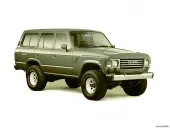 Land Cruiser 60 Series (1980–1990)
An air conditioning system and an additional heater for the rear of the cabin appear. In 1981, the millionth Land Cruiser was sold.
Back to the States
As agreed, we again move to the States—this time to the Jeep Wrangler. After Chrysler bought American Motors Co. in 1987, production of the Wrangler, created on the basis of the last, tenth generation of the Jeep CJ, starts. The new model gets the factory index YJ. Externally, the Wrangler strongly resembles its ancestor, but it has slightly less ground clearance, a wider track, and the interior has become noticeably more comfortable. True, all this is only in comparison with the CJ: against the background of other cars of those years, the interior looked ascetic and frankly uncomfortable. The suspension remained leaf-spring, like the CJ, but the Wrangler acquired anti-roll bars to hold more confidently on asphalt. The off-road arsenal passed from predecessors unchanged: part-time four-wheel drive and a low range in the transfer case. The first generation of the Wrangler turned out to be in demand—more than 685,000 such vehicles were sold worldwide.
In 1997, the Wrangler TJ series goes on the assembly line. The first thing that catches the eye is that the headlights became round again, like on the Willys. Otherwise, it's still the same Wrangler, stubbornly holding on to traditions. The main technical innovation is the coil-spring suspension, which made the TJ noticeably more comfortable (again, compared to the previous YJ). The chassis from the older 'brother'—the Grand Cherokee—was taken as a basis.
The extreme Rubicon version and the extended Unlimited deserve special mention. The Rubicon appeared in 2003. Its differences are special off-road Dana 44 axles with locking differentials (gear ratio 4.1:1), a transfer case with an even deeper 'reduction' (4:1) than the regular version, and 16-inch wheels with Goodyear MTR P 245/75 tires. Until 2004, the modification came with a 5-speed manual, and in 2005 it was replaced by a 6-speed gearbox from Mercedes. For an extra charge, a 4-speed 'automatic' could also be ordered.
The Unlimited version, released in 2004 (also called LJ), received a wheelbase extended by 254 mm. At the same time, off asphalt, the Unlimited showed itself quite worthy—the same Dana 44 axles were installed on it, though with a higher gear ratio of 3.73:1. And from 2005, the Unlimited Rubicon also appeared, equipped with the filling from the regular short-wheelbase 'Rubicon'.
In 2007, the third generation of the Wrangler—JK—debuted. It was the long-wheelbase Unlimited version that we took for our 'historical' test.
Land Cruiser 60 Series (1980–1990)
An air conditioning system and an additional heater for the rear of the cabin appear. In 1981, the millionth Land Cruiser was sold.
Back to the States
As agreed, we again move to the States—this time to the Jeep Wrangler. After Chrysler bought American Motors Co. in 1987, production of the Wrangler, created on the basis of the last, tenth generation of the Jeep CJ, starts. The new model gets the factory index YJ. Externally, the Wrangler strongly resembles its ancestor, but it has slightly less ground clearance, a wider track, and the interior has become noticeably more comfortable. True, all this is only in comparison with the CJ: against the background of other cars of those years, the interior looked ascetic and frankly uncomfortable. The suspension remained leaf-spring, like the CJ, but the Wrangler acquired anti-roll bars to hold more confidently on asphalt. The off-road arsenal passed from predecessors unchanged: part-time four-wheel drive and a low range in the transfer case. The first generation of the Wrangler turned out to be in demand—more than 685,000 such vehicles were sold worldwide.
In 1997, the Wrangler TJ series goes on the assembly line. The first thing that catches the eye is that the headlights became round again, like on the Willys. Otherwise, it's still the same Wrangler, stubbornly holding on to traditions. The main technical innovation is the coil-spring suspension, which made the TJ noticeably more comfortable (again, compared to the previous YJ). The chassis from the older 'brother'—the Grand Cherokee—was taken as a basis.
The extreme Rubicon version and the extended Unlimited deserve special mention. The Rubicon appeared in 2003. Its differences are special off-road Dana 44 axles with locking differentials (gear ratio 4.1:1), a transfer case with an even deeper 'reduction' (4:1) than the regular version, and 16-inch wheels with Goodyear MTR P 245/75 tires. Until 2004, the modification came with a 5-speed manual, and in 2005 it was replaced by a 6-speed gearbox from Mercedes. For an extra charge, a 4-speed 'automatic' could also be ordered.
The Unlimited version, released in 2004 (also called LJ), received a wheelbase extended by 254 mm. At the same time, off asphalt, the Unlimited showed itself quite worthy—the same Dana 44 axles were installed on it, though with a higher gear ratio of 3.73:1. And from 2005, the Unlimited Rubicon also appeared, equipped with the filling from the regular short-wheelbase 'Rubicon'.
In 2007, the third generation of the Wrangler—JK—debuted. It was the long-wheelbase Unlimited version that we took for our 'historical' test.