
Acclimatization
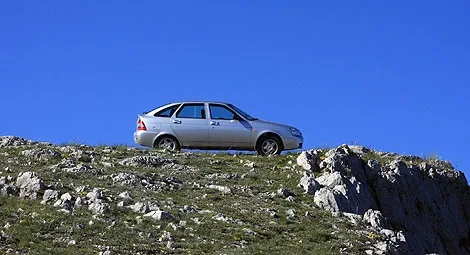
When the Lada Priora hatchback appeared on the market, the Russian auto industry finally got not just a new body, but also a whole range of options that were not available before. Some old ailments were never cured, but it is clear that the plant has begun to move from words to deeds. To understand how the familiar "dvenashka" has changed, we went to Crimea.
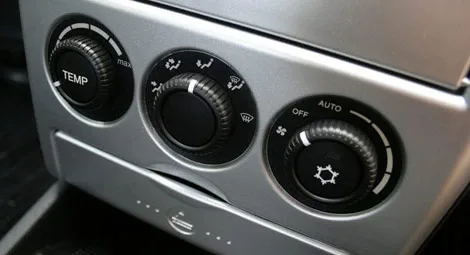
With the advent of the five-door version, the Priora family finally received the "Lux" trim. In addition to what is already in the "Norma" (electric power steering and driver's airbag), it added climate control, a second passenger airbag, heated seats, all four power windows, fog lights, and ABS with brake force distribution.
And that's not the limit. Even a rear parking sensor appeared in the options list. Seems good, but let's take it in order.
 |
 |
Safety plan
As it turned out, AvtoVAZ has its own backup system. For those components that the plant cannot make itself, several suppliers are always selected. The point is not to disrupt the assembly line: if one partner refuses to cooperate, another will replace him.
It is according to this scheme that two air conditioner manufacturers were chosen for the Priora. The "Norma" has a system from the Chinese-Japanese tandem of Panasonic Taiwan Co. Ltd. and Matsushita Electric Industrial. And for the "Lux", a unit from the South Korean Halla Climate Control Corporation is intended.
The plant assures that both climate systems are identical in characteristics and price, but from the description it is clear that their design and performance are different:
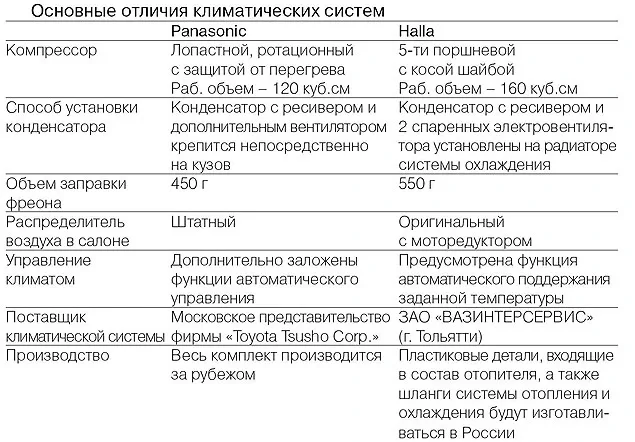
Panasonic is entirely made in China and goes to the Priora in the "Norma" trim. But Halla units are partially produced in Russia, at VAZInterService, which, by the way, also supplies air conditioners to IZH-Avto, including the Kia Spectra. These systems are installed on "luxury" versions, and they are the ones exported.
There are no complaints about the air conditioner's operation — it cools the cabin perfectly and maintains the temperature. But on the first car (and we had two), pressing the activation button noticeably dropped the engine speed. Moreover, this repeated every time, even when the compressor clutch engaged automatically. We had already seen a similar problem on the Lada Kalina station wagon, and then chief designer Vasily Batishchev promised to fix it soon.
At first it seemed that the Priora repeated the mistake, but engineers assured that the problem was solved before production started by carrying out the necessary calibration of the engine control unit. Indeed, on the other Priora hatchbacks, the speed behaved normally when the "air conditioning" was turned on.
 |
 |
Childhood diseases
When the Priora sedan was created, the plant had to master more than two thousand new parts. The hatchback added another 230 original elements, but it still failed to get rid of all the "childhood diseases" of the sedan, known for a year now.
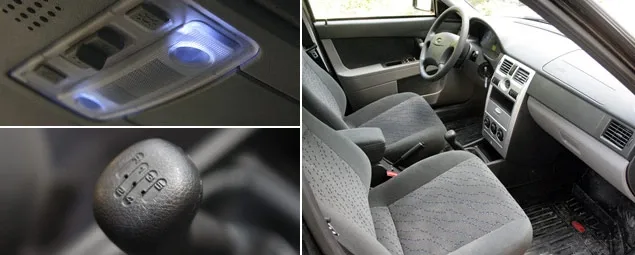
They promised to make a new gearshift lever drive for clearer shifting, but the Priora still suffers from this ailment. Previously, the date was called July 2008, now they talk about September.
Folding the rear seatbacks still requires patience and physical strength. A woman is unlikely to cope with this task. And under the trunk lid, which opens with a key, a button from the cabin, or from the key fob, a recess for a handle is already marked in the upholstery. The handle itself will be installed later.
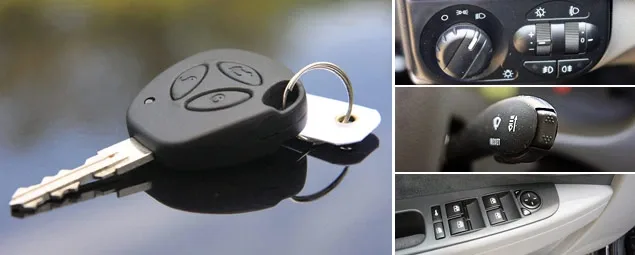 |
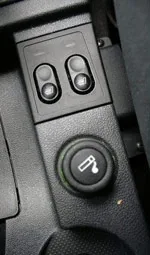
The inscription "Open" remains on the center console. But they promised to remove this "kolkhoz".
The hatchback's trunk is 30 liters smaller than the sedan's — 400 liters. But with the seats folded, there is noticeably more space for cargo. The car also differs in aerodynamics: the drag coefficient is 0.42-0.43 versus 0.41-0.42 for the sedan. For comparison, the Chevrolet Lacetti has 0.34.
Specifics
Officially, the Lada Priora has three trims: "Standard", "Norma", and "Lux". The hatchback in "Lux" costs 326,425 rubles, the sedan in the same trim — 322,680. The five-door in "Norma" will cost 305 thousand. Later, another, unnamed, intermediate version will appear — "Norma" plus air conditioning and ABS, and its price will be 315 thousand rubles.
In 2008, AvtoVAZ promises a fifth trim — "super-lux", if you count the intermediate one. It will include a rear parking sensor, automatic headlights, and a rain sensor. And from next year, the Priora will for the first time receive a standard audio system. According to the already known principle, there will be two suppliers. Which ones — so far a secret.
In total, in 2008 they plan to produce 180 thousand Prioras, of which nine thousand monthly — in the hatchback body. At the beginning of 2009, a station wagon will be added to them.
 |
 |
"Automatic" Priora
Back in 2004, when the Priora project was just maturing, VAZ officials said that the car would get an automatic transmission. Of course, they didn't reveal details then.
The "tenth" family acquired "automatics" in April 2006, when dealers began accepting orders for Lada-110 and Lada-112 with automatic transmissions. The installation was handled by the Tolyatti company "Super-Auto", a "daughter" of AvtoVAZ. It also made the stretched Premier sedans (Lada-21108). To fit the German ZF "automatic" into the "desyatka", the transmission, body, suspension, and interior had to be modified, and a special installation kit was created for mounting.
 |
"Super-Auto" still makes modified Ladas, and their latest work is the Priora sedan with a stretched wheelbase and an enlarged rear door opening, which was put into production in 2008.
It is logical to assume that this very company will take on installing automatic transmissions on regular hatchbacks, sedans, and station wagons of the Priora. That there will be an "automatic" was stated at the presentation by the project's chief designer Valery Kozenkov. But which one exactly — Renault will decide. Journalists were only promised that it would not be a CVT, about which there were rumors, but a classic hydromechanical unit.
Lyrical digression N1
For the second time this year, fate brings me to Crimea, and again "past". Early June, and you can't get into the sea — the water is cold. Some kind of mockery. And there are essentially no vacationers on the peninsula yet. On the other hand, I didn't come to sunbathe, but to work — to get acquainted with the new brainchild of VAZ, the Lada Priora hatchback. But, like any business traveler, I'm always not against relaxing, especially in a place where the climate at this time of year should be clearly better than Moscow's. The work was a success, but the rest without the sea turned out to be incomplete.
 |
 |
Lyrical digression N2
As it turned out, almost every owner of a Chery Amulet sedan knows what is bad about the Lada Priora hatchback, but he is unable to clearly explain in what exactly the Chinese car outperforms the Russian one. One such driver in Crimea approached us with a direct question: "And how are these 'Zhiguli' better than my Chinese car?".
We didn't try to convince this person by telling him about the results of crash tests that AvtoVAZ conducted with the Chery Amulet and the Priora sedan — it's useless. For a typical buyer of any car, such complex categories as active and passive safety, environmental friendliness of materials, or steel strength mean nothing. Moreover, there is the concept of "foreign car", which affects the psyche more strongly than any marketing, advertising, or indisputable tests. It's hard to say where this came from in our heads, but subconsciously any foreign product, even if it was made by political prisoners in Kenya, seems to us of higher quality and more reliable than domestic ones.
Technical characteristics of the Lada Priora hatchback
| Length, mm | 4210 |
| Width, mm | 1680 |
| Height, mm | 1420 |
| Wheelbase, mm | 2492 |
| Curb weight, kg | 1088 |
| Engine displacement, cm3 | 1600 |
| Power, hp/rpm | 98/5600 |
| Torque, Nm/rpm | 145/4000 |
| Acceleration time from 0 to 100 km/h, s | 11.5 |
| Maximum speed, km/h | 183 |
Lenta.Ru expresses gratitude to OJSC AvtoVAZ for organizing the test drive.