
Lada Priora. Deja Vu
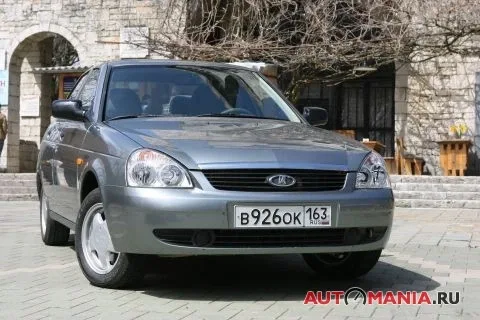
However, let's return to our heroine — the Lada Priora, which is already on sale in showrooms, and in a year should completely replace its predecessor on the assembly line. I'll say right away: I'm not going to sing praises to this car, and there are reasons for that. Firstly, the Priora is a direct product of the notorious state program to support the domestic auto industry, which has managed to fray the nerves of many drivers. According to the plan, the result of this program was supposed to be a truly modern model — both in terms of technology and design — capable of competing, if not with European and Japanese cars, then at least with Korean ones. Apparently, the Priora is that very result, and therefore I will evaluate it with all strictness, no softer than, say, a Hyundai Getz or Kia Spectra. The second reason is financial. By setting the price for the base version in the "Norma" trim at 282,480 rubles (about $11,000), AvtoVAZ immediately made it clear that it is ready for serious competition. And since the manufacturer itself set such rules of the game, why not take advantage of them?
So, meet the Lada Priora. Its appearance, it must be admitted, has become much more interesting than that of the "Ten": an aggressive, "Korean" look of the headlights, a quite decent rear end. The appearance of such a car in the early 90s would certainly have made it a trendsetter and an object of adoration. But, as they say, history does not tolerate the subjunctive mood, and today you can no longer call this a beauty. The designers certainly tried, but the heredity of the "Ten" is visible in every detail — in the contours of the roof, in the door openings, and even in the doors themselves. Of course, the Priora is a direct heiress, but such servile copying, in my opinion, is already too much. The branded stampings on the sides do not particularly adorn it. However, there is no arguing about tastes.
Let's look inside. Here things are much better. It's far from a Citroën C4, of course, but it no longer resembles a FIAT from the mid-80s. A neat front panel, a nice center console. In spirit, it resembles a Volkswagen, and the build quality is quite at the level of the "Koreans." There are, of course, complaints about the materials — they could be more pleasant, and the bolts on the sun visors would be nice to cover with plugs. But overall, the Priora's interior already looks decent, there is a kind of calm harmony in it that gives hope that Togliatti cars will someday catch up to the modern level. I especially want to believe this, keeping in mind the ambitious "Project C."
The set of options also pleasantly surprised: the power window buttons have moved to the driver's door, a spacious armrest has appeared between the seats, a cup holder on the tunnel, and even a glasses case on the ceiling. For our cars, such equipment is a novelty. But here's what's a shame: it has almost no effect on overall comfort. Sitting in the new car is uncomfortable. The steering wheel adjustment only by height is half the trouble. What upsets me much more is the seats themselves. Their profile and that very "stool-like" comfort take me back about eight years, when I first got behind the wheel of a VAZ-2110. In general, you can sit, but you don't get pleasure. And by the end of the trip, your back also gets stiff, and your legs go numb. Although, perhaps, this is a feature of my journalistic physique. But, as assured at AvtoVAZ, these seats won't last long — by the New Year, the model will receive completely new seats, which promise to be much more comfortable. It's just a pity that it couldn't be done right away. It seems the habit of testing new products on customers is here to stay. Okay, let's not talk about sad things.
The Togliatti residents claim that about a thousand changes have been made to the sedan's design, and I readily believe them. The advantages of the new electrics, of course, cannot be appreciated in a couple of days of getting to know the car, but the driving qualities — quite. The most important innovation is the engine. I had already encountered this 1.6-liter unit almost a year ago, though then it was on a regular Lada 112, not on a pre-production Priora. But, as it turned out, the carrier doesn't matter. Almost a hundred claimed "horses" are more than enough for this car. The engine, of course, is not a masterpiece, but it is already very close to foreign counterparts. It runs smoothly and evenly, and even at 4000–5000 rpm it doesn't bother with excessive vibration. I was also pleased with the sound insulation — for our auto industry, it's simply excellent, and its predecessor could only dream of such. But the gearbox, alas, let us down. The VAZ workers didn't touch it, so all the old ailments — vague shifting, long throws, and rapid wear of the mechanism — were inherited. It's a shame, because the car is new. Especially since the Togliatti residents already have a decent manual transmission from the Kalina, which they, by their own words, have perfected.
But the suspension left a pleasant impression. While maintaining the former smoothness, the designers added rigidity, thanks to which the Priora has become noticeably more stable than the "Ten" — it leans less in corners and stands more confidently on the road. I won't presume to judge how it will behave on our broken country roads, but it handles small asphalt irregularities quite decently — the body shakes, but not as much as its predecessor. And the suspension travel seems to have increased — it never bottomed out. The brakes also deserve a kind word. The braking efficiency could be higher, but overall it's quite acceptable. But the steering wheel didn't please — reactions are sluggish, and it makes too many turns from lock to lock; for a compact car, that has long been bad manners.
That's probably all. The Priora, frankly, did not become a revelation, although, honestly, we didn't expect any revolution. Creating a car in two and a half years is not within everyone's power, and AvtoVAZ, alas, is not among them. On the other hand, if the Togliatti residents succeed with "Project C," the Priora will remain only a transitional link, a bridge between the past and the future, which will be forgotten as soon as the transition is completed. I personally vote for that scenario. Otherwise, we will again get a gray, faceless domestic car, and we will have to wait for its replacement for a very, very long time.
Alexey Vorontsov
Technical specifications| Dimensions: | Lada Priora |
| Length (mm) | 4350 |
| Width (mm) | 1680 |
| Height (mm) | 1420 |
| Wheelbase (mm) | 2492 |
| Weight (kg) | 1088 |
| Trunk volume (l) | 430 |
| Engine displacement (cm3) | 1596 |
| Max power (hp) | 98 |
| Max torque (Nm) | 145 |
| Max speed (km/h) | 183 |
| Acceleration 0-100 km/h (s) | 11.5 |
| Average fuel consumption (l) | 7.2 |
| Price (rub.) | 282 480 |
Source – www.automania.ru