
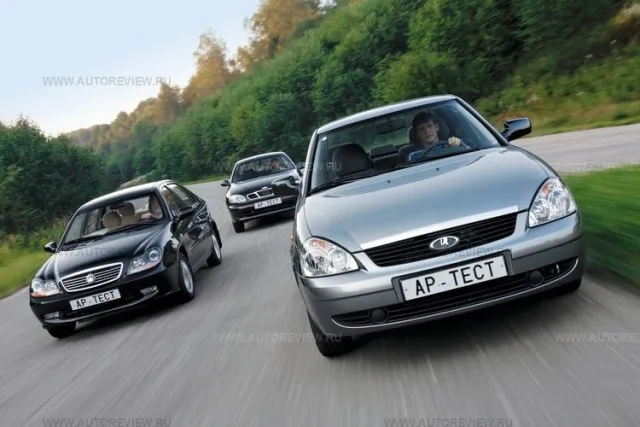
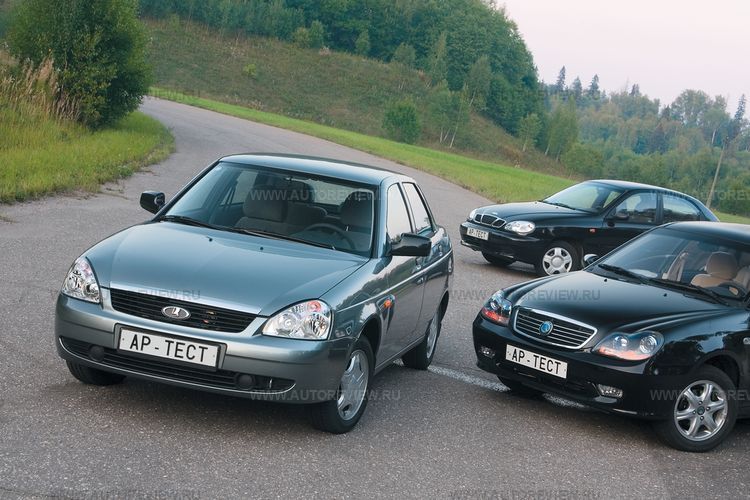
Even at the dealership, the Lada Priora refused to start. The mechanics disconnected the battery from a neighboring car, connected the terminals. And again — silence. And we are in a hurry: at the test site, two competing sedans await us — the Chinese Geely Otaka and the Korean Chevrolet Lanos…
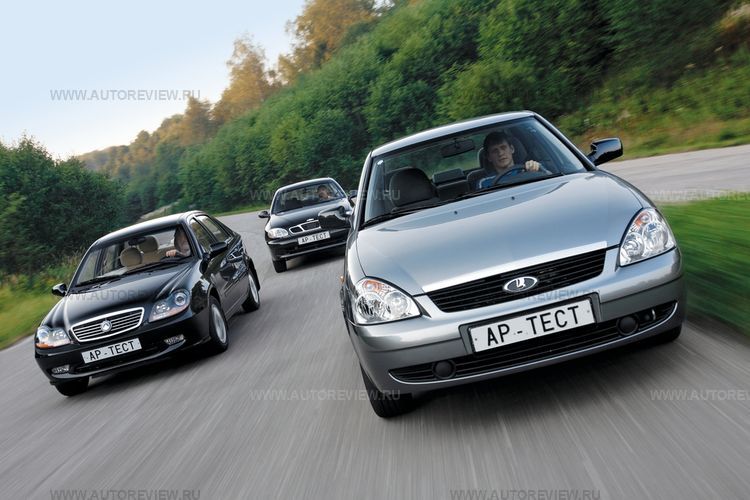
The Priora was warmly received by the market: in May, 3169 cars were sold, in June — 4440, and in July already 6169. And this despite the fact that the Lada Priora is so far offered only in a single trim (with driver's airbag and without air conditioning), and costs by no means cheap — 282,480 rubles ($10,990).
Meanwhile, competition in this segment is intensifying, primarily due to the "Chinese." Sales of BYD F3 and Lifan Breez have just begun, and Maple sedans are about to debut. And the Geely Otaka sedan (known in China as Geely CK), assembled using the CKD method at the Ural plant Amur, with a 1.5 engine (94 hp), manual transmission, and air conditioning, has been on sale for several months — for $11,340–12,590. We took such a car in the top version — with ABS and two airbags — for the test.
| Chevrolet Lanos | Geely Otaka | Lada Priora |
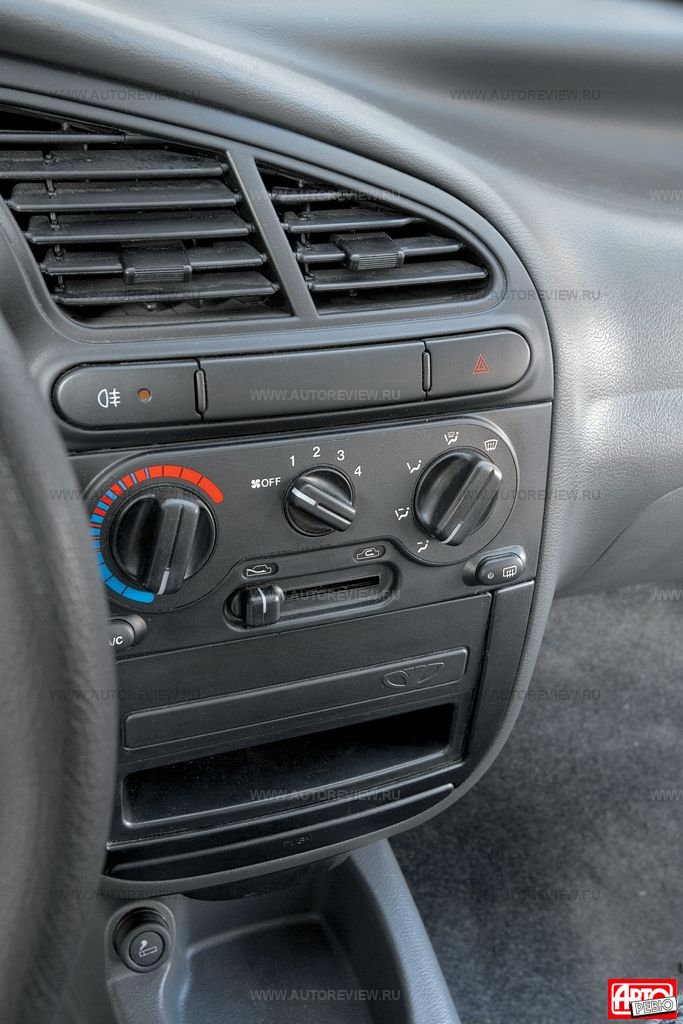 | 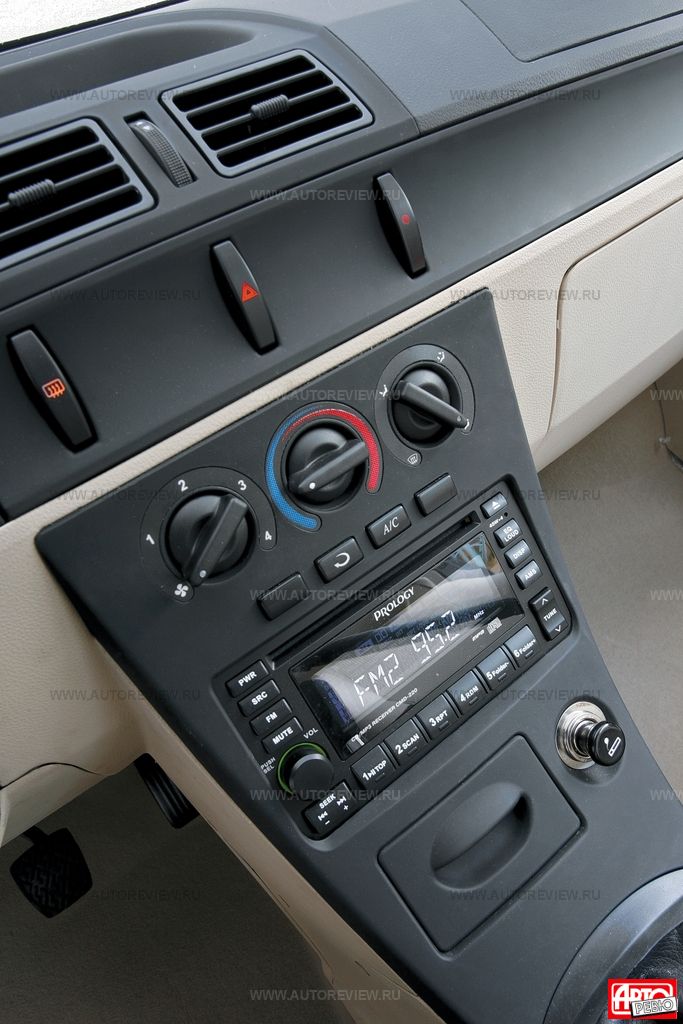 | 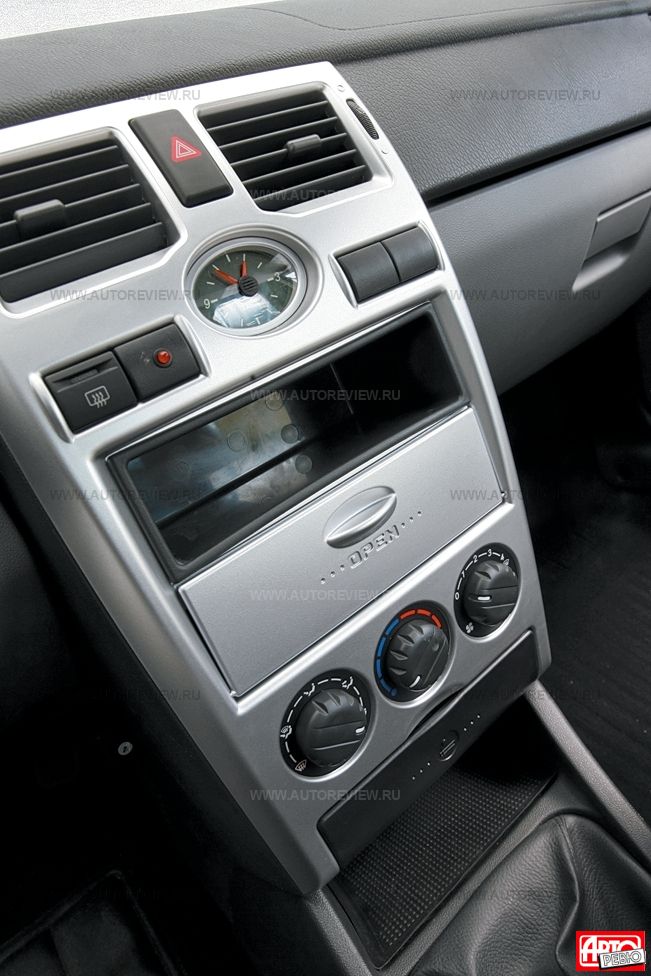 |
| Chevrolet Lanos and Geely Otaka — with air conditioning, but the "climate" knobs of the Geely rotate tightly and jerkily. And the Priora has neither air conditioning nor even a recirculation mode! The Prology radio is installed on the Geely for an extra charge — in the base version, all three sedans have only audio preparation | ||
The Chevrolet Lanos produced by the Zaporozhye Automobile Plant is already familiar to us: in its first battle, it lost to the Renault Logan and Chery Amulet, but surpassed the Uzbek Nexia and the "ten" with Kalina (see AR No. 2, 2006). Today it is one of the most affordable cars in its segment — for 279,500 rubles ($10,875) you can buy a Lanos with air conditioning and power windows. Cheaper than the Priora! It's no wonder that the Chevrolet Lanos is the second most popular foreign car in the class: in the first seven months of this year, 31,257 Lanos were sold (ahead is the Renault Logan — 36,875 cars).
| Chevrolet Lanos | Geely Otaka | Lada Priora |
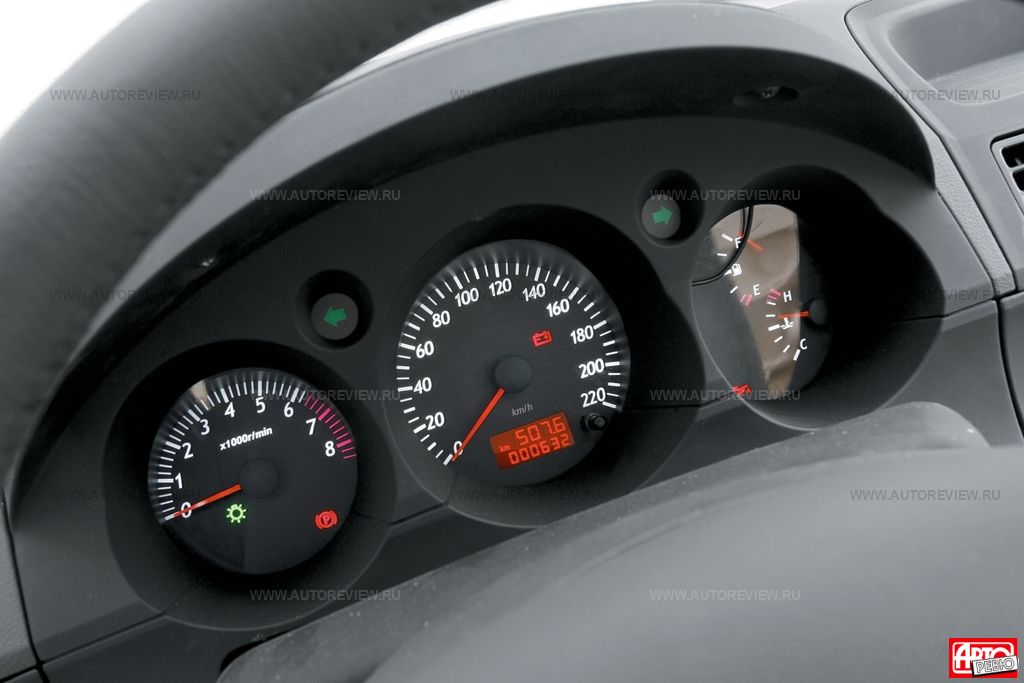 | 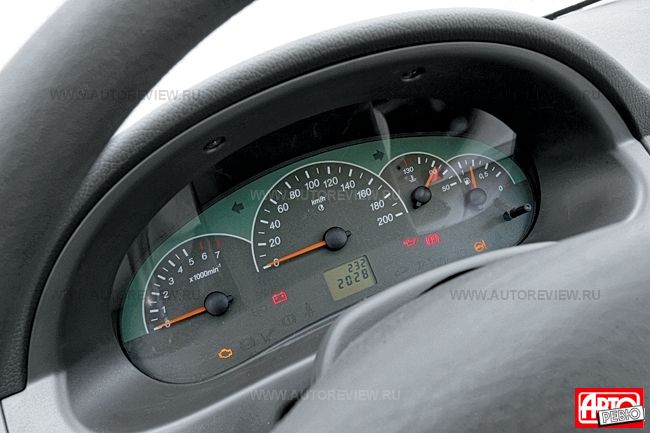 | |
| The instruments of all three cars are informative, and the VAZ ones are also attractive. The Lanos lacks a tachometer, and in the right "instrument" well of the Geely, some wire is hanging | ||
We arrived at the test site on time. At the VAZ dealership, an electrician was finally found who realized that the problem was not the battery: "It's the fuse; they often blow."
While Alexander Divakov was evaluating the driving characteristics of the Lanos, Andrei Mokhov was crawling with a tape measure around the Priora's interior. When measuring the range of steering column adjustment, he, as usual, first lowered the column to the stop, then began to raise it. But no such luck! The column hit something. Mokhov pressed harder, and suddenly smoke poured out from under the plastic cover. Andrei let go of the steering wheel — the smoking stopped.
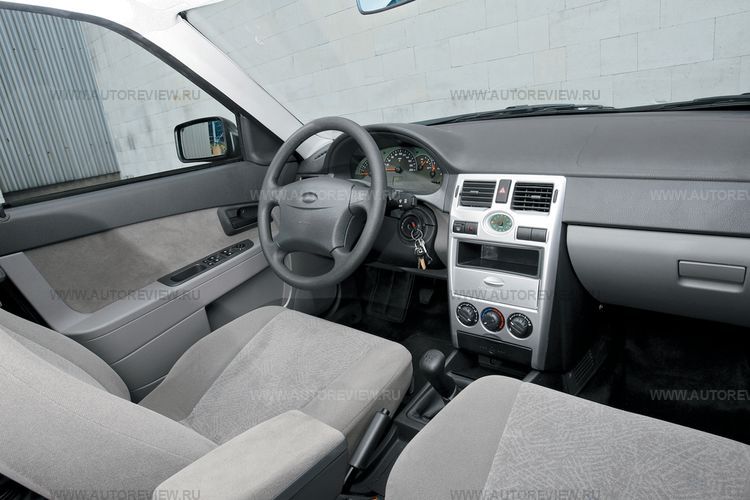
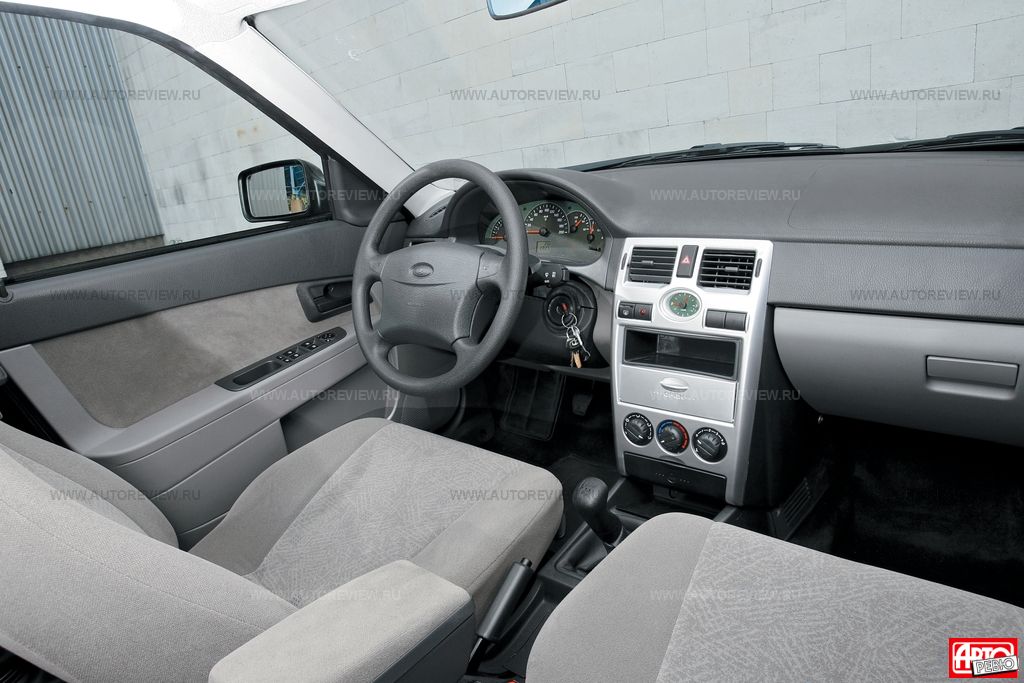
The Priora's interior is adorned with cozy oval clock, but the materials and assembly — alas, leave much to be desired
We removed the cover and found the cause: it turns out that the service technicians had installed a Barracuda anti-theft ignition lock on the Priora, but ran all the wiring not from below, as it should be, but over the lock housing. And as soon as the steering column was raised, the lock housing pressed the wires into the front panel frame, tearing and shorting them. So let us repeat the advice of our "anti-theft" specialist Konstantin Sorokin: do not agree to the installation of security systems at the point of sale of the car, but do it in specialized workshops! We were lucky: after running around the nearby auto shops, we found a replacement for the 50-amp fuse that burned out during the short circuit. Interesting, why do they "often blow"?
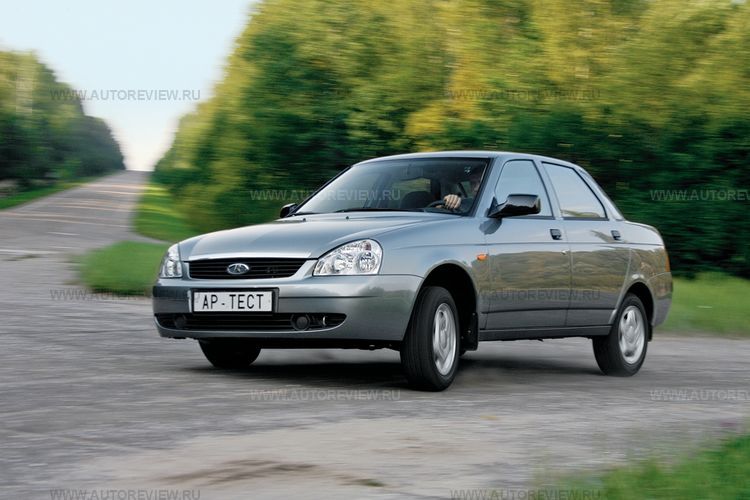
In sharp turns, the Priora leans and sways, but even on hard bumps it holds the trajectory firmly
Externally, the Priora is the same "ten," but with new, Korean-style protruding headlights, a nice radiator grille, and an even nicer rear. And inside — a completely different car: designers from the Italian firm Carcerano rejuvenated the "ten's" interior by about ten years. It was hard, dull, and crooked; it became soft, with silver inserts and even. Only the smell is the same as before. But we won't be scared off by the phenolic smell: while searching for the fuse, we also bought an air freshener! Worse is that the interior does not give a tactile sense of quality: the sunglasses holder on the ceiling and the compartment for small items on the center console have flimsy lids, the armrest between the front seats wobbles... However, in terms of driver's seat ergonomics, the Priora surpasses its test rivals. But it does not even deserve a "four." The amorphous "ten" seat holds the driver worse than others, and its longitudinal adjustment range is barely enough for a person 185 cm tall. You have to reach for the cottony gear shift lever and apply significant effort. Controlling the microclimate with three rotary knobs has become convenient, but the Priora does not yet offer not only air conditioning, but even a recirculation mode! Next to a smoking truck, an air freshener won't help: dealers should think about a "Gas mask as a gift" promotion.
| Chevrolet Lanos | Geely Otaka | Lada Priora |
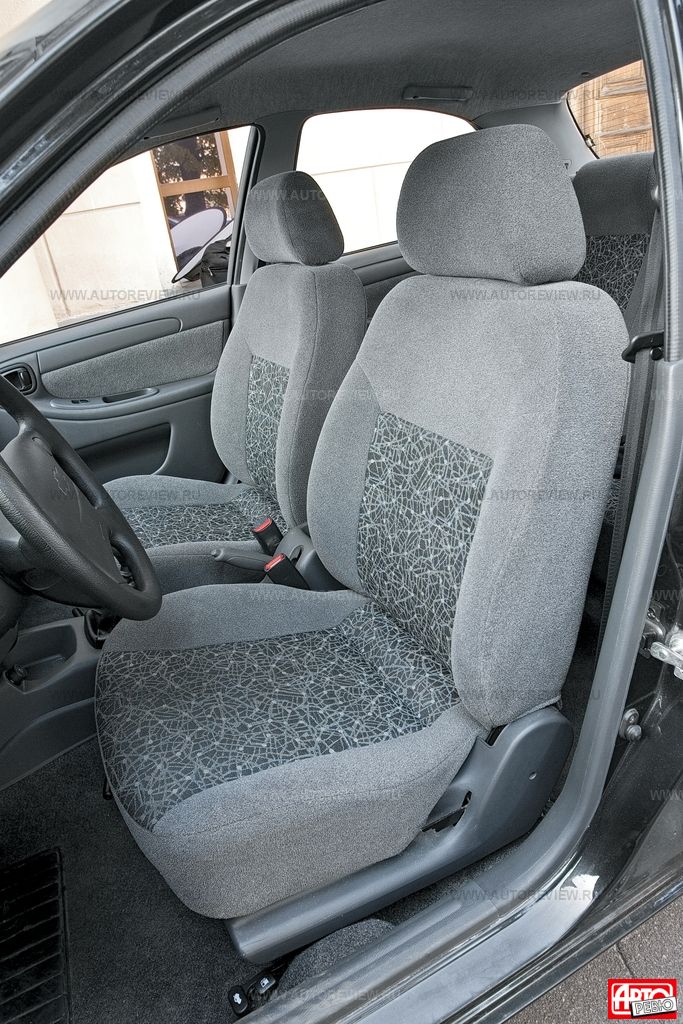 | 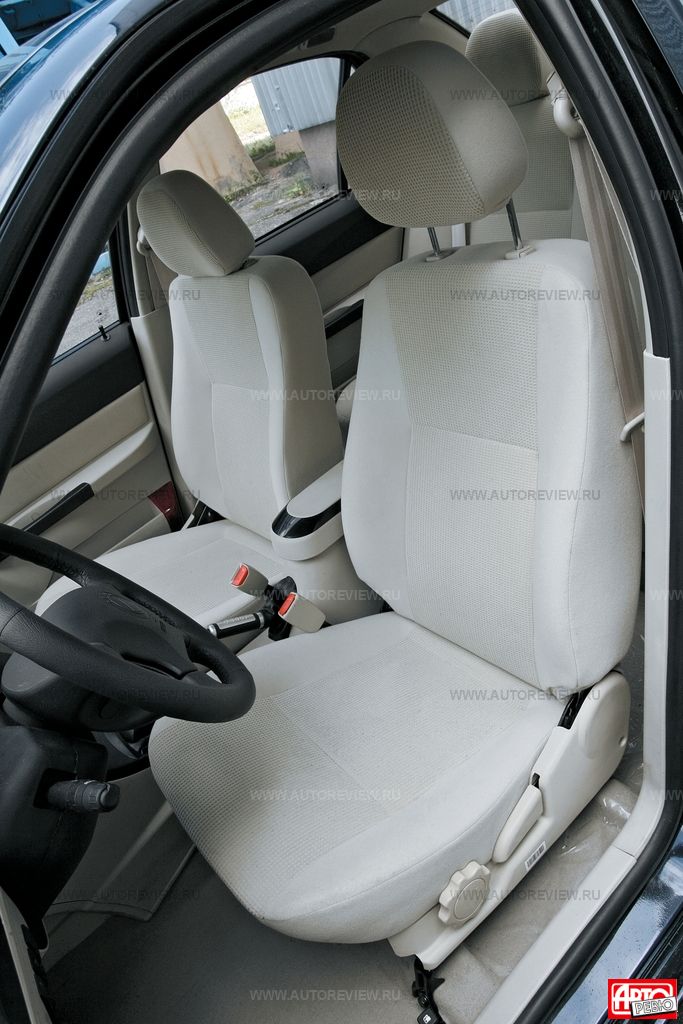 | 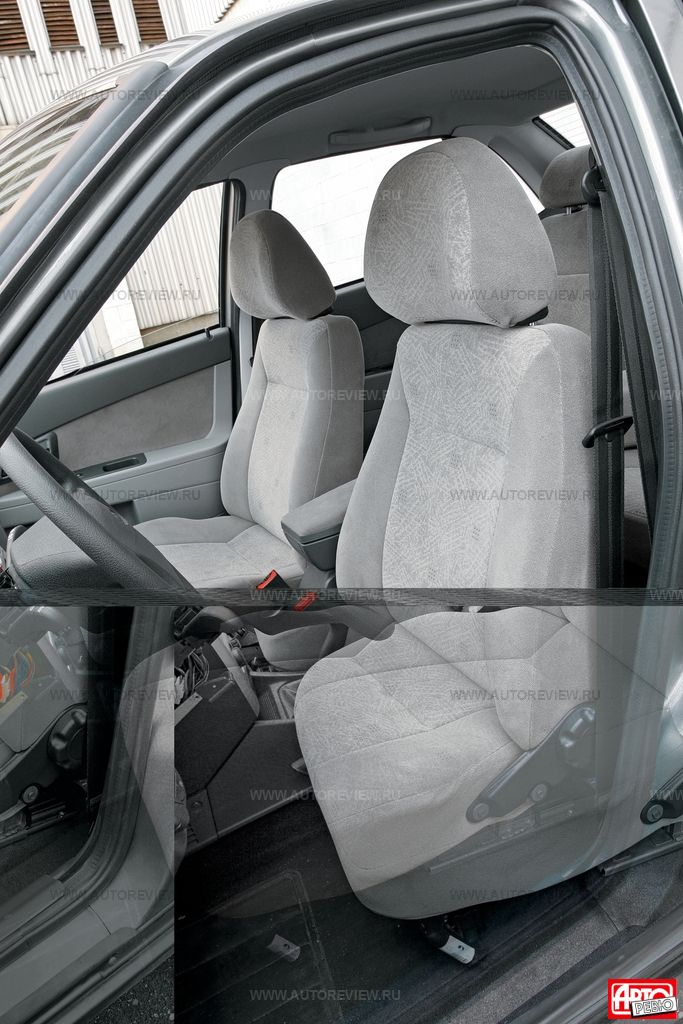 |
| The Priora's driver's seat is soft and amorphous. The Geely's seat is also not comfortable. And the best seat is in the Lanos, but, unlike the other two cars, the steering wheel and belts here are not adjustable in height. Between the front seats of the Otaka and Priora — armrests with boxes | ||
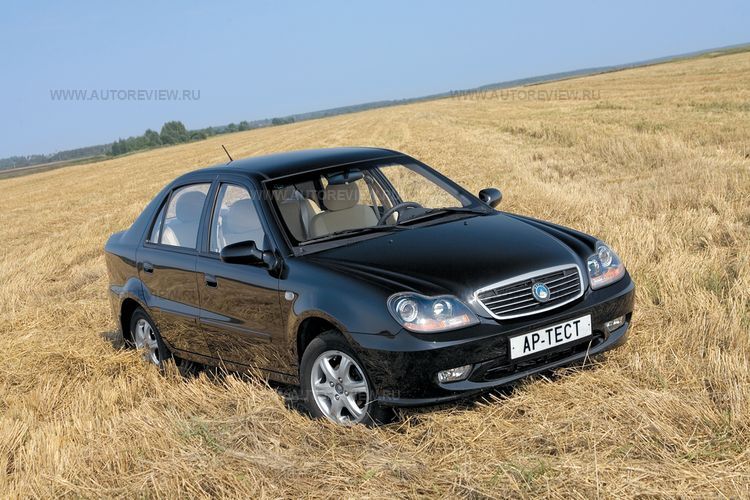
In the Geely Otaka sedan, which externally naively parodies the old Mercedes C-class, there is not only recirculation and air conditioning, but also four power windows (versus two in the Priora and Lanos), and with the auto-close function when the ignition is turned off!
The Geely's interior also initially makes a pleasant impression: a teardrop-shaped center console, a front panel with a concave crossbar like on the BMW Z4, instruments recessed into wells. The chemical smell here is weaker. But if you look closely, run your hand — the same old story! Plastic with flash and burrs, like rubberized door handles, plush seats. Among the consolations — leather-wrapped steering wheel, gear shift lever and parking brake handles. But the driver feels uncomfortable. There is not enough lumbar support and lateral support, and for short drivers, the seat cushion is too long. The steering wheel, like in the Priora, is adjustable in height, but it is tilted forward and turned to the left. The gear selection mechanism has long travel and low precision. The placement of seat belts is also alarming: fastened front occupants of slight build almost do not touch them!
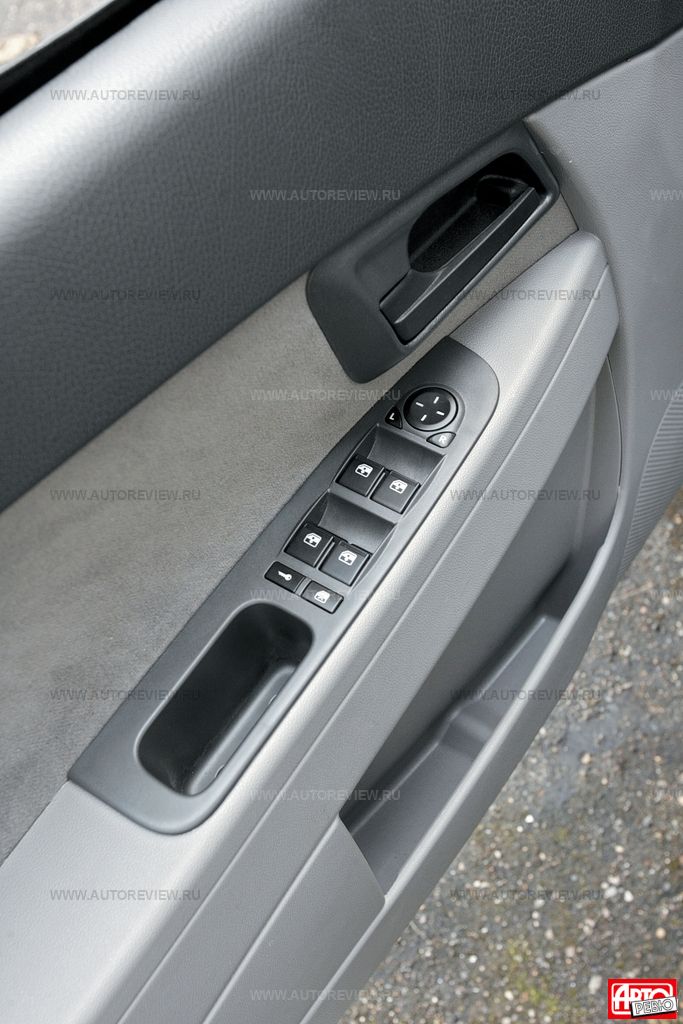 | 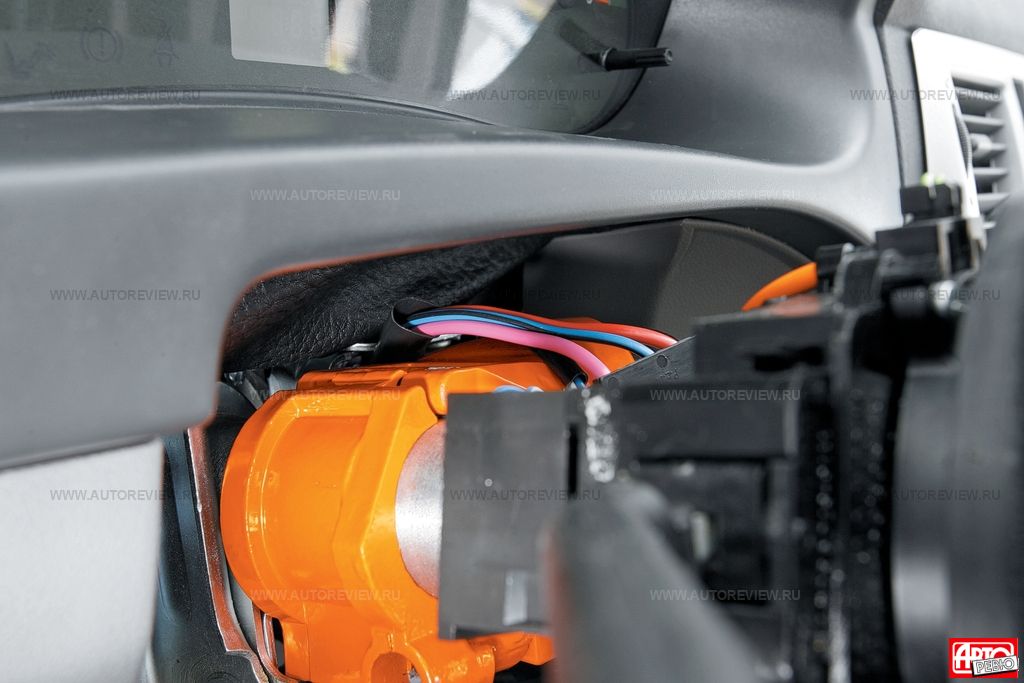 |
| On the driver's door of the Priora — buttons for controlling the mirrors and four power windows. But only the front windows "power up" — the rear ones are still manually operated. The plastic door handle is fragile — the tip has already chipped off | Such "pre-sale preparation" could lead to a fire |
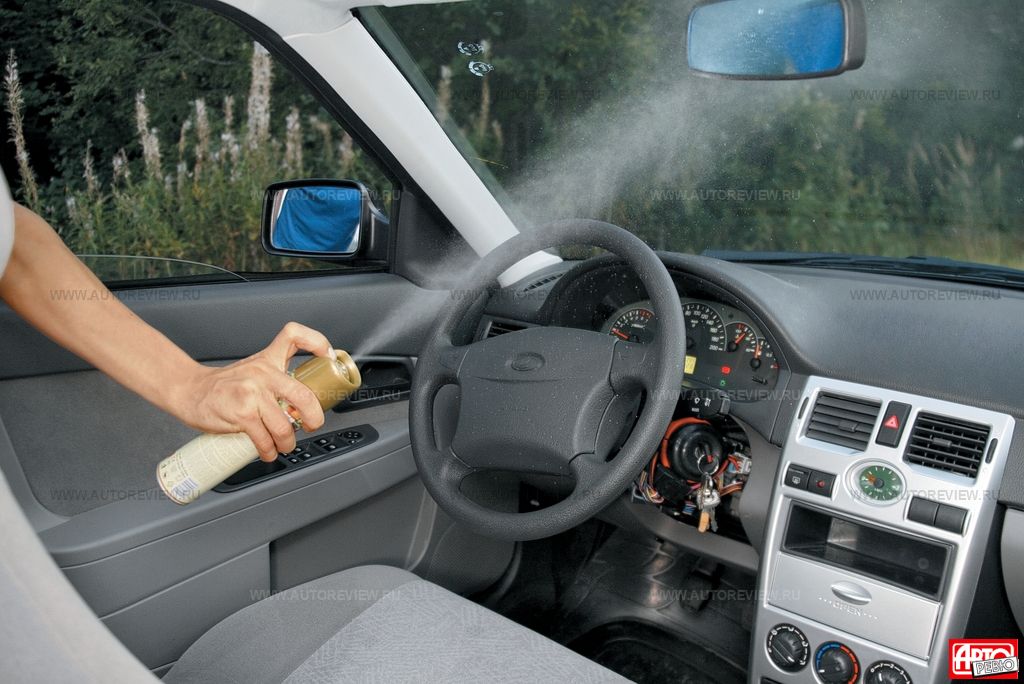 | 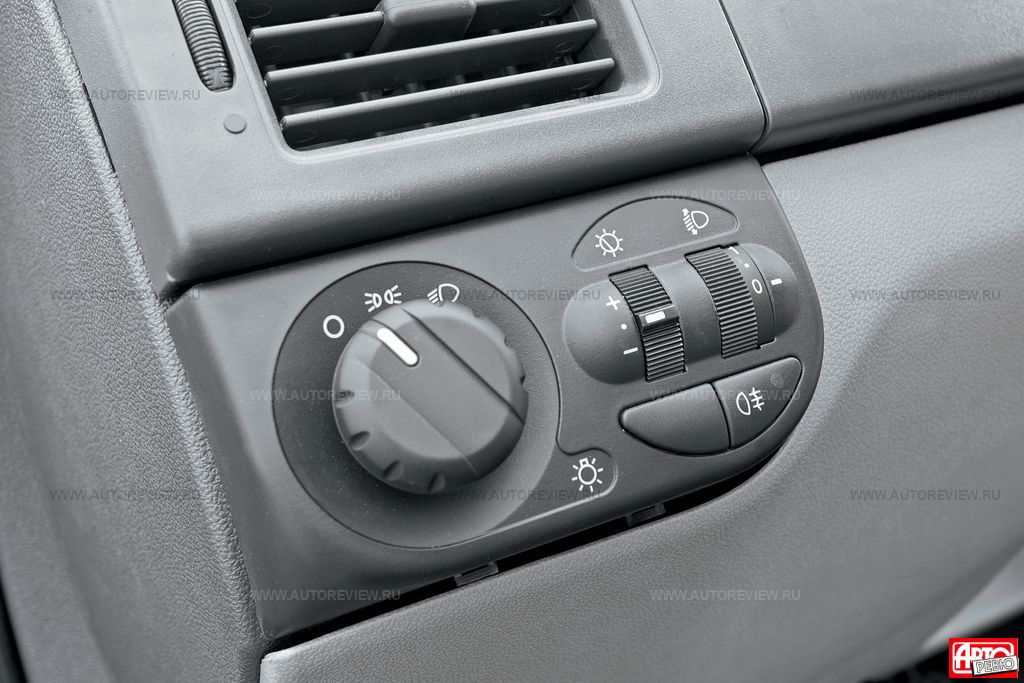 |
| We managed to cope with the phenolic smell in the Priora only this way… | Convenient light control unit — in the German manner |
Chevrolet Lanos is the most boring car in the test, both externally and internally. Even with the new shiny radiator grille trim, even in the top version with front electric windows and air conditioning. Grayer than gray. But the quality of the outdated bio-interior is beyond reproach. However, the ergonomics can be criticized — a person 185 cm tall barely has enough range of longitudinal adjustment of the driver's seat, and the steering wheel, which lacks adjustments, is positioned diagonally: its right part is closer to the driver than the left. The seat itself distributes loads well and holds the driver sufficiently. But Lanos is the only car in the test without height adjustment for the front seat belts.
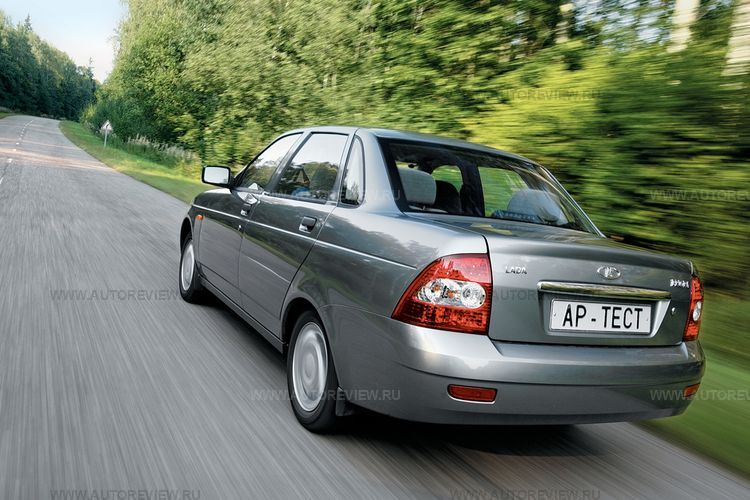
None of the cars can boast a good amount of rear space. Even in the Lanos, which is the most comfortable for rear passengers, it is difficult to sit, and knees raised due to the low seat cushion touch the front seat backs. When three people sit in the back, it is cramped in the shoulders and there is not enough headroom for the outer passengers.
Getting onto the rear sofa of the Chinese sedan is slightly easier, but sitting is even worse — the cushion here is as low as in the Lanos, but there is less legroom and noticeably more cramped for three.
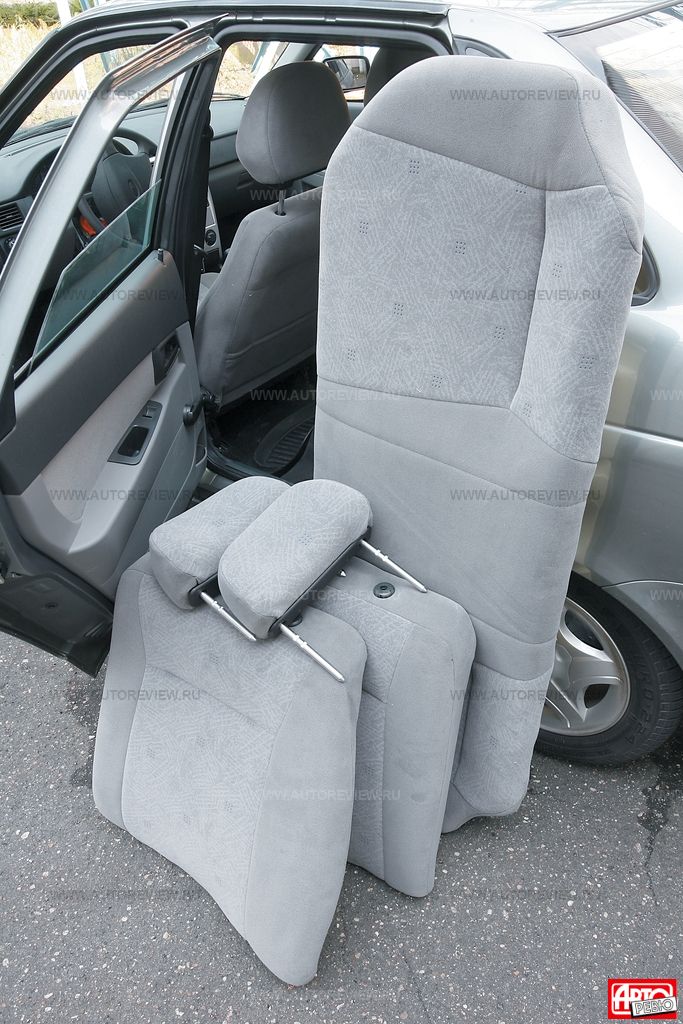
Getting into the Priora is the most convenient, but even a passenger 170 cm tall feels cramped in the back: they hit their head on the ceiling, and their feet are squeezed by the front seat frames. When three people sit in the back, the outer passengers press their heads against the hard rear pillar trims. So it is better to ride in the back of the Priora with two people, especially since it is the only one with a convenient central armrest, behind which there is a hatch for transporting long items. True, in "our" Priora this hatch was somehow screwed tightly to the frame with two self-tapping screws…
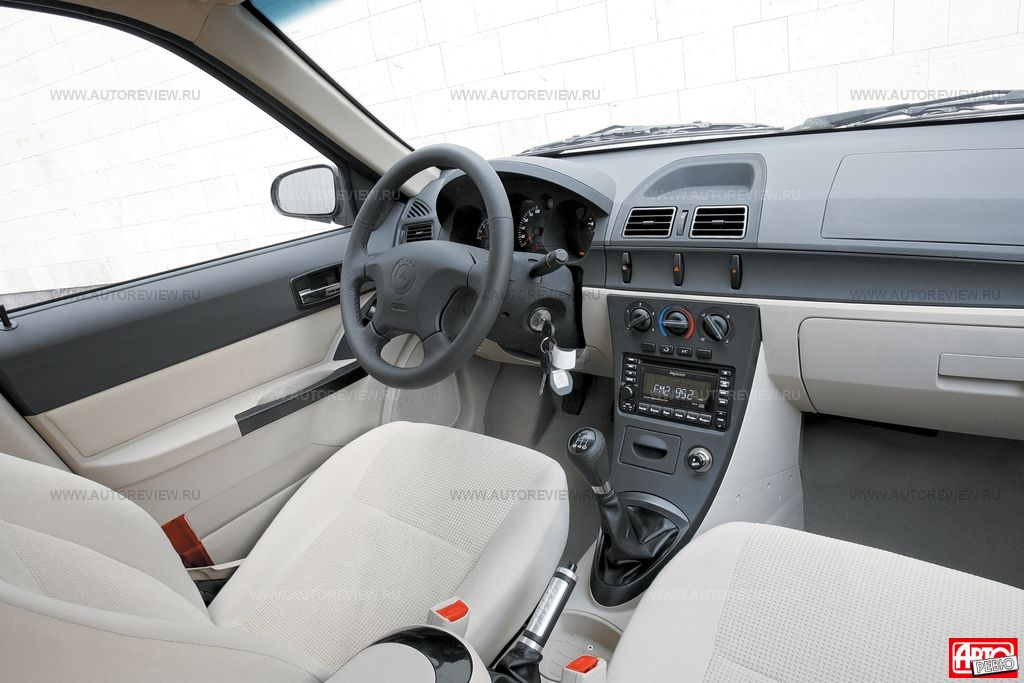 | 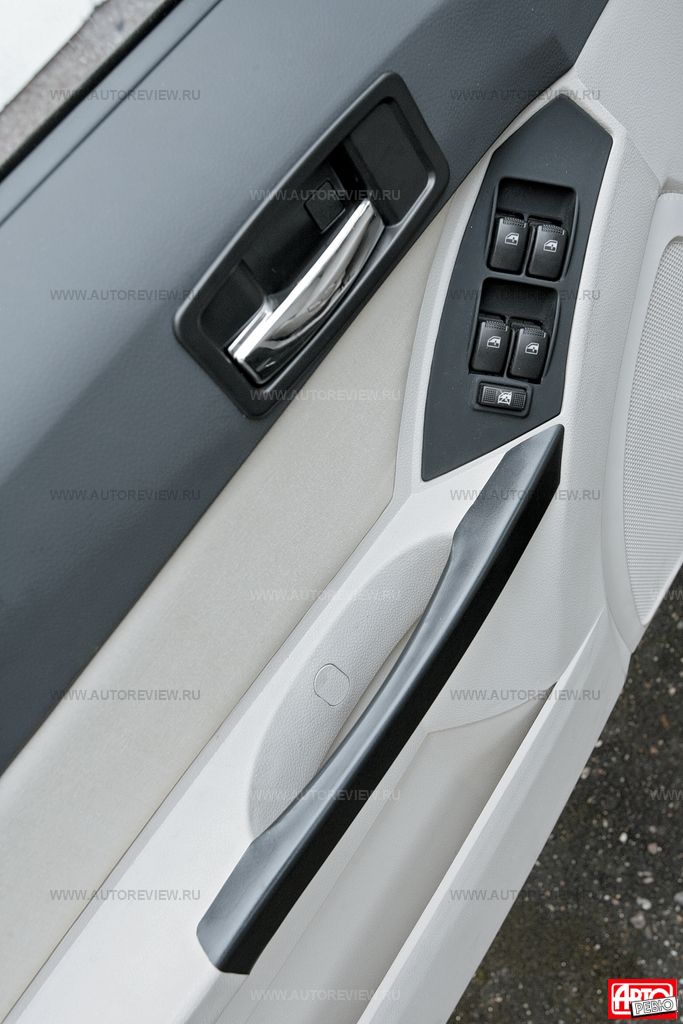 |
| The interior of the Otaka — with pretensions to style, but the matter is spoiled by poor materials and careless assembly | Four electric windows with auto-close when the ignition is turned off — in the base equipment of the Geely |
The trunks of the three sedans can be opened both from the outside and from the cabin. We considered the modest trunk of the Lanos (322 L) the most convenient due to its low loading height and large opening angle of the lid, and the least convenient — the cargo compartment of the Otaka: you might hit your forehead on the lid and the upper edge of the opening. The most spacious trunk is in the Priora: 430 L.
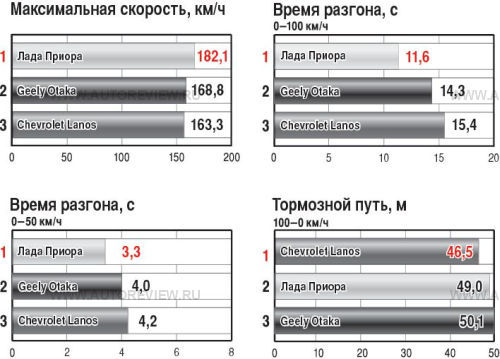
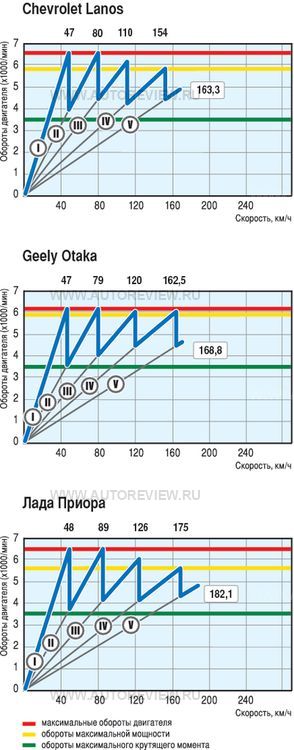
Also, the Priora has the most powerful engine — 1.6 liters and 98 "horses". The 1.5-liter Geely engine is only 4 hp behind the VAZ engine, but the Otaka accelerates as slowly as the Lanos (1.5 L, 86 hp) — 14.3 s and 15.4 s to 100 km/h, respectively, versus 11.6 s for the Priora. Moreover, by feel, the Geely is the most sluggish car, even despite the "short" gear ratios (second gear — up to 79 km/h, third — up to 120 km/h). The engine only slightly comes alive in the range from 3000 to 5000 rpm, declaring this with a strained roar. Managing the thrust is unpleasant: in the first third of the pedal travel, the gas pedal has "play", then it suddenly "hardens", the clutch engages high, and gear changes are not precise.
| Chevrolet Lanos | Geely Otaka | Lada Priora |
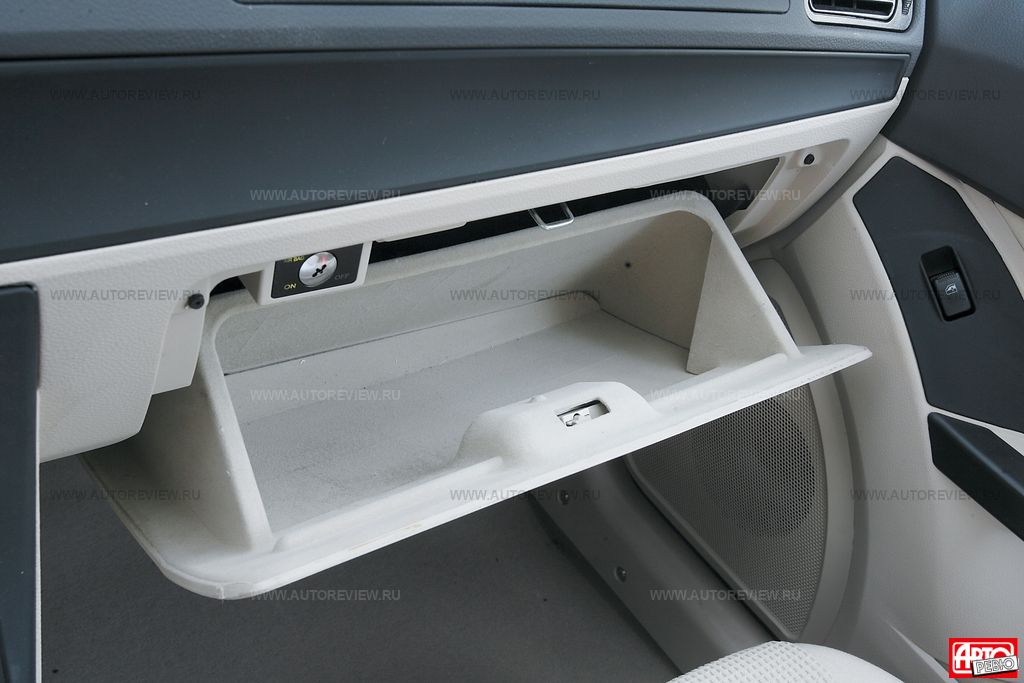 | 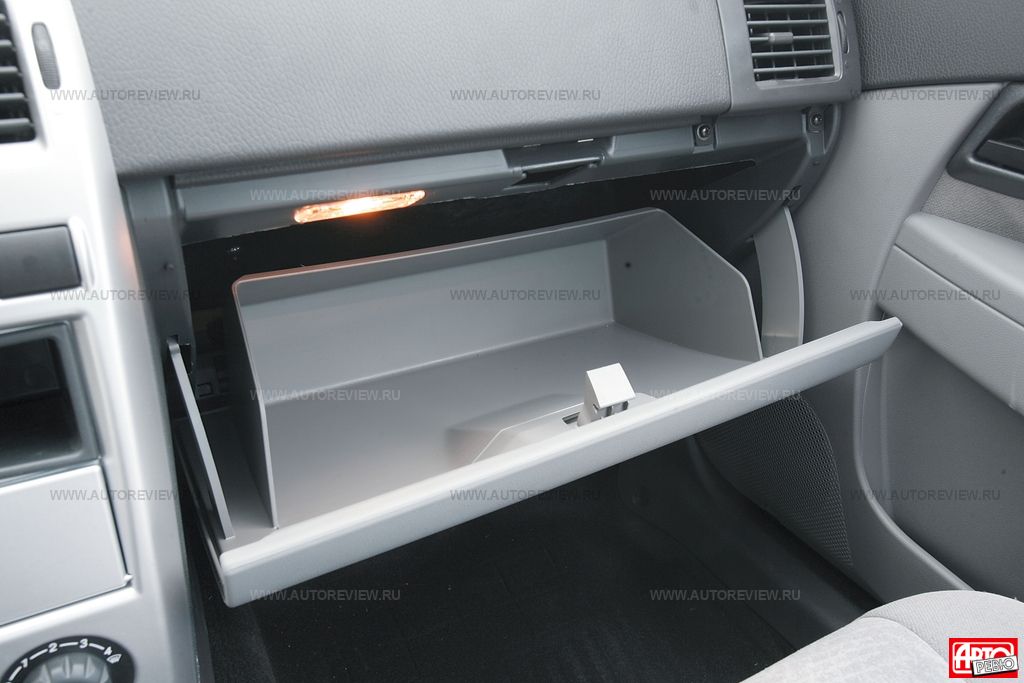 | |
| The most spacious glove box is in the Priora | ||
Against this background, the Lanos pleased with precise gear changes and quick, adequate responses to the light accelerator pedal. Especially since equally short gears (second — up to 80 km/h, third — up to 110 km/h) guarantee calmness in city traffic, and in terms of elasticity, the Lanos is even preferable to the more powerful Otaka. On acceleration, only the low-frequency engine hum with an "intake" whistle is annoying.
The Priora is the fastest car in the test, but it lacks the lightness of the Lanos: a large and uneven force on the gas pedal, stiff and imprecise gear changes. All this makes it difficult to dose the thrust and weakens the feeling of dynamics. But the tractive effort, despite the more stretched gears (second — up to 89 km/h, third — up to 126 km/h), is undoubtedly the best here: in fifth gear, the Priora confidently accelerates from 70 km/h. And the engine revs especially briskly from 3000 to the limit of 6300 rpm. It just sounds a bit hoarse.
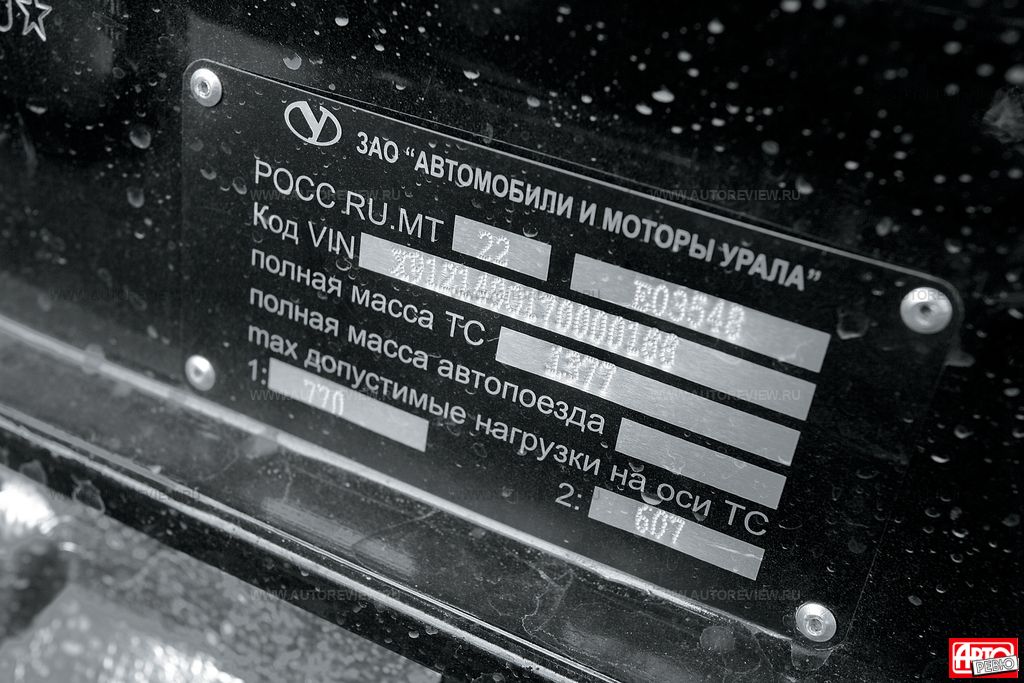 | 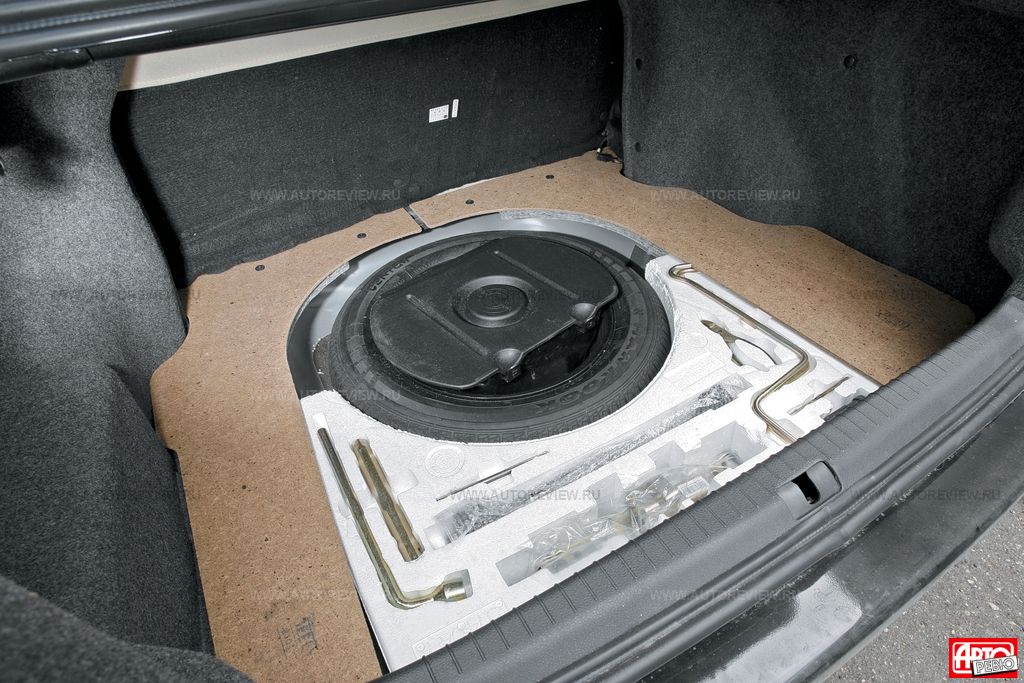 | 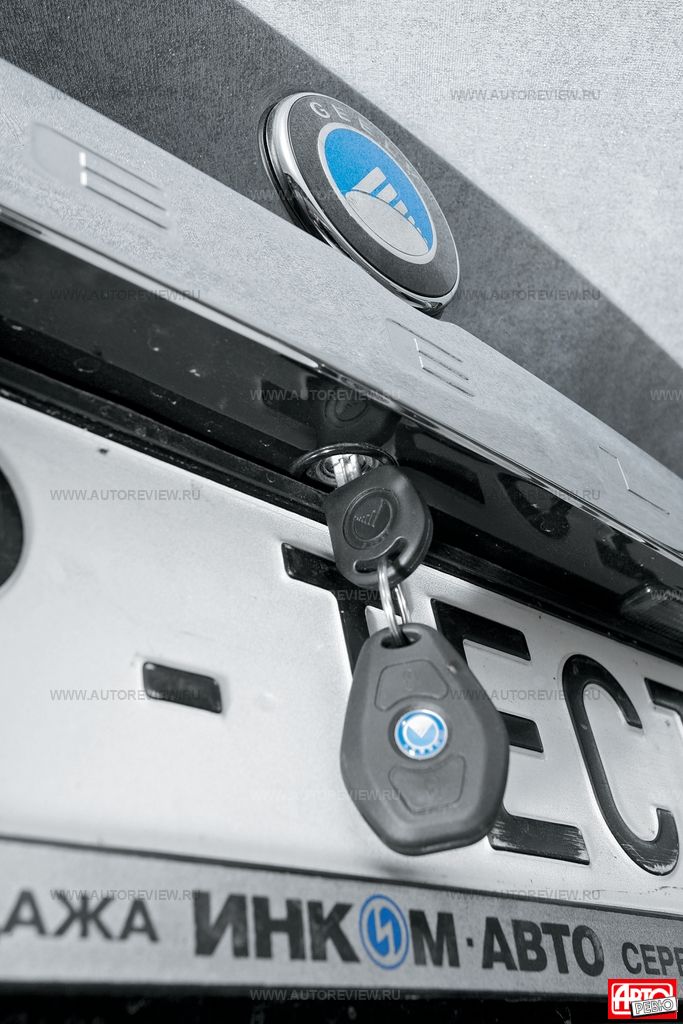 |
| For the Russian market, Geely Otaka sedans are "assembled" at the Novouralsk enterprise AMUR (Automobiles and Engines of the Urals), for the Ukrainian market — at the Kremenchug Automobile Assembly Plant (KrASZ) | In the trunk floor of the Geely, as in its rivals, there is a full-size spare tire | Opening the trunk of the Otaka from the outside is not easy: the key is inserted vertically upward |
The Priora stops well, at least for a car without ABS: 49 m from 100 km/h. But balancing on the verge of wheel lock is hindered by the spongy pedal. Under the same conditions, the Chevrolet Lanos (also without ABS) stops earlier (46.5 m) and it is easier to control deceleration. And the Chinese sedan, despite the proud "ABS+EBD" inscription on the rear, slows down the worst: the ABS engages unexpectedly early, the stiff brake pedal sinks deeply, and as a result — 50.1 m. Moreover, if the results of the Priora and Lanos were stable, then the pedal of the Otaka became stiff already on the second braking and the car rolled another five meters further! At least the electronic brake-force distribution (EBD) works decently — when braking in a corner, the car stays on the arc, only slightly drifting outward in understeer.
But Divakov returned from the mountain road of the Divakov test site angry: "You can't drive this car anymore! It rattles and is about to fall apart."

Divakov was frightened by a hard metallic knock from the left front wheel. After lifting the car on a hoist, we saw nothing criminal — apparently, the breakdown occurred inside the shock absorber strut. It's good that Divakov had already drawn conclusions about the Geely's driving characteristics. But they are also disappointing.
On a straight line, the Otaka holds up well, only slightly twitching the steering wheel on bumps. But even smooth lane changes strain the driver. The car does not react to steering wheel turns of up to 20 degrees, and then it lurches to the side! The reactive action on the steering wheel is stepwise — empty-thick-empty... The Geely enters sharp corners lazily, and on hard bumps it jumps off the trajectory, and it is impossible to compensate for these deviations with throttle — the play in the accelerator pedal interferes.
| Chevrolet Lanos | Geely Otaka | Lada Priora |
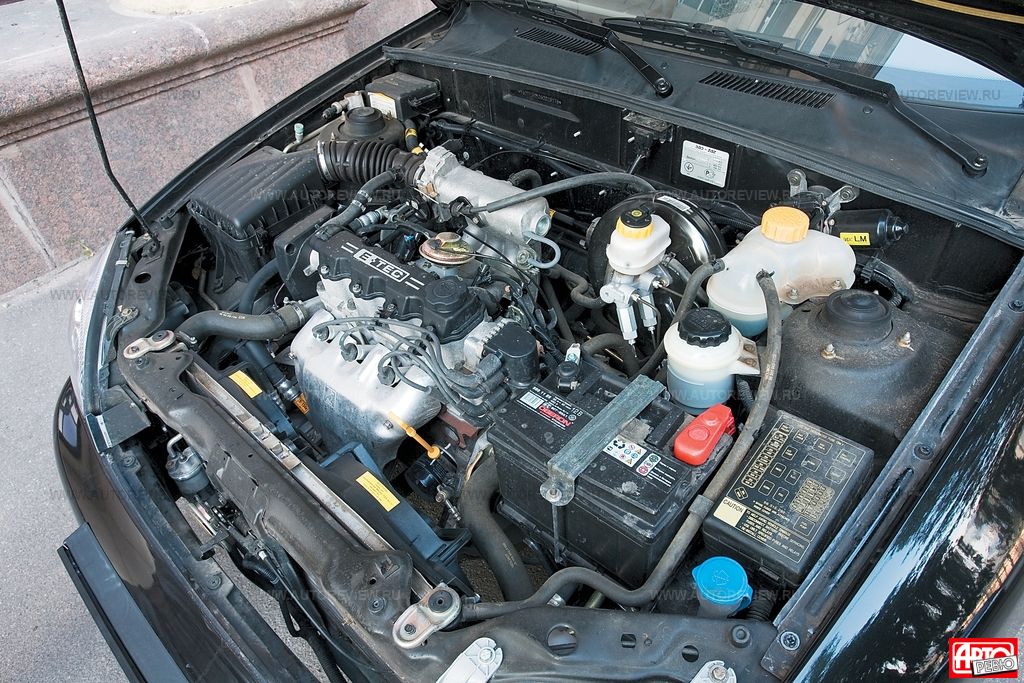 | 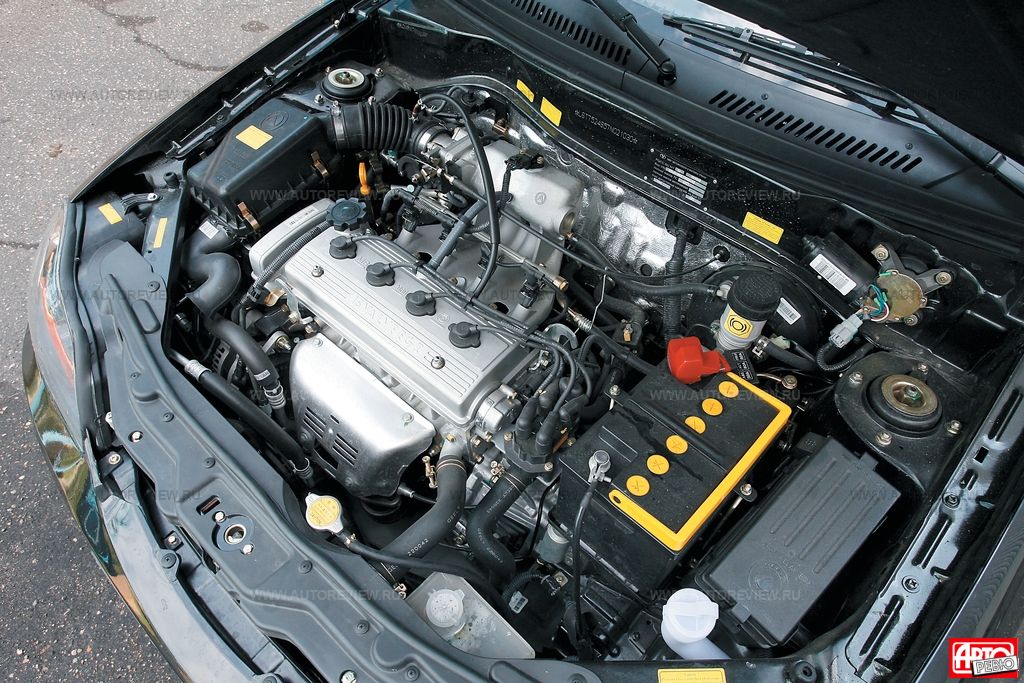 | 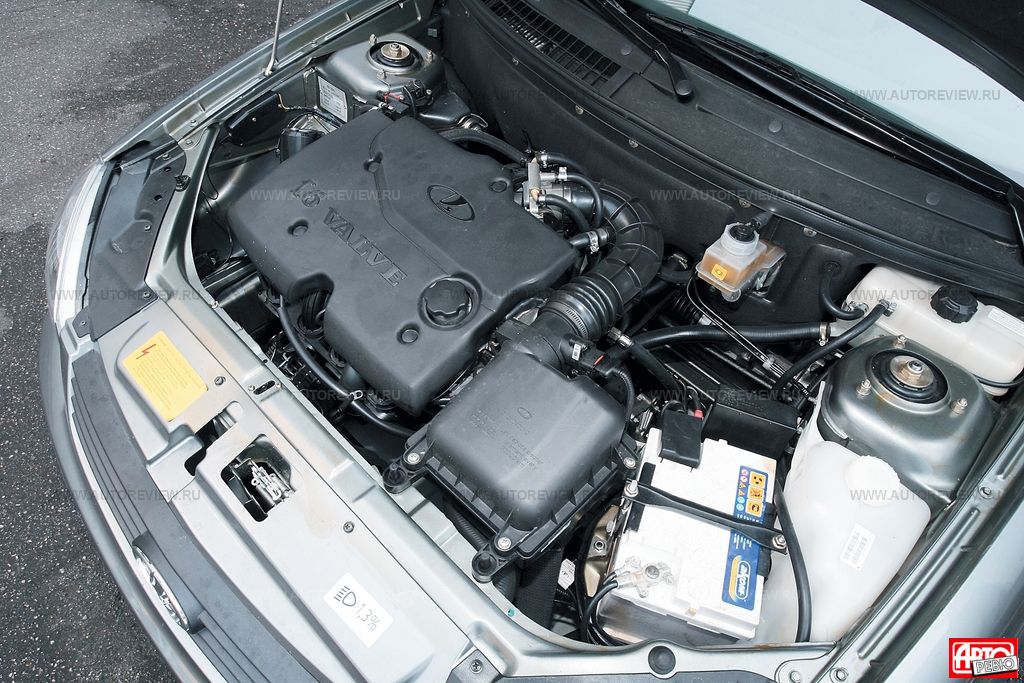 |
| The 1.5-liter Lanos engine develops only 86 hp, but the Chevrolet accelerates much more pleasantly than the more powerful Otaka, equipped with a licensed Toyota 5A-FE engine (1.5 L, 94 hp). And the leader in ultimate capabilities is the Lada Priora with a modernized engine (1.6 L, 98 hp) | ||
After the Chinese sedan, the Priora is a real driver's car! Even at maximum speed, even during relatively sharp maneuvers, the driver fully controls the car. In sharp corners, the Priora noticeably rolls and sways, but even on hard bumps it holds the trajectory, only slightly drifting outward of the turn in time with the oscillations. Unlike the Kalina, the electric power steering here is tuned as it should be — the weightless steering wheel in "parking" mode fills with juicy effort as speed increases. Only a certain stiffness distracts — the steering wheel does not want to return to the straight-ahead position on its own.
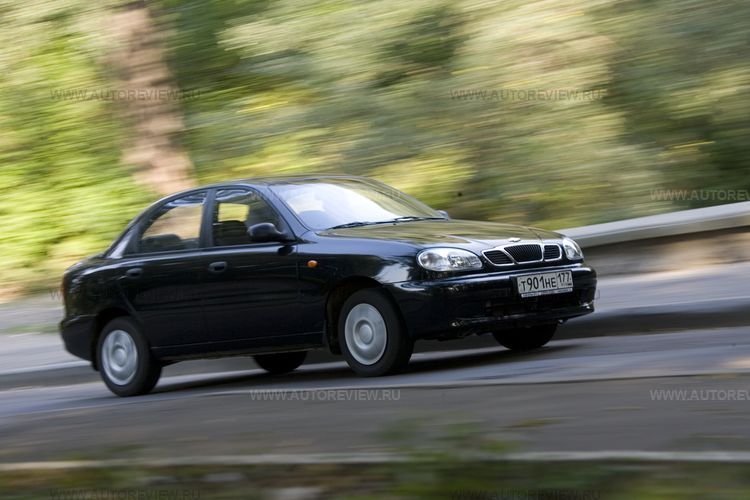
Chevrolet Lanos pleased with calm handling and good ride smoothness
Our memories of the Lanos's handling were unpleasant — last time we were scared by the delayed reactions to steering inputs (see AR No. 2, 2006). But that was in winter, on winter tires — and without power steering. And now, with the power steering — not bad! The low sensitivity remains, but the Lanos responds lively to driver commands. On a high-speed straight, it's the best — unlike the Priora, road irregularities don't cause the dynamic corridor to widen, and reactions to light steering inputs are soft and precise. In corners, it's also fine: the most reliable handling.
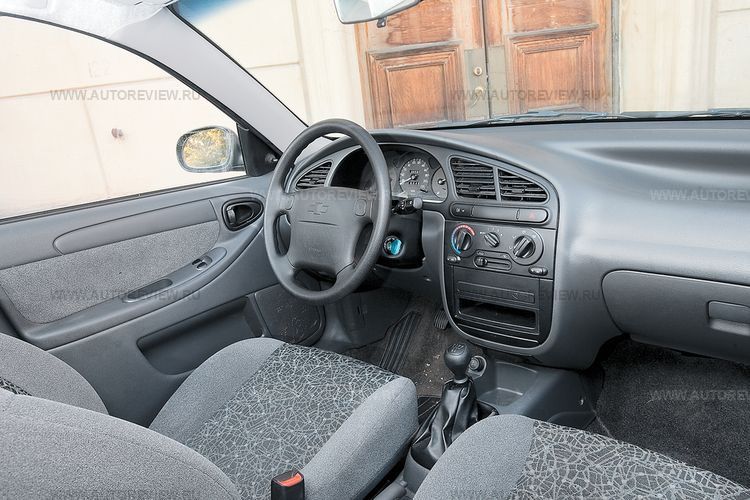
The Lanos's interior is dull but made quite well
The Lanos also leads in ride smoothness. On wavy surfaces, a tendency for repeated oscillations was noted, but without significant vertical accelerations. The soft suspension swallows small seams and cracks, rounds off medium irregularities, and only large potholes are met with noticeable impacts.
The Chinese Otaka rocks more on waves and reacts more sensitively to harsh irregularities. The well-known saying could be rephrased: less speed — more potholes. But the Priora is even more uncomfortable.
| Chevrolet Lanos | Geely Otaka | Lada Priora |
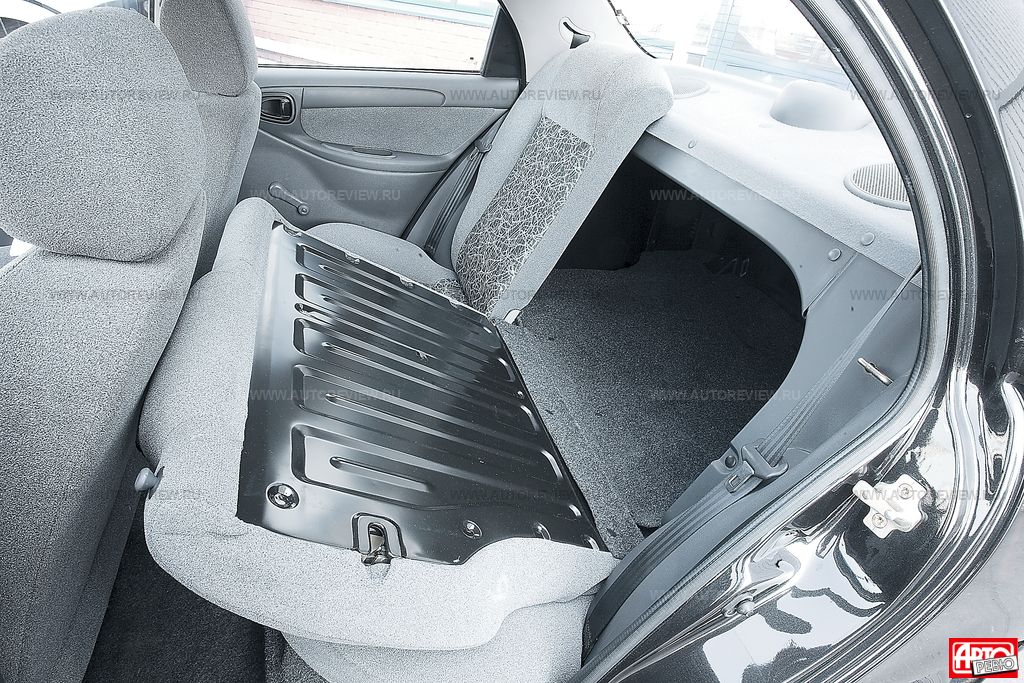 | 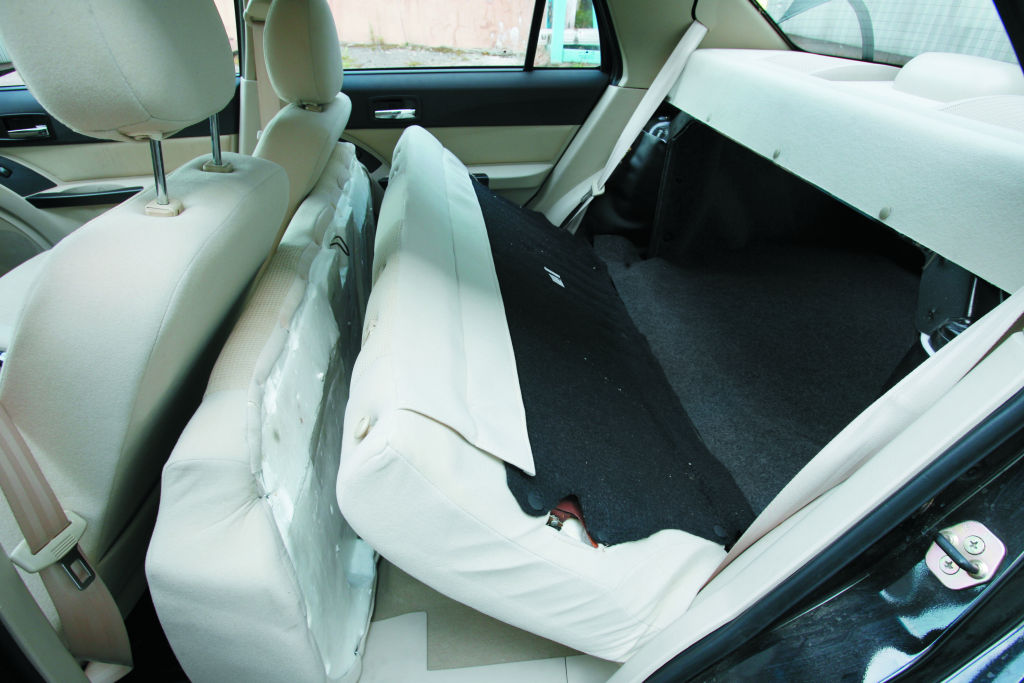 | 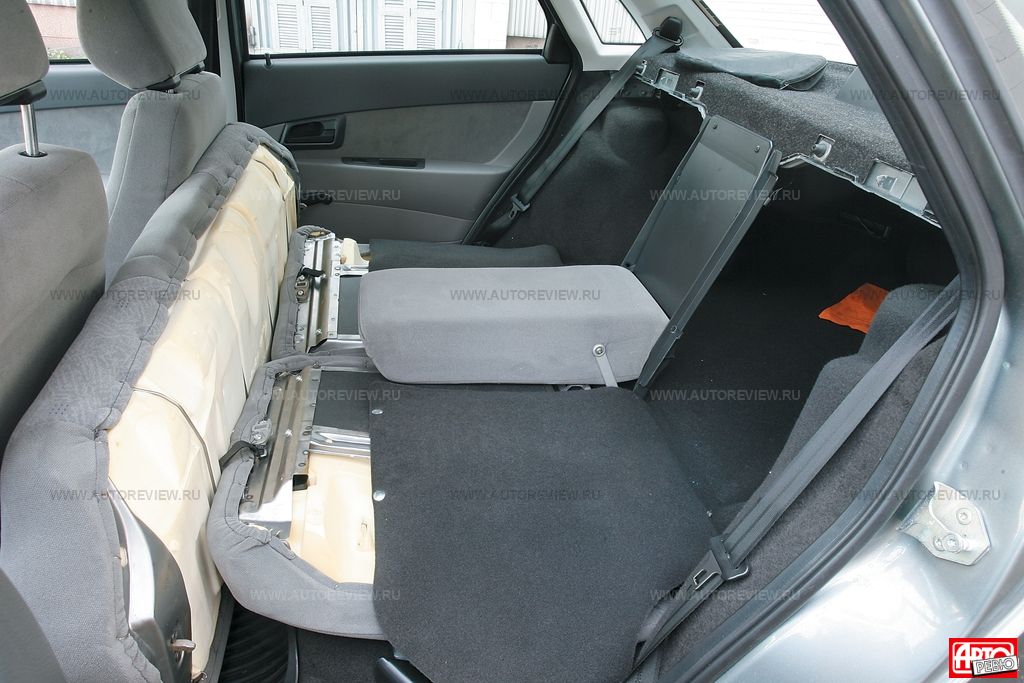 |
| In the Lanos, only the backrest halves fold. In the Otaka, the cushion also folds, but the one-piece backrest rests its side bolsters on the floor. In the Priora, after struggling with the latches, seat parts can even be removed from the car, but the armrest frame, as in the "ten", is rigidly fixed. Note the top of this frame — you can see the heads of self-tapping screws that were used to lock the long-load hatch on "our" car | ||
Even on relatively smooth surfaces, the Priora shudders and shakes. However, unlike the other two cars, it rounds off medium-sized irregularities better and doesn't rock.
What unites the three sedans is that they are all noisy: tires, engine, and wind are bothersome. And the noisiest is the Otaka.
| Chevrolet Lanos | Geely Otaka |
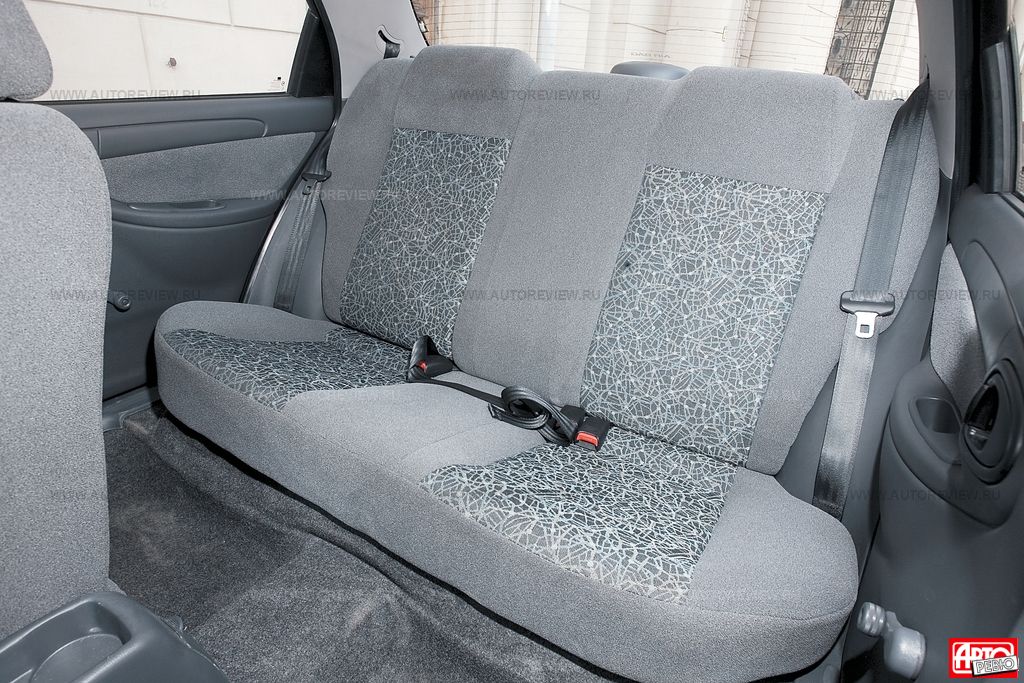 | 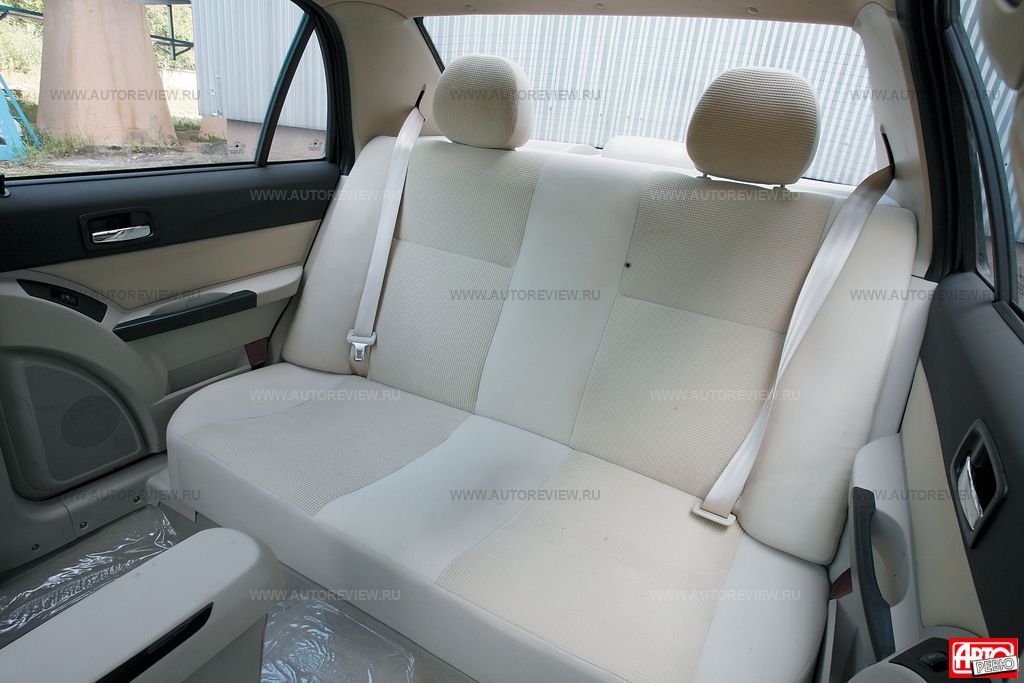 |
| In the back, it's cramped in all cars: in the Lanos and Otaka, passengers' knees press against the front seatbacks, and in the Priora, heads hit the ceiling. But only the Priora has a central armrest | |
| Lada Priora | |
 |  |
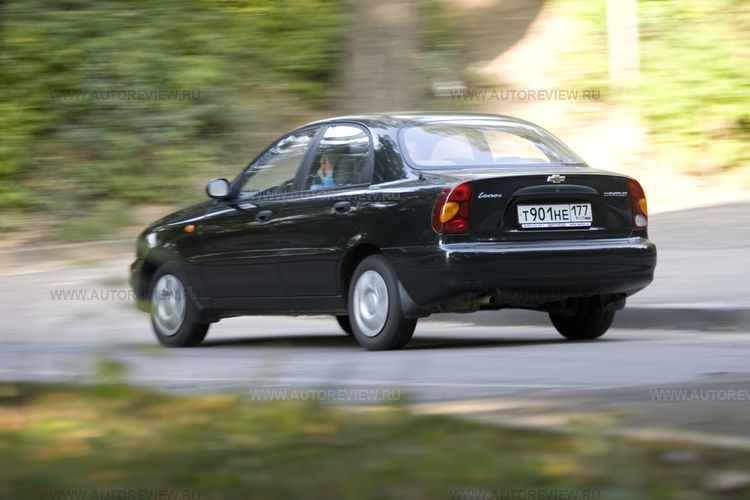
In the end, our choice is the Chevrolet Lanos. The old Korean sedan, assembled in Zaporozhye, is the most balanced in its grayness: everything is assembled and tuned well, reliable handling, good ride smoothness, and the most attractive price. With a driver's airbag, power steering, and air conditioning, the Lanos costs $10,875; without power steering and airbag, it's even $9,640.
The Lada Priora pleased with its interior design, powerful engine, and handling, but disappointed with the cabin build quality and "nervous" ride smoothness. What's even more concerning is that even without air conditioning, the Priora is more expensive than the Lanos — $10,990.
But the Priora is preferable to the Geely Otaka. The extremely low level of active safety immediately negates all the joys of air conditioning, four power windows, and other "bells and whistles." And when we saw the first results of the crash test, which was conducted just during the preparation of this material... Even if there were ten air conditioners here! No, thank you. Better the Lanos or the Priora. And cheaper, by the way.
| Chevrolet Lanos | Geely Otaka | Lada Priora |
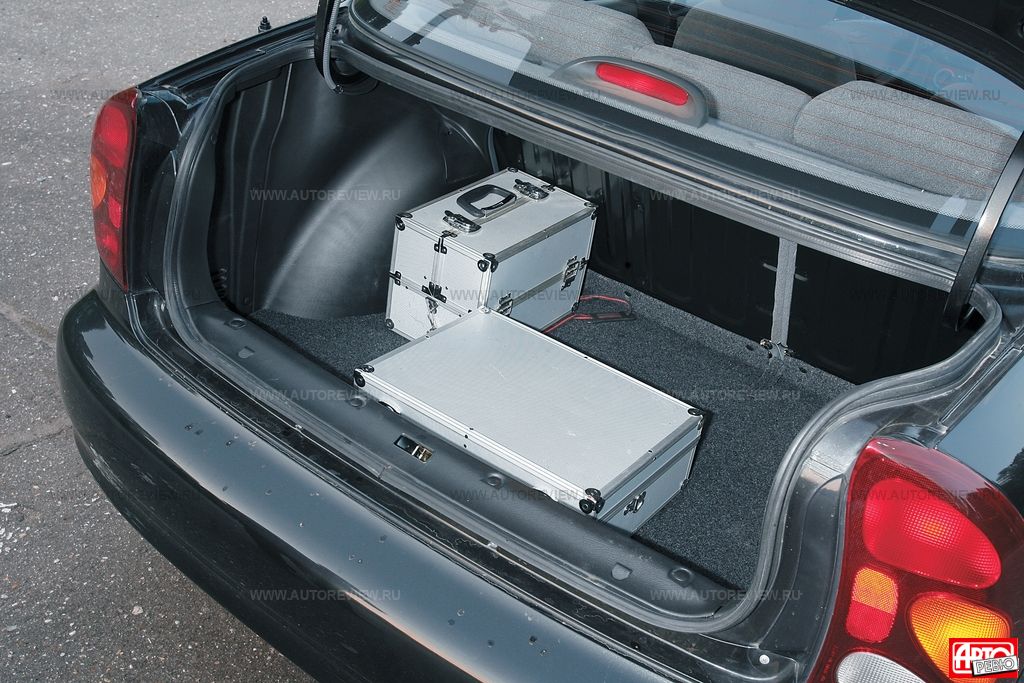 | 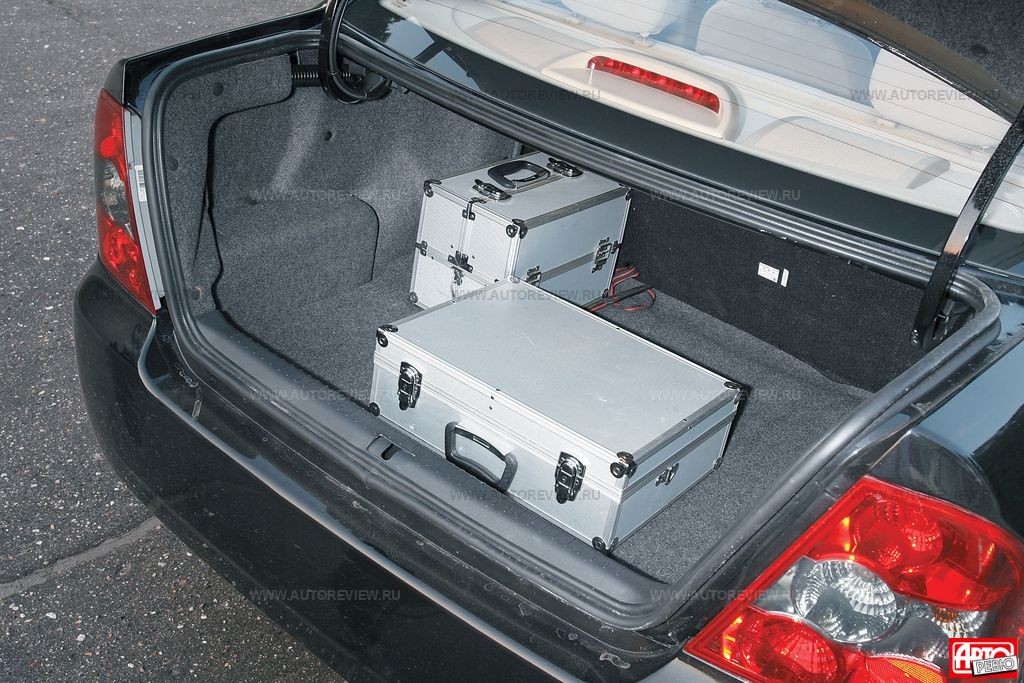 | 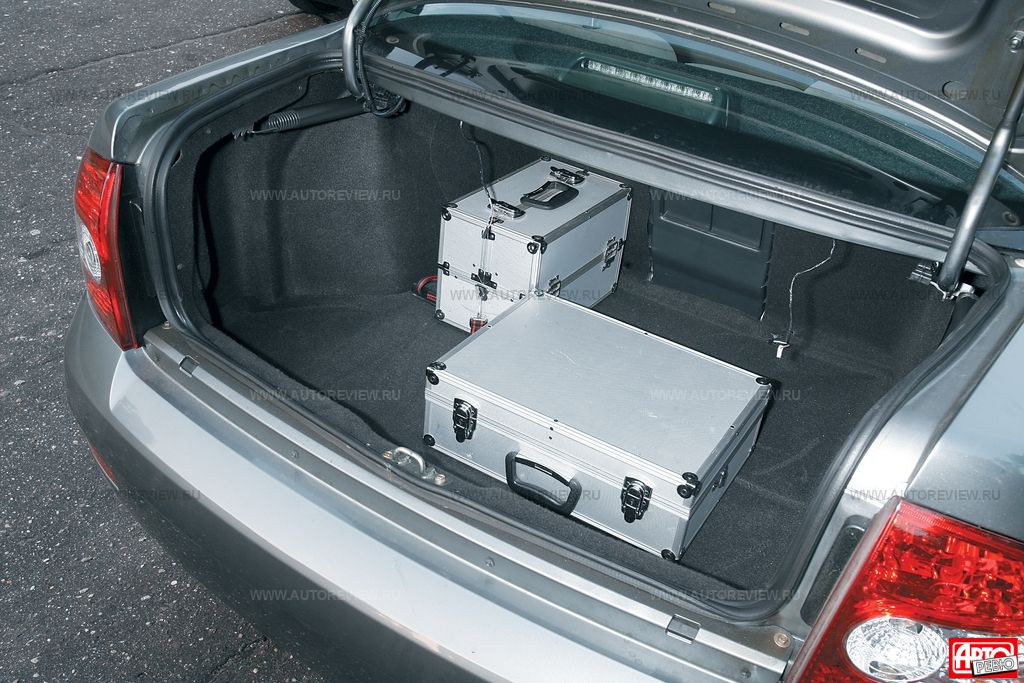 |
| The Lanos's trunk is cramped (322 L), but convenient: the lowest loading height (690 mm), a large lid opening angle. The Otaka and Priora aim their lower lid edges at the "loader's" forehead. The Priora has the highest loading height (750 mm), but the most spacious trunk: 430 L. Hanging wires — audio preparation in the VAZ style | ||
Who's Attacking?
The Chinese company Geely was born in 1986 as a real estate broker and refrigerator manufacturer. A bit later, production of finishing materials began, and in 1992, the company established a partnership with the Japanese firm Honda and launched licensed production of light motorcycles and scooters. Two years later, the first motorcycle under the Geely brand debuted.
Geely began producing cars in 1998 — these were copies of the 1987 Japanese subcompact Daihatsu Charade. Their modifications still form the basis of Geely's automotive business. And in January 2003, the experimental Beauty Leopard coupe appeared, developed jointly with the Korean company Daewoo.
The hero of our test, the Geely CK sedan (sold in Russia as the Geely Otaka), saw the light in 2005. The 1.5-liter engine is licensed from Toyota, and modifications with "automatics" are also available on the Chinese market. Since June of this year, the Geely Otaka has been assembled using the CKD method at the Amur plant in the Sverdlovsk region. About 17,000 cars are planned to be produced by the end of the year, and the plan for 2008 is about 30,000 cars.
In 2006, China began selling larger Geely King Kong (MK) and Geely Vision (FC) sedans on the "monocoque" chassis of the previous-generation Toyota Corolla sedan — the Chinese plan to supply these cars to Russia starting next year.
In addition to the Geely Automobile division, the Geely holding includes SMA (Shanghai Maple Automobile), which produces sedans and hatchbacks based on the Citroen ZX. At the beginning of next year, these cars will also begin selling in Russia.
Besides Russia, Geely cars are already sold in Latin America, Africa, Ukraine (where the Chinese also have assembly production), Belarus, Kazakhstan, as well as in the Middle East and Southeast Asia. This year, the company planned to enter the US market, but due to cars not meeting strict environmental and safety standards, the foray into North America has been postponed until 2010. By then, it is planned to bring Geely's annual production volume to one million (two-thirds for export), introduce fifteen new models, eight engines, and six automatic transmissions.
Before this test, we asked visitors to the website www.autoreview.ru to answer the question: "Which of the cars participating in the next Autoreview test would you prefer?"
Here's how the votes were distributed:
Chevrolet Lanos 50.03%
Geely Otaka 4.21%
Lada Priora 45.76%
5,103 people voted
| Expert assessments of Autoreview | ||||
| Parameters assessed | Cars | |||
| Max. score | Chevrolet Lanos | Geely Otaka | Lada Priora | |
| Design | 160 | 105 | 100 | 110 |
| Exterior | 80 | 50 | 50 | 55 |
| Interior | 80 | 55 | 50 | 55 |
| Ergonomics | 160 | 120 | 100 | 120 |
| Driver's workplace | 80 | 55 | 50 | 60 |
| Visibility | 80 | 65 | 50 | 60 |
| Dynamics | 280 | 225 | 190 | 220 |
| Acceleration dynamics | 90 | 65 | 60 | 70 |
| Braking dynamics | 100 | 85 | 70 | 80 |
| Handling | 90 | 75 | 60 | 70 |
| Ride comfort | 200 | 145 | 125 | 120 |
| Ride smoothness, vibration protection | 70 | 55 | 50 | 45 |
| Acoustic comfort | 70 | 45 | 35 | 40 |
| Climate control | 60 | 45 | 40 | 35 |
| Cabin comfort | 200 | 135 | 115 | 100 |
| Passenger seats | 70 | 50 | 45 | 40 |
| Trunk | 70 | 50 | 40 | 45 |
| Cabin transformation | 60 | 35 | 30 | 15 |
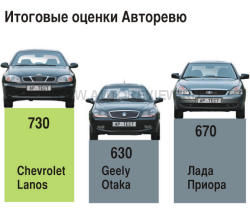
| Total score | 1000 | 730 | 630 | 670 |
Are they safe?
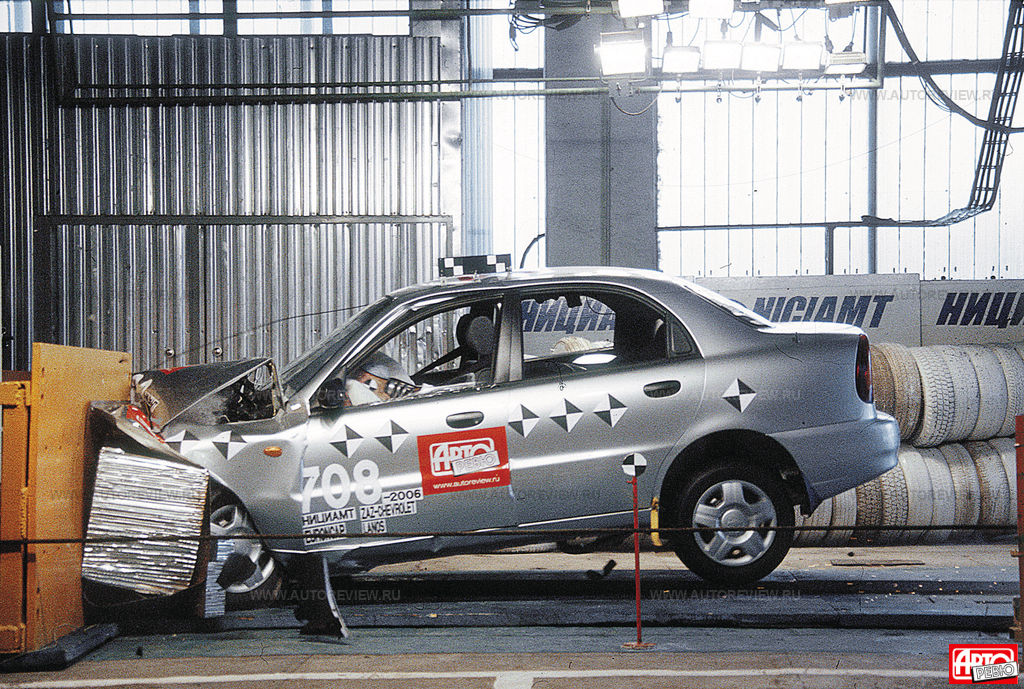
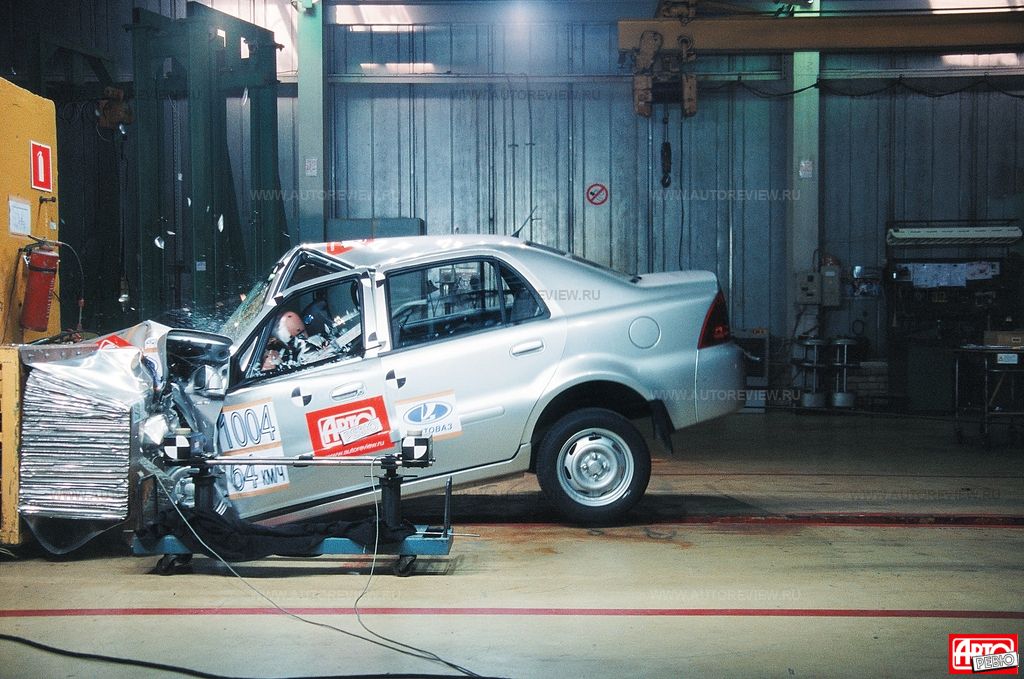
Such cars, as a rule, cannot boast a serious set of active and passive safety features. For example, the base Chevrolet Lanos sedan has no airbags, while the top version has only a driver's airbag. The Lada Priora became the first of the domestic cars to be equipped with a driver's airbag as standard. And the Chinese sedan Geely Otaka gets front airbags in a pair, but only on the top version.
We tested the Ukrainian-assembled Chevrolet Lanos for safety according to the EuroNCAP methodology a year and a half ago (see AR No. 8, 2006). The body withstood the impact well, the airbag deployed normally, and the driver's door opened without much effort. The rating was reduced due to increased loads on the chests of both dummies and dangerous contact of the driver's knee with sharp edges of the cracked dashboard. As a result, for protection in a frontal impact, the Lanos scored 10.5 points out of 16 possible. Interestingly, in 1998, the Daewoo Lanos hatchback for the European market scored only 6 points in the EuroNCAP crash test — due to overload of the passenger dummy's neck.
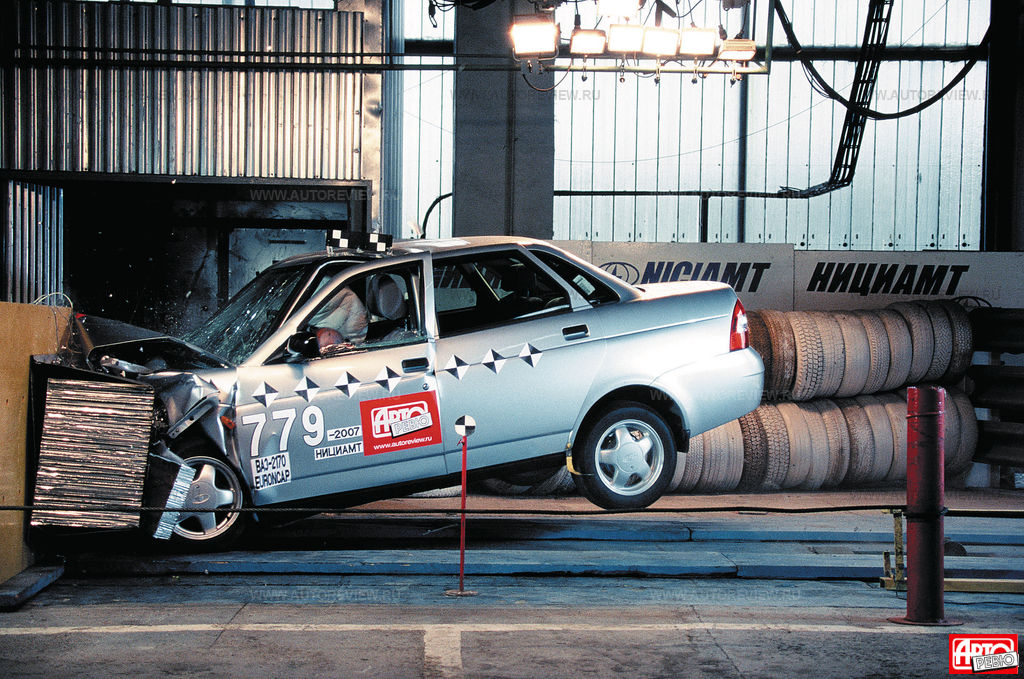
We crashed the VAZ Priora in mid-summer (see AR No. 15, 2007), and it significantly lost to the Lanos, receiving only 5.7 points out of 16 for a frontal impact. The steering wheel shifted strongly upward and to the right from the impact, the driver's head slipped off the airbag and hit the instrument panel visor. The passenger hit his head harder — the pliable belt is to blame. The leg protection of front occupants is also weak. If we add the score for the side crash test (see AR No. 10, 2007) to the frontal points, the Priora scores 14.7 points out of 32 possible — that's only two stars out of five according to the EuroNCAP rating. The situation should change next year with the start of serial production of the Priora phase II — with a reinforced body, two airbags, and pretensioners for the front belts: in the frontal crash test by AvtoVAZ, such a car earned 10.6 points (see AR No. 15, 2007).
And we crashed the Chinese sedan Geely Otaka quite recently. While preparing this material, the data were still being processed, but it is already clear that the Geely Otaka is the most dangerous car in the test: the driver has no more chance of survival than the driver of the Chinese car Chery Amulet (see AR No. 11, 2007) — both the head, hips, and feet are in danger. We will publish a detailed report on this crash test in one of the upcoming issues of Autoreview.
| Chevrolet Lanos | Geely Otaka | Lada Priora |
 |  |  |
Visibility
The best visibility is in the Lanos: good exterior mirrors, excellent rear view. The Priora has more massive front pillars, the wipers leave a wide uncleaned strip in front of the driver's eyes, but the side mirrors are the best, and the rear window opening is only slightly blocked by headrests. In the Otaka, good visibility is hindered by vibrating exterior mirrors with high diopter and huge rear headrests that significantly block the window opening
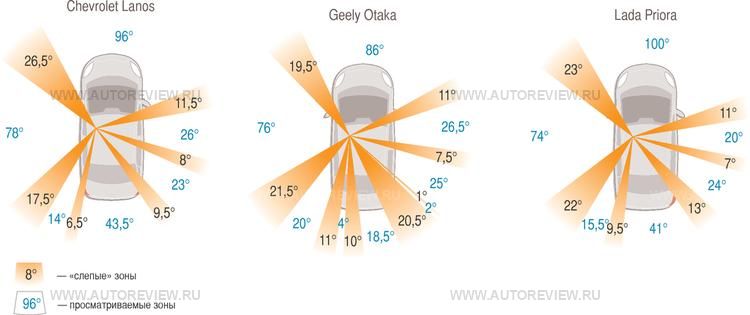
| Car | Total viewing angle, deg. | Total angle of blind spots, deg. |
| Chevrolet Lanos | 280.5 | 79.5 |
| Geely Otaka | 258 | 102 |
| Lada Priora | 274.5 | 85.5 |
| Chevrolet Lanos | Geely Otaka | Lada Priora |
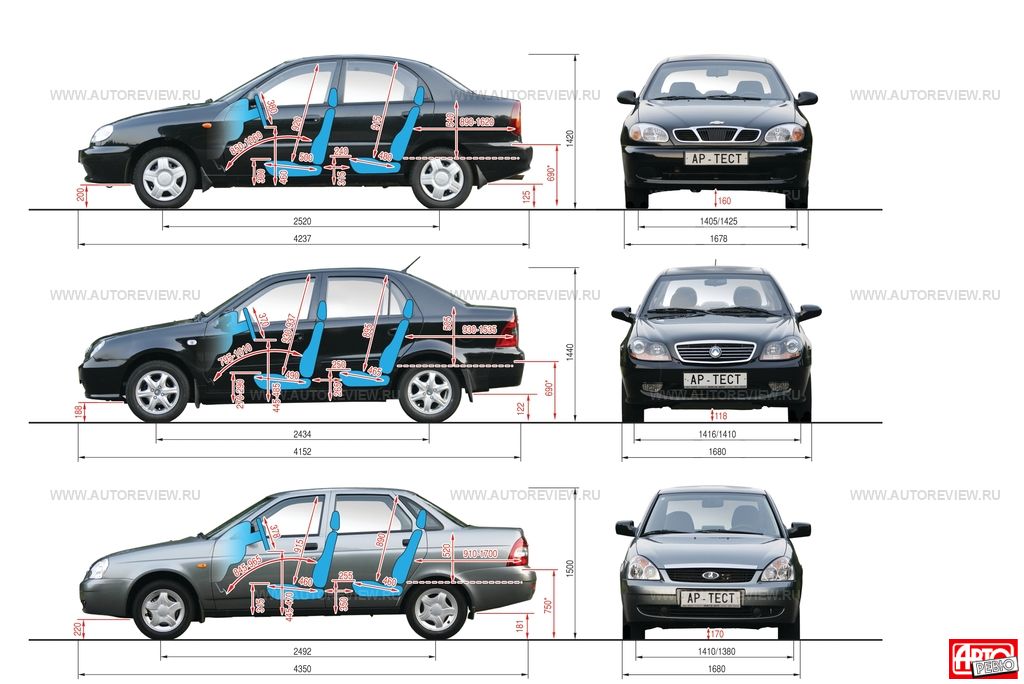
Black indicates manufacturer data, red indicates Autoreview measurement results
* Loading height
 | |||
| Chevrolet Lanos | Geely Otaka | Lada Priora | |
Some results of Autoreview measurements
| Turning diameter of cars | |||
| Car | Chevrolet Lanos | Geely Otaka | Lada Priora |
| By track of outer front wheel, m | 9.78 | 10.29 | 10.43 |
| By outer front dimension, m | 10.62 | 11.06 | 11.18 |
| Number of steering wheel turns from lock to lock | 3.0 | 3.3 | 3.8 |
| Equipment of the cars tested | |||
| Equipment | Cars | ||
| Chevrolet Lanos | Geely Otaka | Lada Priora | |
| Base price of the car, RUB/$ | 247600/9640 | 291500/11340 | 282480/10990 |
| Driver airbag | O | O | + |
| Front passenger airbag | – | O | – |
| ABS | – | O | – |
| Power steering | O | + | + |
| Height-adjustable steering column | – | + | + |
| Leather-wrapped steering wheel | – | + | – |
| Remote central locking | – | + | + |
| Anti-theft alarm | – | + | – |
| Air conditioning | O | + | – |
| Power-adjustable and heated exterior mirrors | – | + | + |
| Front power windows | O | + | + |
| Rear power windows | – | + | – |
| Split-folding rear seat | + | +* | + |
| Pass-through hatch for long items | – | – | +** |
| Rear armrest | – | – | + |
| Rear head restraints | – | + | + |
| CD audio system | – | O*** | – |
| On-board computer | – | – | + |
| Remote trunk release | + | + | + |
| Remote fuel filler flap release | + | + | – |
| Front fog lights | – | + | – |
| Alloy wheels | – | O | + |
| Full-size spare wheel | + | + | + |
| Metal engine underbody protection | – | + | + |
| Metallic paint | O | + | + |
| Child safety locks on rear doors | + | + | + |
| Price of the tested car, RUB/$ | 286500/11150 | 326300/12696 | 282480/10990 |
| * Entirely | |||
| ** Locked | |||
| *** Installed by dealer | |||
| (+) Included in base version | |||
| (–) Not available in base version | |||
| (O) Options installed on the tested cars | |||
| Specifications | |||
| Parameters | Cars | ||
| Chevrolet Lanos | Geely Otaka | Lada Priora | |
| Body type | 4-door sedan | ||
| Number of seats | 5 | 5 | 5 |
| Trunk volume, l | 322 | n/a* | 430 |
| Curb weight, kg | 1030 | 1052 | 1088 |
| Gross weight, kg | 1595 | 1477 | 1578 |
| Engine | petrol, with distributed injection | ||
| Location | front, transverse | ||
| Number and arrangement of cylinders | 4, in-line | 4, in-line | 4, in-line |
| Displacement, cc | 1498 | 1498 | 1596 |
| Cylinder bore/piston stroke, mm | 76.5/81.5 | 78.7/77.0 | 82.0/75.6 |
| Compression ratio | 9.5:1 | 9.8:1 | 10.3:1 |
| Number of valves | 8 | 16 | 16 |
| Max. power, hp/kW/rpm | 86/63/5800 | 94/69/6000 | 98/72/5600 |
| Max. torque, Nm/rpm | 130/3400 | 128/3400 | 145/4000 |
| Gearbox | manual, 5-speed | ||
| Gear ratios | |||
| I | 3.55 | 3.18 | 3.64 |
| II | 2.05 | 1.90 | 1.95 |
| III | 1.35 | 1.25 | 1.36 |
| IV | 0.97 | 0.91 | 0.94 |
| V | 0.76 | 0.70 | 0.78 |
| Reverse | 3.33 | 3.08 | 3.50 |
| Final drive | 4.18 | 4.31 | 3.70 |
| Drive | front | front | front |
| Front suspension | independent, coil spring, McPherson | ||
| Rear suspension | semi-independent, coil spring | independent, coil spring, McPherson | semi-independent, coil spring |
| Front brakes | disc, ventilated | disc | disc, ventilated |
| Rear brakes | drum | ||
| Tires | 185/60 R14 | 175/65 R14 | 185/65 R14 |
| Maximum speed, km/h | 172 | 170 | 183 |
| Acceleration time 0-100 km/h, s | 12.5 | 11.5 | 11.5 |
| Fuel consumption, l/100 km | |||
| urban cycle | 10.4 | n/a | 9.8 |
| extra-urban cycle | 5.2 | n/a | 5.6 |
| combined cycle | 6.7 | 7.0 | 7.2 |
| Fuel tank capacity, l | 48 | 45 | 43 |
| Fuel | petrol AI-92 | petrol AI-95 | petrol AI-95 |
| * N/a - no data | |||
"Moose test"
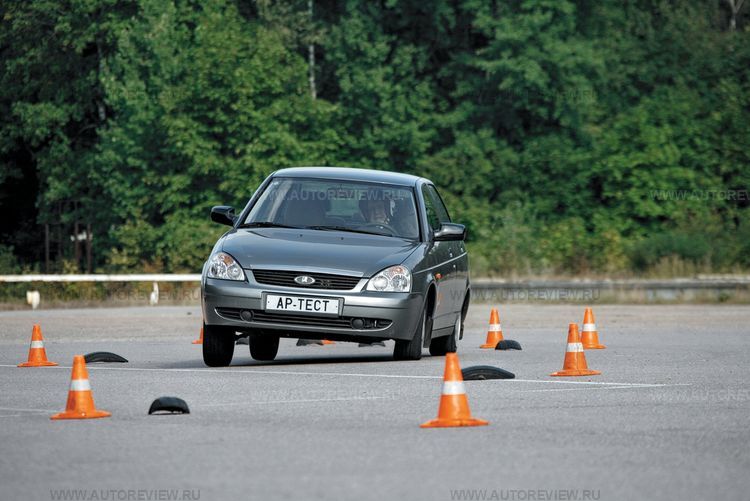
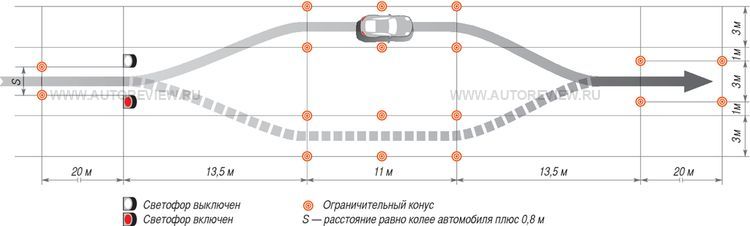
Tests simulating avoidance of a suddenly appearing obstacle are conducted in two stages. First, five drivers, having familiarized themselves with the sedans in normal driving modes, attempted to avoid the "moose" on the first and only attempt at a speed of 65 km/h, and then an expert in a series of runs sought the maximum speed for performing the maneuver. Recall that the test includes an element of surprise in the form of traffic lights that set the direction of avoidance - right or left.
To our great surprise, the fastest avoidance of the "moose" was achieved in the Chinese sedan Geely Otaka - 75.1 km/h. The car confidently stays in the lanes, only slightly sliding with all four wheels. The speed was limited by inadequate steering responses - course oscillations and skids began to occur. Two of the casual drivers managed to dodge the "moose", but everyone was frightened by unexpected changes in the car's reaction character depending on the steering wheel angle.
Chevrolet Lanos is slightly slower - 73.6 km/h. In the "single" runs, the Lanos turned out to be the most understandable - three hits out of five. The losers blamed deep slides in response to sharp steering wheel turns.
The maximum that could be extracted from the Priora was 70.4 km/h. The car lingered for a long time in deep skids and reacted sluggishly to corrective steering actions. And if you are a bit late with correction, powerful, hard-to-dampen course oscillations begin: the car more than once flew beyond the marked lanes. Three of the five casual drivers found the fight against skids beyond their strength.
| Maximum speed of performing the "moose test", km/h | |
| Cars | Speed |
| Chevrolet Lanos | 73.6 |
| Geely Otaka | 75.1 |
| Lada Priora | 70.4 |
| "Moose test" on the first attempt at a speed of 65 km/h | |
| Cars | Maneuver completed |
| Chevrolet Lanos | 3 drivers out of 5 |
| Geely Otaka | 2 drivers out of 5 |
| Lada Priora | 2 drivers out of 5 |
| Speedometer reading accuracy | ||||||||
| Cars | Speedometer readings, km/h | |||||||
| 40 | 60 | 80 | 100 | 120 | 140 | 160 | 180 | |
| True speed, km/h | ||||||||
| Chevrolet Lanos | 37 | 57 | 77 | 96 | 115 | 135 | 154 | — |
| Geely Otaka | 38 | 58 | 78 | 97 | 116 | 135 | 154 | — |
| Lada Priora | 37 | 55 | 73 | 91 | 110 | 129 | 147 | 166 |
| Some Autoreview measurement results | ||||
| Parameters | Cars | |||
| Chevrolet Lanos | Geely Otaka | Lada Priora | ||
| Maximum speed, km/h | 163.3 | 168.8 | 182.1 | |
| Acceleration time, s | 0-50 km/h | 4.2 | 4.0 | 3.3 |
| 0-100 km/h | 15.4 | 14.3 | 11.6 | |
| 0-150 km/h | 50.1 | 39.5 | 29.5 | |
| over 400 m | 19.6 | 19.1 | 17.9 | |
| over 1000 m | 36.9 | 35.4 | 33.1 | |
| 60-100 km/h (III) | 9.6 | 9.8 | 7.3 | |
| 60-100 km/h (IV) | 13.2 | 14.4 | 13.1 | |
| 80-120 km/h (V) | 23.2 | 25.4 | 19.6 | |
| Coast-down, m | from 50 km/h | 520 | 568 | 612 |
| 130-80 km/h | 840 | 888 | 975 | |
| 160-80 km/h | — | — | 1461 | |
| Braking from 100 km/h | distance, m | 46.5 | 50.1 | 49.0 |
| deceleration, m/s² | 8.3 | 7.7 | 7.9 | |
Headlight performance
Night photography of cars from the same point gives an idea of headlight effectiveness. All our sedans have conventional halogen headlights. The best low beam is on the Lanos: a pedestrian standing 80 meters away on the roadside is dimly but visibly lit. In the shapeless beam of the Otaka, the person is barely visible, while the Priora driver, despite the brightest light, does not see the pedestrian at all. However, the high beam is good on all cars.
During photography, only the driver was in the cars, headlight adjusters were in zero positions
| Chevrolet Lanos | Geely Otaka | Lada Priora |
| Low beam. Pedestrian stands on the roadside 80 meters from the car | ||
| High beam. Pedestrian stands in the middle of the road 160 meters from the car | ||
What's the price?
Chevrolet Lanos (1.5 L, 86 hp) in base trim S costs 247,600 rubles ($9,640*), but the only equipment is four speakers without a radio. The SX version with driver airbag, air conditioning, power steering, and front electric windows looks much more attractive at 279,500 rubles ($10,875*). Metallic paint will cost 7,000 rubles ($272*). Production of cars in the middle SE trim has been temporarily discontinued.
Warranty is 2 years without mileage limit. Chevrolet cars are sold by 88 dealers in 57 Russian cities.
Lada Priora (1.6 L, 98 hp) is sold in a single trim, Norma, with driver airbag, power steering, central locking, front electric windows, electrically adjustable and heated mirrors, audio preparation, alloy wheels, and metallic paint. The recommended factory price is 282,480 rubles ($10,990*), which is 4,020 rubles ($156*) cheaper than the metallic-painted Chevrolet Lanos SX.
Warranty is 3 years or 50,000 km, but almost all dealers offer to extend it to 5 years and 75,000 km provided that servicing is done only at their stations. VAZ cars are sold by 451 dealers in 208 Russian cities.
Geely Otaka (1.5 L, 94 hp) in base trim MT-1 costs 291,500 rubles ($11,340*). It includes air conditioning, electric windows, electrically adjustable mirrors, central locking, power steering, and fog lights, but no airbags. The MT-2 trim for 313,000 rubles ($12,200*) additionally includes alloy wheels, ABS, and EBD (electronic brake-force distribution), while the fully equipped Otaka with two airbags costs 323,500 rubles ($12,590*).
Warranty is 2 years or 60,000 km. Geely cars are sold by 26 dealers in 20 Russian cities.
| Cost of scheduled maintenance with consumables and parts, rubles | ||||
| Scheduled service | Cars | |||
| Chevrolet Lanos | Geely Otaka | Lada Priora | ||
| Cost per labor hour | 1190 | 780 | 520 | |
| Mileage, km | 1000 | — | 3490 | — |
| 2500 | — | — | 1800 | |
| 10000 | 4243 | 2740 | — | |
| 15000 | — | — | 1200 | |
| 20000 | 5204 | 2740 | — | |
| 30000 | 5030 | 2740 | 3408 | |
| 40000 | 7965 | 2740 | — | |
| 45000 | — | — | 2724 | |
| 50000 | 4521 | 2740 | — | |
| 60000 | 10459 | 5000 | 4848 | |
| 70000 | 4521 | 2740 | — | |
| 75000 | — | — | 1704 | |
| 80000 | 7965 | 2740 | — | |
| 90000 | 5030 | 2740 | 4926 | |
| Total | 54938 | 30410 | 20610 | |
| Approximate prices for original parts at Moscow dealers, rubles | |||
| Parts | Cars | ||
| Chevrolet Lanos | Geely Otaka | Lada Priora | |
| Oil filter | 130 | 141 | 120 |
| Fuel filter | 420 | 297 | 150 |
| Air filter | 406 | 196 | 120 |
| Spark plug | 225 | 102 | 76 |
| Front brake pads | 1500 | 881 | 150 |
| Rear brake pads | 1595 | 716 | 308 |
| Front shock absorber | 3800 | 1574 | 802 |
| Rear shock absorber | 2253 | 1574 | 590 |
| Clutch disc | 2495 | 1127 | 600 |
| Timing belt | 1326 | 755 | 515 |
| Front headlight | 5917 | 3411 | n/a* |
| Rear light | 3481 | 1695 | n/a |
| Front fender | 4297 | 2843 | n/a |
| Front bumper | 7200 | 2453 | n/a |
| Hood | 9016 | 7039 | n/a |
| Windshield | 9600 | 5476 | 2150 |
| * N/a — no data due to the absence of these parts in retail sale in Moscow | |||
What else?
When choosing an inexpensive car, you can also look at a number of other offers on the market. One of the most affordable is the domestic sedan Lada Kalina (1.6 L, 81 hp) for 236 thousand rubles ($9,180*). The base Standard trim includes central locking and front electric windows. The main thing that spoils this car with a spacious interior and energy-intensive suspension is mediocre build quality. And in the Autoreview crash test, the Kalina performed poorly — 5.6 points out of 16 possible for a frontal impact. Details in AR No. 2, 2006 and AR No. 18, 2006.
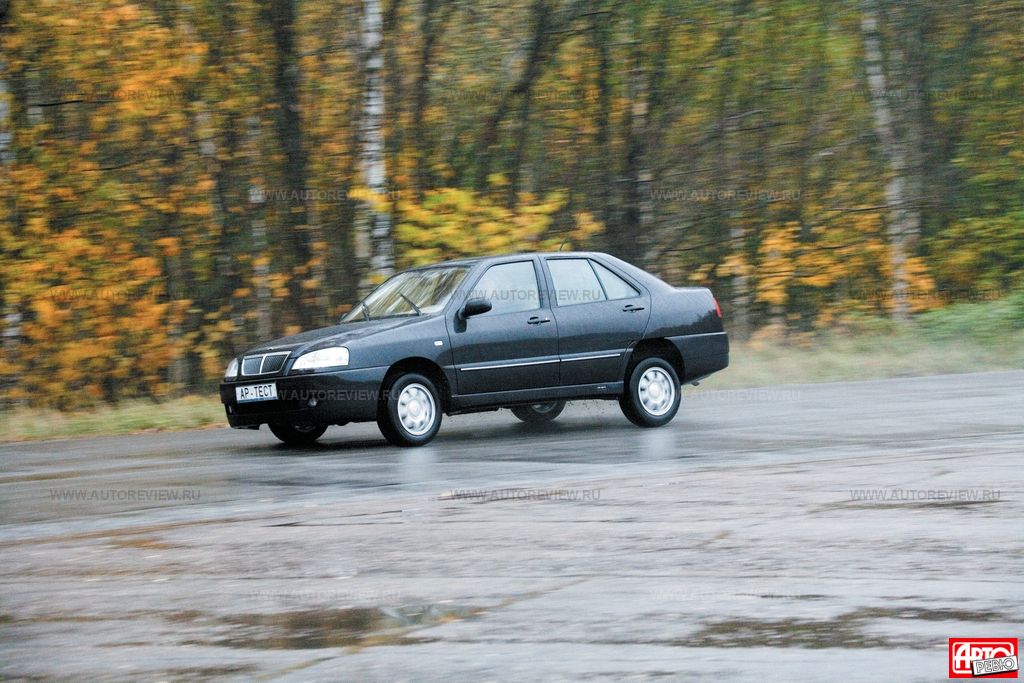
Prices for the Chinese liftback Chery Amulet (1.6 L, 94 hp) of Kaliningrad assembly start from 242 thousand rubles ($9,420*). The base trim includes air conditioning and power steering, but the Amulet suffers from inconsistent build quality and, importantly, as our crash test showed, an unacceptably low level of passive safety: only 1.7 points out of 16 possible. Details in AR No. 2, 2006 and AR No. 22, 2006.
The Uzbek sedan Daewoo Nexia is only slightly more expensive than the Amulet — prices start from 244 thousand rubles ($9,490*) for the version with a 1.5-liter eight-valve engine producing 75 hp. The version with a 16-valve engine (85 hp) will cost 11 thousand rubles ($430*) more. The base trim includes only a cassette radio. Against the background of competitors, the Nexia looks hopelessly outdated, but in a number of consumer qualities it still holds a good position. The level of passive safety of the sedan is extremely low — 1 point out of 16 possible in the Autoreview crash test. Details in AR No. 2, 2006.
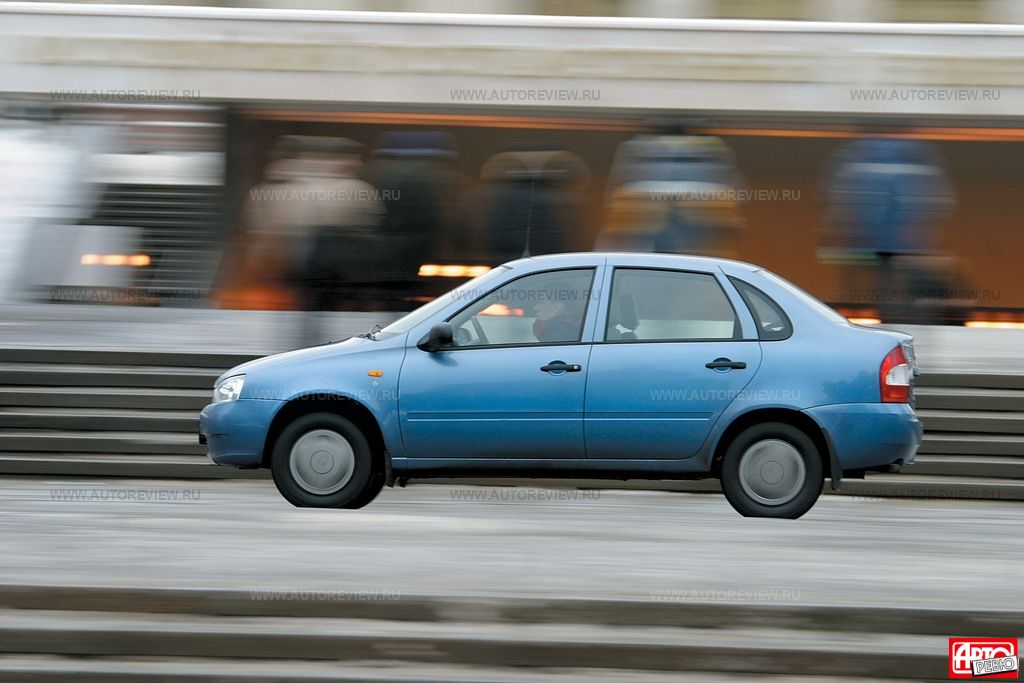 | 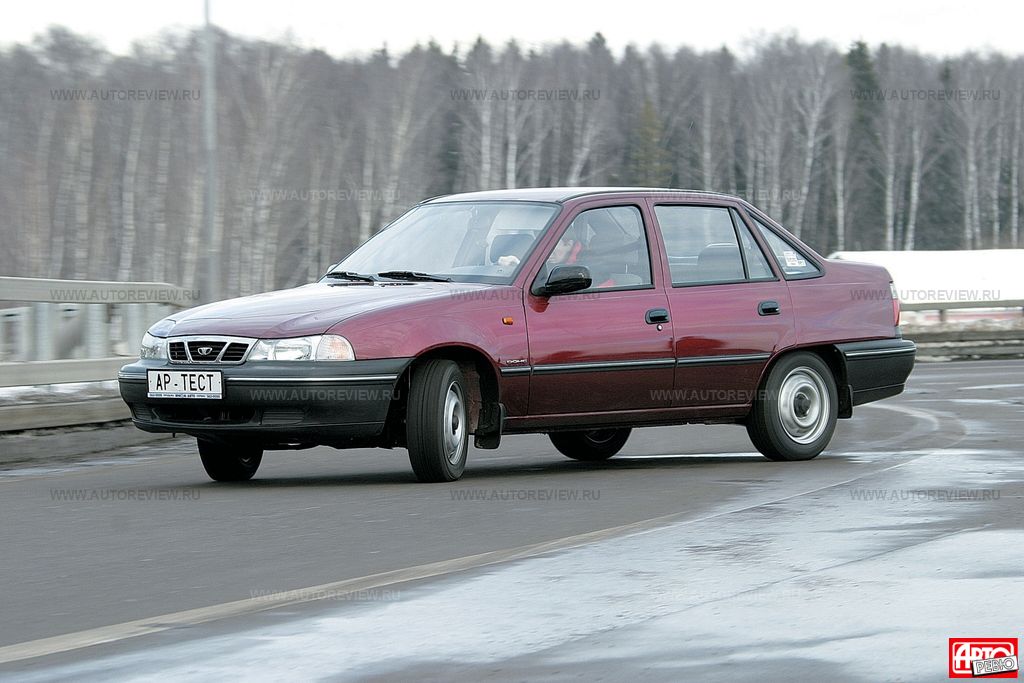 |
| Lada Kalina | Daewoo Nexia |
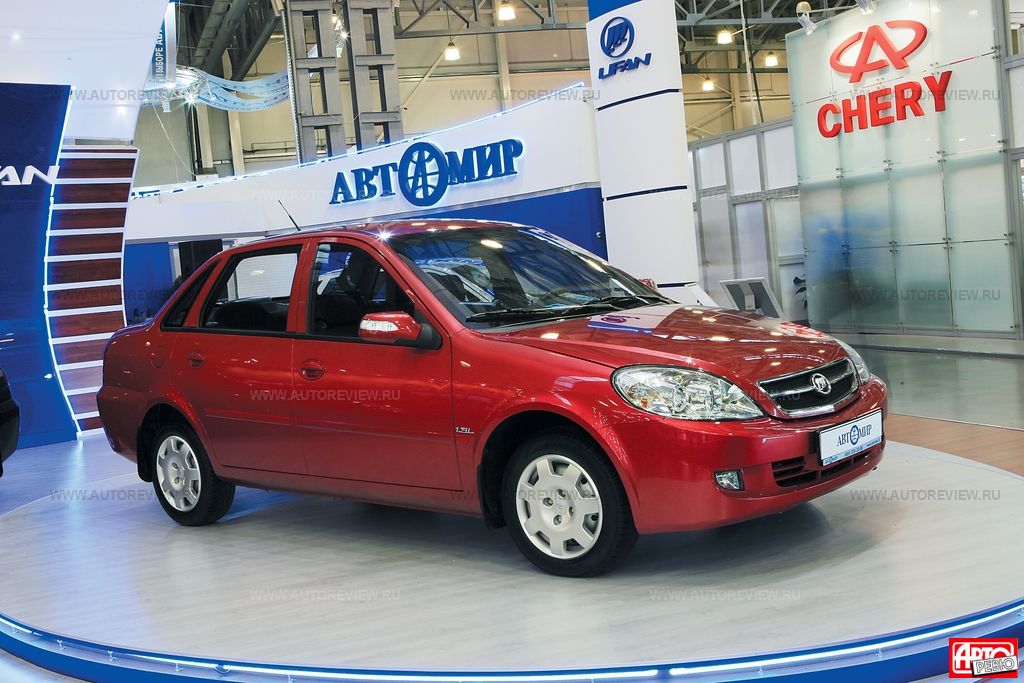 | 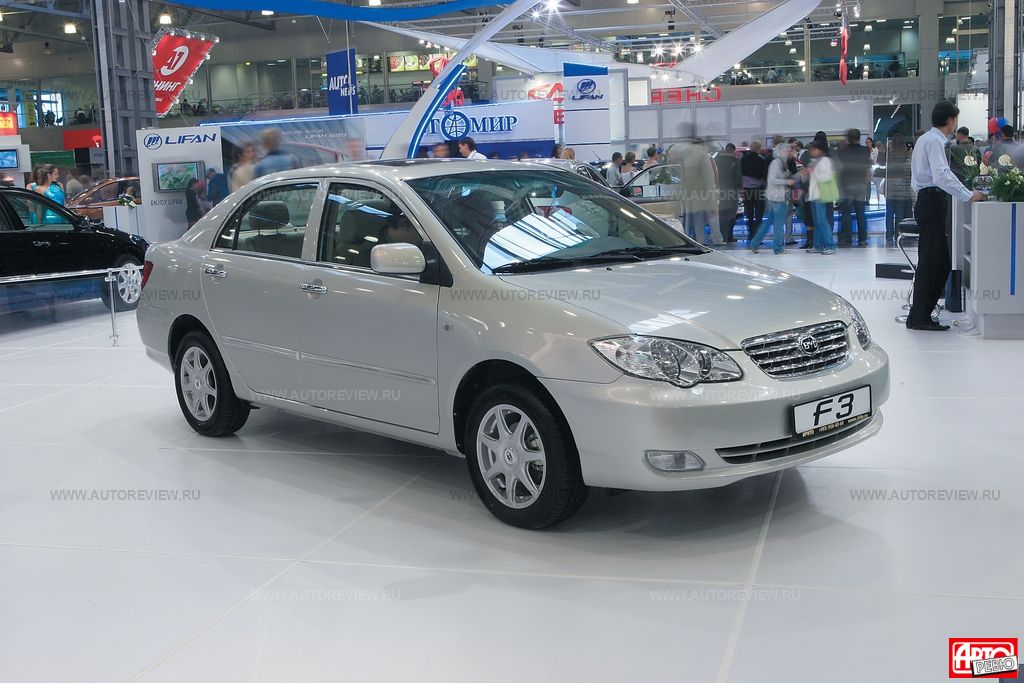 |
| Lifan Breez | BYD F3 |
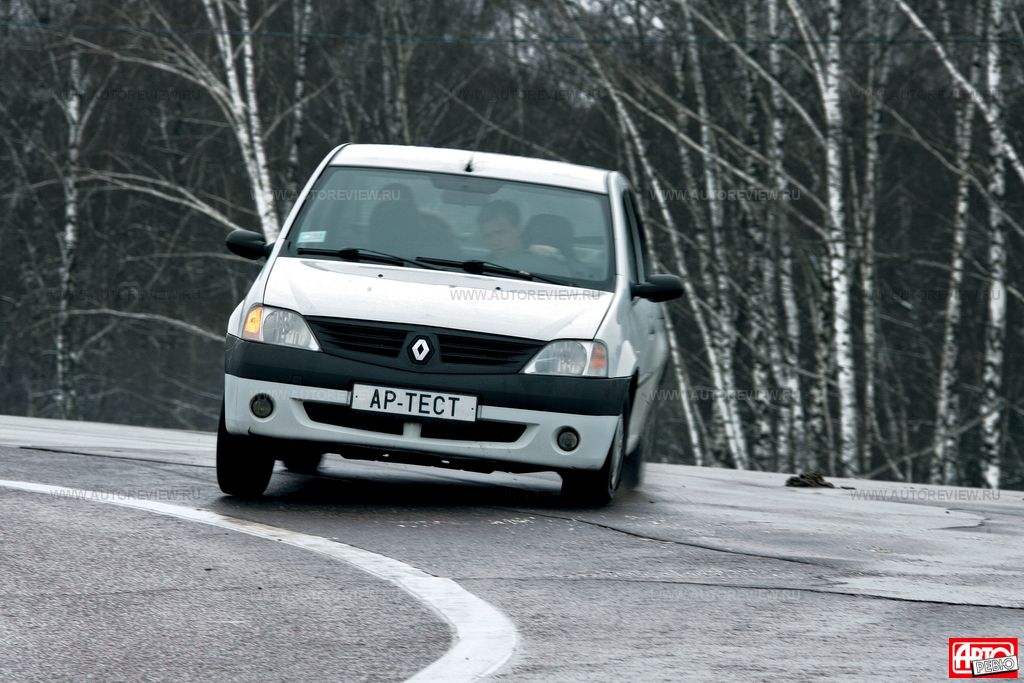
Prices for the Moscow-assembled Renault Logan start from 260,550 rubles ($10,140*) for the base car with a 1.4 engine (75 hp) and one airbag. The version with the 1.6 engine (90 hp) costs at least 300,750 rubles ($11,700*) — it includes power steering, central locking, and front electric windows. The Logan offers a balanced set of consumer qualities and good passive safety (12 points out of 16 in the Autoreview crash test), with the main drawback being the non-transformable rear bench. Details in AR No. 22, 2006 and AR No. 7, 2007.
The Chinese sedan Lifan Breez, whose assembly recently started in Cherkessk, is sold in the base version for 285,000 rubles ($11,090*). The 1.3-liter engine develops 88 hp, and the equipment includes air conditioning, power steering, front electric windows, and central locking. The modification with the 1.6 Tritec engine (115 hp), known from Mini cars, is significantly more expensive — 363,000 rubles ($14,120*).
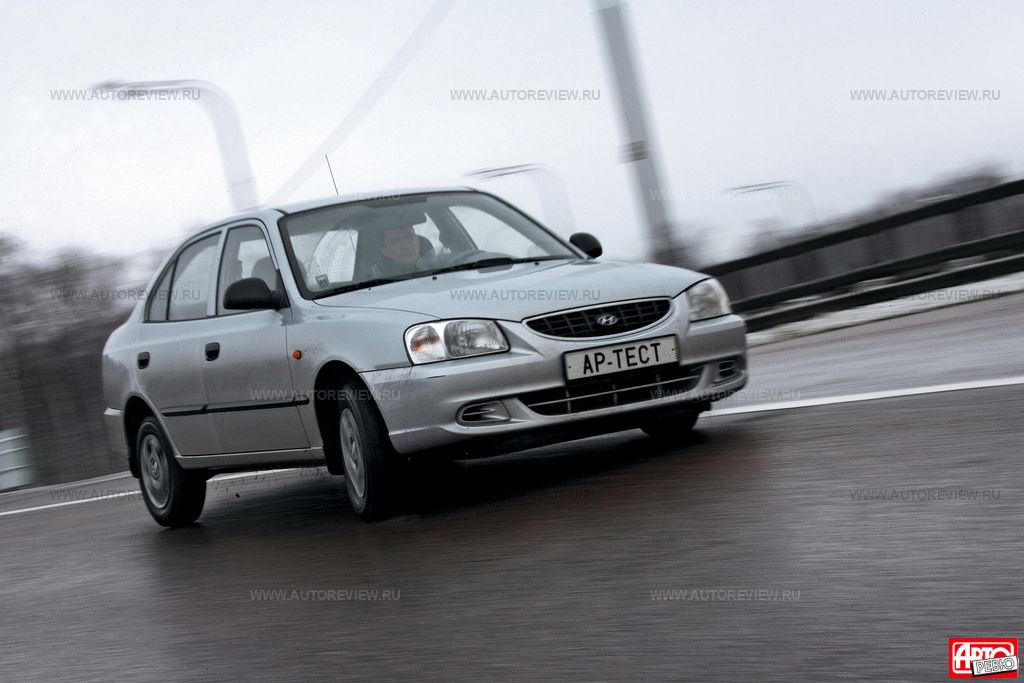
The Hyundai Accent (1.5 L, 102 hp) of Taganrog assembly in the base configuration (only power steering) is offered for 293,700 rubles ($11,430*), but such cars need to be ordered and wait up to two months. Freely available Accents cost 323,700 rubles ($12,600) — with air conditioning and a cassette radio. The surcharge for an automatic transmission is 30,000 rubles ($1,170*). In the Autoreview frontal crash test, the Accent scored 9.9 points out of 16 possible — a decent result for a version without airbags. Details in AR No. 13—14, 2006 and AR No. 7, 2007.
Another Chinese sedan — the BYD F3 (1.6 L, 100 hp), copied from the previous-generation Toyota Corolla. The price of the base version with power steering is 299,950 rubles ($11,670*). Modifications with a wider equipment list are significantly more expensive.
The Chevrolet Aveo sedan with a 1.2 engine (72 hp) is offered for 311,300 rubles ($12,110*). The base includes a driver's airbag, CD/mp3 radio, front electric windows, and central locking. The modification with the 1.4 engine (94 hp) will cost at least 367,000 rubles ($14,280*). The Aveo's passive safety is low — only 3 points out of 16 in the EuroNCAP frontal crash test, and combined with side impact scores, just one and a half stars out of five possible. Details in AR No. 13—14, 2006 and AR No. 3, 2007.
 |  |
| Chery Amulet | Renault Logan |
 |  |
| Hyundai Accent | Fiat Albea |
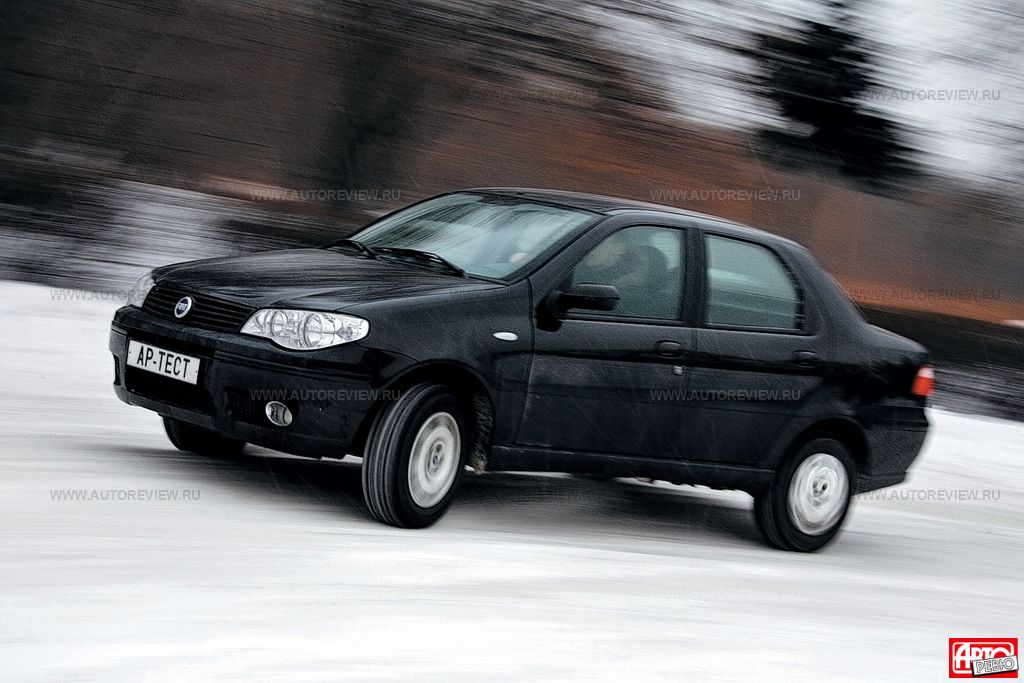
The Fiat Albea (1.4 L, 77 hp) is assembled in Naberezhnye Chelny and sold for at least 315,000 rubles ($12,260*). The initial configuration includes one airbag, power steering, and central locking. The sedan features a comfortable cabin with good ergonomics. In the Autoreview crash test, the Fiat Albea showed an average result, scoring 8.5 points out of 16 possible. Details in AR No. 7, 2007.
Additionally, there are the Renault Symbol, Peugeot 206 Sedan, and Kia Spectra, but all of them, even in base configurations, cost more than the Geely Otaka with the maximum possible equipment.
* At the exchange rate of $1=25.7 rubles.