
A superficial inspection of a row of fresh Lada Kalina cars did not reveal any radical changes. However, upon closer acquaintance, you can find door moldings, alloy wheels, and black window trim. Actually, this is all that distinguishes the new 'Norma+' and 'Lux' trims from the previous 'Standard' and 'Norma'. Moreover, any of the versions can be equipped with either the old 8-valve 1.6-liter engine or the new 16-valve 1.4-liter unit. Visually, cars with different engines do not reveal their technical features in any way.
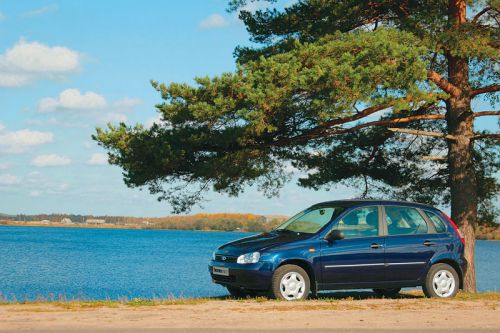
2008 Lada Kalina
© Photo: AVTOVAZ
The first test day began with a 300 km route to the 'Black Stones' recreation center, located near Sortavala. To start, we took a car with a completely fresh 1.4-liter engine producing 90 hp. Engineers at the Tolyatti scientific and technical center achieved these figures by lightening the connecting rod and piston group and lengthening the connecting rods. As a result, mechanical losses decreased, and power increased. True, like any small-displacement engine, this motor needs to be constantly revved: at low rpm it is completely empty. Peak output occurs at 5600 rpm, and maximum torque of 130 Nm is reached at 4000 rpm. The engine revs up to 6500 rpm without problems, but there is no point in that — after 5600–5800 rpm acceleration noticeably fades. As for acoustic comfort, already at 100–120 km/h you have to strain your ears to make out the words of your interlocutor. Aerodynamic noises are practically absent, but the engine hum has not gone away.
2008 Lada Kalina
© Photo: AVTOVAZ
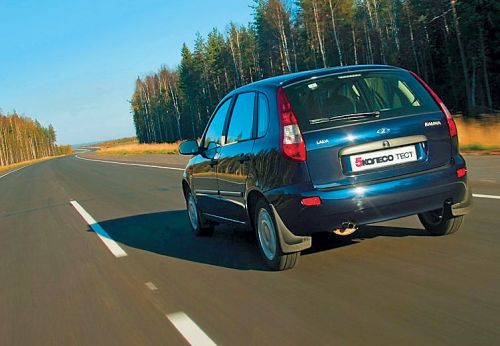
The section of the highway between Palalahta and Leppäsilta, approximately 70 km long, is a high-speed road with smooth long bends and long straights. An ideal place to test the car at its limits. According to the documents, the Kalina with the 1.4-liter engine should accelerate to 167 km/h. The car overcomes the 160 km/h mark without much strain. Further, you have to take the terrain into account: speed increases on descents and drops on ascents. Our personal record on this stretch was 180 km/h, of course, according to the speedometer.
2008 Lada Kalina
© Photo: AVTOVAZ
At high speeds, it is important to maintain the correct trajectory — sharp movements of the steering wheel can provoke unwanted body sway. The steering wheel is not very informative, especially in the area near zero. Simply put, the driver has to constantly correct the steering. In addition, the considerable ground clearance of 160 mm adds trouble: the air flow tends to lift the car above the asphalt. But comfort is in perfect order. The suspension adequately handles both small and large surface defects, and the cabin is quiet. This complaisance on bumps was achieved thanks to the installation of barrel-shaped springs.
2008 Lada Kalina
© Photo: AVTOVAZ
On the second day, the program included several checkpoints where the car faced various tests — sandy sections and a winding asphalt road. We completed these stages in the version with the 1.6-liter engine. And here an interesting thing emerged: the larger-displacement engine is inferior to the smaller one in a number of parameters. Its power is 9 hp less, and the stated top speed is 5 km/h lower. Practice confirmed the theory. The peak power of the 1.6-liter unit occurs at 5200 rpm, and the maximum torque of 120 Nm at 3000 rpm. On the highway, this is felt when approaching top speeds. In terms of acceleration dynamics, the engines are very close: the difference of a second cannot be determined by eye. But the 'senior' wins in elasticity — it does not need to be revved so hard, the pickup begins already at 2500 rpm.
2008 Lada Kalina
© Photo: AVTOVAZ
On the way back from Petrozavodsk to Sortavala, we set two records. The Kalina with the 1.6-liter engine accelerated to 170 km/h according to the speedometer — ten less than we squeezed out of the 1.4-liter version. The second achievement of a personal nature: we covered the 300-kilometer route in three and a half hours. This is largely due to Karelian drivers, who willingly gave way to the new Kalina.
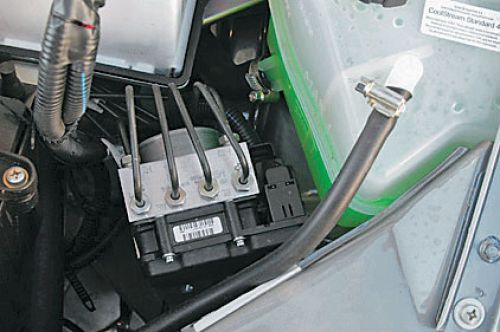
The version with the 1.6-liter engine is also equipped with ABS from Bosch. It is noteworthy that the rear still has ordinary drums, not discs. Engineers claim that the introduction of the anti-lock braking system reduced the braking distance by 10 meters. The intensity of deceleration has indeed increased, and on loose or uneven surfaces you feel more confident. We tested this on gravel on the final, third day of the test. The new Kalina trims received two airbags — driver and passenger, as indicated by the SRS Airbag inscriptions on the steering wheel and front panel. Fortunately, we did not have to test them in action in Karelia. Let's hope they are in working order.
For the new Kalina trims, they ask from 262,000 rubles — 22,000 more than for the previous versions. The next modernization is expected in the spring, when the appearance of air conditioning is promised.
To the nearest millimeter
2008 Lada Kalina
© Photo: AVTOVAZ
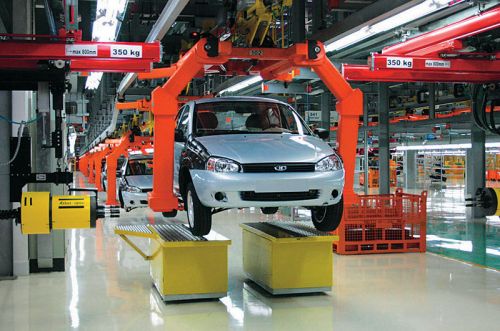
The production process of assembling the Lada Kalina consists of four stages: welding, painting, assembly, and quality control. Welding is carried out on automated complexes with eight lines, where 350 robots are involved. In a limited area, they perform thousands of operations per minute. The lines are configured according to mathematical models, and the precision of the manipulators ensures high quality of body geometry. Painting is done by 32 robots, with equipment supplied by Eisenmann. The paint coating of the Kalina is characterized by increased resistance to scratches and corrosion. Assembly follows a modular principle: doors, dashboard, and the body itself are assembled separately, then joined. At the output, each car undergoes quality control, and if necessary, shortcomings are eliminated on the spot.
Driving
The steering wheel is poorly informative, especially in the zero zone. The suspension holds up well, coping decently with sway and bumps.
Interior
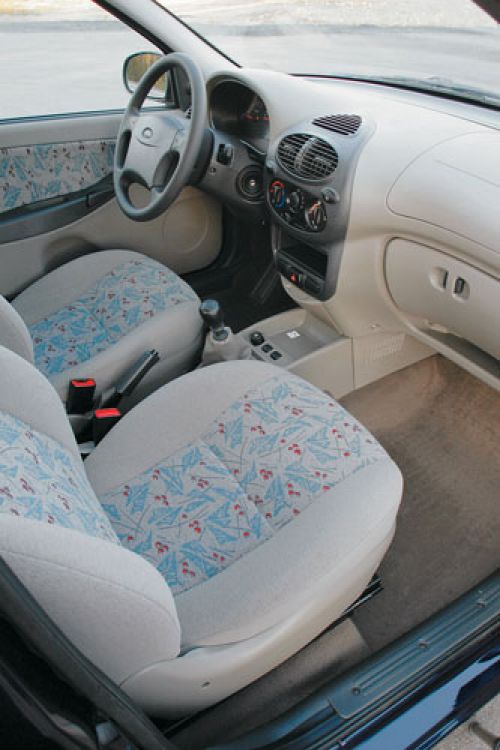
Assembled solidly, but the color scheme requires refinement. Moreover, the factory smell in the cabin is quite intrusive.
Comfort
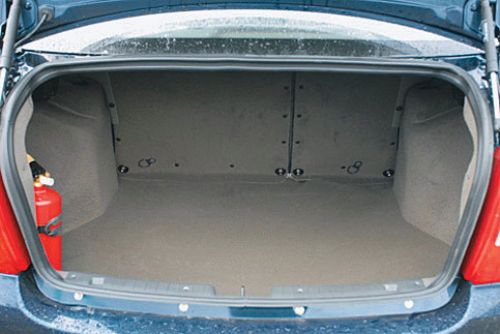
Passengers sit quite comfortably. The trunk is also not deprived of space.
Safety
The power capsule of the body was initially designed with a high degree of protection in mind. Now two airbags have been added to this.
Price
Against the background of constantly growing assembly quality, the starting prices look more than attractive.
2008 Lada Kalina
© Photo: AVTOVAZ
| Dimensions, mm | 4040x1700x1500 |
| Engine | petrol, 1400 cm3, 90 hp/5600 rpm |
| Transmission | manual, 5-speed |
| Dynamics 0-100 km/h, s | 12.5 |
| Top speed, km/h | 167 |
| Competitors | Chevrolet Lanos, Chery Amulet |
Advantages and disadvantages
+ Economical and torquey new engine, energy-intensive suspension.
- Noise in the cabin, uninformative steering wheel, rough plastic.
Our opinion
The Lada Kalina is not yet perfect, and flaws are found. But there is a noticeable desire for improvement and equipping the car with modern options. The most important thing is not to miss the price. So far, this aspect is in order for VAZ marketers. The Kalina is a quite successful price-quality ratio. In the basic configuration, the Lada Kalina costs 238,300 rubles.
© 5 Koleso