
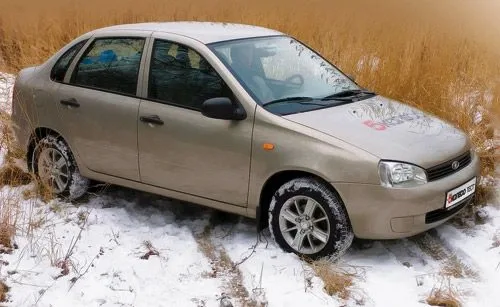
The winter period turned out to be a real test of strength for our editorial 'Kalina'. A few annoying breakdowns and minor faults were still brightened by the fact that the car started and drove reliably even in thirty-two-degree frost.
During three months of cold operation, namely from five to eleven thousand kilometers of mileage, the 'Kalina' threw us quite a few surprises. We started the season by replacing the factory all-season tires with winter ones. According to the manufacturer's technical recommendations, wheels 185/60R14 can be installed on the car. With such tires, the 'Kalina' looks even slimmer and neater.
Since the car mainly drives around the city, the choice fell on non-studded tires. A new product from Japan caught our eye — Yokohama IG10, designed for harsh winters and confident movement through snow slush and packed ice. Five longitudinal grooves are responsible for resistance to lateral skidding, and the increased number of micro-sipes noticeably improved grip. The manufacturer claims that the braking distance compared to the previous model has been reduced by a fifth. We fitted the new wheels on inexpensive but reliable 'Selena SKAD' rims from Divnogorsk. Immediately after this, the car began to handle differently. The non-directional tread pattern helps the driver maintain the set trajectory without extra effort. Moreover, the 'Kalina' turned into a kind of mini-SUV that fearlessly tackles small snowdrifts and snow banks.
What cannot be taken away from the 'Kalina' is its serious preparation for frost. When the temperature dropped below minus thirty-two, Moscow seemed to have died out. Rarely do you see such deserted streets of a metropolis. The silence was broken only by the hum of the few cars, among which was ours. That's a plus. But the fact that the rear window warmed up unevenly is a clear minus. Such a defect is found on all cars of the first batch. The reason is the rubbing of the heating threads by the seal. The factory prescribes free replacement of the glass along with the heating system. After replacing the defective elements, everything worked as it should.
But the ill-fated electric window drive of the driver's door, which we replaced less than two weeks ago, failed again. The technicians blamed the motor. Perhaps that is indeed the case.
At nine thousand kilometers, right while driving, the gas pedal refused to return to its original position. I had to pry it up with the toe of my boot. It turned out that the return spring had come off. It was fixed in a couple of minutes, but the feeling, you must agree, is unpleasant.
Despite its modest dimensions, the 'Kalina' knows how to surprise with its capacity. The fully folding rear seat back is an extremely useful thing. True, the plastic plugs that cover the hinges and technological holes could not withstand and fell off. It has not been possible to fix it yet — dealers do not have spare parts. Closer to ten thousand, the 'patient' began to have more serious problems. At first, the battery lamp came on from time to time, then it came on for good. We immediately suspected something wrong with the generator. At the service center, the fears were confirmed, and the unit had to be replaced.
At the same time, when replacing the generator, an oil leak from the engine was discovered. The culprit was a metal plug on the end of the motor on the drive belt side. It was also replaced. In addition, the knock sensor failed — the constantly lit check engine light reminded us of this tirelessly.
The result is this: the car withstands the Russian climate and our roads with dignity. But at the same time, it continues the traditions of its predecessors, being a kind of generator of random breakdowns. No one will undertake to predict what will break next. Although an approximate list of faults inherited from the 'tenth' family of 'Ladas' can be compiled quite realistically.