
Lada Kalina wagon. The taste of "Kalina"
Not so long ago, the Volga Automobile Plant, familiar to every Russian driver, took on obligations that in Soviet times were called increased. The company's management promised that by 2013, all models currently coming off the assembly line of the largest domestic manufacturer would be sent to the archive. In other words, in just over four years, the people of Tolyatti will say goodbye not only to the "classic" and "Samara-2", but also to their newest family — Priora.
Interestingly, such a statement does not fit at all with the traditional approach of the plant, where a model is mastered by the market not in ten months, but over several years. This was the case, for example, with the Lada Kalina. First, about four years ago, the sedan appeared, then the hatchback. And the wagon, the most practical in the family, was saved for dessert: it came out only a month ago. Were they late? But what is done is done. True, it is worth admitting: with the Priora, the plant workers were more agile, and this is encouraging.
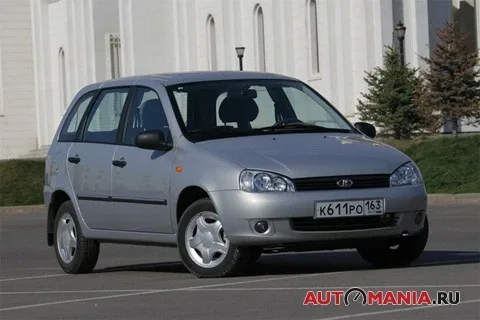
However, let's return to the new product. Since the appearance of the family took shape back in the early 2000s, nothing new has appeared in the exterior of the wagon. The same "slanted", Korean-style front end, a narrow and perhaps overly tall body with a high beltline, and the rear, reminiscent of a hatchback, is stretched for practicality. Perhaps that's all that can be said about the appearance.
The main feature of the wagon is its ordinariness and stylistic inconspicuousness. The sedan looks quite original and even solid, albeit with an Asian accent; the hatchback, due to its truncated rear, seems more dynamic. The wagon got neither one nor the other — it's just a car that looks like a "Korean" from the mid-90s with a spacious trunk.
And yet, despite the shortcomings, the Kalina received a fairly soft and logical exterior — at least in comparison with what came from the Tolyatti pen before 2005. The car has stepped far forward and in quality has noticeably approached world standards (stylistic moderation did not prevent this). We're not even talking about the appearance, the assessment of which is subjective, but about the quality of assembly and painting. The usual complaints about gaps can no longer be made, and the paintwork is unlikely to peel off after a couple of years. In a word, before the appearance of the Priora, this model could rightfully be considered the best mass-produced car ever made in our country. For this, the VAZ workers should be praised.
Let us repeat: in essence, the Lada Kalina is the first Russian car that can be compared with foreign rivals without discounts or condescension. Of course, it won't defeat them, but at least it will offer worthy resistance, and at most — it will open the way for fundamentally new models, which the people of Tolyatti announced a couple of weeks ago.
The first argument in favor of the car is the equipment. The car has finally acquired a modern air conditioner and a set of passive safety features: ABS, airbags, and belt pretensioners. This is a big plus. Now, for complete happiness, only an automatic transmission is missing.
Alas, this optimism does not fully apply to the interior. With such a cabin, no VAZ model will be able to compete with foreign brands. Budget plastics in the trim can still be understood, but the quality of execution is still far even from Korean standards. The car has not gotten rid of the notorious "crickets", and burrs are visible on some surfaces, and not only in inconspicuous places. But to be fair: the Kalina has nothing in common with the former "rattles" from the "made in Tolyatti" series. The gaps are even, and the "soapy" materials remain only in the lower part of the cabin.
By the way, about capacity. Although in the hierarchy the Kalina is lower than the "ten", its cabin is wider and longer. Of course, there is no excess of space in the shoulders and above the head, but there is no shortage either. Tall people will not experience the previous discomfort. The longitudinal adjustment is quite enough to make the legs comfortable, and the knees do not interfere with reaching the gear lever or the steering wheel, which, moreover, is adjustable in height. It is also worth mentioning the friendly profile of the seats. In general, the Lada seats are no longer the same stool on which one had to ride before (although they are, of course, far from Mercedes-Benz). Rear passengers can be promised a fairly comfortable ride, but only if there are two of them: then there will be enough space for knees and shoulders.
And luggage will definitely fit in the trunk: the Kalina is equipped with a 350-liter compartment. Nominally, this volume is not a record (in the sedan, the cargo area is larger), but the space is not spoiled by unnecessary protrusions, so it is a pleasure to use. After folding the rear seat back (in a 40:60 ratio), the volume increases to 650 liters when loaded to the window level, and if you fill the trunk to the roof, the initial volume will increase almost threefold.
True, there is no documentary confirmation of this yet: the plant, apparently, did not carry out such measurements. However, maybe there was no need. AvtoVAZ marketers see the Kalina wagon not as a car for an avid summer resident, but as transport for young people who need the cargo area not for seedlings, but, say, for tourist or mountaineering equipment.
The wagon has no fundamental technical differences from other family members — the same engines and manual gearboxes, so it drives the same as the sedan and hatchback. True, it has a reinforced front suspension and more efficient brakes. The car accelerates well, confidently holds the trajectory, and decently handles bumps. We also note lower fuel consumption, readiness for Euro 4 standards, and, of course, a power of 90 hp, which is already comparable to the more expensive Opel Corsa and the outgoing Ford Fiesta.
The only thing that spoils the impression is the five-speed manual: the throws are a bit long, the precision lets you down, and the shifts require noticeable effort, which does not have the best effect on the resource. But the Kalina engine, compared to the previous Volga engines, which had many complaints, is almost ideal. In general, the beginning of the renewal of the AvtoVAZ model range has been laid, and it is quite good. Let's wait for the continuation.
Technical specifications
| Dimensions: | Lada Kalina |
| Length (mm) | 4040 |
| Width (mm) | 1700 |
| Height (mm) | 1500 |
| Wheelbase (mm) | 2470 |
| Ground clearance (mm) | 160 |
| Weight (kg) | 1110 |
| Trunk volume (l) | 350/650 |
| Engine displacement (cm3) | 1400 |
| Max power (hp) | 90 at 5250 rpm |
| Max torque (Nm) | 127 at 4200 rpm |
| Max speed | 165 |
| Acceleration 0-100 km/h (s) | 12.2 |
| Average fuel consumption (l) | 7 |
| Price (RUB) | From 247,000 |
Magazine "Autoguide" August 15, 2008 No. 78
Source – AUTOMANIA.RU