
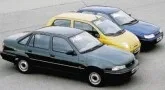
Today we have a rather unusual and colorful company at our disposal. These three cars are united by the fact that they are the most affordable options for drivers who want an unremarkable car, but at the same time one that "nobody else has."
The domestic "desyatka" is a car about which it is unlikely that anything new can be said. Countless tuning parts, accessories, and all sorts of improvements are produced for it, as well as companies ready to install them. Thanks to this, the owner can fully realize their creative ambitions. This car can be repaired in any, even the most remote village. And, of course, it is our domestic car, so most Russian drivers do not distrust it.
The Daewoo Nexia costs $1,600 more. Its advantages are the same, but exactly the opposite. It is a practical "full-size" foreign-made car. Moreover, if one may say so, its "coefficient of foreign car per unit of money" is simply record-breaking. The Nexia is a ready-made dish that requires neither additional "processing" nor any "spices."
The Matiz is made from completely different dough. It is a representative of the "young, unfamiliar tribe" on our roads. Tiny, it does not even try to seem bigger or more serious. The naive gaze of its round headlights is open and radiates joy. It seems that this little car itself offers the owner to enjoy life together with it. Everything that makes the Matiz attractive would turn into a real nightmare for its opponents. Almost everyone smiles at the sight of this little one, but try to speak ironically about the car of a respected motorist with extensive experience!
Italian designers worked on the appearance of this little "internationalist." This happened not so long ago, so the little one's appearance is the most modern in this trio. And the detailing of small elements here is the most thorough. The Matiz can even give its rivals a head start in terms of tactile sensations and the sound of the door locks engaging (seemingly a trifle, but the theater begins with a coat rack, and the car with a door handle).
Sitting in the Nexia is a bit more spacious than in the "desyatka." The seat adjustments have a larger range, and the adjustment process itself is better thought out. For example, to change the backrest angle, you do not need to turn a tight and uncomfortable knob—just pull the lever. The Matiz stands apart: the seating position is almost like in a minivan. All three cars have thin and hard plastic steering wheels, and they are all equally uncomfortable from an ergonomic standpoint.
The VAZ can boast the richest trim: here you have climate control and electric windows. The Nexia in the base version will not please with anything except a radio. The Matiz is also extremely modestly equipped: in addition to the "music," there is only rear window heating.
The pedal assemblies of both Korean-Uzbek cars are equally convenient, but differ in character. In the Nexia, everything is familiar and without complaints. In the Matiz, the pedal travel is light and short; you just need to get used to the unusually small footrest for the left foot, which is angled for an upright seating position. But the pedals of the "desyatka" are too closely spaced, and for a large male foot this is a real test.
Rear passengers have enough space, but it is tight. Interestingly, in this indicator, the Matiz is not inferior to its older rivals, and even surpasses them in headroom.
The most spacious trunk is in the Nexia. The VAZ loses only slightly: 480 liters versus 530. But something else upset me: because the rear seat back and the trunk floor are upholstered with a single piece of material, it was not possible to fold it down. And after such an unsuccessful attempt, returning the backrest to its place turned out to be completely impossible—the lock tongue simply does not fit into the socket. To solve this problem, you need to either apply significant force or use a file.
Seriously talking about the "cargo" capabilities of the Matiz is only possible if you fold the rear seat. In this form, a TV or a washing machine will fit into it. By the way, the fixation of the interior elements here is clearer than in many European cars.
On the road, the absolute champion of this trio is the Matiz with its impeccable manners. The handling is simply excellently tuned: in the city, it easily performs any maneuvers. But on the highway, oddly enough, this purely urban car performed better than its longer-wheelbase competitors, giving the driver precise information about the position of the front wheels and remaining composed up to the maximum speed.
The other two participants behave almost identically: in the city, when turning at low speed, the steering wheel returns to the neutral position too strongly, which interferes with comfortable driving, and on the highway it becomes completely "empty," causing uncertainty: you want to rock the "wheel" one more time to make sure everything is in order. On the highway, the Nexia, despite the weightless steering wheel, goes straight, but the "desyatka" slightly "floats" in the lane.
If we take the VAZ engine as a starting point, whose character is well known to many, then the Nexia engine is quieter, more elastic, and more powerful, but the difference is felt only at the level of nuances. The modest three-cylinder Matiz engine with a volume of only eight hundred "cubes" holds up well—it is quite enough for confident city driving; only at high revs it becomes a bit noisy.
Let's sum up. The choice between the "desyatka" and the Uzbek Nexia will depend mainly on the amount you are willing to allocate for the purchase and, of course, on your personal preferences. "Ideologically," the cars are very similar, but the VAZ is inferior in all parameters, and this difference is roughly proportional to the difference in price ($5,800 versus $7,400 for the Nexia).
For life far from large cities, the "desyatka" is certainly better suited: let it require more frequent repairs, but you won't have to travel far for spare parts, and you won't be afraid to get into it yourself if the need arises. But the choice between the VAZ and the Matiz is like choosing between a large jar of instant coffee and a small cup of espresso for the same money ($5,800 and $5,900, respectively).
The Nexia and the Matiz are a choice between the past and the present, practicality and driving pleasure, solidity and charm.