
 Lanos holds the line well, but responds to steering inputs with a delay  The fancy lines of the dashboard are an acquired taste  Instruments: primitive but informative  The glovebox is small  The lever has a long throw, and the mechanism works imprecisely  Air conditioning is not offered even for an extra charge  The trunk and fuel filler flap are opened from the cabin  A rare case: the Chinese "restyling" did not spoil the appearance of the old Toledo  The Chery Amulet accelerates briskly but noisily  The Toledo interior in Chinese interpretation  The decent instruments are spoiled by the toxic green backlighting  The symbols on the handles are unreadable. But there are cupholders  You have to reach for fifth gear  The glovebox is deep but narrow  Light control is push-button  The Amulet's front armrest has compartments for small items, and the rear one also has cupholders  The Logan has the most modest engine but the most comfortable suspension  The interior is modest but neat   Glovebox in A4 format  The mirrors are small: that's a drawback  In a极限 turn, the Nexia smoothly goes into a slide  The Nexia's cabin is a trip back to the 80s. But everything is assembled neatly  The glovebox is a bit small, and the shelf is slippery   The interior design is old-fashioned, and the build quality is as bad as it gets   The glovebox volume deserves praise  The power window buttons on the tunnel are not the best solution  Factory-tinted mirrors: unsafe  The Kalina behaves well, even at the limit, but it's not easy to drive  You can put up with the interior design, but not with the quality  The instruments on the Kalina are good  The light control unit is on the left  Only gloves will fit in the glovebox  At the end of the steering column stalk is the trip computer button  Central locking and front power windows are standard  The factory tinting is slightly lighter than on the "ten" | Alexander DIVAKOV,
Is that so? Inside, Lanos is as gray as outside. Everything is assembled and fitted neatly, but the ornate reliefs of the front panel and door trims with tiny pockets left us indifferent. However, we were pleased with the ventilation system deflector stretched across the entire width of the windshield and the heating mode "to the glass and to the feet": in winter, that's what you need! Also, unlike the Kalina, there are two pull-out cup holders. But there is not a single mirror in the sun visors. The driver's seat suited us in both shape and firmness, but did not please with the range of longitudinal adjustment: a person 185 cm tall wants to move back "one more notch," but there is nowhere. The steering wheel is positioned diagonally: its right part is closer to the driver than the left, and there are no adjustments at all. If three people sit in the back seat, it becomes cramped in the shoulders, and the outer passengers will have their heads pressed against the side slopes of the roof. It is much more comfortable for two, although the knees still touch the backs of the front seats. Only in Kalina are the legs worse. But, unlike Logan and Nexia, the rear seat back of Lanos folds in parts, but forms a step with the floor. Loading luggage is inconvenient: the narrowed opening and the strongly protruding (and usually dirty) bumper get in the way. But the trunk can be opened from the cabin — like on the "desyatka" or Nexia. Ground clearance is beyond competition! Between the road and the gearbox oil pan, there is a record 200 mm, 15 mm more than in Kalina, the previous class leader. True, like all other cars except Logan, there is no protective underbody shield for the engine compartment.
The interior hints at bourgeois luxury (naturally, after getting acquainted with Lanos): beige velour seats, plastic of the front panel matched in tone, decent materials, good assembly... But the "geometry" of the driver's seating is not optimal. Despite the fact that the steering wheel is adjustable in height and the seat cushion in tilt angle, not everyone will be able to sit comfortably: the range of longitudinal seat adjustment is too small, the backrest has a "pushing out" profile, and the gear lever is too far from the driver. Among the flaws of the "visual series" are the poisonous green backlighting of the simple instruments and the symbols hidden from the driver's eyes on the climate control knobs, which, in turn, are located at the very bottom of the central console — like on Logan. And when you find yourself among three other passengers in the back seat, you will finally understand: the feeling of spaciousness created by the light upholstery and the large glazing area is just a feeling. Cramped in the shoulders, cramped in the knees. It is much more comfortable for two, especially if you pull out the wide armrest from the backrest — with a box and cup holders. In Logan, there is more space in the back, but there is no armrest, no convenient ceiling lamp, no 12-volt socket. No interior transformation is provided either. But in Amulet, the rear sofa folded "Volkswagen-style" (the halves of the backrests lay on the place of the folded halves of the cushions) forms a flat area with the trunk floor. No one can boast of such space for luggage! It is a pity that the fifth door is too heavy to lift. That's a different matter on the VAZ "desyatka"! You press a button on the front panel — and the trunk lid itself soars up and sways. So much so that, if you gape, you can get hit in the teeth. But the trunk of the "desyatka" is large, and it is convenient to load. It is also good with transformation: the rear seat folds in parts, although a single opening is not obtained — a plastic armrest frame remains in the center. However, it was not possible to latch the locks the first time. Nor the second. Nor the third... Kalina is devoid of these shortcomings. The cushion and backrest of the rear seat fold in parts in no time — almost flush with the trunk floor. True, it has to be unlocked with a key, and closed by the dirty edge. But sitting in the back is still more comfortable in the "desyatka." It is slightly better than in Amulet and noticeably more spacious than in Nexia or Lanos. However, if in Lanos the knees touch the soft material of the front seats, in Kalina you press against their hard ribs: unpleasantly painful! And getting out of the rear sofa of Kalina is not so easy: the feet barely fit between the front seat and the "pedestal" on which the rear one is erected. But in terms of front seat comfort, Kalina is one of the best. Optimal "geometry," huge adjustment ranges, a comfortable steering wheel, clear instruments. But the quality of assembly and fitting... However, in the "desyatka," things are even worse in this regard. The "old lady" Nexia is assembled much more neatly. But how dreary its forms are! No "cosmetics" will help here. Perhaps the price will console? But you can only console yourself with the simplest version with an eight-valve engine and without power steering — such a car costs $8800. And "our" Nexia with a sixteen-valve engine and power steering is already sold for $10000, a thousand dollars more expensive than Logan! Of course, Logan cannot be called a handsome man either, but its lines are at least individual and even modern. And in terms of interior space, Logan is beyond competition! This joyful feeling cannot be overshadowed by the ascetically straightforward interior design, nor the frankly cheap recessed handles in the doors, nor the climate control knobs pushed to the bottom of the central console. But everything turns, opens, closes, and presses with normal efforts. It is a pity that Logan, like Nexia, is not adapted for transporting long items: the rear sofa backrest stands firmly. The trunk of Nexia, although smaller than Logan's, can be opened both from outside and from the cabin (the lid rises a quarter of a meter, rather than jumping up like on the "desyatka"). The trunk of Logan opens only with a key, and this is inconvenient. What to expect from the "workhorses" on the move? They carry — and thank you for that? Then special thanks to Kalina and Logan for ride smoothness. But that's where the similarity ends. In acceleration, Logan yields not only to Kalina but also to all other test participants. When starting off, the excessive effort on the accelerator pedal draws attention — it is even greater than on the clutch pedal! But it must be admitted that the traction capabilities of the 1400-cc engine are quite enough for confident city driving. Gears shift easily (second accelerates Logan to 85 km/h, third to 125 km/h), the brakes allow precise deceleration, and only the noise is annoying. This is noise from tires, from imperfect aerodynamics, from passing cars, and especially from the engine "revved" above 3000 rpm. Fortunately, Logan handles simply and understandably. But only up to 100 km/h. Then the reactions to steering actions become sharper, and a tendency to oversteer appears. This already requires precise steering actions and considerable concentration. And on bumps in high-speed corners, Logan tends to slide off the trajectory. In Lanos, it is much quieter, but it is more difficult to drive. The steering wheel without power assist makes 4.5 turns from lock to lock — even more than on Kalina with its "long" rack! In normal modes, this only strains the muscles, but at high speed, even during smooth lane changes, the delay in the car's reactions to steering actions becomes unacceptably large! As if instead of steel tie rod ends, there are rubber ones. Dangerous and scary! Fortunately, Lanos has good brakes, it holds the arc well, and road irregularities are harder to knock it off course than Logan or Kalina. But Lanos yields to this pair in ride smoothness, although it is better than Nexia and Amulet.
Amulet is one of the leaders in acceleration dynamics. But before you can be convinced of this, it would be a good idea to plug your ears with earplugs: the engine screams mercilessly, even louder than in the Logan! The brakes are in order. The handling also did not present any unpleasant surprises: Chery yields only to Renault due to the low sensitivity of the steering and less precise reactions. In terms of ride smoothness, the "Chinese" can only compete with the Nexia — both cars react unpleasantly sharply to all hard road irregularities. These cars are also close in acceleration dynamics. But from the point of view of acoustic comfort, the Nexia is still preferable. The acceleration capabilities of the "ten" and Kalina are approximately at the same level as those of the Amulet and Nexia. But driving our cars is already work, and unloved work at that. In the Kalina, it begins when starting off: the procedure is complicated by delayed reactions to the accelerator, high force on the clutch pedal, and the vagueness of the moment of its engagement. In the "ten", starting off is a little easier, but the equally poorly tuned drives of the VAZ gearboxes prevent realizing the generally good potential of the eight-valve engines. And the noise, the noise! Like a conductor's baton, the tachometer needles awaken sounds in all corners of the front panel; engines roar, transmissions whine... What a lousy little orchestra! Where the Togliatti cars differ is in handling. The "ten", despite the vagueness and delay of reactions, remains more predictable even during emergency maneuvers than the Kalina. Driving the Kalina is sheer torment: you don't feel the connection between the steering wheel and the wheels, and the electric power steering is completely devoid of informativeness! God forbid you find yourself as an "unexpected obstacle" in the Kalina's path.
The main hero, as in our summer test (see AR No. 13-14, 2005), was again the Logan, and only the "non-transformable" rear seat prevented it from becoming the leader in total points. Solid build, spacious interior, and very energy-intensive suspension — these are the main components of its success. The old lady Daewoo Nexia continues to reap the benefits of Opel engineering from the eighties, maintaining fairly high positions in a number of consumer qualities. But if earlier one of the main advantages of the Nexia was the price, now there are cars that are both more affordable and more modern. It's a pity that the Kalina can only be classified as such a car with a stretch. It seems that its advantages over the "ten" are limited only to ride smoothness and the ergonomics of the driver's workplace. And in terms of handling, noise, and vibration load, the Kalina frankly loses to its older sister. Was it worth the trouble? As for the newcomers to our market, they performed decently, although not brightly. The Chery Amulet pleased with the quality of assembly, a relatively high level of equipment, and wide possibilities for transforming the interior. But it is a very noisy car. And not Chinese-cheap. The Chevrolet Lanos got lost against the background of "foreign cars", losing in some parameters even to the VAZs. But it surpassed all rivals in acoustic comfort and ground clearance. And the Ukrainian Chevrolet also has a very attractive price ($8990) — even against the background of the VAZ "ten". What costs how much? The "basic" Kalina with electric power steering, central locking, and front electric windows can now really be bought for the factory-recommended $8000 — this is the most affordable car among the test cars. Soon the Kalina in the Lux version will appear — with improved interior trim, heated front seats, fog lights, rear head restraints, and electric drive for heated mirrors and rear windows. The "ten" is a little more expensive — from $8200 for a car with an eight-valve 1600-cc engine (80 hp), central locking, and front electric windows (Norma version). The "luxury" version is about $200 more expensive — here there is seat heating, a trip computer (on the Kalina it is in the Norma), "fog lights", and electric drive for heated mirrors. Cars with 16-valve engines (90 hp) cost from $8400. You can also find a version with air conditioning (from $9200) or a restyled sedan with a changed appearance and modernized interior (from $8800). Hatchbacks (2112) are offered at the price of sedans, and station wagons (2111) are $150 more expensive. The warranty on VAZ models is 2 years or 35 thousand km. Prices for Daewoo Nexia sedans start from $8800, but for this money cars with 8-valve 75-horsepower engines are offered, in more modest equipment than the "ten" with the Kalina: neither central locking, nor electric windows, nor power steering. In the GLE version, which externally differs from the simple GL by body-colored bumpers and "fog lights", all this is present, but such a Nexia is $1000 more expensive. Air conditioning — plus $700, and for a 16-valve engine (85 hp) you need to pay an additional $500. The upper price limit for the Nexia is $11300. But there is still no ABS or airbags. The warranty is 5 years or 100 thousand km. Chevrolet Lanos is a little more expensive — $8990. But there is a driver's airbag, body-colored bumpers, and audio preparation. But there is no power steering or ABS. The warranty is 2 years without mileage limit. The basic Renault Logan with a 1400-cc engine (75 hp) is equipped approximately the same as the Lanos and is more expensive by only $9. But the bumpers are black. The Logan Expression with painted bumpers, power steering, and central locking costs already $9979. But in the more powerful 1600-cc version (90 hp), all this together with front electric windows is basic equipment ($10699). And in the top version Privilege ($12099), in addition, there is air conditioning, a trip computer, a height-adjustable driver's seat, "fog lights", and a body-colored radiator grille. Electric mirror drive, ABS, passenger airbag, and seat heating are offered for an additional charge. The warranty is 2 years without mileage limit. The Chinese liftback Chery Amulet is the most expensive car in the test. But for $10990 the Amulet has air conditioning, for $12100 — ABS, a CD player, and alloy wheels. True, airbags are provided only in the version for $12400. In the spring, the appearance of cars with a variator from ZF is expected, which will cost about $1000. The warranty is 3 years or 100 thousand km. Alternative? First of all, this is the Hyundai Accent of Taganrog assembly — a sedan with a powerful engine (1.5 L, 102 hp), power steering, air conditioning, and a radio is offered for $10900. The second option is the Chevrolet Aveo. Sedan (1.4 L, 83 hp) — from $10900, hatchback (1.2 L, 72 hp) — from $9900. You can also buy a Volkswagen Pointer (1.0 L, 67 hp, from $9520) or a Hyundai Getz (1.1 L, 66 hp, $10190).
| ||||||||||||||||||||||||||||||||||||||||||||||||||||||||||||||||||||||||||||||||||||||||||||||||||||||||||||||||||||||||||||||||||||||||||||||||||||||||||||||||||||||||||||||||||||||||||||||||||||||||||||||||||||||||||||||||||||||||||||||||||||||||||||||||||||||||||||||||||||||||||||||||||||||||||||||||||||||||||||||||||||||||||||||||||||||||||||||||||||||||||||||||||||||||||||||||||||||||||||||||||||||||||||||||||||||||||||||||||||||||||||||||||||||||||||||||||||||||||||||||||||||||||||||||||||||||||||||||||||||||||||||||||||||||||||||||||||||||||||||||||
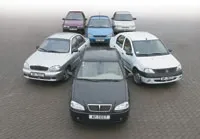
Working class. Lada Kalina, Lada-110, Chevrolet Lanos, Renault Logan, Daewoo Nexia, Chery Amulet
Lanos holds the line well, but responds to steering inputs with a delay The fancy lines of the dashboard are an acquired taste Instruments: primitive but informative The glovebox is small The lever has a long throw, and the mechanism works imprecisely Air conditioning is not offered even for an extra charge The trunk and fuel filler flap are opened from the cabin A rare case: the Chinese…


Source: АвтоРЕВЮ
Comments
No comments yet. Say the first word.