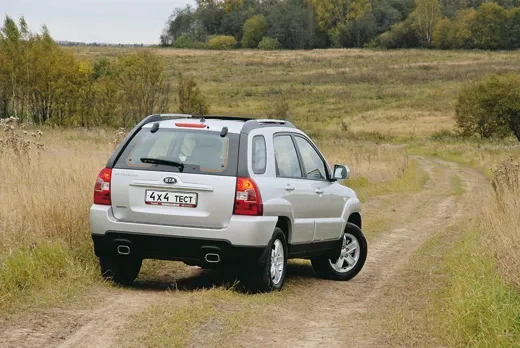
The main differences of the updated version are the exterior and a couple of important points inside, particularly the driver's seating position and the quality of the trim.
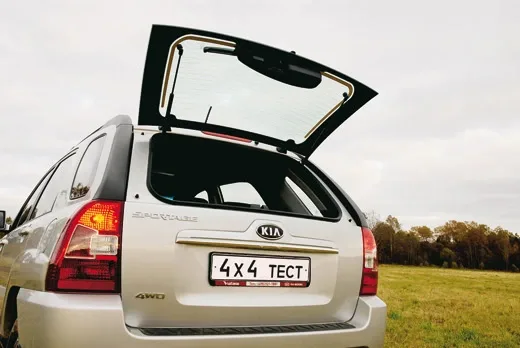
The standard wheels now look more off-road. The headlights at the front have been slightly changed, the radiator grille is drawn differently, and because of this, the front of the crossover has become very similar to one Japanese competitor. The rear lights have also been refined. At the back, there are now two exhaust pipes instead of one — even on the two-liter gasoline engine. The mirrors are of a different shape, and the fog lights have become round, although they used to be triangular. These seem like small things, but they are what make the car visually fresher and more spirited.
SITTING HAS BECOME MORE COMFORTABLE
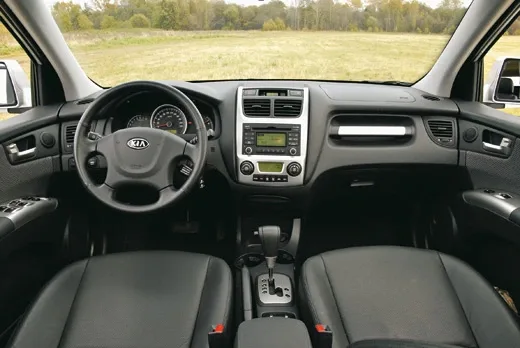
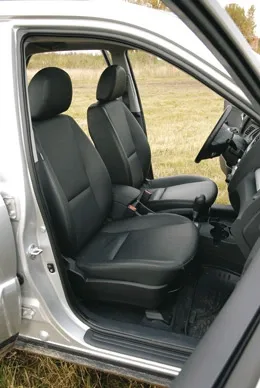
I have always believed that changes in the cabin are more important than an external cosmetic repair. After all, the driver spends almost all their time in the car. And here the KIA Sportage restyling pleased. The trim materials have become noticeably better quality (previously, journalists often criticized the car for them). The central console in the new design also looks better than before. But the most important thing is the new seats. It has really become more comfortable to sit in them. The seat adjustment mechanisms have been seriously refined in terms of ergonomics: instead of discrete positions, there is now smooth adjustment.
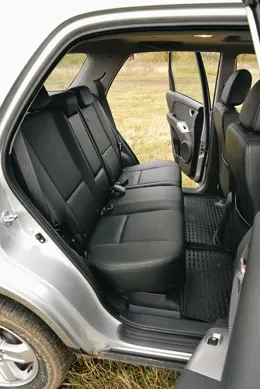
The cushion of the front seats has become 4 cm longer. The backrest is 6 cm higher. The distance from the pedals to the backrest has grown from 103 to 107 cm. The seats are so successful that the only remark is the lateral support (although on the two-liter version it is hardly needed). Rear passengers also have more space, especially those with long legs. In the rear armrest, there are now two holes — square and round: one for a cup, the other for a juice pack. In general, there is enough space in the cabin for both people and things.
I have always believed that changes in the cabin are more important than an external cosmetic repair. After all, the driver spends almost all their time in the car. And here the KIA Sportage restyling pleased. The trim materials have become noticeably better quality (previously, journalists often criticized the car for them). The central console in the new design also looks better than before. But the most important thing is the new seats. It has really become more comfortable to sit in them. The seat adjustment mechanisms have been seriously refined in terms of ergonomics: instead of discrete positions, there is now smooth adjustment.
The cushion of the front seats has become 4 cm longer. The backrest is 6 cm higher. The distance from the pedals to the backrest has grown from 103 to 107 cm. The seats are so successful that the only remark is the lateral support (although on the two-liter version it is hardly needed). Rear passengers also have more space, especially those with long legs. In the rear armrest, there are now two holes — square and round: one for a cup, the other for a juice pack. In general, there is enough space in the cabin for both people and things.
There are also changes in the KIA Sportage trim levels. Side airbags and ESP are now included in the basic set of the EX version, not as options. Bumpers and lower moldings can now be ordered in body color in all 12 colors, previously this option was only available for four main ones. The music system with CD and MP3 is now standard for all versions, but the sound quality is, to put it mildly, budget. A function to disable the passenger airbag has appeared. On versions with an automatic transmission, cruise control has become available.
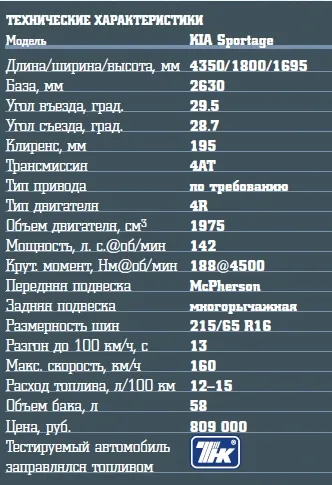
SPECS: KIA SPORTAGE
AND THE AWL, AND THE SOAP
In our editorial office, a Hyundai Tucson — a twin crossover on the same platform as the KIA Sportage — is on a long-term test. Of course, we could not resist a quick comparison. KIA confirmed that it is not in vain that it bears the root sport in its name. It is noticeably more assembled in terms of suspension and steering. There are fewer rolls and dives, more confidence in corners. And you have to pay for this with stiffness.
In our editorial office, a Hyundai Tucson — a twin crossover on the same platform as the KIA Sportage — is on a long-term test. Of course, we could not resist a quick comparison. KIA confirmed that it is not in vain that it bears the root sport in its name. It is noticeably more assembled in terms of suspension and steering. There are fewer rolls and dives, more confidence in corners. And you have to pay for this with stiffness.
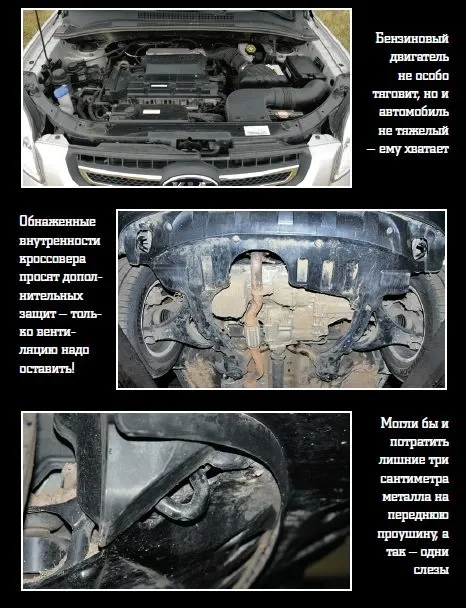
When we looked under the bottom of the updated crossover, it turned out that there is no standard protection for the engine compartment, but it can be installed — the mounts are provided. The lowest point limiting geometric cross-country ability is the exhaust system, and rather its tract, because the muffler is located high and the rear overhang does not interfere.
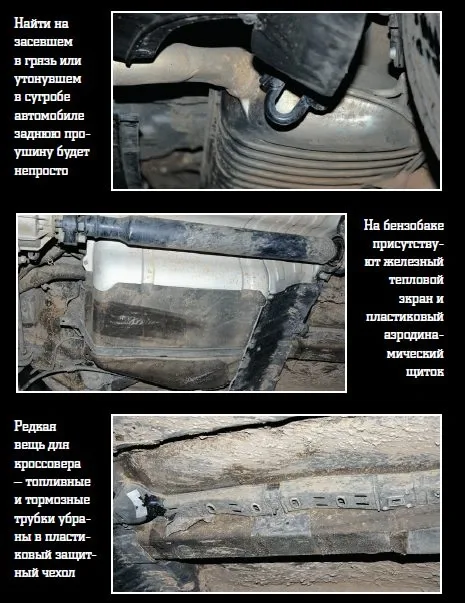
The approach and departure angles are larger than those of a regular crossover. The tow hooks are not in the most convenient place. On rough terrain, the KIA Sportage drives well — the short wheelbase, small overhangs, and light weight help. Plus an energy-intensive suspension and decent travel. But on terrain breaks, when one of the wheels hangs in the air, ESP makes the car freeze, and with the electronics turned off, spinning in place begins. So there you have it — the awl and the soap in one bottle. If you go with momentum, it turns out easier and more effective.
What else? The wheel size is correct. The spare wheel is full-size. Overall, the impressions are the most pleasant. Only the suspension is stiff.
What else? The wheel size is correct. The spare wheel is full-size. Overall, the impressions are the most pleasant. Only the suspension is stiff.