
Soul squared
Nature has long created a mechanism that allows the small and weak to pretend to be big and strong in a moment of danger, in order to cool the appetite of a nearby predator. The essence of such protection is purely decorative: to scare the aggressor, you can, for example, either puff up like a pufferfish, or spread a bright leathery collar, like one of the New Guinea tree lizards. In general, "perform for the audience".
Kia Soul is from the same "show-off" breed. The single-drive compact minicar, thanks to its high roof (1610 millimeters) and masculine, chopped "brick-like" body, looks more like a small crossover. This impression is enhanced by the swollen arches, wheels widely spaced at the corners of the body, as well as the textured stamping of the body panels. As a result, when examining the "Soul" in low light and with the right choice of angle, the adjective "compact" most often wants to be discarded.
For example, it is taller than the Nissan Qashqai,
and only five centimeters lower than the "adult" SUV Audi Q5
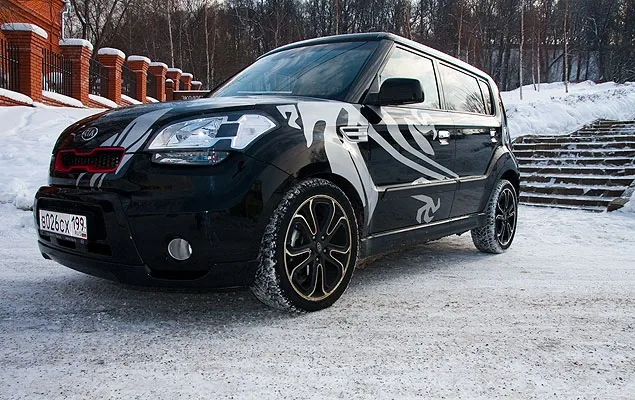
Moreover, the "Kia" badge on the hood, which indicates the budget Korean origin of the car, is not readable at first meeting with the "Soul" – all attention is drawn to the aggressive double radiator grille. Especially its upper segment, which even in the base version is sportily covered with a mesh grille. And the sloping hood "like a shoe", as on the Mini, looks unusual.
In Moscow, the interesting appearance and especially the seemingly impressive dimensions of the "Soul" are appropriate. The capital of our homeland for a car owner is the same jungle: here on avenues and boulevards, as in nature, the strongest has priority (it's easy to navigate: at the highest step of the "food" car chain are five-meter limousines and SUVs with flashing beacons).
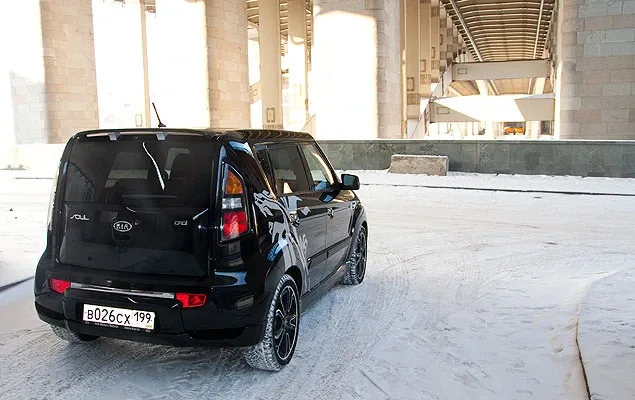
In this hierarchy, a small car, of course, will never rise to the top, but you can enhance the effect of the Kia Soul's appearance in public. It is enough to order the "tuned" Burner version with silver stickers under airbrushing on a black body and blackened 18-inch wheels. It was exactly this Kia Soul that we got for a test drive.
Play hormone
Under the hood of the "Burner" there was no tuning. Here is the most powerful of the two engines installed on the "Soul" – a 128-horsepower diesel with a volume of 1.6 liters. But the interior of the Korean "lighter" makes no less impression than its external "tattooed" shell. The scarlet front panel and inserts of the same color on the fabric seats hit the eyes right through the windows even when approaching the car, and as soon as you turn the key in the ignition, the "pancakes" of the speakers installed in the front doors begin to rhythmically blink with red backlighting.
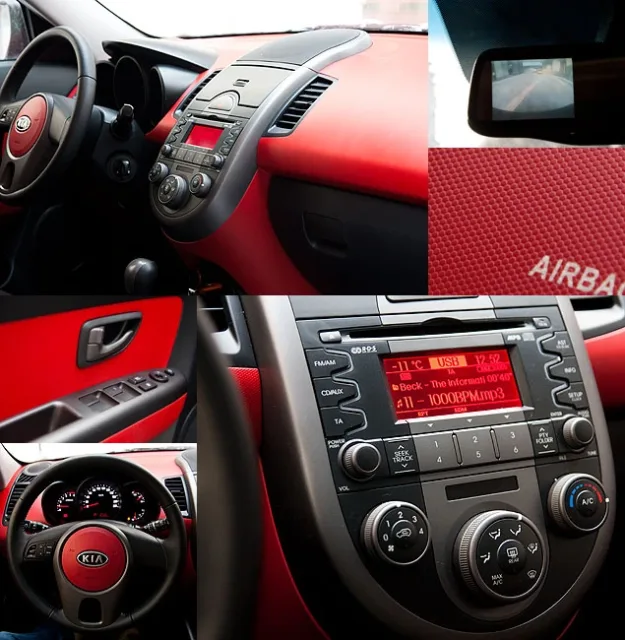
But the driver's seat armrest and the trunk curtain can be bought for extra money. However, such pleasure will not be cheap - these accessories on the manufacturer's website cost 11 thousand 971 rubles and 12 thousand 196 rubles, respectively.
But Korean tuning fascinates only at first - having settled in the cabin, you understand that stickers, "cast wheels" and crimson plastic in the cabin are superficial, another shocking technique borrowed from nature to win over potential buyers. In soul, the "Soul" is different: a practical small-sized city car with a spacious interior, high seating position and excellent design. For which, by the way, the California studio of the Korean company was responsible. It is such cars that are now gaining popularity in Western Europe.
However, neither to European standards, nor even to its own, established during the creation of the Kia Cee'd hatchback, the Korean automaker still did not reach when creating the Kia Soul. For example, there is no soft plastic in the cabin of the Korean small car at all, the steering column is adjustable only by tilt, the front seats lack rigidity, and in general, the seating position in the driver's seat is more bus-like than passenger-car-like.
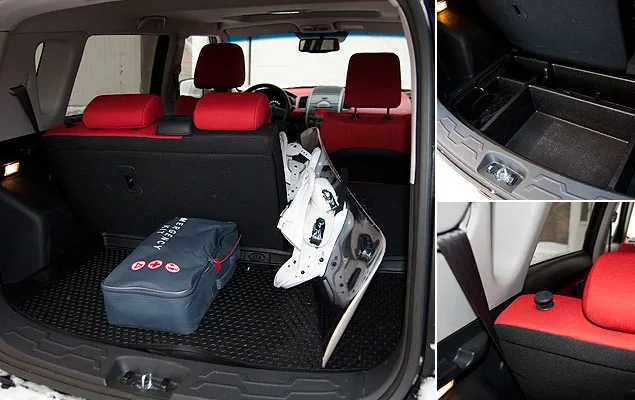
The Koreans were clever with the trunk - only 225 liters remain for bags in the Kia Soul. True, under the floor of the cargo compartment there is a spacious plastic box with compartments where you can put antifreeze, tools or spare shoes for sports. But this organizer is convenient to use only if the dwarf trunk is empty, and therefore there is no particular need for the underground. On the other hand, there is enough space in the cabin of the compact van: Korean engineers competently used the 2550 millimeters of the "Soul's" wheelbase. As a result, it is spacious not only in the front, but also on the rear sofa, where three adults can comfortably sit.
They will catch up with us
| Color music
|

A car with 1354 kilograms of curb weight divided by 128 horsepower obviously does not guarantee the driver breathtaking dynamic characteristics. And our test Kia Soul, despite its combat coloring, is not ready for a revolution: according to the passport, the compact van accelerates to a hundred in 11.9 seconds, and by feel - even longer. On the other hand, on the "Soul" you can still "have fun" in traffic light races – the first two gears most effectively realize the solid torque of the turbodiesel: the engine reaches maximum 260 Newton-meters already at 1900 rpm and holds them up to 2750 rpm. However, then the Korean "horses" get stuck in the four-speed "automatic", which for a long time weighs the need for each downshift or upshift.
They say that on a five-speed "manual" the diesel Kia Soul is more dynamic. However, judging by the passport, the difference between a car with automatic and manual transmission is mostly psychological. The actual - according to the passport - is only 0.6 seconds.
The compact van also has a gasoline engine with a volume of 1.6 liters and a power of 124 horsepower, which is equipped only with a manual transmission. This engine accelerates the small car to a "hundred" faster than the diesel - in just 11 seconds. But there is no talk of any pickup at low revs here. And in the top trims of the "Soul", the gasoline engine gave way to the diesel engine.
The first driving impression of the Korean "compact" is that the steering wheel is "over-tightened" at zero. At the same time, the suspension, unfortunately, does not provide tram-like directional stability on straights, and therefore on the highway you have to steer. And from constantly fighting the steering wheel for every degree, or even minute, of deviation from the trajectory, you quickly get tired.
In sharp turns, the car's reactions to steering are blurred. But the last complaint is most likely on the conscience of wide low-profile winter "velcro" tires of dimension 225/45R18 - in our climatic conditions, for winter you need to put narrower wheels. Because of them, the "Soul" also slips out of deep ruts like butter. And also the Korean compact van mercilessly bucks, shakes and bounces on bad roads. Of course, low-profile rubber is also to blame, but the main reason is still a very stiff suspension. And the minimal body rolls, which delight the driver during active maneuvering at low speeds, cannot save the situation: all the charm of such handling dissipates at the first speed bump.
with the geometry of urban architecture
Critical realism
Some may think that we are too picky in our assessment of the Korean compact MPV. After all, the "Soul" is a small-displacement and therefore budget car, and compromises in this class are inevitable. But the Koreans are to blame themselves for making us want to hold their creation to high standards. After all, on the outside, the Soul looks expensive - almost like a compact crossover, and in fact it costs a lot. At least, with the price of the base gasoline Soul with a manual transmission starting at 580 thousand rubles, this "little one" surpasses in cost both the five-door hatchback Kia Cee'd (with a 1.6-liter gasoline engine - from 570 thousand rubles) and the Kia Cerato sedan (560 thousand rubles).

For example, in this case, for the stickers, wheels, bumper and side window overlays, spoiler, special radiator grille, and other accessories that distinguish the Burner from the top Diva, you'll have to pay only 20 thousand rubles. At retail, the same set of equipment will cost much more. One "Silver Dragon" tattoo costs 13 thousand$ 14 (109 UAH)ya, and the radiator grille - another 13 thousand 391 rubles.
Another way to save money is to order simpler tuning. For example, if the owner limits themselves to just the "Trident" sticker on the hood, then personalizing the "Soul" will cost them only 4 thousand 808 rubles.
At the same time, the more expensive trim levels of the Korean compact MPV compete with rivals such as the diesel Ford Focus, Volkswagen Golf, and Mazda3. And in the Skoda model range, for the price of the top "Soul" with a diesel engine and automatic transmission, you can buy a real Yeti crossover (though it will be the base front-wheel-drive version). With such competition, the Korean compact MPV certainly has a hard time.
The "Soul" can only counter its rivals with two trump cards – design and an excellent diesel engine. And if this car is destined to take root in our market, it will be the personal merit of the Kia California studio, which created the fun and feisty look of the Soul, as well as the Korean engineers responsible for developing the in-house engine. Without these two components, marketers promoting the Korean compact MPV on the global market would have to borrow some other trick from nature to attract buyers to the "Soul". Like sexual pheromones.
Technical specifications of Kia Soul
| Length, mm | 4105 |
| Width, mm | 1785 |
| Height, mm | 1610 |
| Wheelbase, mm | 2550 |
| Curb weight, kg | 1354 |
| Engine displacement, cm3 | 1582 |
| Power, hp/rpm | 128/4000 |
| Torque, Nm/rpm | 260/1900-2750 |
| Acceleration time from 0 to 100 km/h, s | 11.9 |
| Maximum speed, km/h | 176 |
| Fuel consumption in combined cycle, l/100 km | 5.9 |
| DISCUSS | [ comments: NONE ] |