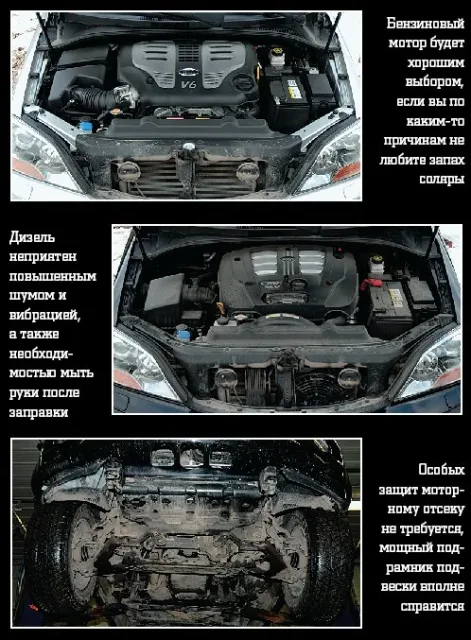
There were few changes on the outside, and technical changes were not announced too loudly, so many, including us, did not take the modernization seriously: just a facelift, we thought. But in reality, in Izhevsk, where the SUV has been assembled using the SKD scheme (semi-knocked-down assembly of ready-made vehicle kits) since March 2007, a different Sorento is already being produced. Now our attention to the car is drawn by the appearance of a new diesel engine. The engine is interesting: 2.5 liters with turbocharging and a common rail fuel system produce 170 hp and 400 Nm of torque. Well, to have something to compare with, we took a competitor from the same stable – a Sorento with a 3.3-liter gasoline engine producing 241 hp and 307 Nm.
HOMEWORK
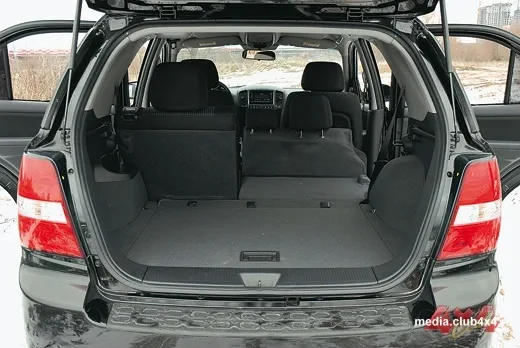
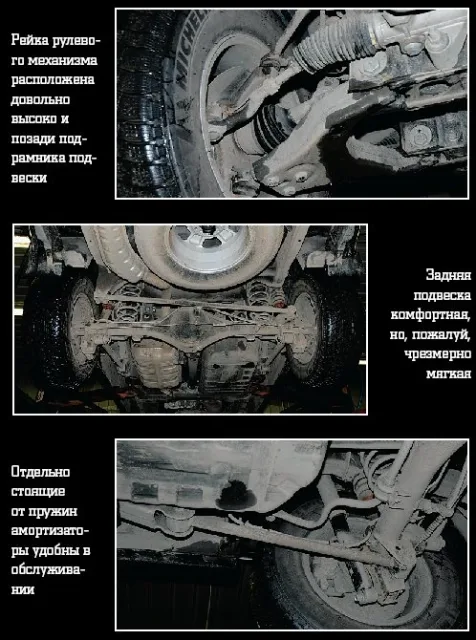
The 2006 update cannot be called fixing mistakes, although some annoying shortcomings were removed. In theory, the picture is as follows: the suspension silent blocks, which wore out quickly on broken roads, were replaced with larger ones made of new materials, the caster angle was increased, which improved directional stability, the rear suspension geometry was redesigned, increasing its travel and articulation angle. Plus, the deformation zones were recalculated, active headrests and a new airbag deployment algorithm were added, as well as an ESP stability control system.

ON ASPHALT
Despite the refined chassis, both cars start to "float" at high speeds even on a smooth highway. On the gasoline version, after 120 km/h, the steering effort disappears completely. It's creepy... On the diesel, this is not the case. It seems that the fact that this engine is about fifty kilograms heavier than the gasoline one has an effect. On small bumps, the car shudders in fright... Of course, by evening you get used to this and to the steering wheel, which becomes lighter on the move. But the overall feeling is that the Kia Sorento lacks refinement in its tuning. But overall, it's not all that bad. Comfortable seats and a soft suspension will please on a long journey... Noise at speed is acceptable, but I would like fewer aerodynamic whistles. Maneuverability and dynamics are excellent in both cases, although the characters are different. The diesel takes off from a standstill and pulls, gradually fading by 4000 rpm, then finally goes flat. The "gasoline" enters corners more easily but holds the line a bit worse, tending to drift outward, and during acceleration it first seems to weigh its chances, but after assessing, it goes so hard that the engine seems ready to jump out of the hood and run away. The engine is tuned perfectly, accelerating to 100 km/h in 9.5 seconds with pleasure, showing excellent elasticity – from 60 to 100 km/h in less than five seconds. Manual mode on asphalt is pointless unless you are in the mountains, where you need to constantly brake with the engine and keep the revs near the torque peak. Off-road is a different matter. However, there is a nuance here: on the diesel, you can brake with the engine, but the gasoline gearbox even in manual mode starts shifting up on a descent.
ON ROUGH TERRAIN
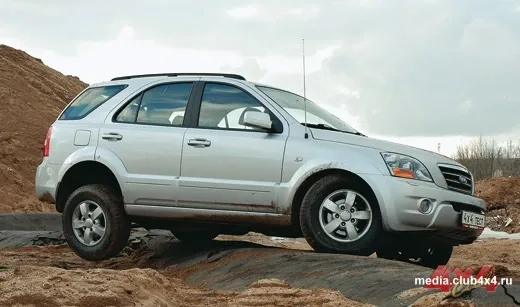
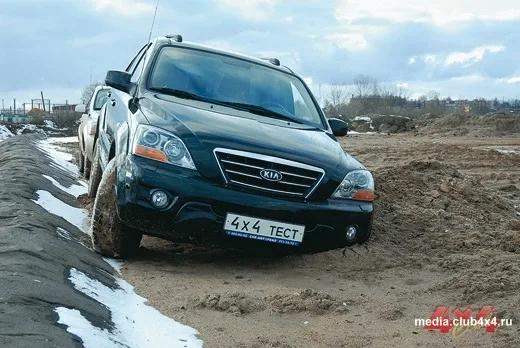
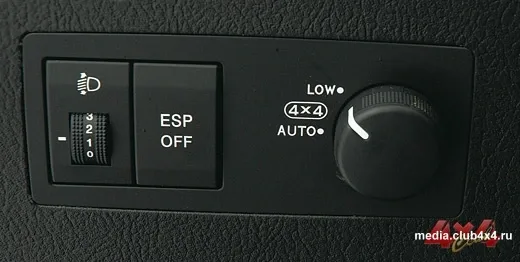
The off-road potential of the Kia Sorento, which is quite good in its specifications, runs into the concept of a "universal family SUV" as it was understood in the nineties. Good geometric cross-country capability, low-range gearing, traction control system – all these are pluses and inspire confidence. But what's wrong? Look at the underbody, the frame, the placement of transmission components, the skid plates, bumpers, and nice side steps. All this was done for comfort and aerodynamics. The components hang almost lower than the frame, massive plastic bumpers are right at the point of contact, the side steps won't survive a hit from below, and the skid plates are as light as possible. A compromise car. An SUV of the type that "can overcome limited off-road in extreme cases," but it's better not to leave the road. That is, you can leave the road, of course – look at us! Just don't be offended if you tear off something useful or crush something needed.
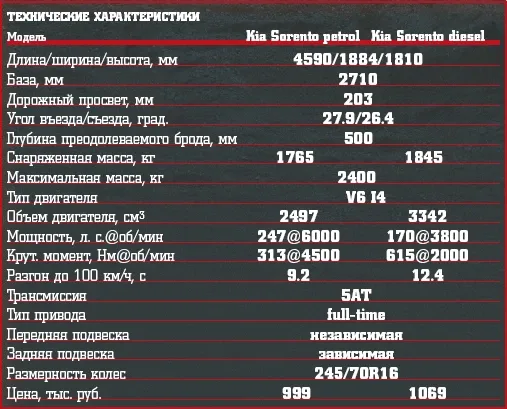
SPECS: KIA SORENTO
NOT TOUCHING THE DETAILS
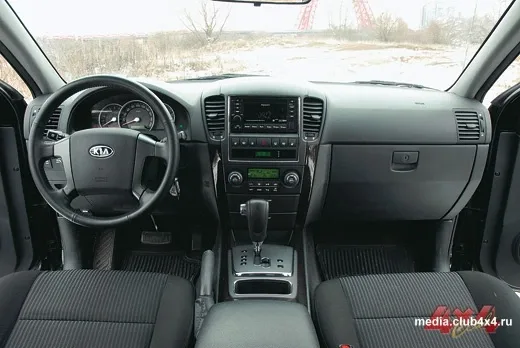
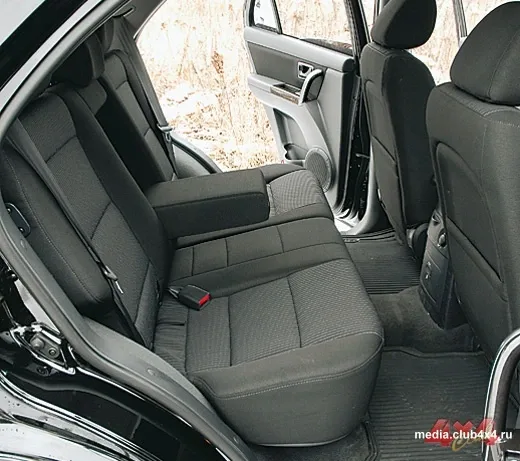
I did not describe the exterior, interior, and equipment of the SUVs, because, firstly, there are no obvious flaws, and secondly, there are 13 trim levels, and it's better to learn the details from a dealer. As for competitors and the point of purchase, everything is simple here too. There are two competitors – the SsangYong Rexton and the Mitsubishi Pajero Sport. In both cases, the Sorento looks more expensive, is slightly better finished, more comfortable on the move, and its engines are more powerful. In addition, the cramped Mitsubishi is already for retrograde people, and the SsangYong looks, let's admit, we-ell... peculiar. In short, the Sorento seems a quite reasonable purchase. Oh yes, we were going to decide: gasoline or diesel? Well, of course, the second – with it, the Sorento feels better both on the road and on dirt.