
KIA Sorento. Not without some qualities
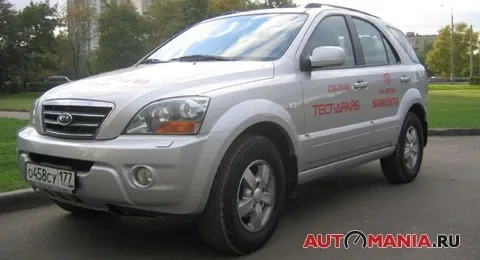
The first acquaintance with the SUV did not disappoint. It is huge, roomy and spacious. In appearance, it is much more elegant than the Ssang Yong Rexton or Kyron. During the test, we were convinced that the respectful attitude towards it from other road users is no worse than towards more solid jeeps costing an order of magnitude more.
So, our impressions. At first, we had to get used to the steering wheel. It seemed too soft. You don't need to hold the steering wheel tightly; you can control the car by touching the wheel with your fingertips. Unusual, but pleasant, and it is unlikely that this softness of the steering wheel could lead to an emergency situation. But entering a turn after a fairly powerful acceleration brings the first disappointment. It is clear that this is a body-on-frame SUV, but the lateral rolls are so strong that it seems if I turned the steering wheel a little sharper, the jeep could roll over.
Comfort, smooth ride, excellent operation of the automatic transmission, and even the mentioned rolls – all the advantages and disadvantages are explained quite simply – the Korean jeep was created exclusively for the American market. Where, by the way, it sells well at a price of 25 – 27 thousand $ (in Russia the car costs about 40 thousand $). Several more options we found serve as extra proof of the priority market for the Sorento.
The first example of "Americanization" can be the leather seats in the cabin. They are so soft and comfortable, as if they were an expensive sofa from a furniture boutique. Passengers in the rear seats feel almost like in business class on a good airplane.
The original location of the onboard computer was quite surprising. For the first few hours, I generally thought that this mighty jeep did not have one (by the way, the competitor in the form of the Ssang Yong does not have a computer). And I found it not in the usual place on the central console or instrument panel, but right above the central rearview mirror, i.e., on the ceiling of the cabin. Three buttons located nearby are responsible for switching operating modes and for opening/closing the sunroof. The main thing is not to mix them up! The "onboard" shows everything, including the main position for Americans – the compass, but it does not show the average fuel consumption. Of course, who in the USA cares about average fuel consumption with their gasoline prices and standard of living. Over there across the ocean, they generally love SUVs with large displacement and horsepower. In the Sorento's passport data, by the way, this indicator is also absent. According to our estimates, consumption in the city is no less than 16-18 l/100km. The only thing that pleases is that the car eats 92-octane gasoline.
Well, of course, we cannot fail to mention the presence of cruise control and dual-zone climate control. True, you should not trust the numbers displayed on the screen for the outside air temperature. The difference between the readings and the real temperature can be 5-8 degrees. Apparently, the sensors are located too close to the engine, so they lie shamelessly.
Let's talk about the engine. If the pre-restyling Sorento in 2003 had a 3.5-liter engine with 195 hp, today the 2-ton SUV has a 3.3-liter V6 power unit with 247 hp (in the advertising brochure, by the way, it says 238 hp for some reason). This number of "horses" under the hood allows you to easily accelerate the jeep to 100 km/h in 9.8 seconds and reach a top speed of 190 km/h. However, more is not needed, given the lateral rolls and nose dives during hard braking.
The cabin is quite comfortable. In addition to the huge legroom for the driver and passengers, the Sorento has an equally spacious trunk. Its volume with the seats not folded is 900 liters, and with them folded, as much as 1900 liters.
What KIA manufacturers saved on was the adjustment of passenger seats. While the driver's seat has 8 positions of electric adjustment, the front passenger has to adjust everything manually, and the rear seats do not have these functions at all.
The interior trim cannot be called ideal. The seats are comfortable, but the plastic is hard, though not as rough as in the Ssang Yong. The central console is less elegant than in the Hyundai Santa Fe or Chevrolet Captiva. I did not like that the Sorento does not have a standard audio system. In the place where the American version has navigation, and the Korean version has an audio system (look at the advertising brochure in the dealership), in Russia you will only see a plastic plug measuring 100x100 mm. The test car had a Kenwood audio system installed, which categorically refused to pick up a dozen of my favorite FM stations. Another minus is the too loud and annoying sound of the turn signal. But we add 6 airbags as a big plus.
In fact, all the secrets of the car are revealed very simply. Of course, it has Korean roots, but... Open the passenger door, and you will find two inscriptions: the first – "Made in Russia", the second – "IZH".
Yes, the car is assembled in Izhevsk, where they once made the "Moskvich". At the same time, there are no complaints about the quality of assembly or sound insulation. They made an excellent SUV, ideal in terms of price-quality ratio.
Not without some individual shortcomings. But so far, no one has created a car completely without flaws, ideal for all occasions. And it is unlikely that this will happen in the foreseeable future.
Technical characteristics:
| Dimensions (mm) | 4590x1865x1730 |
| Wheelbase (mm) | 2710 |
| Ground clearance (mm) | 203 |
| Curb weight (kg) | 2104 |
| Gross weight (kg) | 2550 |
| Engine displacement (cc) | 3297 V6 |
| Power (hp) | 241 |
| Tires | 245/65 R 17 |
| Maximum speed (km/h) | 190 |
| Acceleration 0-100 km/h (s) | 9.8 |
| Price of the tested car (rubles) | 1,100,000 |
Dmitry SHAVYRIN
Source – AUTOMANIA.RU