
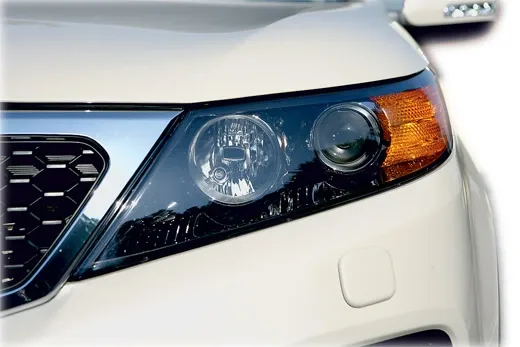
First, we were invited to the company's design center, where at a press conference they promised to tell us everything about the new model. But the interpreter, apparently, opened a Russian textbook about thirty minutes before the start, so we understood almost nothing. We had to wait until the next day, when a test drive was scheduled. And it was there that the encounter with the new Sorento literally shocked many. One journalist, seeing the car, threw his hands up to the sky and began to lament: "It's all over, the Sorento is no more. They killed it! God, why!" If it weren't for his decent trousers and fashionable cap, he would have definitely fallen to his knees and banged his head on the asphalt. I suffered along with him, because in front of us stood a Hyundai Santa Fe, slightly restyled in the current KIA fashion.
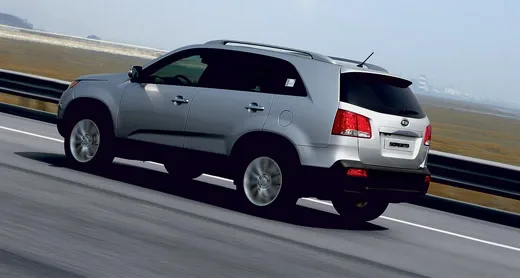
So, the new KIA Sorento is no longer a body-on-frame SUV: no rear axle, no low-range gear. The rear axle engages automatically via a multi-plate clutch. Of course, it's sad to realize that "soft-roaders" are becoming more numerous. But I won't mourn the old Sorento so fervently. Once I drove it along the entire Black Sea coast. It doesn't have the best underbody layout, and due to American suspension settings, the car rocked unpleasantly and nosedived. But still, when you remember the short front overhang and the low-range gear, the old model's shortcomings somehow fade into the background. I hope they'll continue to assemble it in Izhevsk.
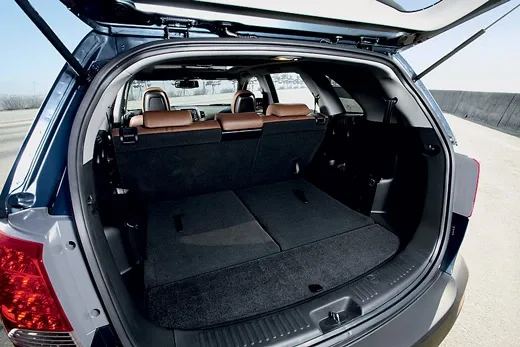
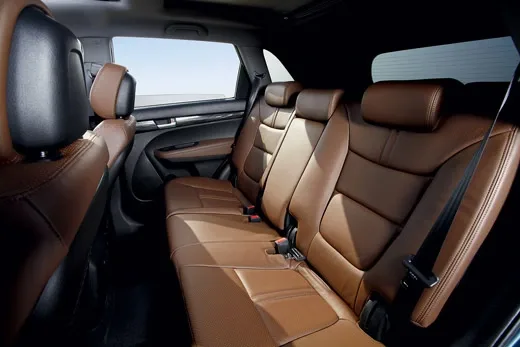
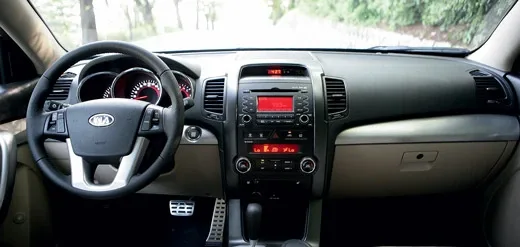
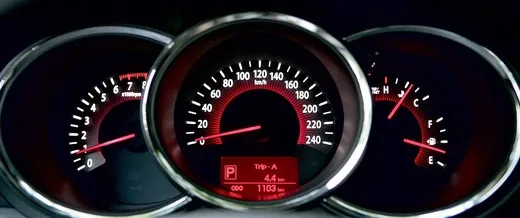
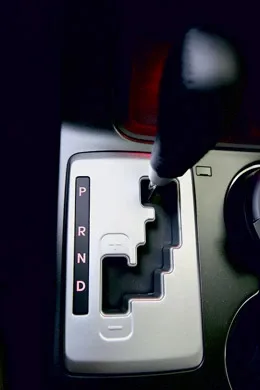
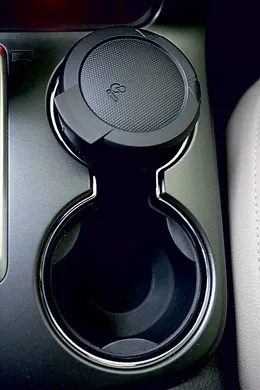
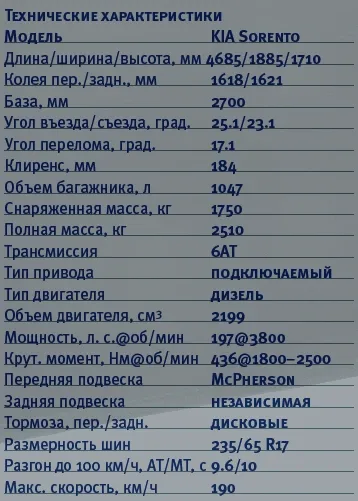
I walked around the Sorento — looked, smelled, touched. Sat in the cabin. Flipped through the technical data: it's not all that bad. The new model is longer and wider than its predecessor. There's more legroom for the driver and rear passengers. I'm not tall enough to judge whether it's comfortable for long-legged people, but hardly anyone will complain about cramped space. Climbed into the trunk — it's also bigger than the old model's. You can even order a third row of seats. In general, everything is like the Hyundai Santa Fe, only with a different design. The quality of part fit in the cabin is excellent, and this once again confirms that assembly flaws should be sought more in Fiat-Chrysler than in Hyundai-KIA. In total, I drove the new model for no more than an hour and a half, mostly on a monotonous route, but I can say that noise and vibrations in the Sorento have noticeably decreased. The cabin is quiet. By the way, the Koreans reduced the drag coefficient to 0.38, previously it was 0.425.

LIGHTER, WIDER, SHARPER
When the monotonous highway gave way to a mountain road, I realized that my colleague had cried in vain. Let's be honest: the frame and low-range — a minus, but handling on asphalt — a plus. The new KIA Sorento noticeably obeys the steering wheel more precisely, which now has only three turns from lock to lock. The previous model had almost four. And, of course, it leans less in corners thanks to a lower center of gravity and modern suspension. What's more, even directional stability has improved — surely due to the widened track.
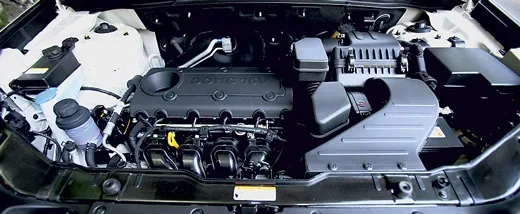
While overtaking trucks with hieroglyphs on their sides, I thought that the main acquisition for KIA fans is the new diesel. The most inspiring detail of the young Sorento! With a modest displacement of just 2.2 liters, it produces nearly two hundred horsepower and 436 Nm of torque (only a similar-displacement engine from Land Rover Freelander can boast a comparable figure — 400 Nm). This fully aluminum unit uses all modern diesel technologies — from third-generation common rail to piezoelectric injectors and a variable-geometry turbocharger. I wouldn't even think about gasoline. The diesel accelerates the Sorento to 100 km/h faster and feels much more confident off-road.
THE MAIN THING – CLEAN WHEELS
Driving the new Sorento on Korean roads, I kept trying to remember how the Santa Fe behaves to find a clear line between them. It seems the difference is the same as between the Hyundai Tucson and KIA Sportage. The former is a bit softer and more laid-back, while the KIA is stiffer, with a less smooth ride and simple trim, but with a claim to better handling. Apparently, this line — soft "premium" versus modest "sport" — was continued in the Santa Fe–Sorento pair to somehow separate them into different niches. We'll have to sort out the details in Russia. The foreign test drive, as usual, didn't give the opportunity to properly feel the new model. The off-road part was completely absent. One Russian journalist arbitrarily crossed a river and then long apologized to the Korean organizers for why the SUV had dirty wheels. By the way, they worried in vain — in a couple of months, back home, we'll take the Sorento together with the Santa Fe and get both covered in mud up to the roof.
So, the new KIA Sorento is no longer a body-on-frame SUV: no rear axle, no low-range gear. The rear axle engages automatically via a multi-plate clutch. Of course, it's sad to realize that "soft-roaders" are becoming more numerous. But I won't mourn the old Sorento so fervently. Once I drove it along the entire Black Sea coast. It doesn't have the best underbody layout, and due to American suspension settings, the car rocked unpleasantly and nosedived. But still, when you remember the short front overhang and the low-range gear, the old model's shortcomings somehow fade into the background. I hope they'll continue to assemble it in Izhevsk.
I walked around the Sorento — looked, smelled, touched. Sat in the cabin. Flipped through the technical data: it's not all that bad. The new model is longer and wider than its predecessor. There's more legroom for the driver and rear passengers. I'm not tall enough to judge whether it's comfortable for long-legged people, but hardly anyone will complain about cramped space. Climbed into the trunk — it's also bigger than the old model's. You can even order a third row of seats. In general, everything is like the Hyundai Santa Fe, only with a different design. The quality of part fit in the cabin is excellent, and this once again confirms that assembly flaws should be sought more in Fiat-Chrysler than in Hyundai-KIA. In total, I drove the new model for no more than an hour and a half, mostly on a monotonous route, but I can say that noise and vibrations in the Sorento have noticeably decreased. The cabin is quiet. By the way, the Koreans reduced the drag coefficient to 0.38, previously it was 0.425.
LIGHTER, WIDER, SHARPER
When the monotonous highway gave way to a mountain road, I realized that my colleague had cried in vain. Let's be honest: the frame and low-range — a minus, but handling on asphalt — a plus. The new KIA Sorento noticeably obeys the steering wheel more precisely, which now has only three turns from lock to lock. The previous model had almost four. And, of course, it leans less in corners thanks to a lower center of gravity and modern suspension. What's more, even directional stability has improved — surely due to the widened track.
While overtaking trucks with hieroglyphs on their sides, I thought that the main acquisition for KIA fans is the new diesel. The most inspiring detail of the young Sorento! With a modest displacement of just 2.2 liters, it produces nearly two hundred horsepower and 436 Nm of torque (only a similar-displacement engine from Land Rover Freelander can boast a comparable figure — 400 Nm). This fully aluminum unit uses all modern diesel technologies — from third-generation common rail to piezoelectric injectors and a variable-geometry turbocharger. I wouldn't even think about gasoline. The diesel accelerates the Sorento to 100 km/h faster and feels much more confident off-road.
THE MAIN THING – CLEAN WHEELS
Driving the new Sorento on Korean roads, I kept trying to remember how the Santa Fe behaves to find a clear line between them. It seems the difference is the same as between the Hyundai Tucson and KIA Sportage. The former is a bit softer and more laid-back, while the KIA is stiffer, with a less smooth ride and simple trim, but with a claim to better handling. Apparently, this line — soft "premium" versus modest "sport" — was continued in the Santa Fe–Sorento pair to somehow separate them into different niches. We'll have to sort out the details in Russia. The foreign test drive, as usual, didn't give the opportunity to properly feel the new model. The off-road part was completely absent. One Russian journalist arbitrarily crossed a river and then long apologized to the Korean organizers for why the SUV had dirty wheels. By the way, they worried in vain — in a couple of months, back home, we'll take the Sorento together with the Santa Fe and get both covered in mud up to the roof.