
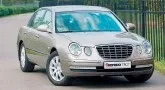
The new Kia Opirus went on sale quietly, without a loud advertising campaign or preliminary announcements. The car has become noticeably larger and more solid. Those who remember the previous generation will surely find plenty of surprises in the new model. And those not yet familiar with the model should take a closer look at this representative of the Korean business class.
Kia amazes with the speed of updating its model range. Rio and Cee'd were recently released, which, however, strongly resemble their classmates. But Opirus is a completely different matter. This car, even if it doesn't shock the public, is certainly unlike anything else. It was the original appearance that played a cruel joke on the first-generation Opirus: many were put off by its unusual look.
The new Opirus is a completely different story. From the previous version, only the massive chrome shield-shaped radiator grille and four round headlights remain. The placement of the optics strongly resembles the Mercedes-Benz E-class. And if you look at the Kia in the rearview mirror at speed, the resemblance becomes even more obvious. Well, let them confuse it — the main thing is they yield the right of way! Only the badges on the trunk lid can give away its Korean origin.
Overall, the new Opirus turned out to be a proper, well-balanced car. Even the dimensions are surprisingly even: length — exactly 5000 mm, width — 1850 mm, height — 1485 mm. A lot? Undoubtedly, but in this class it can't be otherwise.
The interior greets you with the sharp smell of a new car — a mixture of plastic, rubber, and velour that hits your nose as soon as you open the door. However, the air conditioning system with an automatic charcoal filter does an excellent job of combating street smog: if a truck is smoking nearby, the climate control automatically switches to recirculation mode. As soon as the danger passes, fresh air starts flowing in from outside again.
The interior doesn't shine with design flair and looks, frankly, a bit gray. But it's practical and convenient. The center console is trimmed with silver plastic and polished wood. The materials feel pleasant, and their quality is quite decent. True, the light beige velour on the seats and doors is very easily soiled. A carelessly eaten hamburger — and you'll have to shell out for expensive dry cleaning.
A leather interior would look much more logical here — status demands it. But leather went only to the steering wheel and gearshift lever. The steering wheel, by the way, has wood inserts. It looks good, but your hands slip quite a bit.
The instrument panel pleases with informativeness and pleasant backlighting: the numbers glow with some kind of moonlight, and the rims of the needles are blue. Between the speedometer and tachometer, there's an LCD screen with the most important information: open doors, mileage, automatic transmission selector position. And almost always, as befits a solid business sedan, the inscription Opirus is displayed on it.
Other data — fuel consumption, outside temperature, radio frequency — are displayed on a second display at the top of the center console. But here's the problem: in the sun it glares heavily, and you have to squint.
The seats are like big plush armchairs. You sit as if in a cozy wardroom of a drifting yacht. The rear feels the same. True, the profile of the rear sofa hints: it's designed for a maximum of two. The third passenger will get an uncomfortable hump or a hard armrest. There's enough space in the back — both overhead, in the shoulders, and in the legs — but due to the plump seats, there's a slight feeling of constraint.
The trunk is a matter of special pride. It's huge: you can carry a washing machine without even folding the seatbacks. And under the floor — a full-size spare tire.
Starting the engine is accompanied by nothing — excellent sound insulation makes the V-shaped "six" completely inaudible. The engine only raises its voice closer to 6000 rpm, where it delivers its maximum 266 hp. Given the solid weight and dimensions, the Opirus is surprisingly brisk: it reaches 100 km/h in 7.5 seconds. The automatic works quickly and almost without delays, so manual mode isn't really needed. But you have to pay for such dynamics: instead of the stated 11 liters in the combined cycle, the car easily consumes all 20. However, for an engine with a displacement of 3778 cm³, this is normal.
At speed, the Opirus can't be called maneuverable — this "boat" prefers straight highways. In corners, body rolls appear, and on uneven surfaces the body can sway. It's good that the independent multi-link suspensions at the front and rear quickly dampen the consequences of a maneuver. The steering wheel is a bit empty, and the effort on it is too low. At speed, it becomes slightly heavier, but it's almost imperceptible. But in parking, where you need to turn the wheel, the Opirus is excellent. The turning radius is 5.83 m, only slightly more than the length of the body. And the light steering wheel is a pleasure.
In the end, the Korean engineers managed to make a fast and comfortable car. This new model will clearly add trouble to European competitors.
Driving
On straight roads, the Opirus has few rivals, but in corners it's not as confident: rolls and possible swaying make themselves known.
Interior
A classic solution — convenient and practical. But the light velour on the doors and seats will cause the owner a lot of trouble.
Comfort
Spacious for everyone. Even with a full cabin of passengers, you can take a lot of cargo. True, the overly soft seats may serve you poorly on a long journey.
Safety
In a business sedan, protection is important not only for the driver but also for all passengers. The Opirus meets modern standards.
Price
Such an extensive basic list of options at a starting price is more than reasonable. Five trim levels are available, the top one for $39,560.
| Dimensions, mm | 5000/1850/1485 mm |
| Engine | petrol, V6, 3778 cm³, 266 hp/6000 rpm |
| Transmission | automatic, 5-speed |
| Dynamics | max 230 km/h; 7.5 s to 100 km/h |
| Competitors | Ford Mondeo, Nissan Teana, Toyota Camry |
Advantages and disadvantages
+ Powerful engine, huge trunk, distinctive appearance.
- Body roll, sharp smell of a new car, easily soiled velour.
Our opinion
The Kia Opirus is a true business class with decent performance characteristics. The car is big, fast, comfortable, but a bit prone to rolling. At the same time, the unusual design is offered at an attractive price. It's the non-standard appearance that is the main trump card of the new model, which may well ensure its market success.