Escape from the City
From the very beginning, I caught myself mentally comparing this car to the Sorento equipped with a 2.2-liter turbodiesel. Of course, I realize these are machines from different worlds: one is a typical crossover, the other is a true body-on-frame SUV. Nevertheless, the Mohave doesn't demonstrate the same ease of acceleration, and this is felt both in city traffic and on the highway. Don't get me wrong: the three-liter turbodiesel has sufficient torque, and the dynamics are decent. But that sparkle that the Sorento with the 2.2 engine has is missing here. Although, if you think sensibly, for a body-on-frame design, the ability to accelerate quickly is far from its main asset.
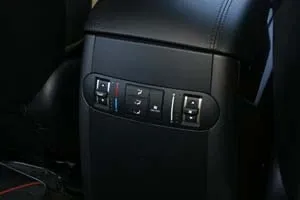
Now let's look inside the cabin. The trim materials are a solid four out of five. They fall short of what we see in the Discovery 4 or the new Prado, but there are no complaints about quality. What surprised me most was the third row of seats. Usually, only children can fit there, but here adult passengers will be quite comfortable. However, I won't delve into details — I'm sure Sergey Krasikov will thoroughly cover all the nuances of the interior and trim levels, especially since he's looking at a similar car for himself. I'll just note that there's climate control with separate vents for rear passengers — both at the top and bottom.
Now I'll share my impressions from a passenger's perspective. On our city roads, which are a continuous "patchwork quilt" of repairs, it shakes considerably. It's hard to talk about comfort in such conditions. But as soon as you get onto smooth asphalt, you understand that you could just keep driving — everything is so smooth and good! The body-on-frame design, with all its off-road advantages, turns out to be not the best solution in the city. On a country road, unpleasant jolts and rocking also periodically broke through. But you quickly get used to it: let it shake, but there's confidence that we'll get where we need to go.
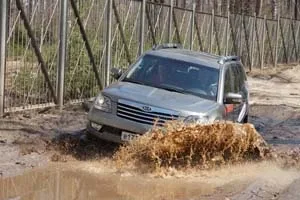
Speaking of getting anywhere on any dirt road. Sergey suggested driving to his "cordon" on the Volga bank — where just a week ago the road resembled more of a mud bath. It would have been awkward to refuse, especially since on a body-on-frame SUV it's shameful not to go where even regular crossovers manage. On the way to Orlovka, there are sections with winding asphalt where I usually enjoy myself in a passenger car, "diving" into corners. The Mohave immediately made it clear: such entertainment is not for it. In bends, it leaned noticeably and reluctantly held the line. However, this was expected. But on the dirt road, it showed its best side. When the mud reaches the sills and you're calmly driving in standard mode without even manually engaging off-road systems — that commands respect. True, there was one moment when on wet clay the car struggled. We started to complain about the "highway" tires, but it turned out the issue was something else. As soon as we turned off the traction control system, the car easily got out of the trap. That was truly impressive.
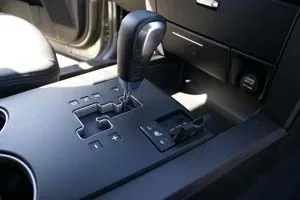
The turbodiesel version is equipped with a six-speed automatic transmission. Considering that peak power comes at 3800 rpm, its characteristics are comparable to the nine-speed automatic on the gasoline engine. To put it simply — it's impossible to fault this automatic's operation: everything is precise, timely, without delays. Surprisingly, the gasoline 3.8-liter engine has a five-speed gearbox, which is a bit insufficient. Although, in my opinion, a real SUV should be diesel.
Sergey Krasikov, photographer, drives a KIA Sorento
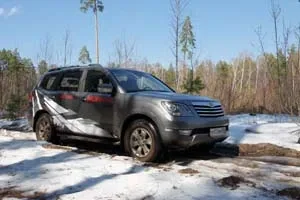
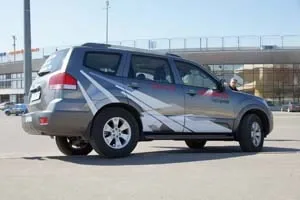
I first got acquainted with the KIA MOHAVE at the Moscow Auto Show in 2008 — I studied its characteristics and looked into the cabin then. Our test vehicle was in the near-top trim, priced at 1,840,000 rubles, and it was equipped with a spring suspension and leather interior.
Let me list the drawbacks right away:
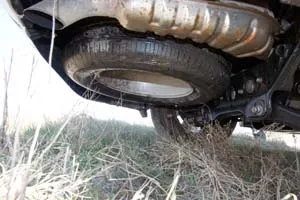
- no rear tow hook, which looks strange for a body-on-frame jeep with a low-range gear;
- no cargo cover, although competitors have it;
- immobilizer is absent in all diesel versions except the top one;
- for the 3.8 engine (275 hp), the tax is "unattractive";
- the price is not crisis-friendly, especially considering Russian assembly.
That's probably all.
We hit the road — the engine is torquey, the interior is solid, but the suspension seemed a bit stiff to me. Although we didn't check tire pressure, so the assessment is preliminary.
Gear shifts were absolutely imperceptible — six gears for a three-liter turbodiesel is optimal.
If comparing with competitors, the closest in spirit is the Nissan Pathfinder: similar dimensions (4740x1850x1783), same drivetrain, seven seats, and a comparable price. The second rival is the Mitsubishi Pajero 4. If its price is comparable to our hero, then in terms of drivetrain capabilities, the Pajero is clearly ahead: the center differential and rear locking differential are worth a lot.
Now about seating: the driver's seat is spacious, and the seat adjustments will suit most drivers. The rear row also pleased — the seats move on rails, backrests recline, the central tunnel barely gets in the way, and there's separate climate control. The third row is quite spacious — a passenger up to 185 cm tall in summer clothing will fit comfortably. Perhaps the sixth and seventh seats here are the best among competitors, although in the Pajero they are easily removable, while the MOHAVE can't boast such an option. The seats are upholstered in quality perforated leather, but we never found floor mats in the cabin.
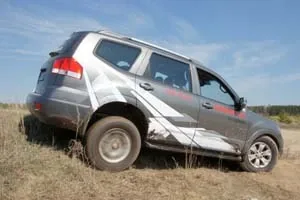
A few words about the drivetrain. The main mode is rear-wheel drive, which saves fuel and reduces drivetrain noise. The second mode is all-wheel drive for difficult sections (not recommended for constant driving). And the third is with the low-range gear engaged. We tested the last two on light off-road. On slippery surfaces, highway tires don't allow the engine's full potential to be unleashed, and electronic aids like the traction control system are better turned off when stuck.
With the arrival of the KIA MOHAVE, the market for large all-wheel-drive SUVs will become more crowded. The rivals here are renowned: Honda Pilot, Jeep Commander, Discovery 4, Toyota Prado, Ford Explorer, VW Touareg, Hyundai ix55, Subaru Tribeca, Volvo xc90. All of them have history and image. I hope the Kaliningrad assembly won't spoil KIA's reputation, and dealers will help the MOHAVE find its place in this lineup.
The short test-drive period doesn't allow a full assessment of all the car's intelligent systems. We can only hope that KIA MOHAVE owners will share details on forums.