The folks at the Russian office of KIA Motors seem to be real daredevils. They weren't afraid to hold a presentation of the new model in almost extreme conditions and, more importantly, gave journalists cars in all possible trim levels. Usually, automakers provide only the top version for testing to create the most favorable impression, or at best allow trying out different engines. Because of this, reviews turn out one-sided.
FROM BASE TO MAXIMUM
In Astana, we were awaited by fresh KIA Mohave SUVs. One unit with a gasoline engine, four with diesel engines, two with rear air suspension, three with coil springs, one in the base trim, one in the top trim, three in intermediate trims. That's five cars in total. Three journalists per car. During the three-day route, crews swapped cars in turn so that everyone could try all versions.
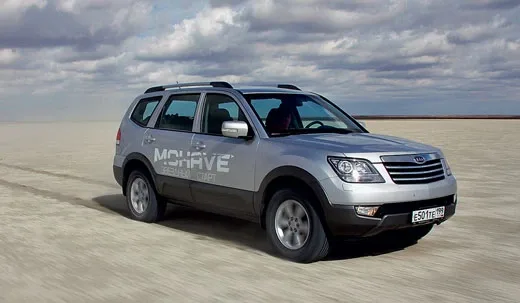
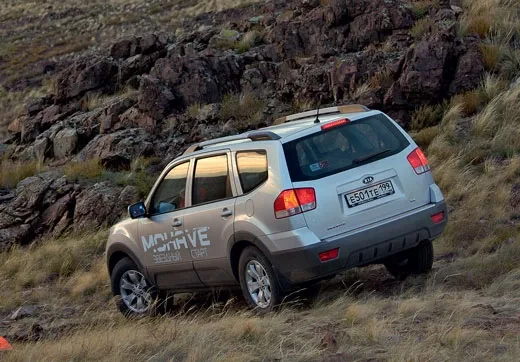
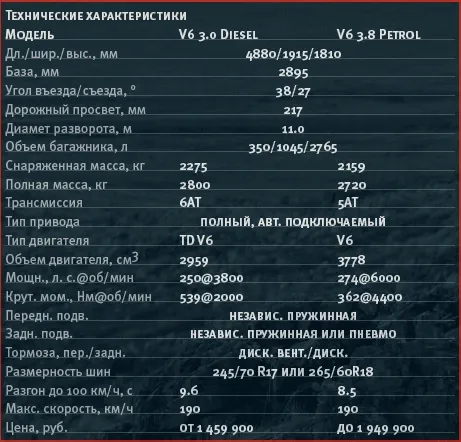
So, what is the KIA Mohave? It's a body-on-frame seven-seat SUV with a low-range gear and, unusually, independent suspension on all wheels. This combination is rare, but it exists, for example, in the Infiniti QX56 and SsangYong Rexton. Ground clearance is 217 mm. All-wheel drive works through a multi-plate clutch that replaces the center differential in the Mohave. In normal mode, the transmission sends 90% of torque to the rear axle, and when slipping, it can transfer up to 50% to the front. There's also a 4H mode where the clutch locks and torque is split evenly between axles. The next mode, 4L, is the same but with the low-range engaged.
ENTRY VIA THE BALTIC
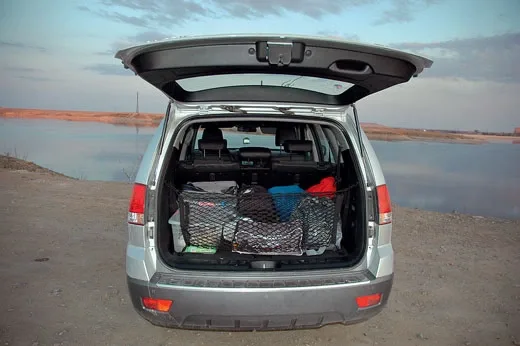
Naturally, everyone is concerned about how well our "Korean" is built. It's actually ours, by the way, because it's brought to Russia through Kaliningrad's Avtotor, where semi-knocked-down assembly is set up to bypass duties. So, all five cars pleased with neatly fitted bodies and solid interiors. The trim materials aren't premium yet, but they're already quite decent. The plastic is mostly soft. The driver is comfortable – there are many adjustments. In the top version, even the pedals can be adjusted for height. Passengers also have enough legroom, and the seats are ergonomic. Even the third row is almost full-fledged. True, these extra seats are positioned low, and the seating position there is specific – you wouldn't want to travel far in them. When folded, they stow into a flat floor of a large trunk. Well, that's basically the basic idea of the model, so as Gagarin said, let's go!
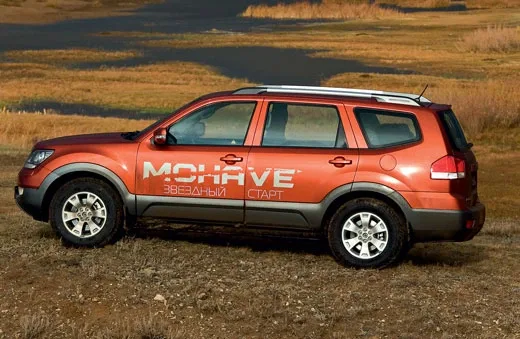
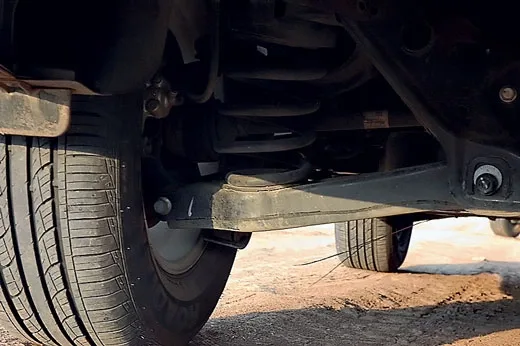
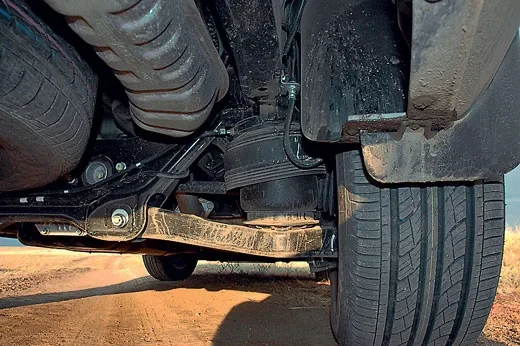
Air suspension (left) so improves ride comfort that buying a car on springs loses all meaning
ASPHALT IS FOR BUREAUCRATS
Astana is a typical city of officials. Its business district is built on a grand scale according to a single master plan. In the center stands the Baiterek monument, resembling an inverted launching rocket. In fact, it's a symbol of the world tree. Around it are the Presidential Palace, the Ministry of Defense, golden towers of some bank, a shopping and entertainment center. Parks, boulevards, fountains, Lexus 5700, Land Cruiser 100 and 200. The roads are excellent, no traffic jams. But as soon as we left the capital of Kazakhstan, the good asphalt and luxury ended. And then two things became clear. First, the 3-liter turbodiesel accelerates the KIA Mohave superbly. With a curb weight of over two tons, the car flies like a swallow – 100, 130, 160 km/h. And second, the coil spring suspension at any speed transmits all road imperfections to the body and doesn't even try to combat vertical pitching. Behind the wheel, it's easier to bear. Sitting on the right, you can also endure it. But when I ended up in the back, I feared my vestibular system wouldn't hold up. This version of the Mohave can be confidently recommended as a training device for cosmonauts. Interestingly, in corners the car rolls moderately – meaning the suspension isn't hopeless overall, but the tuning clearly needs refinement.
WE'RE FROM RALLY
We tackled the off-road section with the symbolic name "Rally" – about a hundred kilometers of dirt steppe roads – in the same car. Off asphalt, on poor hard surfaces, the spring Mohave behaved, though not perfectly, noticeably more pleasantly. We even allowed ourselves a little race at sunset. By the way, when it got dark, it turned out the headlights could shine farther. The intensity is normal, but both low and high beams hit too delicately. Not critical, but still. Later we tried the version with xenon – impressions were similar. And we never managed to find the headlight leveler in either case.
ON AN AIR CUSHION
When we left Karaganda the next morning in the gasoline Mohave (V6 3.8), we had no illusions – we had already studied the specs. With the diesel, of course, it was more fun. It's clear why: its torque is one and a half times greater – 539 Nm at 2000 rpm, and the power loss is minimal: 250 hp versus 274. Moreover, the gasoline V6 comes with a 5-speed automatic, while the turbodiesel gets a 6-speed. True, when I switched the 5-speed auto to manual mode during overtaking, it was quite exciting. But when buying, I'd only recommend the diesel, even despite its higher price. And the fuel consumption difference feels like about fifty percent.
Of course, we eagerly awaited the car with air suspension, especially since it was in the base trim, which is always interesting. And so? The interior is fabric, with leather inserts on the sides of the seats. Manual adjustments? No problem, we don't change driver's seat settings that often. It's a pity the steering column here adjusts only for tilt, though I was still comfortable sitting. Climate control is in place, as is the media center with navigation (it didn't work in Kazakhstan, but it's already ready for Russia) and a USB port. Externally, the Spartan version differs by the absence of side steps (and so what – even though they're wider than many, they still only allow you to place your foot on the edge) and wheels 245/70 R17. So, with the rear air suspension, the ride is much more pleasant. Ride comfort is noticeably higher. True, on asphalt waves, vertical pitching still appears, but at high speeds. One of my colleagues said: "The coil spring suspension is more honest; it lets you know what's what earlier." Forget that honesty; let it lie for a while. Especially since the air system is generally mysterious – for some reason, it can raise the rear by 40 mm. To increase ground clearance only at the back? To change the departure angle? I'm afraid there's no noticeable effect. As with lowering the suspension by 40 mm from standard. Theoretically, this should ease loading, but in practice, I'm not sure. Although, maybe it's easier to hitch a trailer tongue to the tow bar.
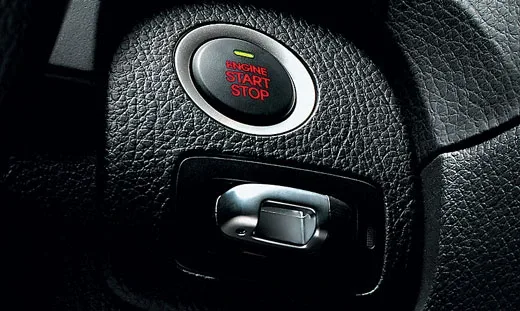
More expensive versions start with a button. The key can be kept in your pocket
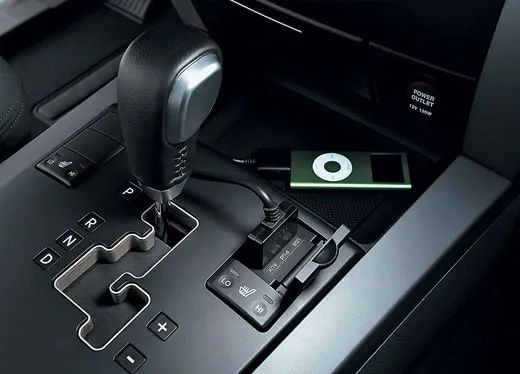
Even in the simplest trims, there's a USB port for a flash drive or iPod
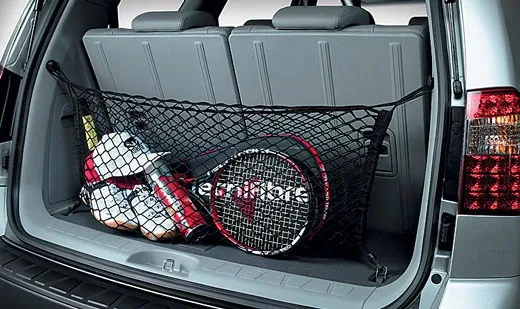
With the third-row seats folded, the trunk can hold gear for a trip with five people. But in the seven-seat configuration, cargo space is only enough for a couple of tennis rackets and sneakers
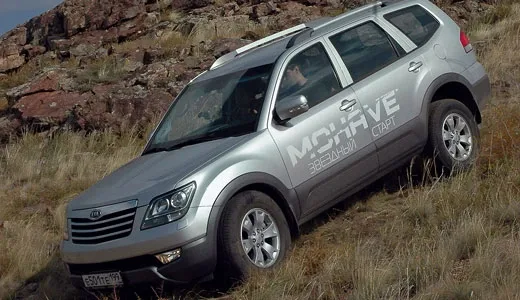
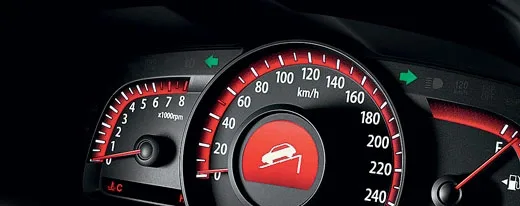
HILL STARTS AND DESCENTS Finally, we got to the off-road section with the telling name “Mountains.” Here we had to test how the hill start and descent assist systems work. By the way, have you ever wondered how the Soyuz spacecraft launch works? Before liftoff, the rocket hangs on special clamps, but as soon as it rises 4 cm, the paws come out of the grooves, counterweights activate, and the masts swing aside under their own weight. All mechanics, without a single piece of electronics. In the Mohave, everything is much more complex: when you stop on an incline, the brake pedal locks, and the car hangs on the slope without the handbrake, and when starting, the pads release on their own. On descents, the electronics hold the speed at about 10 km/h, which on steep hills feels like the limit of what's possible. NOT A JEEP, NOT A CROSSOVER Let's immediately sort out the Mohave's off-road talents, without getting distracted by lyrical digressions. We were allowed to drive on virgin terrain on a salt lake — dynamic shots, sharp turns, clouds of dust. It looked impressive, but if you lock the center clutch and constantly spin on loose ground, it overheats in about twenty minutes, and the car stops. True, it cools down just as quickly — about five minutes. But the very fact of using a multi-disc clutch in the transmission suggests that this model was not created for serious off-roading. At the rear, it has an independent suspension with limited travel, and the traction control systems can't handle diagonal wheel hang. So in terms of off-road capability, the Mohave is inferior to most modern SUVs. But it can't be put in the same category as crossovers either: the ground clearance is decent, there's a low-range gear, and the air intake is routed to the edge of the hood. All of that means something. I think for most owners of versatile SUVs, the KIA Mohave's capabilities will be quite sufficient.
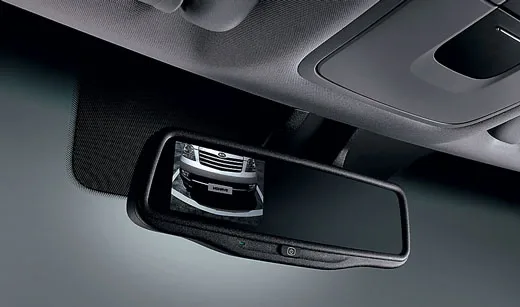
3.5-inch LCD rearview camera display built into the mirror – very convenient
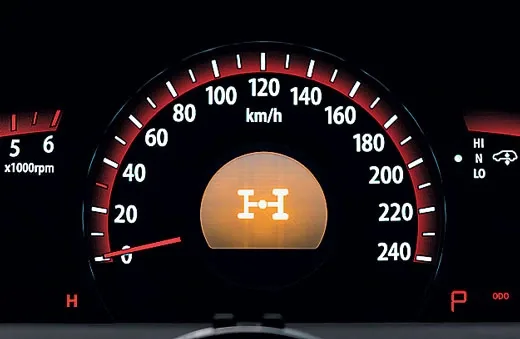
The Supervision instrument cluster focuses attention on the most relevant information
TO BAIKONUR IN ROYAL STYLE
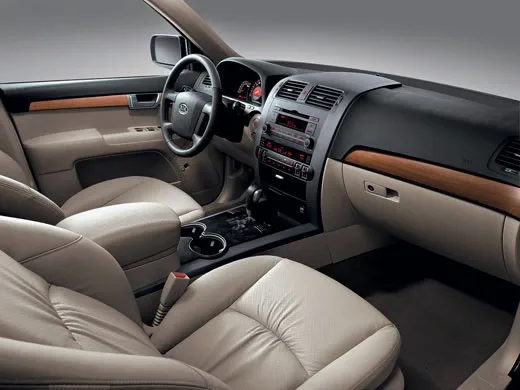
We arrived in Baikonur, formerly Leninsk, in the most luxurious version of the Mohave from all those on the test. Air suspension (a low bow to its creators), light leather interior with wood inserts, ventilated driver's seat that gives your buttocks a feeling of minty freshness, Infiniti audio system, decorative lighting on the doors — it looks truly rich. But here's a nuance: due to the trendy 265/60 R18 wheels, the ride smoothness of this car seemed slightly worse than that of another one, also with air suspension, but on higher-profile tires. Even though the expensive version also had adaptive dampers. By the way, about the equipment. There are touching little details here: many handles near the door openings — on the ceiling and on the body pillars. And deep in the center armrest, there's a 12-volt outlet hidden: you can charge your phone by running the wire through a special hole in the top of the armrest, and keep your phone right at hand, not dangling near the automatic transmission selector. In general, the interior is thought out to the smallest detail, and that's winning. It's precisely such details that reveal the class of a car. SO FAR, ONLY INTO ORBIT The culmination of our “Star Start” run was the launch of the manned Soyuz spacecraft. From the helipad where we watched it, it was only two kilometers to the launch — very close. Smoke, flames, a roar that penetrates to the bone, a white cloud when the first stage separated — and after seven minutes, only a bright star remained in the blue sky. This spectacle was supposed to symbolize the powerful start of KIA Motors in Russia. Did it work? Judge for yourself. The company has indeed changed its status, moving away from the image of a manufacturer of cheap cars. And the fact that it can't yet compete with giants like Mercedes-Benz or Lexus — well, the Soyuz also didn't fly to the stars, but to low Earth orbit. However, I have no doubt that we will still see flights to distant planets and the emergence of premium divisions among Korean brands. All of this is no longer science fiction.