
KIA Mohave. Bounding across the steppe
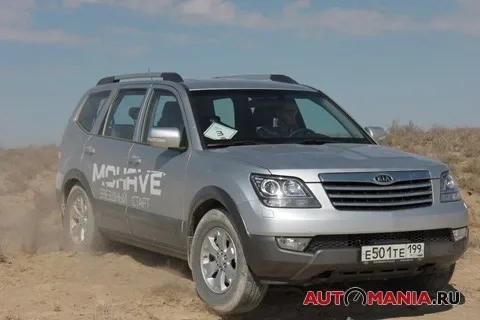
The KIA Mohave SUV with all-wheel drive, solid ground clearance and a spacious body has recently begun its fight for the attention of Russian buyers. In the US, this model has been sold under the name Borrego for the second year now. But just say that name out loud to understand: the name taken from the California desert, where KIA's test site is located, sounds much nicer!
Although the Mohave looks similar to crossovers like the Hyundai ix55 or Mazda CX-9 — the same dimensions and three rows of seats for seven people — the similarity ends there. This is a full-fledged SUV with a ladder frame, albeit with independent multi-link suspensions all around and an automatic transmission with a low range. Therefore, its direct rivals are the same off-roaders like the Ford Explorer or Nissan Pathfinder.
"Who needs such mastodons now?" you might ask. It turns out that against the backdrop of the overall collapse of the car market, demand for large SUVs has fallen the least. Marketers have noticed: we, like Americans, like big cars, so the Honda Pilot, Mazda CX-9, Hyundai ix55 and others have appeared on the market. Moreover, according to KIA's calculations, the share of this segment has grown from 11.9% to 20% over the past five years.
Inside as outside
This image of a classic SUV, created under the influence of the Detroit concept Mesa from 2005, is perceived without internal resistance, as is the three-row seven-seat interior. In terms of trim materials and the shape of the front panel, the car is somewhat reminiscent of the VW Touareg, only here the red backlighting is more expressive. It's comfortable behind the wheel: the seating position is good, the seat has a pleasant profile, and all controls are at hand. The only thing one could find fault with is that the leather trim is a bit plain, but this is only noticeable in the black version: the beige interior, which is not particularly favored in Russia, looks richer. The equipment matches the status: a TV with navigation adapted for Russia, electric adjustments for windows, seats, mirrors and even the tailgate, a rear-view camera with image output to a 3.5-inch display in the mirror…
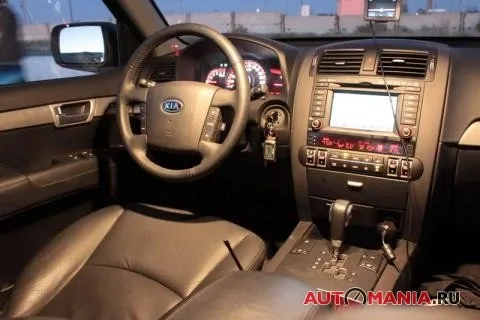
It is also important that even in the base version, the KIA's cabin is full of useful compartments and containers, and on the center tunnel there is a large slot for iPod and USB devices.
Space for passengers and cargo
There is plenty of room in the Mohave: even three adults can easily fit in the second row. There is also a separate climate control unit on the console between the front seats and its own vents in the ceiling. To get to the third row, just pull the lever, fold the cushion — and the passage is ready. Not only children but also adults will be comfortable in the gallery.
If desired, the Mohave turns into a small truck: fold all three rows of seats — and you get an almost flat floor with a volume of 1685 conventional liters. True, in this discipline, the eight-seat Honda Pilot will certainly win over the Mohave.
Journey into a "fairy tale"
The tests took place in the harsh conditions of the Kazakh steppes. The route started in Astana, then went through Karaganda, Zhezkazgan, Kyzylorda, and the finish was at Baikonur. As a reward for the shaking and the long road, we were waiting for a manned launch of the SOYUZ TMA-16 spacecraft. Who in childhood didn't dream of space at least a little? I agreed instantly. But let's take it in order.
In 12 years, Astana has turned from a district center of Tselinograd into a luxurious presidential capital. But the rest of Kazakhstan, except for large cities, seems to be after an invasion: destroyed houses, high fences, rare monuments of socialist realism reminiscent of the Soviet past. Not to mention the roads... While the highway from Astana was smooth and straight, the Mohave behaved excellently: it obeyed the steering wheel, was predictable in corners, the steering effort was pleasantly viscous, although it is felt that KIA engineers deliberately isolated the steering wheel from the road. This is not scary: with increasing speed, the steering wheel becomes heavier, adding calmness and confidence. The brake pedal is a bit soft, but in the city the deceleration dynamics are quite sufficient.
The path of life and death
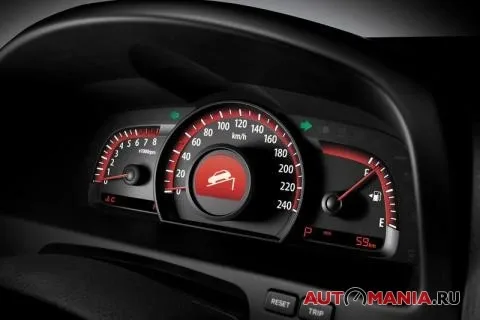
As soon as we drove away from Astana, the normal highway turned into a real "bad road": potholes, bumps, ruts, holes, endless waves. Even the most genuine jeep would howl here! Our car on regular springs and all-season Hankook P265/60R18 tires began to behave like a truck: it jumped, harshly transmitted impacts from the surface, pushed and kicked so that without seat belts passengers would fly around the cabin like balls in a lottery drum. That's why the world is switching to crossovers: on a broken road they are much more comfortable. But as soon as at the next checkpoint we switched to a Mohave with air suspension, the car regained our trust. The electronics control the rear air suspension, increasing stability and comfort: the body is always horizontal, regardless of the number of passengers and load. The height of the rear part can be adjusted automatically or manually. The mood noticeably improved, and the flaws of the Kazakh roads stopped shaking our insides. It became possible to listen to the voice of the engine.
What's under the hood?
Two engines are provided for the Mohave. The base one is a gasoline V6 with a volume of 3.8 liters (274 hp). According to the specs, it accelerates the 2.2-ton car to 100 km/h in 8.5 seconds, delivering 362 Nm of torque. Overall, a decent unit. It's not a problem that the five-speed automatic sometimes thinks a second longer than we'd like. But when you look at the fuel consumption, you quickly sober up. For America, where a gallon of gasoline costs $3, almost 20 liters per 100 km is not a problem, but here 95-octane has already exceeded 25 rubles per liter... You can't help but think about economy. Sorry if someone doesn't share my frugality, but lately this has been the main criterion for me. Therefore, it's worth taking a closer look at the turbodiesel. And it's not just about economy: the modern three-liter "six" is not at all like a traditional diesel. It has excellent characteristics — 250 hp and wonderful traction — and it works almost silently. Seriously! Some German "premiums" rattle more angrily, but this engine is really very quiet, you can't even believe you're driving a Korean. Paired with it is a six-speed automatic that perfectly selects the shift timing. You don't even need manual mode.
The best is yet to come
The entire route took several days. First, we reached a city that is usually named in response to the question "where are you?". According to legend, this place was discovered by a shepherd boy, Appak Baizhanov, who was the first to find coal here. Already at the end of the 19th century, fuel began to be mined here, first by Russian merchants, then by the French and British.
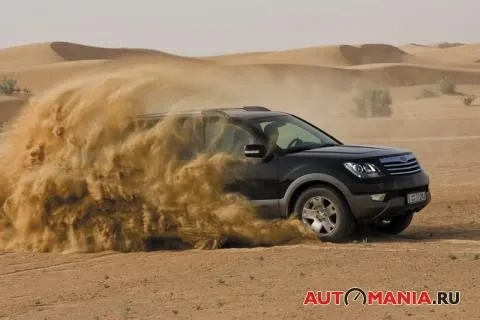
Next, our path lay to the "copper capital" — Zhezkazgan. In Soviet times, cosmonauts were brought here and sent from the local airport to mislead potential enemies of the USSR about the location of the cosmodrome. In fact, it's at least 300 km away. We were more interested in the picturesque Ulytau mountains north of the city. The landscapes here amaze with their diversity: flowering meadows, birch groves, mountain rivers and lakes, as well as "Martian" desert areas with poisonous snakes and scorpions. It was here that the real off-road tests began. The car handled them without problems, except for one episode: on a dry sandy hill, one Mohave, having lost speed, got stuck. Alas, it has no central differential lock.
Having passed Kyzylorda, closer to sunset we saw the antennas of the cosmodrome. Under the lease agreement until 2050, Baikonur is a Russian enclave in Kazakhstan: entry with passes, many cars with Russian license plates, prices in stores in rubles. Although Baikonur began to be built on January 12, 1955, and the first launch took place in 1957, the scale is still impressive: an area of more than 6000 km². True, many facilities are simply mothballed.
Key to start!
A few kilometers from us, a rocket stands on the launch pad — from such a distance it fits between the fingers like an ordinary lighter. The countdown, and now the earth trembles, the air fills with a deafening roar — the rocket has lifted off the ground! A couple of minutes later, the receding point splits in two: these are the side boosters separating. A little later, the second stage landed somewhere in the Altai steppes, and the crew entered orbit and docked with the ISS.
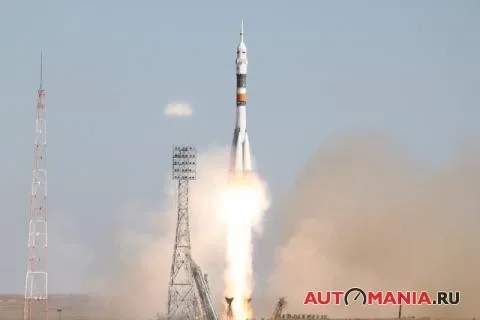
In general, the launch was successful!
As for the KIA Mohave, the balance between price and capabilities looks quite reasonable: the gasoline version on spring suspension starts from 1,459,900 rubles, while the diesel with air suspension starts from 1,609,900. If you want a car with a full set of modern automotive benefits — xenon, leather interior, three-zone climate control and navigation with DVD in Russian — then prepare from 1,779,900 to 1,839,900 rubles depending on the engine. All KIA cars have a warranty of 5 years or 150,000 km.
The space journey ended, and I parted with the Mohave without much emotion. Perhaps it's all because the family budget doesn't yet reach 200-300 thousand rubles a month, and I'm not yet ready to call myself a successful middle-aged person who has made it in life...
Vladimir Palkin
Technical specifications
| Length, mm | 4880 | |||
| Width, mm | 1915 | |||
| Height, mm | 1765 | |||
| Wheelbase, mm | 2895 | |||
| Gross weight, kg | 2800 | |||
| Curb weight, kg | 2275 | |||
| Trunk volume (l) | 350/1675 | |||
| Engine displacement, cm³ | 2959 | |||
| Max. Power, hp | 250/3800 | |||
| Max. torque, Nm | 540/1800–2750 | |||
| Max. Speed, km/h | 190 | |||
| Acceleration time (0-100 km/h) s | 9.6 | |||
| Average consumption (l) | 10.2 | |||
| Tank volume, l | 82 | |||
| Fuel | diesel | |||
| Price, RUB | 1 609 900 | |||
Source – AUTOMANIA.RU