
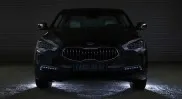
Exterior. The first thing every passerby tries to notice: Quoris looks like this, Quoris looks like that. The effect is achieved! At first glance, the car confidently elbows its way into the dense ranks of the big German trio and the Japanese grandee, who follows the Europeans as if on a rigid tow. Quoris doesn't look like anything.
Seeing Quoris in the mirror, the only desire is to give way to it. The aggressive grille and powerful lighting do their job.
It has a quite authentic design. The level of which Peter Schreyer has raised to unattainable heights. And wasn't Schreyer, serving the Volkswagen Group for almost 20 years, one of the trendsetters in that very big trio? The body turned out balanced, without excesses or overloads. So much so that it visually "robs" the true, gigantic dimensions of a car five meters long. There are a couple of controversial places, such as fake air intakes on the front fenders, arched turn signal repeaters in the rearview mirrors, and the design of the wheel rims.
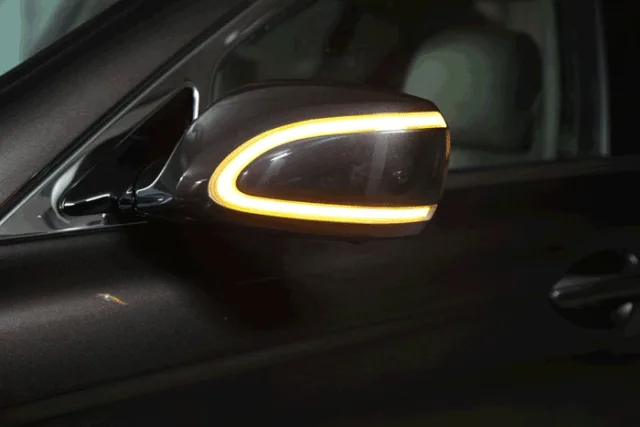
And if the third issue is solved by simply replacing the rims, then with the first and second it's more complicated, but the Koreans will soon cope with this too, moving away from Asian kitsch elements.
A burning red thread of technological solutions runs through the entire car. The lighting makes anyone who sees it tremble with excitement :). Not a single incandescent lamp. Only high tech, only LEDs.
Scatters of LEDs, many small lenses. The optics look not only very modern and fashionable, but also have excellent characteristics in terms of luminous intensity.

In the headlights, including fog lights, there are 5 sets of LED blocks, two of which - low and high beam - are lensed, possessing incredible luminous intensity, a giant service life, low energy consumption, and complete absence of heating. The rear lights also do without prehistoric lamps. They are bright, presentable, and informative.
It often happens that in the pursuit of a place in the market, the manufacturer shows weakness... And the powertrain, suspension, and transmission either do not reach the level of the declared car, or, which is more often the case with Asian brands, manifest themselves with excessive indicators. Yin Yang - that is the principle of Quoris.
A V-shaped naturally aspirated six-cylinder engine with a volume of 3.8 liters, paired with an eight-speed gearbox. It produces 290 horses at 6000 rpm and 358 N-m of torque at 4500 rpm. Not shocking figures, but quite acceptable and, most importantly, without any deficit for the driver. The car reaches the first hundred in 7.3 seconds, consuming according to the passport in urban mode 11.4 liters. In suburban: 8.1 liters. In the most popular, combined, 9.3 liters of fuel per hundred kilometers. Which, of course, is not true: during the test in combined mode, it was not possible to get a consumption of less than 12 liters. Taking into account stable sub-zero temperatures from -15 and below.
The gearbox is good. It has all the necessary attributes of a modern device. Four operating algorithms - Drive, Sport, Eco, and Snow, as well as manual mode. And every driver can optimally select the speed and frequency of shifts to their driving style. Drive mode is optimal for forgetting that any shifts are happening at all, but at the same time accelerating at the right moment. Moving the selector to Sport, you must be mentally prepared for overly fussy shifts, not always justified. But if, subjectively, with such an algorithm, you can get the most efficient return from the powertrain.
The platform carrying all this armament was developed anew, specifically for rear-wheel-drive Kia/Hyundai cars. It does not have any supernatural solutions. In front - double wishbones. In the rear - multi-link with separated damping elements.
A huge plus in the piggy bank of comfort and practicality of driving is the air suspension. At the standard level, it maintains a decent 150 mm. When the computer processes information from the road surface, the car can rise by an additional 30 mm, and when reaching cruising speed, on the contrary, lower by 15 mm. All manipulations with the suspension can be done manually. But upon reaching a speed of 40 km/h, the car takes the reins into its own hands and levels the height to the required one.
Everything from A to Z is aimed at total comfort inside. We will not particularly delve into the description of materials and build quality. Everything here is at a phenomenally high level. The leather is excellent, the ceiling is Alcantara, aluminum and soft plastics everywhere. Without all this, there was no point in releasing the car to the market. The consumer would not understand it. What we want to draw attention to is the authentic control and design elements. No unification with more affordable models of the brand, which Lexus still sins with.
We got the top trim for the test, costing 2,659,000 rubles. The way this car is equipped with electronics is hardly comparable to anything. A fully electronic instrument panel with graphics worthy of modern computer games. Up to changing the style of the instruments from modern to classic, etc. I won't be surprised if over time, at the service center, you can download additional design themes like Angry Birds or Smeshariki :)
There are all possible assistants: cruise control with distance support to the car ahead, collision warning and prevention systems, blind spot monitoring with warning output on the virtual head-up display of the windshield. The readings on the KIA head-up display can not only be moved up and down, and brightness changed. In its settings, three colors and 3 font sizes for display are available! All this electronic feast is controlled from the steering wheel by an elegant rotating element that has feedback. That is, at the end of the menu, this knob rested against a virtual limit and refused to turn further. And the rotation force of this control can also be adjusted to your preference by choosing one of 4 options. Yes, BMW uses similar technology for its "iDrive" wheel. But in Quoris, it is on the steering wheel!
The only oddity is the navigation system. It seems to be initially absent from the car. There are no familiar NAV and MAP buttons. But when holding the "Return to previous menu" button on the central console for 2 seconds, navigation appears. And, oh miracle! The central monitor becomes touch-sensitive. Judging by the design of the navigation system, it is foreign, standing out from the overall concept of the digital environment. As a result, navigation readings cannot be duplicated either on the instrument panel or on the head-up display. But we hope that in the future, such a necessary function in a modern and ambitious car will take its rightful place and work according to a more understandable algorithm.
The seats are ultra-comfortable. They have a lot of adjustments, heating, and ventilation. A bit lacking is the "breaking backrest," that is, adjustment of the seat in the shoulder area. And at least on the right rear seat, a massage. This could add a little more comfort to the "main passenger," who, in addition to a huge amount of space, has all the controls in their hands, duplicating the driver's. That is, the passenger can change tracks, increase, decrease the volume, etc. Also, the passenger can, by pressing a single button, fold the front seat under the glove box, thereby organizing an almost reclining place for rest. Sound insulation and smoothness of ride unconditionally ensure the owner's serene sleep during a transfer between important meetings.
Based on the test results, it can be unequivocally said that KIA has a 100% killer instinct. And if the fall of the European grandees still needs to be worked on, then the executive sedans of Asian brands can be safely buried if they do not reconsider their views on building a car and, most importantly, its pricing.