
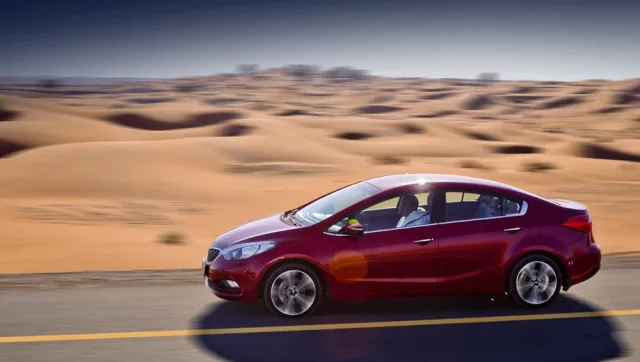
People go to Dubai to see the tallest, the biggest and the most expensive. We were invited to look at the most successful Kia model, presented in its third generation. "Kia Cerato is the best car in the world, isn't it? — Kim Sung Hwan, president of Kia Motors Rus, asked with a smile after the briefing. — Look, since the launch of Cerato in 2004, 2.5 million cars have been sold worldwide! Annual sales reach 500 thousand units! Isn't that the best car in the world?"
It would be a mistake to think that in Dubai everyone drives only supercars: Cerato goes on sale here too. And the largest sales markets for the new sedan are the USA (the predecessor was called Spectra here, and the newcomer is called Forte), Korea and China (in both countries the car is called K3). Versions for different markets differ not only in names, but also in dimensions, suspensions, engines and much more.
Unlike the rest of the world, in Russia the Cerato model is far from being the best. For the entire premiere year of the previous generation in 2010, Russians bought 10,180 cars. The same sedan finished the past 2012 with 11,833 cars. And the best-selling Kia model in our country is, of course, Rio (84,730 units in 2012), Sportage is in second place (32,716 cars), and cee'd takes third (23,290 units). Managers tend to attribute the modest Cerato figures to quotas. They say that due to the model's huge popularity, supplies are limited — they would sell more, but the manufacturers don't allow it.
Kia says the Cerato quota for Russia is 20 thousand cars. It also applies to third-generation cars, but may be revised due to increased demand.
However, the matter seems not to be about limited supplies. The "second" Cerato, which looked like the more affordable Rio, was hardly understandable against its background. The offer was too vague, and also in the highly competitive golf class. Well, by the release of the third generation, the Kia team has honed its formulations and armed itself with convincing arguments. According to the Koreans, Kia Cerato will be bought, firstly, for its design, which is now more sporty, secondly, for its rich equipment, cool by segment standards, and thirdly, for everything else — it is now of higher quality and more efficient.
Analysts of the Korean company calculated that more than 50% of sales in the C segment are sedans, 38% of cars are sold with automatic transmissions, 85% of purchased cars are equipped with 1.5 and 1.6 engines (1.8 and 2.0 — 12%). That is why the optimal new Cerato for Russia is seen as a sedan with an "automatic" and a 1.6-liter engine.
In the Kia company, as it turned out, the golf class is divided into two segments: C1, where Kia Rio and other "budget" cars reign, and C2, where the new Cerato bursts in, defying the trio of main competitors. They are Ford Focus and Opel Astra, as well as Chevrolet Cruze. Of course, the "secondary rivals" — Toyota Corolla, Volkswagen Jetta, Skoda Octavia, Nissan Almera and Citroen C4 L, which were deprived of the "first degree" for their traditionalism and practicality, are not very happy about the new sedan either. Why?
Because the strongest enemies, as the Koreans believe, are emotional and innovative. Just like Cerato itself and its friend Cid, that is, Ceed. They, therefore, are the main contenders for the second-largest segment of the Russian market, which numbers about 600 thousand cars a year. (Note that Hyundai with its Elantra decided not to seriously get involved in the fight for this pie and limited itself to a nominal circulation in Russia.)
In photographs, the sedan looks portly when viewed from the side. However, when examined live from human height, the Cerato is quite sexy — a sturdy build is perceived as an indicator of health and a guarantee of quality offspring. The stamping along the bottom of the doors is on point. By the way, the overhangs were reduced: by 15 mm in the front and 5 mm in the rear.
If the Cerato design were sold separately, the car would bear a Made in USA label. The sedan's appearance was created in California by American Tom Kearns, who came to Kia in 2004 from General Motors, where his last work was the first-generation Cadillac CTS. Kearns is one of Peter Schreyer's hands, doing all the routine (and not only) work for the global boss.
Tom is responsible, for example, for the appearance of the Soul and similar concepts such as KV7 and Track'ster. It was from Kearns' studio, called Kia Design Center America, that the current Sorento and Sportage rolled out, and the Rio sedan and the "second" Cerato also come from there. In general, thanks to American designers who found a new vein, the Cerato now has a distinctive face, and you no longer need to run around the back of the car to read on the badge which Kia model it is.
The newcomer has a solid rear, which is visually even more raised by the black insert at the bottom of the bumper and is lined with sharp edges. The Cerato's rear is not a question, but it stands on edge!
In profile, the developers suggest seeing a hint of a sports coupe, but it is more useful to pay attention to the improved body aerodynamics. The drag coefficient Cx has been reduced from 0.29 to 0.27; now it is like the Golf's. In practice, this means no wind noise while driving. It is also worth noting the additional windows that have formed at the "spread" front and rear pillars. The transparent triangles in the front slightly improve visibility, and the quadrilaterals in the rear are a bit more useful — passengers get more light.
According to Kia, the development of the "third" Cerato took three and a half years and cost $250 million. The new sedan will be sold in almost 130 countries.
Compared to its predecessor, the Cerato has become longer (by 30 mm) and wider (plus 5 mm), but lower (minus 25 mm) and heavier by a hundredweight or so. Without mentioning the increased mass, the manufacturer emphasizes the millimeter differences in dimensions. There is a truly touching indicator: the trunk has grown in length by 2 mm!
Due to lowering the floor level by 5 mm, the front seats have become closer to the ground by 26 mm, and the rear ones by 20. Thus, the interior height from the seat cushion to the ceiling is 992 mm in the front and 948 in the rear.
Above the head, the Koreans managed to win back an additional 4 mm, but a driver taller than average touches the ceiling trim with the tips of their hair. In the photo — Autoreview correspondent Igor Vladimirsky, height 186 cm. With the sunroof closed, the hair on his crown reached the ceiling.
The Cerato's wheelbase has increased by 50 mm — now 2700, like the Elantra's. Among the main competitors, only the Peugeot 408 has a longer wheelbase (2717 mm): the Focus has 2648, the Astra and Cruze have 2685 mm. And in the Cerato, thanks to its increase, there is more legroom in the first row of seats — by 13 mm (1073), and shoulder width in the cabin has increased by 9 mm (to 1424) in the front and 5 mm (1395) in the rear. Hip width is 1366 and 1348 respectively. Nowhere is it cramped.
In the Ceed, the driver's seat is arranged more interestingly, but in the Cerato's interior, apart from laconicism, there is nothing to complain about: no obvious ergonomic miscalculations were found, and there are no defiantly cheap elements.
In some ways, the new Cerato has succeeded so much that its predecessor looks like a Jurassic dinosaur — a ceratosaurus. So, in the old-fashioned interior of the second-generation sedan, a reel-to-reel tape recorder was missing for the full picture. In the third generation, it is also absent, and that's good — a reel-to-reel is out of place in this modern, quite comfortable, simple, understandable and practical environment.
A 4.2-inch TFT LCD display is equipment for top trim levels. The small screen at the top of the center console is surprisingly readable and does not glare in the sun.
The ergonomics in the Cerato are maintained exactly at the level where everything necessary is located predictably, within easy reach, and you don't need to look for anything or get used to alien quirks. The decent quality of materials is also soothing. True, the plastic on the front panel and inside the doors goes in waves, but that's intentional — for beauty.
There are three "soft waves" (as the special effect is called) on the front panel and each door. The designers drew inspiration from nature: dunes, circles on water, mollusk shells. It must be admitted that the relief brings liveliness, which will not be superfluous in Russian trim levels with the only fabric upholstery option. We will be offered two color schemes: solid black or two-tone gray. By default, the fabric is coal-colored (Comfort trim), the second option is also black — this is a higher-quality knit (Luxe, Prestige), and the top has a knitted combined upholstery (Premium).
The plastic on the waves is indeed soft. Next to it is hard, but decent in execution. The visor above the instruments is decorated with artificial leather, and in general, the finishing materials in the new Cerato are not like before. Only the "carbon" inserts in the center console invite criticism: they are designed to emphasize the sporty image and give a "premium look", but they only bring a smile. And not at all the tiger one, in which the signature Schreyer grille gapes.
The connectors for connecting to the audio system are in the right place — in a two-liter compartment with a closing curtain in front of the gear lever. A good storage for a phone, and there is also a USB port. You can also carry small items in door pockets, in a two-tier box with a volume of 5.8 liters between the front seats, and, of course, in the glove box, whose size has been increased by 30%, to 8 liters.
The Cerato steering wheel resembles the one in the Ceed and deserves a separate mention. Not because it's wonderfully informative — everything here is average, without surprises. But the wheel fits nicely in the hand, is trimmed in natural leather, adjusts for height and reach (in any case within 40 mm), is heated (optional), and is equipped with paddle shifters, buttons for controlling the music, trip computer, cruise control, and phone. Perhaps the most interesting button on the wheel is the one with the image of the steering wheel itself. It's located on the right side, above the cruise control dial, and makes life easier by adding weight to the steering.
The Cerato steering wheel turns with adjustable effort — this is the Flex Steer feature, which allows you to change the power steering modes with a button. Switch to Comfort — the wheel turns with all possible lightness; switch to Normal — the steering becomes normal; choose Sport — it will be stiff. This function affects nothing except the driver's mood — the steering wheel makes an unchanged 2.96 turns from lock to lock.
The second reason after design to choose the Cerato is its abundant equipment. The second-generation sedan on the Russian market is available in three trim levels (Comfort, Luxe, Prestige), while the new one will also be offered in a fourth called Premium. The test cars in Dubai were packed to the "premium" level, which meant a sunroof, leather interior, as well as memory for two drivers and ventilation for the driver's seat. But in Russia, there will be no sunroof, no leather, and no ventilation — too expensive for our consumer.
Instead, it was decided to pamper the Russian customer: along with a heated steering wheel, we'll get heating not only for the front but also the rear seats, as well as heated mirrors and the wiper rest zone. Among other niceties — keyless entry and push-button start, dual-zone climate control with rear passenger vents, adaptive xenon and LED taillights, front and rear parking sensors, as well as the Smart Welcome Lighting system, which unfolds the mirrors and turns on the lights at the doors and their handles, switches on the interior lighting, and turns on the parking lights when the driver approaches the car.
The previous-generation sedan looked like a suspicious security guard; the new one stares like an angry guard of an arthropod colony. The front end turned out faceted in the designers' hands. In the sense that the headlights and grille hint at the compound eyes of an insect. The mood is combative, the spirit sporty, the look hungry. The Kia emblem has popped out of the "tiger nose," making the front bumper look underfed as well.
In our country, the new sedan, like its predecessor, will be offered with two gasoline four-cylinder engines. The naturally aspirated 1.6 MPi engine from the Gamma II family is well known from Hyundai models. On the third-generation Cerato, it gained four horsepower and one newton-meter (now 130 hp, 157 N•m) — exactly the same one is installed on the new cee'd. The engine pulls weakly at low revs and performs decently once revved higher. For the city, this is obviously enough, and fuel consumption is also good: in Dubai, without being gentle with the car, we burned 7–7.5 liters per 100 km. But on the highway, the Cerato would probably be better suited with the two-liter Nu series engine, which hasn't changed: 150 hp and 194 N•m. Note that in the US, the new Kia Forte sedan is also equipped with a pair of gasoline four-cylinders, but these are different engines from the Nu line: 1.8 (148 hp, 177 N•m) and 2.0 GDi (173 hp, 208 N•m).
Both transmissions prepared for us are six-speed, also celebrated by Hyundai, but modernized. Working the manual gearshift is a pleasure; driving with the proper automatic, occasionally intervening with the paddle shifters (this is called Sport mode), is another.
The area under the driver's feet doesn't make you feel cramped. There's another hint of sport here: the accelerator pedal, while being suspended like the others, has a floor-mounted pivot.
The sound insulation of the Cerato turned out to be very decent for its class. The Koreans used new soundproofing screens, coatings, and fillers, and it worked. The ride comfort would be excellent, except that the rear suspension, unlike the front, takes large bumps like speed bumps too much to heart. During our drives around Dubai, we had impacts so strong that we had to get out and check if the car was intact. They say the torsion beam has been modernized, but watching how it absorbs impacts is worrying, especially in the rear seats...
Overall, the back is not bad. The central tunnel protrudes very little, and you can seat a third passenger by sacrificing the armrest with cupholders. The seatbacks fold in a standard 60:40 split.
However, on "Russian" Ceratos, the suspension will be different: Kia representatives promise to adapt it specifically for us, most likely by further stiffening. Be that as it may, the chassis remains the Achilles' heel of the Korean brand: the complaints about the new Ceed are essentially the same. And as long as this vulnerability persists, it's unlikely that anyone except an owner head-over-heels in love with their car will recognize Kia's golf-class model as the best car in the world.
The Cerato's trunk has grown by six liters — to 421 liters. Kia was quick to announce that this is one of the best figures in the segment, but it's quite the opposite. The Focus has a trunk volume of 475 liters, the Astra 460, and the Cruze 450 liters.
The Koreans rightly consider success in markets as the criterion for "world-class bestness." They cannot be unaware that the Toyota Corolla and Volkswagen Beetle, with worldwide sales of 37 and 21 million respectively, will remain unrivaled for a long time. These models earned their top spots thanks to more than adequate price tags. What about the price of the new Kia?
The Cerato will be supplied to Russia in ten colors. The base paint is plain white. Then there are seven "metallic" options (red, golden, gray, beige, silver, blue, and bright blue) plus two "pearl" options (white and black). Kia once again emphasized that it doesn't charge extra for "metallic" and "pearl."
The benchmark for potential owners should be the price of the second-generation Cerato, whose base trims are priced between 640–820 thousand rubles (for comparison: Ford Focus costs 542–882 thousand, Opel Astra 614,900–883,900, Chevrolet Cruze 609–806 thousand). In theory, the Cerato's higher price compared to competitors is apparent, since it's offset by options. The most affordable version of the sedan will be equipped with air conditioning, an MP3 stereo, central locking with remote control, power-adjustable heated mirrors, front power windows, and something else.
Kia dealers expect educated men aged 27–33 to come to their showrooms — these will be highly qualified professionals who value design, are "in trend" with modern technologies, enjoy outdoor activities and travel, and get a kick out of driving. The portrait of the ideal customer, as we see, is not at all original.
Prices will be announced in March, sales will begin in April. Among other things, buyers should be encouraged by the five-year or 150,000 km warranty. "This model is truly significant for Kia," said President Kim Sung Hwan in farewell. And it must be admitted that the status of significant suits the Cerato much better than the title of "Best Car in the World." At the same time, Kia's progress is such that we will hear the question about the best car on the planet from South Korean managers again.
Specifications
| Kia Cerato | 1.6 AT Premium | 1.6 MT Premium |
|---|---|---|
| Body | ||
| Body type | sedan | sedan |
| Number of doors/seats | 4/5 | 4/5 |
| Length, mm | 4560 | 4560 |
| Width, mm | 1780 | 1780 |
| Height, mm | 1445 | 1445 |
| Wheelbase, mm | 2700 | 2700 |
| Track front/rear, mm | 1553/1566 | 1553/1566 |
| Curb weight, kg | 1295 | 1263 |
| Gross weight, kg | 1740 | 1720 |
| Trunk volume, l | 421 | 421 |
| Engine | ||
| Type | petrol | petrol |
| Location | front, transverse | front, transverse |
| Number and arrangement of cylinders | 4, in-line | 4, in-line |
| Number of valves | 16 | 16 |
| Displacement, cc | 1591 | 1591 |
| Max power, hp/rpm | 130/6500 | 130/6500 |
| Max torque, Nm/rpm | 157/4850 | 157/4850 |
| Transmission | ||
| Gearbox | automatic six-speed | manual six-speed |
| Drive | front | front |
| Chassis | ||
| Front suspension | independent, coil spring, McPherson | independent, coil spring, McPherson |
| Rear suspension | semi-independent, coil spring | semi-independent, coil spring |
| Front brakes | ventilated disc | ventilated disc |
| Rear brakes | disc | disc |
| Tires | 205/55 R16 | 205/55 R16 |
| Ground clearance, mm | 150 | 150 |
| Performance characteristics | ||
| Maximum speed, km/h | 195 | 200 |
| Acceleration time from 0 to 100 km/h, s | 11.6 | 10.1 |
| Fuel consumption, l/100 km | ||
| — combined cycle | 6.8 | 6.5 |
| Emission standard | Euro-5 | Euro-5 |
| Fuel tank capacity, l | 50 | 50 |
| Fuel | AI-95 | AI-95 |
Engineering
Kia engineers admit that the design of both suspensions (McPherson struts at the front, torsion beam at the rear) has not fundamentally changed, but they say they have carried out modernization to improve handling, ride comfort and increase energy intensity. Now the front suspension is mounted on a new reinforced subframe. Wide L-shaped lower arms are equipped with new bushings of increased diameter, and the steering mechanism is shifted forward by 15 mm. The Koreans also boast that the CTBA rear suspension is exceptionally compact and has allowed to reclaim additional space under the floor.
The engines with multi-point injection, according to the developers, can boast of a lightweight block and cylinder heads made of aluminum alloy, a crankshaft offset relative to the cylinder axis (to reduce friction), a low-noise timing chain, variable intake/exhaust valve timing and a plastic intake manifold with variable geometry. The two-liter engine was specially derated for the Russian market so that buyers would pay less transport tax.
The main features of the upgraded manual transmission, the manufacturer calls multi-cone synchronizers, low-noise gears with optimized tooth profile, a new reverse gear shift fork, hydraulic clutch drive and low-viscosity transmission oil, thanks to which the transmission does not require any maintenance throughout the entire service life of the car. As for the six-speed automatic, it is said to be very compact and allows to reduce fuel consumption by 12% compared to automatic transmissions of traditional sizes.
In the third Cerato, the share of parts made of high-strength steels reaches 63%. In the diagram, pink highlights new reinforcements made of ultra-high-strength steel (150 kgf/mm²) — these are, in particular, the middle pillars. Blue marks elements with an index of 60 kgf/mm²: these are side members on both sides of the central tunnel, reinforcing beams in the doors and other parts. Green shows parts made of steel with a strength of 45 kgf/mm², and gray — of ordinary steel. Among other things, the Koreans report that the torsional rigidity of the body compared to the predecessor of the Cerato has increased by 37%.
Excessive noise and vibration, problems with ride smoothness are usually denoted by the three-letter abbreviation NHS (noise, vibration, harshness). What helped Kia engineers improve noise and vibration insulation is shown in the diagram. The results of the fight against NHS are as follows: at idle, the level of vibrations transmitted to the steering wheel and floor of the cabin is reduced by 2 dB, noise in the cabin has decreased by 1 dB (up to 38), and the background during acceleration is reduced depending on the model by 1–2 dB. The noise level in the cabin at a speed of 110 km/h does not exceed 65 dB (on almost any scale this indicator is interpreted as “noisy” and approximately corresponds to a loud conversation).
History
The first generation — a sedan called Kia K3 — debuted in South Korea in 2003. The successor to the Kia Sephia model (also known as Mentor, Shuma, Timor) for other markets, the Koreans decided to launch in 2004 under different names. In the Old World, the car (now available also as a hatchback) was presented as the Cerato, and in America it continued to bear the glorious name Spectra.
The new product inherited a lot from the related company Hyundai — the car shared the platform with the third-generation Elantra (McPherson struts at the front, double wishbone at the rear) and received engines of the Beta II family: petrol fours 1.6 (105 hp) and 2.0 (143 hp). The Cerato was also equipped with three CRDi diesels. Gearboxes — five-speed manual and four-speed automatic.
The car had a very successful price-quality combination and became a real bestseller in some markets: sales of the first Cerato were record-breaking — 1.23 million cars, which is over 200 thousand units per year and 28.5% of Kia's global sales. To consolidate the success, in 2006 the Koreans carried out a restyling: the car got new bumpers and lighting.
The second generation of the model, presented in 2008, was called Kia Forte in many markets. The car retained the name Cerato in Russia and a number of other countries, for example, in Australia and Brazil. Moreover, while in the States the hatchback modification was still called Spectra (Spectra5), in Europe sales of the car in this body were curtailed due to the timely arrival of the Ceed — so that they would not compete with each other.
The Koreans stated that the second Cerato is built on a completely new platform, which will form the basis of the next generation of the Hyundai Elantra sedan (such a return of the debt). Having McPherson struts at the front and a torsion beam at the rear, the second-generation sedan for the non-American market has petrol engines 1.6 (126 hp) and 2.0 (150 hp), working with six-speed manual or automatic.
According to data at the end of 2012, sales of the previous Cerato exceeded 1.21 million cars (in 2011 alone, 445,000 units were sold — 17.9% of Kia's global sales), and the Koreans have reason to believe that the record of the first generation will be repeated, and maybe even broken. Regarding the third Cerato, no such ambitious plans have been heard yet.
Design
In the Californian city of Irvine, there is a branch of the Korean company — Kia Motors America, which is an integral part of the HATCI technical center (Hyundai America Technical Center, Inc.). It operates a design studio headed by American Tom Kearns (pictured). It was his team, which performs up to 85% of Kia's corporate design programs and produces a show car per year, that created the appearance of the third Cerato — of course, under the control of the legendary Peter Schreyer.
The authors of the project did not comment on their work either at the time of the leak of sketches in July 2012 (see illustrations) or after the premiere of the Cerato at the Los Angeles motor show. The silent designers had to be answered for by PR specialists, who noted in the car's exterior an “aura of elegance”, and in the interior — a “motif of ebb and flow”.
Behind the scenes
Before leaving for the city, the organizers scared us with aggressive driving of Arabs and bloodthirsty police, but in fact everything turned out to be no worse than in Moscow. The roads in the Emirates pleased with impeccable quality and surprised with strict speed limits with “sleeping policemen” in the most deserted corners. We managed to look at the tallest skyscraper in the world only from afar, but in the desert we met lonely camels and furious cyclists. We also drove along a huge and completely empty autobahn (six lanes in each direction) and were passengers of an open electric car that brought us to a paradise oasis. As a result, we for some reason arrived at a ten-meter monument in the form of an arrow pointing to the sky — this monument was erected in honor of the city of Sharjah, which in 1998 was elected by UNESCO as the cultural capital of the Arab world. Dubai is definitely worth visiting again and exploring properly.