
Double Strike
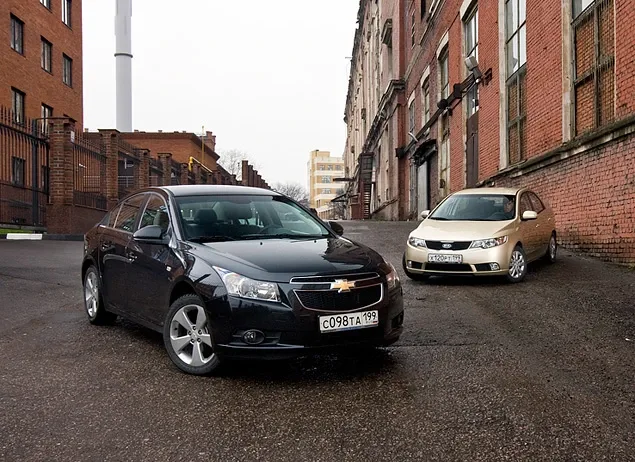
Back in September, at the Russian presentation of the Chevrolet Cruze, we concluded that this sedan simply begs for a comparison with another fresh creation of the South Korean auto industry — the Kia Cerato, which had also just entered our market. Both cars were designed with an eye on countries where cars with a trunk are traditionally loved: Korea, North America, China and, of course, Russia.
Moreover, these models share a common ideological background — the arrival of the Cruze and Cerato can be seen as a fresh attempt by Korean manufacturers to demonstrate that their products have already grown to the level of Japanese and Western European counterparts.
to prove that their domestic auto industry is no worse than the Japanese and Western European ones
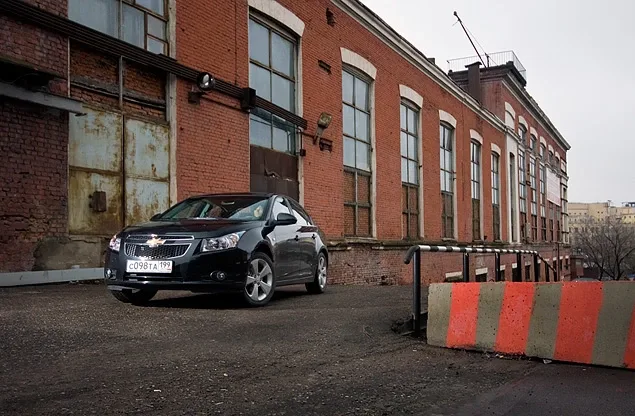
The main trump card of the Kia Cerato is its modern design, created by Peter Schreyer, who worked at Audi before moving to Kia and had a hand in models such as the Audi TT and the new "Beetle". But the Cruze can be called a Korean only with a stretch: it is based on the global GM platform, which unites it with the new Opel Astra family, and it was designed by an international team of General Motors specialists from Korea, Germany, both Americas and Australia.
If Not by Price, Then by Driving
Previously, the democratic prices of Kia cars and GM Daewoo models sold under the Chevrolet brand gave them a serious advantage over European and Japanese competitors. But times are changing, and Koreans no longer rely on dumping. For example, in Russia, the base Chevrolet Cruze of Russian assembly with a 1.6-liter engine producing 109 horsepower and a manual gearbox costs 540 thousand rubles.
This is not cheap at all — the same Ford Focus with a four-door body (also, by the way, assembled near St. Petersburg) in the Comfort trim with a 100-horsepower 1.6-liter unit is priced at 583 thousand rubles, and if you take into account the discount of 55 thousand rubles, which is valid until the end of the year, then it's even 528 thousand. Moreover, the base equipment of the Korean "Chevrolet" cannot be called generous: the Cruze and Focus have similar lists of standard equipment, but the "American" in the initial version lacks, for example, air conditioning.
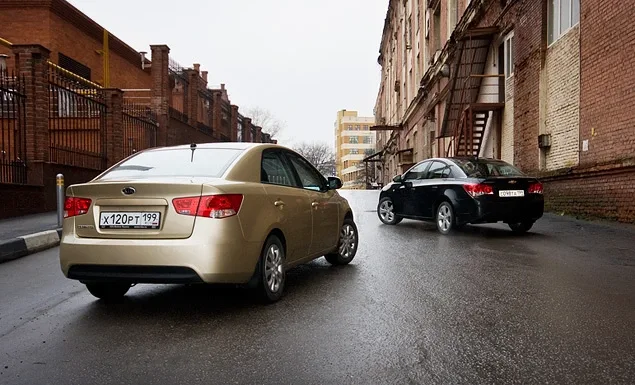
Buying a Kia at first glance looks even less attractive — due to high duties, the Cerato with the base 1.6-liter engine and five-speed manual starts from 560 thousand rubles. But this engine develops 126 horsepower, so in the range of the same Focus it is more logical to compare it with the 1.8-liter version with 125 horsepower.
Such a Ford costs 615 thousand rubles (and with the special offer — 560 thousand). So while the discount is in effect, the "Korean" bypasses the Ford bestseller only in terms of equipment: the Cerato has a trip computer, audio system and rear power windows as standard, which are offered for the Focus at an extra cost.
The Cruze's 1.6 engine is also a bit weak, so for the comparative test we chose the version with the 141-horsepower 1.8-liter engine. Despite the power advantage, this Chevrolet accelerates to 100 km/h only 0.3 seconds faster than the Kia (10 versus 10.3 seconds), so the comparison is quite fair.
Almost a European Car
So what does the buyer get for almost European money? An almost European car! Take the Kia Cerato — at first glance, there is very little Korean left in it. Even the aggressive body lines are not as simple as they seem. Just look at how unusually the window line rises in the area of the front pillar. And the Cerato's interior is enlivened by "optitronic" instrument scales recessed into deep wells, and a funny round joystick for controlling electric mirrors, located on the armrest of the driver's door.
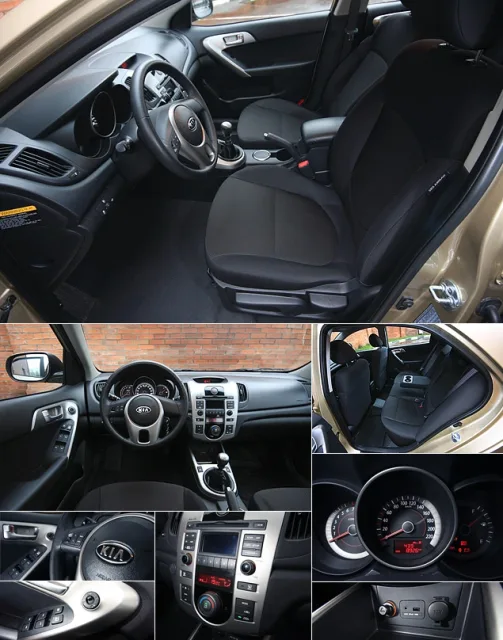
At the same time, there is not a single piece of soft plastic in the Cerato's cabin — after the "Cee'd", created for Western Europe, where the entire front panel is covered with elastic polymer, such savings are a bit disappointing. But credit must be given: the plastic itself is of good quality and looks decent. Moreover, the Spartan interior is saved by excellent assembly and ergonomics: to get comfortable behind the wheel, a minute of "playing" with the seat adjustments is enough, and the gaps between panels remind you not of Asia, but rather of Germany. True, the steering column stalks made of shiny plastic clearly got here by mistake.
The Chevrolet Cruze is completely different. In both the literal and figurative sense, it has "more car": at 4530 millimeters in length, it almost reaches the D-class, and the large golden cross on the pentagonal radiator grille adds solidity to the black sedan. The interior looks bright and stylish: the chopped central console rests on a massive metal-look trim on the tunnel, and the low seating position makes the driver feel like a race car pilot.
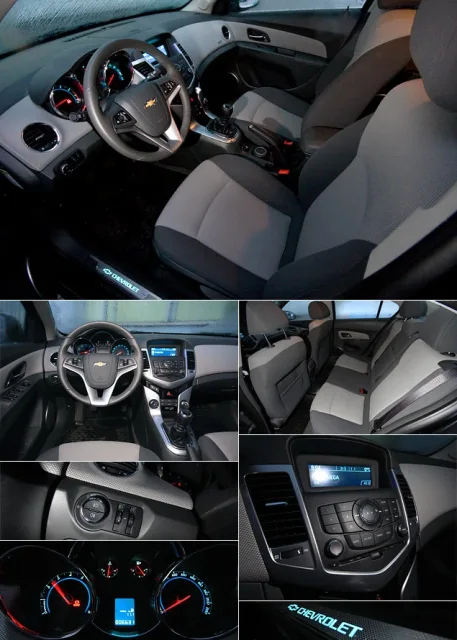
At first, the Cruze is perceived as a more expensive car compared to its opponent. But the devil, as we know, is in the details, and at Chevrolet they are worked out worse than at Kia. The plastic of the front panel on top and bottom looks too cheap, the bluish-green backlighting of the instruments quickly gets boring and seems too intrusive, and when you notice the "wandering" panel joints and the climate control knob that your right knee constantly catches on, the first "wow!" is replaced by a vague "hmm...". And the more small ergonomic miscalculations surface during Cruze operation, the more often you remember the simple interior of the Cerato, which, with the same Korean roots, lacks many of the rival's shortcomings.
Passengers in the back will likely also be more comfortable in the Kia — there is slightly more legroom and it's brighter. But in the Cruze you sit lower, shielded by massive body pillars. By the way, the rear seat backs in both sedans fold in parts, like in hatchbacks. Moreover, in the Cerato this can be done directly from the trunk by pulling special handles.
Fast and Solid
On the road, both "Koreans" behave quite convincingly. But the longer you get to know each one, the more nuances you notice in their settings.
The Kia Cerato from the first minutes tries to show itself as a car with a sporty character — the tight steering wheel and the engine that willingly revs to the limiter provoke aggressive driving. But then you realize that all this sportiness is feigned. The heavy steering wheel hinders parking, and with increasing speed, its "tightness" seems artificial. The responsive engine truly wakes up only at high revs, and the overly sensitive gas pedal in traffic jams requires careful handling — otherwise unpleasant jerks are unavoidable.
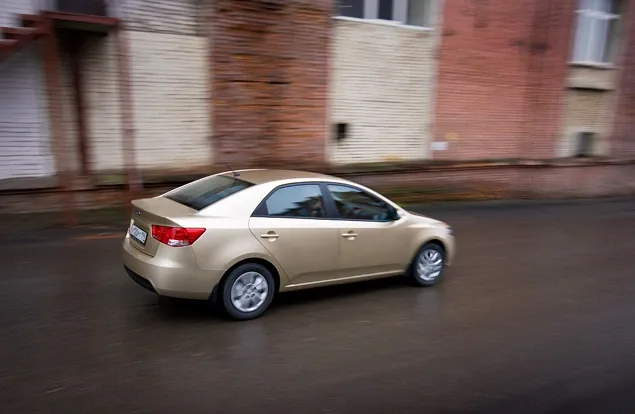
Also, Kia engineers did something tricky with the clutch — behind the wheel of the Cerato, even an experienced driver initially finds it hard to catch the moment of "engagement" of the discs, which is why the car regularly stalls when trying to pull away. And combined with the tight and uninformative clutch pedal, this feature turns driving in traffic jams into hard work. Although there are no complaints about the five-speed manual — the slightly long-throw gear lever pleases with excellent selectivity.
At low speeds, the Cerato's suspension works exemplarily: it smoothly swallows cracks, joints and potholes that generously dot Russian asphalt. Artificial bumps in the form of "speed bumps" and serious potholes the car also passes without strain. However, as soon as you add speed, the chassis begins to give way: in corners, the rear axle stubbornly jumps off the set arc, and on large waves of the surface, the body noticeably rocks. The longitudinal dynamics are also not pleasing — when braking, the car noticeably dives with its nose.
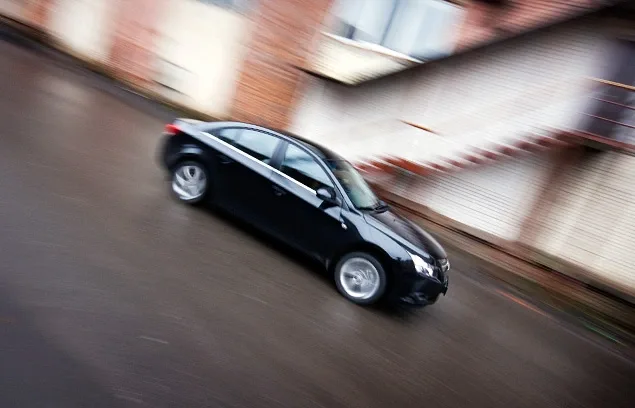
The Cruze's situation with the manual gearbox is different: the lever moves short and almost sporty, but it lacks shift precision. However, starting from a standstill is easier — the engine is more torquey, and the clutch actuation is perfectly tuned. But there's no desire to rev the engine to the redline: at high revs it noticeably loses steam and runs out of breath.
The Chevrolet's suspension is tuned in a European manner — firm and composed. This comes at the cost of ride comfort: all road imperfections, from small cracks to serious potholes, transmit vibrations into the cabin and produce a distinct "thumping" on rebound. The heavy 17-inch wheels are partly to blame. However, in corners the Cruze stands confidently, without excessive body roll, and under braking the car doesn't "dive" nose-first.
The Cruze's steering suffers from the same ailment as the Cerato's: the effort at the wheel feels synthetic. In city driving, the steering is precise and understandable, but as speed increases, responses to driver input become vague and sluggish. This is all the more strange, since during an autumn test near St. Petersburg, the Cruze behaved differently and obediently followed the steering at any speed. Perhaps the reason lies in the tires: the Finnish "Hakka 7" with studs performs terribly on Moscow's wet, chemical-treated asphalt at above-freezing temperatures, and the car literally tiptoes along.
In terms of acoustic comfort, there's a parity between the rivals: in the Cerato's cabin, the main noise source is the intrusive engine sound, while in the Cruze, it's tire roar and other noises penetrating through poorly insulated wheel arches.
Friendship Won
So, is it a draw? Yes, and the score — 0:0 or 1:1 — depends on one's point of view. From the perspective of the Korean engineers, they clearly deserve at least one point: they managed to find most of the ingredients for a successful modern sedan capable of competing with Japanese and European rivals in the most challenging "golf class."
and the Chevrolet Cruze
Perfecting this recipe isn't that difficult. Take the Cruze, improve the sound insulation and interior trim quality — and you get an Opel Astra. And if you teach the Cerato's suspension not only to smoothly absorb bumps but also to precisely handle irregularities, retune the transmission, and replace the hard, noisy plastic in the interior with soft-touch materials — you'd get a Kia cee'd.
The only question is the price: are buyers willing to pay as much for Korean sedans as for European counterparts? And if we set aside the Ford Focus, which is suspiciously cheap on the Russian market, the Cerato and Cruze have virtually no competitors in their class.
But from the perspective of a buyer who wants maximum value for minimum money, the rivals can only be awarded points with great reluctance. Their main advantage, besides a slightly lower price, is a fresh and memorable design that hasn't yet become boring. And for many modern motorists, appearance is the decisive factor when choosing a car.
Technical Specifications of Kia Cerato and Chevrolet Cruze
| Cerato 1.6 MT | Cruze 1.8 MT | |
| Length, mm | 4530 | 4597 |
| Width, mm | 1775 | 1788 |
| Height, mm | 1460 | 1477 |
| Wheelbase, mm | 2650 | 2686 |
| Engine displacement, cm3 | 1591 | 1796 |
| Power, hp/rpm | 126/6300 | 141/6200 |
| Torque, Nm/rpm | 157/4200 | 176/3800 |
| Maximum speed, km/h | 190 | 200 |
| Acceleration from 0 to 100 km/h, s | 10.3 | 10 |
| DISCUSS | [ comments: NONE ] |