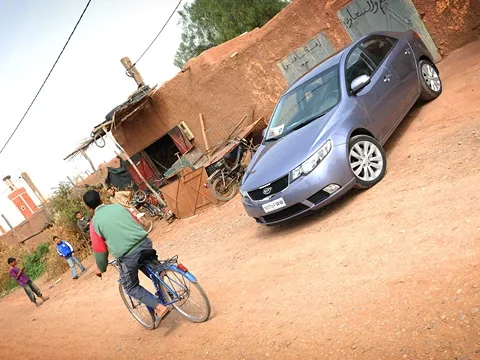
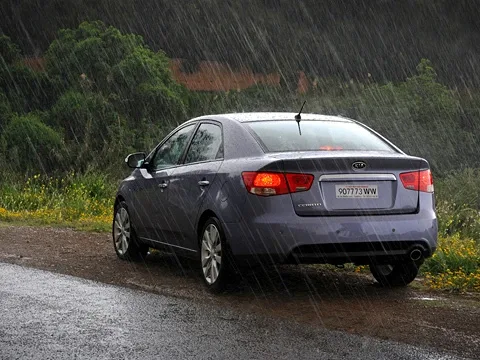
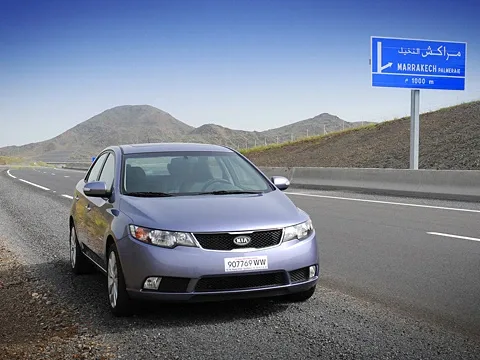
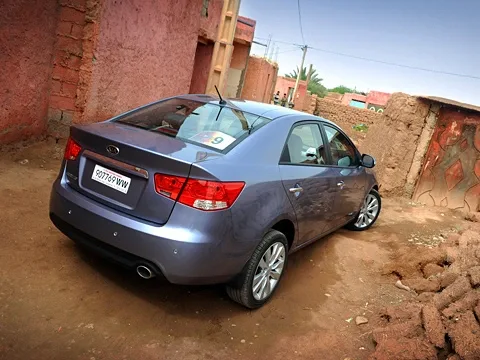
Let's start by giving credit where it's due: the Koreans have transformed the golf-class sedan Cerato beyond recognition, and it now looks quite attractive. The main creator of the new look is Peter Schreyer — it was he who came up with the current corporate style of the brand. He is also the author of the Soul and cee'd, and previously the Volkswagen Passat fifth generation and Golf fourth. Schreyer once headed the design division of the German concern, and the past Audi A6 and TT were not without his participation.
But if the Cerato's exterior can make those who drew the Honda Civic envious, the interior is a triumph of simplicity. There is no single concept here, but there are many heterogeneous types of plastic, and all of them feel hard and cheap to the touch. The door handles are made of plastic painted to look like metal, and the travel of the steering column stalks is so long that it can be compared to the length of the Baikal-Amur Mainline. In short, we have the gray reality of the economy class.
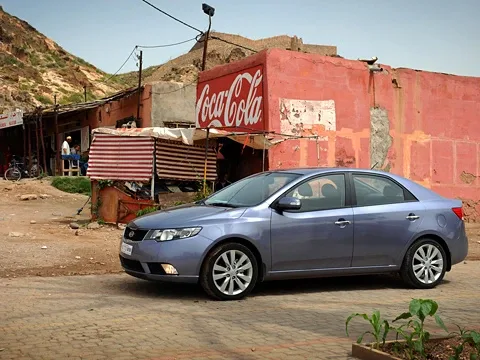
17-inch alloy wheels are a distinctive feature of expensive versions.
The interior is enlivened only by the instrument panel (in rich trim levels the speedometer is illuminated in red) and the steering wheel borrowed from the Soul model. There are also three interior trim options — black-brown, black-black, and black-gray. But that's not enough.
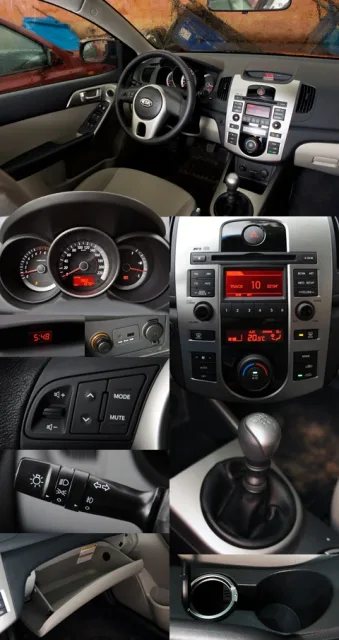
The interior looks simple, although the equipment is not bad: there is climate control, preparation for connecting an iPod or any other player, cruise control, and a smart key. But only the driver's window has automatic mode, the audio system plays mediocrely, and the climate control does not work perfectly.
But practicality is in perfect order. The rear seat folds in parts, and the trunk holds a lot — 415 liters. There is also enough space in the back, although the Koreans themselves admit that the new Cerato has become more cramped: there is less space for both legs and head. Plus, the seating on the short and heavily inclined cushion is not very comfortable.
Behind the wheel, however, it is quite tolerable to sit. The only complaint is that the seating position is not ideal: you have to bend your legs more than you would like, even despite the steering column adjustment in two planes. If you move the seat further back, you immediately want to move the steering wheel closer, but its adjustment range is only 4 centimeters. The lateral support of the front seats is the same as that of the rear bench, that is, practically absent.
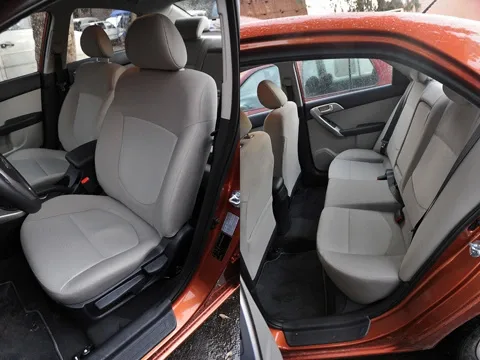
The front seats are too amorphous, and the rear ones have a heavily inclined cushion. Otherwise, sitting is quite comfortable.
The Cerato is the brand's bestseller. The previous generation accounted for 28.5% of global sales, exceeding 200 thousand units annually. True, the new generation will not be sold in Europe — there the bet is on the cee'd. But in the summer, a coupe version of the Cerato is expected (apparently only for the USA), and then a hatchback will appear.
From a technical point of view, everything is quite mundane: the Cerato is simpler than the cee'd. The Koreans insist that the platform here is completely new (the new Hyundai Elantra will also be built on it), but the front suspension is the same as the Ceed's, and at the rear there is a simple torsion beam, not a multi-link. In initial versions, there are rear drum brakes. Savings on everything.
By the way, about the name — they saved on that too. In Korea, where local brands rule the roost, the car was named Forte. But in Europe and the USA, where promoting a new name would cost a lot of money, they decided not to overcomplicate: here it's Cerato, and for Americans it's Spectra.
The engines are a 1.6-liter unit from the Ceed and two Theta II engines with a displacement of 2.0 and 2.4 (the latter only for the States). These engines were developed jointly with Mitsubishi and Daimler, and their modifications are installed on the Mitsubishi Lancer and Dodge Caliber. The engines are not bad, but without enthusiasm.
But where progress is obvious is in fuel efficiency. The new Cerato has become lighter thanks to the widespread use of high-strength steels and a simpler rear suspension. The steering has received an electric power assist, and the aerodynamics have been better thought out.
Checking fuel efficiency in the crazy traffic of Marrakech is a pointless exercise. Local drivers perceive the yield sign as an invitation to a bold maneuver, and traffic lights are nothing more than city decoration. As a result, you drive jerkily and constantly twitch.
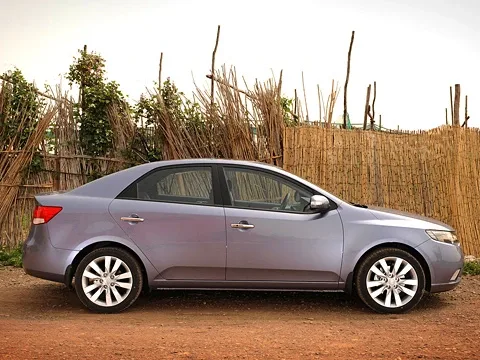
In profile, the Cerato is beautiful and resembles a hatchback. The unusual beltline and side stamping at the bottom add drama.
But it's like going to a non-tourist place: there the locals no longer try to extort money from you, but simply communicate. So here — drive a little further from the center, and the traffic becomes completely different.
So how does the Cerato drive? Overall, fine. There are no complaints about the power of the engines: the 1.6 in our specification produces 124 hp, the two-liter — 156. But the automatic transmission is old, four-speed, with a refined and more compact torque converter (different for 1.6 and 2.0) — it tries its best. But there is not enough traction at low revs in both engines, so the gearbox has to shift often and sometimes abruptly. There is still not enough dynamics. With the manual, the car feels more lively, but the gearbox itself is not distinguished by clarity, and the clutch pedal is not very informative.
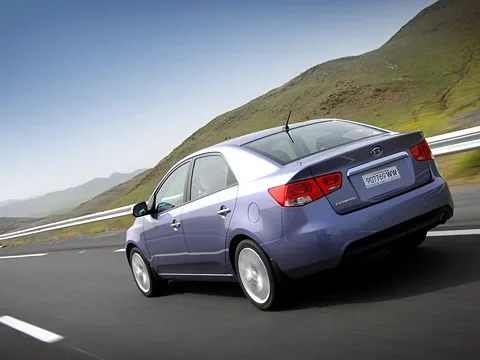
On the highway, the Cerato behaves well: reactions are dulled, but the car does not require steering corrections.
Handling is at a good level. The steering has adequate effort, the car enters corners willingly and without delay, although during sharp maneuvers the rear sometimes unpleasantly steers. There are complaints about the suspension: it is not soft and thoroughly transmits all the defects of Moroccan roads, which mostly leave much to be desired (the exception is excellent toll highways). At the same time, rolls and pitching are noticeable. At speed, the car stops paying attention to bumps, but at low speeds the suspension is often broken through.
And so, is everything so sad? Not at all! Like any global golf-class model aimed primarily at the USA, the Cerato turned out to be somewhat... average. But does it look bad against the background of most classmates? Not at all. They are the same — with average dynamics, handling, practicality, and comfort.
The previous Cerato was like from the provinces: it looked modest, but the form matched the content and, more importantly, the price. That car was at least 10% cheaper than competitors. The current Cerato is like a hotel in a resort place: the facade is beautiful, but there is not enough originality. The new model did not make a breakthrough in driving qualities or interior, but it is truly beautiful. When you return from vacation, what do you show your family first — photos of the hotel or still the picturesque landscapes? Now everything depends only on the price.
The technical characteristics of the Kia Cerato are presented in the table below. For both versions — with the 1.6 and 2.0 engines — the main parameters of the body, engine, transmission, and chassis are indicated.
Dimensions and weight
The body is the same for both modifications: four doors and five seats. The length of the car is 4530 mm, width — 1775 mm, height — 1460 mm. The wheelbase is 2650 mm, the track front and rear — 1557 and 1564 mm, respectively. The curb weight for the 1.6 version is 1236 kg (with automatic transmission — 1261 kg), for the 2.0 version — 1280 kg (with automatic transmission — 1293 kg). The gross weight is 1680 kg (1720 kg) for the younger engine and 1720 kg (1740 kg) for the older one. The trunk holds 415 liters.
Engines and transmission
Both gasoline units have distributed injection, are located transversely at the front, have four cylinders in a row and 16 valves. The displacement of the 1.6 engine is 1591 cc, it develops 124 hp at 6300 rpm and a torque of 156 N•m at 4200 rpm. The 2.0 engine with a displacement of 1998 cc produces 156 hp at 6200 rpm and 194 N•m at 4300 rpm. The gearboxes are either a five-speed manual or a four-speed automatic, drive is only front.
Chassis and dynamics
At the front there is an independent spring suspension McPherson, at the rear — semi-independent spring. Brakes are disc: ventilated at the front, ordinary at the rear. The maximum speed for the 1.6 version is 190 km/h (182 km/h with automatic transmission), for the 2.0 — 200 km/h (190 km/h). Acceleration to 100 km/h for the younger version takes 10.3 seconds (12.0 s with automatic), for the older — 9.3 seconds (10.5 s).
Fuel consumption in the urban cycle for the 1.6 engine is 6.6–6.7 liters (7.0–7.1 with automatic transmission), for the 2.0 — 7.5–7.7 liters (7.6–7.8 with automatic transmission). There is no data for the suburban and combined cycles. The environmental class is Euro-4. The tank holds 52 liters, fuel — AI-95.
Behind the scenes
The road to Morocco was not easy: first a plane to Milan, then a flight to Casablanca and from there - to Marrakech. The distance seems small, but the whole trip took more than 14 hours. The weather was pleasing, although by evening it consistently deteriorated: either a downpour started, or hail fell.