
KIA Ceed SW. Cosmopolitan
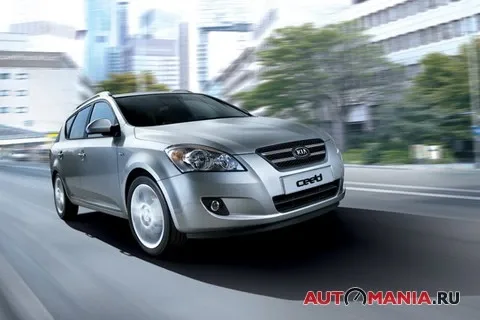
Kia, together with its "older brother" Hyundai, has always aimed at the European market. But to win over a discerning buyer, a low price tag alone is clearly not enough. In the Old World, people have long been accustomed to thinking not only about savings but also about ecology and their own safety. And now, finally, the Asians have a model that fully meets these requirements.
When designing the new compact hatchback Cee'd, Kia engineers kept the Western consumer in mind. The Koreans do not even hide this — on the contrary, they proudly emphasize that the European direction is now a priority for them. And, notably, Europeans have finally appreciated this approach, which prompted the company not only to expand the lineup but also to create bolder versions — such as the Kia Procee'd or the Excee'd convertible. Our buyer, as it turned out, is indifferent to such exoticism. Not spoiled by an abundance of choice, he votes for practicality, so the Cee'd SW wagon from the same family is of much greater interest to him.
Usually, the abbreviation SW after a model name means only the body type — station wagon. However, the Koreans interpret it differently — sporty wagon. This is exactly how the company's marketers position their car, intriguing potential buyers from the very start. Although, even if they adhered to the classic interpretation, the essence would not change: the sporty nature of the car is visible to the naked eye. The wagon looks very swift. This is especially true of the rear with taillights stretched to the very roof, and the side panels. In profile, the SW, in my opinion, is even the most attractive. And all thanks to one detail — the pillar tilted in the opposite direction. Without it, the car would surely have turned into a stylistically dull copy of the Chevrolet Lacetti. It is clear that this element is rather functional, but the courage of the Koreans deserves respect.
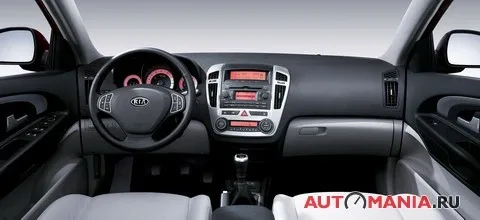
The Cee'd SW wagon is 235 mm longer than the hatchback of the same name and 10 mm taller, while the wheelbase remains the same — 2650 mm. That is, almost all the extra millimeters went into the trunk, which has become 200 liters larger. However, this is logical for a wagon. The cargo area is the main thing here, because the interior completely repeats the hatchback's interior, and the Koreans did a great job on it. It is enough to simply open the tailgate. Its upper hinges are located not at the roof break, as in many competitors, but 225 mm closer to the front. At first, this seems strange, but as soon as you have to load something heavy or bulky, you understand the trick. You do not need to bend down, crawling under the "roof," but can slightly hang over the compartment. In a Ford Focus Wagon, this is impossible to do. And your hands are intact, and your trousers are clean.
In the normal state, the driver has access to a cargo area measuring 1021x1040 mm. The rear sofa, like in many classmates, folds in a 60:40 ratio. The useful volume increases from 534 to 1664 liters — this is 100 liters more than the hatchback and about 60 liters more than such recognized leaders as the Renault Megane II and Opel Astra Caravan. The only drawback is the lack of a full-size spare wheel. The Koreans did not provide space for it under the false floor. You can, of course, say that the car was made for Europe, where they are used to "space-saver" spares. But our roads are not European. However, the spare wheel can be placed under the foam spacer, as done in the Ford. True, then you will have to sacrifice part of the useful volume, but this is quite justified. Wagons of this class are certainly capable of feats, but sometimes. For moves or commercial transportation, it is better to take something more suitable — it will be cheaper. By the way, about prices. The Cee'd SW is assembled at the Kaliningrad "Avtotor" plant, like the hatchback, so the cost does not go beyond reasonable limits. The base version will cost 511,000 rubles. For this money — front and side airbags, curtain airbags, ABS with EBD, onboard computer, air conditioning, three-spoke steering wheel with audio controls, a double-DIN radio with MP3 support, power accessories, heated mirrors, and power windows. Agree, not bad.
However, the main drawback of the SW is hidden under the hood. We are talking about the base 1.4-liter gasoline engine, which the wagon inherited from the hatchback. In principle, a calm driver may like it — with a power of 109 hp, the unit pulls quite decently, but with it, the car will definitely not justify the name Sporty Wagon. If you want the word and deed to match, you need to choose a more powerful engine — fortunately, Russian dealers have all five options, including a brand new 1.6-liter turbodiesel with an "advanced" turbocharger. It delivers peak power (115 horses) already at 4000 rpm, and maximum torque of 260 Nm at 1900 rpm. And this, you will agree, is already interesting.
Under the hood of our test wagon was an engine of the same displacement, but, alas, gasoline and naturally aspirated. In short, we never felt the full sportiness of the model. Nevertheless, this engine has the right to life. And if there is only the driver in the cabin, it can prove to be a very good fighter, especially in tandem with a regular manual transmission. Its 122 horses are quite enough for a wagon in such a situation. The Kia accelerates willingly, especially when the tachometer needle goes over 4000 rpm — the car seems to wake up. In short, it is better not to drop the revs: at low revs, the car does not like it — it requires constant revving. It is also worth noting that the Cee'd owner will not have to spend a fortune on fuel — the appetites of the power unit are quite moderate. Otherwise, the car repeats the hatchback in most parameters. However, is that strange?
| Technical specifications: KIA Cee'd SW | |
| Length (mm) | 4470 |
| Width (mm) | 1790 |
| Height (mm) | 1490 |
| Wheelbase (mm) | 2650 |
| Weight (kg) | 1317 |
| Trunk volume (l) | 534/1664 |
| Engine displacement (cc) | 1591 |
| Max power (hp) | 122 at 6200 rpm |
| Max torque (Nm) | 157 at 4200 rpm |
| Max speed (km/h) | 192 |
| Acceleration 0-100 km/h (s) | 11.7 |
| Average fuel consumption per 100 km (l) | 6.5 |
| Price (rub.) | From 511,000 |
Source – AUTOMANIA.RU