
Memories of the old interior details can't be called pleasant: an unfriendly seat with a stiff, literally pushing-out-the-driver filler, an uncomfortable three-spoke steering wheel, a simple instrument panel... Here — everything is spot on. The new seat is softer, and therefore it seems you sit lower. The cushions and backrest distribute the load perfectly. The leather four-spoke steering wheel begs to be held, and the grip is surprisingly tenacious. The instruments have an expensive-looking white-red backlight.
The trim materials of the center console and doors haven't changed, but there is less silvered plastic inside, which made the interior more solid. The build quality, as before, is decent. By the way, the climate control is now dual-zone.
The round knobs of the now dual-zone climate control and the large buttons on the center console are convenient to use. There are enough adjustments for the driver's seat and steering column to sit comfortably in front. I'm also comfortable "behind myself." However, the layout was initially verified in a German way. Visibility, as before, raises no questions, despite the different side mirrors with built-in turn indicators.
Well, the beginning is made. The organizers offered journalists a trip through Tuscany. From the rocks of the Castiglione d'Orcia fort, first mentioned in 714, to the springs of Bagni San Filippo and the resort village of Bagno Vignoni, where Andrei Tarkovsky filmed "Nostalgia" in 1983... I, however, go wherever my eyes lead. To find, perhaps, the ideal place for a conversation with the car — a heart-to-heart talk. The deserted paths winding through plains and hills allow you to fully appreciate the capabilities of the power unit and handling. And there's a place to listen to the suspension.
Actually, the range of petrol engines hasn't undergone any changes. The gearboxes have remained the same. So, paired with the only 1.6 (126 hp) "four" presented in Italy, I chose the five-speed "manual" without much thought. The acceleration is as smooth as a desk, a monotonous hum, a lack of traction at low revs — the "atmospheric" engine that doesn't reach for the stars is for the average family man. It won't surprise with dynamics, but it will calmly maintain a cruising speed of 140 km/h.
The instrument panel with constant contrast backlighting Supervision — only in the top Prestige trim.
The "automatic" selector has remained the same, while the manual gearbox lever has a new angular knob with a trigger button for reverse gear instead of a locking ring.
The glove box volume has increased by a liter — to 6.5 liters.
Cars with a "manual" now have a hill-start assist system (HAC). Overall, it works adequately. I would only like the brakes to release a little faster when sufficient torque is applied to the wheels.
Apparently, KIA decided that the cargo-passenger capabilities are already at a good level, so there are absolutely no changes in the rear of the cabin.
Oh, if only there were a two-liter 143-horsepower engine here — because you can get pleasure from the chassis! The engineers increased the pitch of the spring coils (their stiffness has been increased), recalibrated the shock absorbers, and equipped the rear suspension with less compliant silent blocks. Body roll decreased, and composure appeared in the behavior.
On the A1 motorway, the cee'd rushes confidently, sticking to the road. But for overtaking at speeds above 130 km/h, 126 hp is no longer enough.
The steering wheel is now not artificially heavy, sticking in a "rubbery" background with a blurred "zero," but informative, with an adequate increase in effort in corners and at high speed. Moreover, the electric power steering has been taught to interact with the stability control system. Ideally, in the event of a loss of directional stability, it should give the driver light impulses to suggest the correct actions. I didn't get to test the system myself: it didn't come to skids, and it doesn't work on understeer.
There's no point in revving the 1.6 four-cylinder engine beyond 5000 rpm: you won't get any pickup, and your ears wilt. But up to 4000 rpm, the engine is quite quiet.
The trunk volume of the station wagon is the same: what's there is enough. At least, colleagues had no problems loading bulky photo and video equipment.
Licking the curves of the serpentine, catching glimpses of the landscapes of Rapolano Terme out of the corner of my eye, I catch myself thinking that the cee'd is a full-fledged "European." Fast and unambiguous, like military regulations, reactions, cat-like tenacity on far from ideal Italian asphalt, almost neutral handling... The gearshift mechanism primarily prevents you from getting full pleasure: a long-throw lever with an uncomfortable knob, combined with a light and equally "long" clutch pedal. Although such a "manual" is much better than the four-speed "automatic" — a rare slow-witted and energy vampire.
It's hard to single out the main source of noise. Tires hum and wind howls equally persistently. But they go beyond the bounds of decency only at "illegal" speeds.
At first glance, the suspension has become stiffer. However, it hasn't lost comfort. On the contrary. The merciless and meaningless shaking on bumps has disappeared, and the looseness has disappeared. There is no trace of the sharp impacts transmitted from the steering wheel to the palms, nor the loud sound accompaniment of the suspension's work. The chassis is now not only more elastic, but also less "talkative." This was achieved largely thanks to additional sound insulation of the cabin, which reduced the noise level by several decibels.
The length of the hatchback has increased by 25 mm, and the station wagon has stretched by 20 mm. This is due to the modified bumpers.
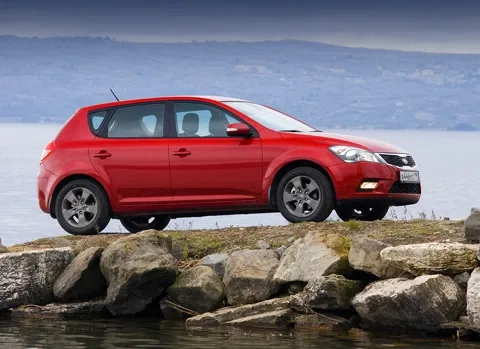
I have no doubt that the updated cee'd will sell better than before, despite the shrinking market. The car has been improved on all sides, and it's even possible that sales volume will increase (18,943 units in 2009). Especially since prices for restyled cars have risen by an average of 3–5%. True, the updated 1.4 version (the previous one was priced from 499 thousand rubles) will not appear immediately, nor will the two-liter (currently from 749 thousand), so the price range is currently 525,900–725,900 rubles. At the top of the range, until the arrival of the 2.0 modification, is the SW 1.6 station wagon with an "automatic."
The suspension of the station wagon has been modernized on the same principle as that of the hatchback. Only the SW version is about 60 kg heavier than the hatch.
In Russia, KIA prefers pinpoint strikes. Since, according to statistics, in the golf class, most cars are bought with 1.6 engines, and a third of customers prefer an automatic transmission, the Koreans focus on exactly this combination. Why, for example, spend money on diesels, whose share in Russia is generally no more than one percent? We won't have cars on heavy fuel anymore.
True, the same statistics claim that the percentage of Russians aware of the existence of the KIA brand is still below the industry average. But this, they assure me, is fixable: a few years, and everything will be fine. Image is an acquired thing, if there is a worthy product. And the cee'd has both a five-star Euro NCAP rating and a place in the top seven finalists of the Car of the Year competition. After all, a consistent pro-European, and now pro-Russian, position cannot but bear fruit.
Let me start with the fact that in Russia the restyled cee'd will be offered only with petrol engines, but in Europe, where diesel cars make up about 45% of the market, a new version with a 1.6 CRDi turbodiesel from the U2 family will appear. This engine is equipped with a common rail injection system with latest-generation injectors, a variable-geometry turbine, and a particulate filter. Power is 115 hp, torque is 255 N•m. Notably, the engine works in conjunction with a new six-speed manual gearbox.
The engineers also worked on the rear suspension: new rubber-metal elements made its operation quieter. The springs have become stiffer and better hold lateral loads, and the shock absorbers have received different damping settings.
On the way to Tuscany, we were told that heavy rain was falling there and it wasn't going to stop. But, fortunately, for the two days allotted to Russian journalists for the test drive, the weather improved — it was dry and even sunny.