
Let's take a look at the pair left over from the collapsed DaimlerChrysler alliance. Both of these five-second monsters to 100 km/h are creations of factory tuning studios. AMG is the court studio of Mercedes, whose products are renowned for their high cost and technical complexity. It was here that the world's most powerful naturally aspirated V8 was created, which we decided to pit against a competitor in this test.
The abbreviation SRT (Street Racing Technology) is the brainchild of Chrysler's young and ambitious "racing" division. It appeared in 2002 in Switzerland and over five years produced several bold and unconventional models built on the principle of "maximum output for minimal money."
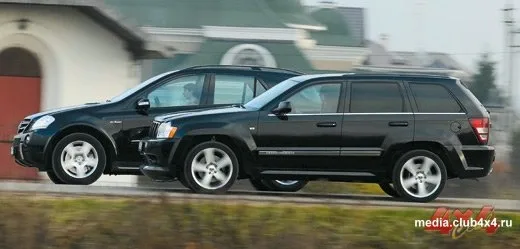
Yes, it's hard to find two more different masters of factory tuning. An American company with a "cheap and cheerful" philosophy and a European firm for which brand reputation is paramount.
MONEY IS DIRT
Is it even appropriate to compare cars with a chasm between their prices? The Mercedes ML 63 AMG costs 151,000 euros (in our test configuration), while the Jeep Grand Cherokee SRT 8 is priced at 65,800 euros. I understand what you're thinking right now—and I share the same opinion: money is dirt, the main thing is acceleration. Those five seconds from the specs need to be lived and felt to the fullest, and only then think about the price.
No matter how many times we launched together, on the initial stretch the Grand Cherokee consistently pulled ahead of the ML 63 by a car length or two. Sitting behind the wheel of the SRT, it was impossible to tell where the AMG was. Did it oversleep? Stay put? Only as we approached 100 km/h did the Mercedes suddenly emerge from behind and overtake its rival.
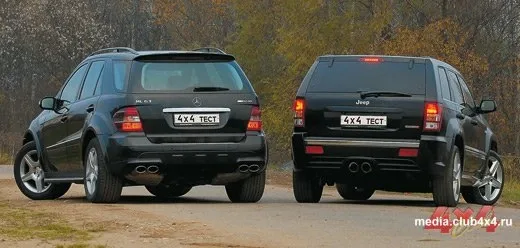
The identical five seconds turned out to be completely different in reality. The less rev-happy SRT engine, paired with a modified five-speed automatic (by the way, from Mercedes!), has no equal when launching from a standstill up to 90–100 km/h. And the high-revving AMG naturally aspirated engine with a seven-speed "automatic" reigns supreme at higher speeds.
EACH IN ITS OWN WAY
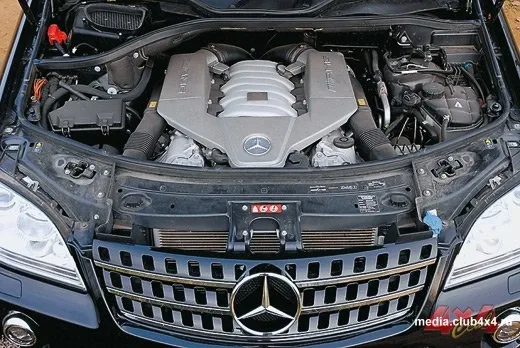
Oddly enough, both engines are naturally aspirated. AMG, drawing on 30 years of experience in GT racing, created its engine from scratch. And what technologies are there? A rigid frame construction of the crankcase using a "closed deck" design. Cylinder bores with LDS coating (electric arc spraying). A controlled intake manifold with variable geometry and integrated throttle flaps. Vertical arrangement of intake and exhaust ports. Valve actuation with bucket tappets. The list goes on.
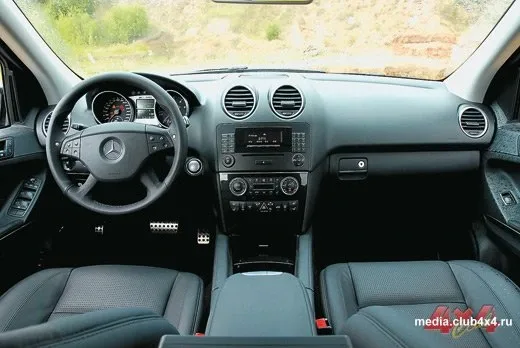
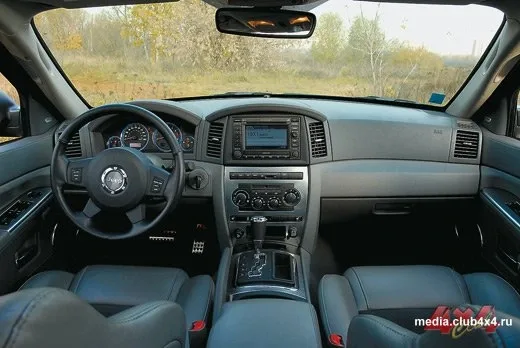
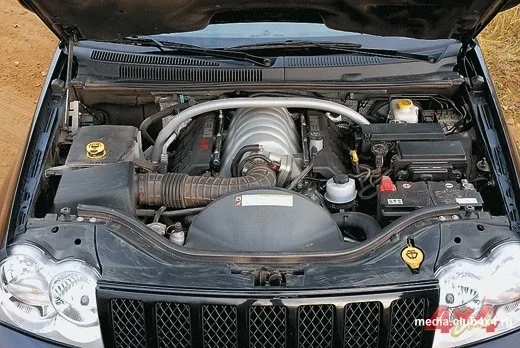
The SRT engineers, lacking such financial resources, took the standard "Chrysler" HEMI 5.7L with hemispherical combustion chambers as a base and boosted its power by 85 hp. They worked on displacement (cylinder bore increased by 3.5 mm) and compression ratio. Refined the cylinder head. Installed larger-diameter valves. Changed the intake and exhaust manifold runners. Added new camshafts, a forged steel crankshaft, pistons with floating pins (with oil jet cooling) and an oil pan that facilitates oil drainage into the sump at high RPMs.
NOT FOR EVERYDAY LIFE
The SRT 8 is a car with a rough masculine character: a solid rear axle, the low rumble of the V8, and sloppy interior finish. Need a more civilized, softer, more compliant and comfortable vehicle? Then your choice is the ML from AMG: it has a more refined engine note and is much better suited for daily life. Here's a prime example: when I drove the ML out of an underground parking garage through a tightly coiled spiral tunnel, I had no problems at all. But my colleague in the Jeep Grand Cherokee ahead was squealing tires, constantly breaking traction, like in the movie "Tokyo Drift"...
The first speed bump on our route hit the Grand's front spoiler—its ground clearance is barely more than a Honda Civic's. In this regard, the ML from AMG is much more practical. Moreover, its suspension retains its inherent dual-mode nature—if you get tired of enjoying the sharp handling, you can switch to "comfort" mode.
P.S. The conclusion will be short and clear. Those who buy only five seconds to 100 km/h can really save money. But if you also want to drive properly, you'll have to shell out twice as much.