
When Land Rover introduced the Freelander, loyal brand fans claimed the brand had lost its identity. Similarly, when Jeep released the Liberty with independent front suspension, hardcore off-roaders treated it with disdain. This state of affairs seems likely to persist for a long time, as it's known that avid off-road enthusiasts are the most stubborn conservatives who adhere to the principle: "The simpler, the more reliable." But if you look at racing SUVs or dissect the design of rock buggies... However, no need to look far! A proper trophy prototype is no longer just a UAZ or Land Cruiser. I'm getting at the point that technology evolves, and one shouldn't reject innovations merely because they don't fit conventional notions.
CHOOSING THE ROUTE
We were offered to test the new Jeep in Sweden. This means you can't really speed on the roads—speed control is strict, and fines are huge. You can't drive on mud tires—there are private properties and electrified fences everywhere. In the city, maneuvering is also tricky: most of Stockholm's streets are pedestrian-only, and the rest have one-way traffic. I was consoled: "But there will be tasty herring and fresh sea air." The new model was brought in three modifications: a diesel with a six-speed manual, a petrol with a CVT, and a petrol with a manual gearbox, all with all-wheel drive. Moreover, diesel versions were intended for asphalt, while petrol ones for off-road. The only petrol car with a manual was snatched by Slovak journalists and never shared—a common thing at international tests. Well, we choose light khaki and, resetting the odometer, set off—to the Jeep Activity Center.
For the European market, the Compass will be offered in two trims—Sport and Limited, i.e., base and more advanced. Options, as is now customary, are combined into packages. You can order Sport with the P1 package, which includes air conditioning, a full-size spare tire, heated seats, and cruise control. The P2 package adds the Musik Gate audio system, leather interior, and a radio with CD changer and MP3 support. It's worth noting that recently Americans have become more thorough in equipping cars for Europe—Japanese and European manufacturers have long surpassed them in this regard.
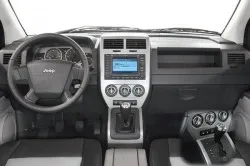
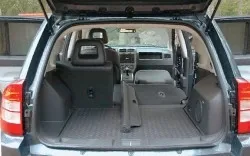
The interior is quite simple: straight lines and smooth surfaces. If you fold down the front seat backrest, you can transport long items up to two meters.
Now about how Jeep engineers and testers worked on handling and dynamics. On regular roads, you can't really push it. A stretch of highway packed with trucks, where we barely reached 130 km/h, ended quickly, and we turned onto secondary roads. They are smooth and winding, but mostly narrow—for two cars, with a 70 km/h limit. A local from the Jeep team warned that police like to set up ambushes precisely in such places, and fines are unlikely to please us. However, we still managed to find a pad with markings for helicopter landing. A few sharp maneuvers and several laps at the limit of grip showed that the suspension has become stiffer, and the steering could use some refinement. But if you drive the Compass obeying the rules, the impressions will remain positive. The new Jeep is quite comfortable, the seating position is slightly higher than in a car, visibility is decent, only the front pillars are a bit wide at the bottom. On turns with a roll, you have to stretch your neck to check if someone is coming from the left. Rear visibility, contrary to expectations, is quite good—headrests don't interfere, mirrors are large. The driver's seat adjustment is also beyond reproach. At least on asphalt. Off-road, you want to raise the seat higher to see the area in front of the bumper, but you hit the ceiling.
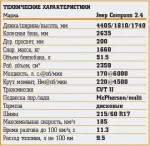
TECHNICAL PART: JEEP COMPASS
STONE MASSAGE
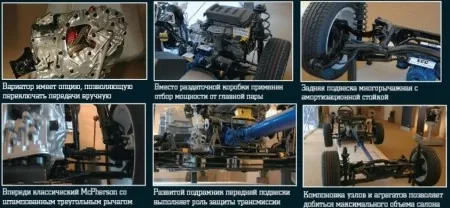
At the Jeep Activity Center, built for the Compass presentation right in the forest, petrol crossovers awaited us and—unexpectedly—several Wranglers. Probably for comparison, to show the opposite poles of the Jeep lineup. There, we also had a technical briefing, and the "innards" of the Compass were displayed: engine with transmission, chassis, and suspension. Both engines in cross-section and a disassembled CVT. Separately, it's worth mentioning the real stone massage. Large heated stones the size of a fist are used to rub the back. Very pleasant! By the way, the stone massage was received not only by the pilots but also by the cars themselves—Sweden is essentially a huge rock, slightly covered with soil. The cars hit stones and boulders with suspensions, axles, and frames. Of course, the trails for the Compass and Wrangler were different. The classic got it in full: there were those who got stuck and those who scratched against a tree. And the "modern" in the person of our hero confidently passed a trail very similar to our forest roads after a month of rain. The Freedom I all-wheel-drive system worked perfectly that day! In essence, it's a regular electronically controlled clutch that locks when wheels of one of the axles slip. In our case, the front axle, which is the drive axle on asphalt. The feature of Freedom I is the preload mode: even with a slight difference in wheel rotation speed, the discs begin to close, transferring part of the traction to the rear axle. This helps on weak surfaces like sand or snow, where you can dig in before the clutch engages. If you hang a wheel and press the gas, the front wheel spins, the car slides—and that's it, grab a shovel. The Compass in such a situation jerks "with its whole body"—both axles engage. The chances of getting out double, at least theoretically. The CVT also pleased. What on asphalt is perceived as a delayed response turns out to be very useful in mud.
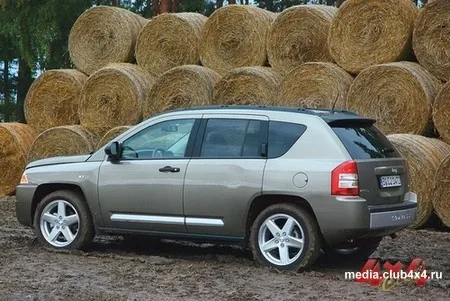
Geometric off-road capability won't allow the Compass to climb over a log half a meter thick, but for ordinary forest roads, the margin is sufficient. Ground clearance is 200 mm, approach, departure, and ramp angles are 21, 32, and 20 degrees, respectively. The underbody protection of the Compass is conditional: mostly subframes of suspensions and side rails, the rest is plastic. Therefore, the navigator needs to carefully monitor how the obstacle passes between the axles. In the off-road arsenal of the new Jeep, besides active all-wheel drive, there is a traction control system and specially tuned ABS. In short, with careful driving, the Compass on rough terrain won't yield to its competitors—Toyota RAV4, Honda CR-V, and Hyundai Tucson. Prices are also known: the Compass in Sport version costs 24,900 euros (2.4MT), with CVT—25,800 euros, the most expensive trim—28,700 euros. Diesels will appear next year.
CAPTAIN JACK'S COMPASS
 And still, did Jeep choose the right path with the new Compass? Both yes and no. A crossover in the Jeep lineup certainly has a place—it's a global trend. You don't always need a low-range gear and solid axles. Moreover, a brutal appearance is not necessary for a car that only needs to overcome a twenty-centimeter snowdrift at the garage gate. Overall, in its class, the car is no worse than others. But how will the new direction affect Jeep's image, its reputation as a "good guy" on any road and almost any off-road? A charming unshaven man in worn jeans, boots covered in clay, and a flannel shirt with a happy smile doesn't fit the framework that the Compass sets... And a petite lady with a small dog looks strange next to the round headlights, seven-slot grille, and the Jeep badge. In short, I'd like the Compass not to become the very tool with which Jack Sparrow sought his happiness... I don't know. Like any off-road enthusiast, I'm probably too conservative.