
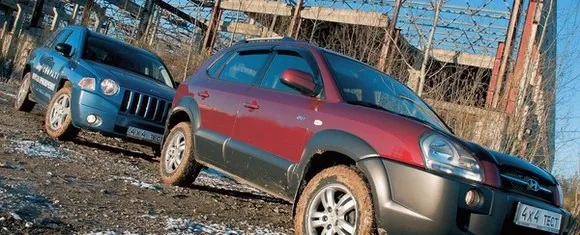
The Tucson is no stranger to us. Compact, comfortable, and lively — for its money, it offers a V6 paired with an automatic transmission in manual mode. The suspension is fully independent, the body is unibody, and the all-wheel drive is engaged via an electronically controlled clutch when slipping. Neat assembly, quality materials, and an attractive price have made it a leader in its class on the Russian market.
LOVE THAT FADES
Before the shoot, the cars were, as usual, sent to the car wash. Shiny, with droplets on the hood, they drive out into the light, and you can see what the designers worked on while polishing the body shapes.
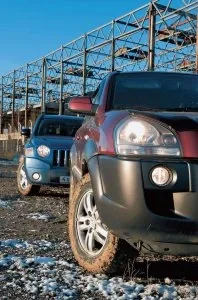
You can't take your eyes off the Compass. It blends aggression and smoothness, heaviness and lightness, the spirit of off-road and sporty zest. A companion with a different brand won't confuse it — before you is definitely a Jeep, although the entire effect is built only on round headlights and a grille with seven slots.
You fall in love with the Tucson because it doesn't try to seem like something bigger. No attempts to imitate a legend, no pathos or desire to overcharge for the name — which, according to statistics, adds about 20% to the cost. But the initial charm of the Compass quickly fades. You look closer — and start tripping over the downsides. The front pillars are so wide that a pedestrian can easily hide behind them in a turn. The low front bumper will meet the first curb with a crunch. And in general, is it worth fussing so much over design? What if it becomes outdated tomorrow? Or, on the contrary, becomes a trend? And hasn't this bland Korean "bun" already gotten tiresome?
SOFT TO THE TOUCH
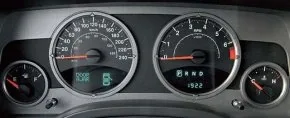
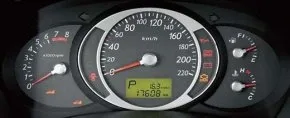
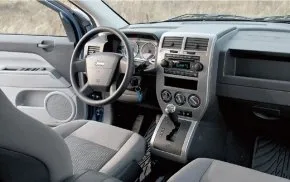
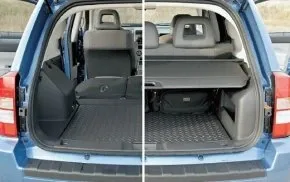
Inside, the difference is no less than outside. Although in terms of cabin and trunk volume they are close, and the instrument clusters in both are clear, without unnecessary tinsel, and even with onboard computers. It's funny that real compasses are in both: in the Jeep it's built into the dashboard, in the Hyundai — into the rearview mirror.
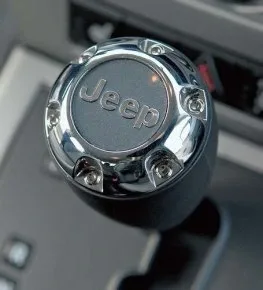
The Compass's cyberpunk advertising is not accidental. The interior is cheap but bold. Speakers the size of a watermelon. In the rear door, fold-down speakers are hidden — open the trunk, and a picnic turns into a disco. On the center tunnel, like a mushroom, sticks out the CVT lever, studded with glass bits.
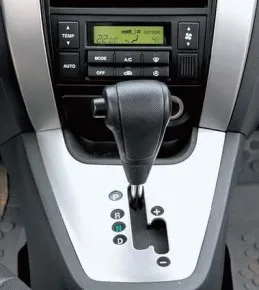
The Tucson inside is a serious family car. No associations with a toy. The plastic is soft, pleasant to touch. However, the "American's" dashboard is clearly more resistant to scratches than the Korean's. Will this console the Jeep owner when, after a year or two, his SUV starts rattling? Although the "plastic concert" is a matter of the future, but the sound insulation in the "American" is worse already now. Especially audible is the low hum of the CVT with a metal belt.

ECONOMY OR RELIABILITY
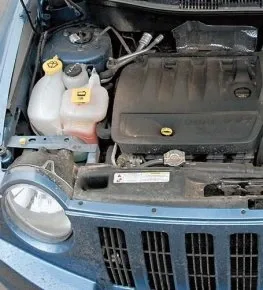
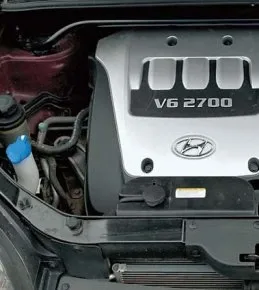
Under the hood of the Compass is a 2.4-liter gasoline unit with four cylinders. The low end is frankly not "diesel-like." Emissions comply with Euro-4, and this, as is known, stifles dynamics. However, the VVT system is on both camshafts. This saves fuel, makes the engine more flexible, and delivers optimal torque at any RPM. True, there is a risk in this progressiveness. A couple of bad fill-ups — and on a frosty day, the engine with variable valve timing may get sad due to carbon deposits on the valves. The Tucson's engine is older and simpler — a V-shaped "six" with confident low end. But for reliability and torque, you have to pay: consumption is 2 liters more. In the city, the "Korean" drinks 16 liters versus 14 for the "American." If we honestly admit that those two liters aren't that important to us, then in terms of the engine, the Hyundai looks preferable. At least on paper. Maybe in motion, the Jeep will take revenge?
AROUND AMERICA
The "American" starts softly, without jerks, and briskly shifts through the virtual gears of the CVT, which also has a manual mode. Its suspension is not American-style stiff at all. There is no trace of body roll or pitching. Small bumps on the asphalt are felt clearly, but the younger Jeep handles large potholes heroically, without bottoming out. The steering is manly, with excellent feedback. Overall, the Compass behaves like a solid passenger car.
 The Tucson is the complete opposite of the composed Compass. The steering is free, but within reasonable limits. The suspension has an American character, yet it doesn't cross the line between comfort and wallowing. Small irregularities are almost unnoticed, but on larger potholes, bottoming out occurs. Body roll is present but within acceptable limits. Although flying into a truck rut at 120 km/h is already risky — unlike the Compass, the Tucson's manners are not so "passenger-like."
 So who won? The answer is simple: to each their own. The Tucson once again proved it is nimble and comfortable. The Jeep did not yield to it in dynamics, confidently passed the lane change test, and wasn't afraid of holes in the asphalt. Let's call it a draw.
PARKETTE DEMOLITION
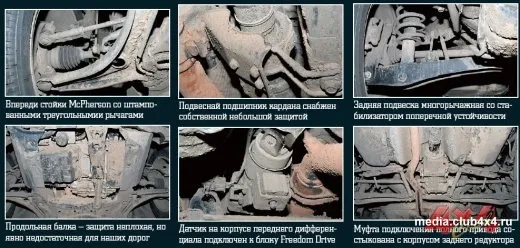
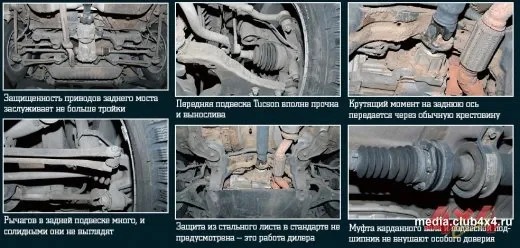
The all-wheel drive system in these two cars is built on the same principle: an electromagnetic multi-disc clutch is responsible for transmitting torque to the rear wheels. But in the "Compass," it is implemented more interestingly — with a proprietary function of pre-tensioning the friction discs. The engineers assure that this scheme minimizes the pause in engagement when the wheels have already started to slip.
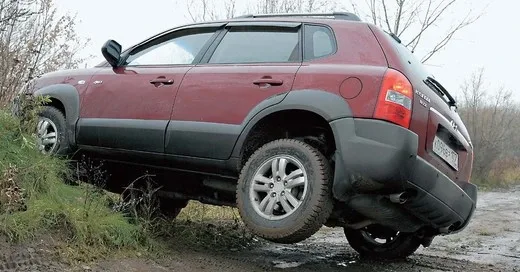
Honestly, I've never been a big fan of driving on asphalt, and if you have an all-wheel-drive car in your hands, you want to get off the road even more. Ahead of us was wet clay, which local off-road enthusiasts had turned into a mess. You couldn't ask for a better testing ground for a "parkette." The stock road tires instantly clog with mud and turn into smooth slicks, after which the crossover can show everything it's really capable of in such conditions. This is especially evident on a long incline.
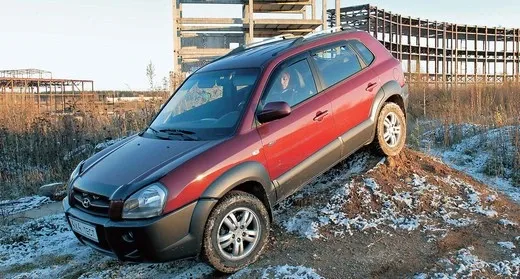
The first attempt to storm the clay hill was unsuccessful: both rivals crawled up almost sideways, struggling to control the drift of the front axle. The attempt to catch on the dry grass with the right wheels, to my surprise, also did not bring results. Turning off the stability control system did not add drive. Okay, let's try again. Here I liked the Tucson a bit more: it digs in more confidently with momentum, and that is the only available way to overcome such climbs for these cars, and its front bumper is also positioned higher. Therefore, the off-road stage remained with the Hyundai.
In our editorial office, readers often call and demand a direct answer: "Tell me honestly - should I take it or not?" Of course, take it, but with reservations. In this test, as in life, everything is ambiguous. The summary can be formulated as follows: the Tucson is a choice for calm family use with the ability to get out of an unpleasant situation, but if you value spirited driving, like to follow fashion trends, and consider yourself an aesthete with alternative taste - the Compass will seem more interesting and will give more driving pleasure.
|
SPECIFICATIONS
|
||
| Make | Jeep Compass | Hyundai Tucson |
| Length/width/height, mm | 4405/1810/1740 | 4325/1795/1730 |
| Wheelbase, mm | 2635 | 2630 |
| Ground clearance, mm | 207 | 195 |
| Curb weight, kg | 1660 | 1675 |
| Fuel tank capacity, l | 51.5 | 65 |
| Displacement, cm3 | 2359 | 2656 |
| Power, hp@rpm | 170@6000 | 173@6000 |
| Torque, Nm@rpm | 220@4500 | 241@4000 |
| Transmission | CVT II | AT4 |
| Suspension front/rear | independent spring | independent spring |
| Brakes | disc | disc |
| Tires | 215/60 R17 | 235/60 R16 |
| Maximum speed, km/h | 185 | 182 |
| Fuel consumption, l per 100 km | 14 | 16 |