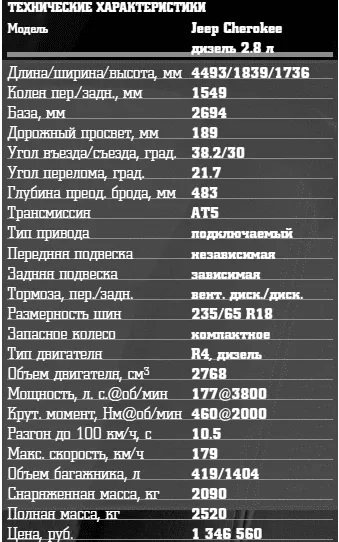
The new Jeep Cherokee boasts an approach angle of 38 degrees and a departure angle of 30. Such figures have not been offered by the global auto industry on fresh civilian SUVs with all-wheel drive for a long time. Add to this a diesel that delivers 460 Nm already at two thousand rpm — and you get a car that you wouldn't be afraid to get lost with in a winter forest.
NOT STUPID
The presentation route ran along village and forest roads familiar from the Seliger rally. There was no chance to show off the excellent geometry: no hills or ground elevation changes were encountered on the way. We weren't allowed to wallow in mud either — it was dry outside. Although nothing prevented setting up a couple of artificial puddles with water trucks. In short, the official off-road part of the test, as often happens, turned out almost toy-like, and we couldn't truly assess the updated Cherokee's off-road capability. But we didn't lack vivid impressions.
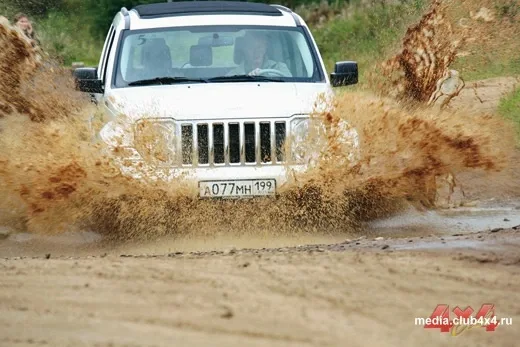
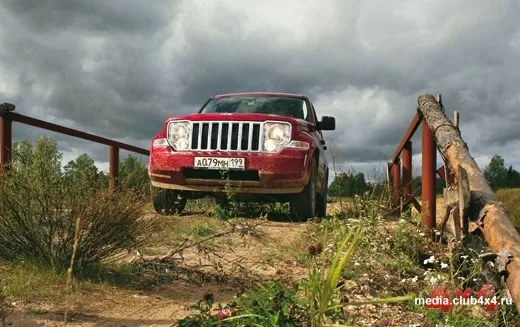
There are two main pieces of news, especially for those who get carsick from American suspension settings and can't stand the "sea rolling." First: the Cherokee no longer rocks its body on waves. Second: neither during acceleration nor braking does the car dive nose-first. Now you can eat a hearty meal and not fear that your breakfast will end up on the dashboard. But more important is something else — the ride over Seliger's bumps, where pothole sits on pothole, turned out quite comfortable. The new five-link rear suspension with upper and lower trailing arms and a Panhard rod added stiffness and made the car more composed, but without turning it into a "teeth-rattler."
BETTING ON DIESEL
At the test, you could choose a petrol or diesel version. The engines are already familiar to us. The four-cylinder 2.8 L turbodiesel with piezo injectors gives the Cherokee the best-in-class towed load figure — up to 2800 kg, at least according to the manufacturer. With this engine, the car is also 6% lighter. The timing belt replacement interval has increased to 140,000 km. Plus, improved "cold start" is promised thanks to the electronic turbocharger drive.
The alternative is a 3.7 L petrol V6 producing 205 hp at 5200 rpm and 314 Nm at 4000 rpm. In Russia, depending on the engine, the Cherokee is offered with a five- or four-speed automatic. The diesel version has one more gear.
BETTING ON DIESEL
At the test, you could choose a petrol or diesel version. The engines are already familiar to us. The four-cylinder 2.8 L turbodiesel with piezo injectors gives the Cherokee the best-in-class towed load figure — up to 2800 kg, at least according to the manufacturer. With this engine, the car is also 6% lighter. The timing belt replacement interval has increased to 140,000 km. Plus, improved "cold start" is promised thanks to the electronic turbocharger drive.
The alternative is a 3.7 L petrol V6 producing 205 hp at 5200 rpm and 314 Nm at 4000 rpm. In Russia, depending on the engine, the Cherokee is offered with a five- or four-speed automatic. The diesel version has one more gear.
INSTEAD OF A LEVER — A BEAK
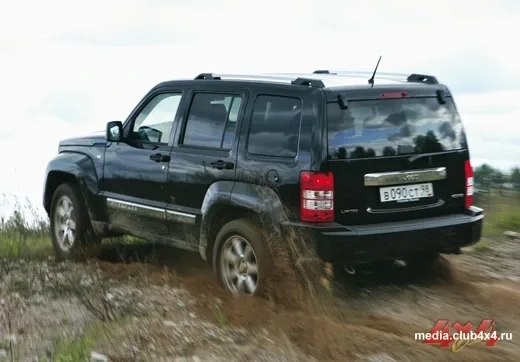
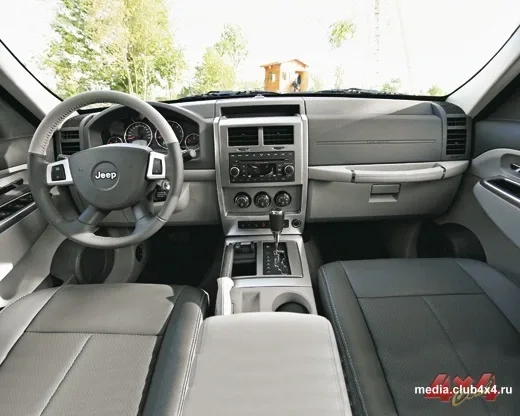
The transmission has also changed. Who doesn't know the famous Jeep's stiff transfer case lever that didn't always engage on the first try? Now it's been replaced by an electronic "beak." You can select an automatic mode for engaging the front wheels "on demand" or drive only on rear-wheel drive, and if necessary, engage low range with center locking. The all-wheel drive is managed by a multi-disc clutch.
The base equipment of the Jeep Cherokee has added a hill-start assist system — this wasn't available before. Hill Descent Control holds pressure in the brake system for a couple of seconds so the car doesn't roll back when the driver takes their foot off the brake pedal.
The transmission has also changed. Who doesn't know the famous Jeep's stiff transfer case lever that didn't always engage on the first try? Now it's been replaced by an electronic "beak." You can select an automatic mode for engaging the front wheels "on demand" or drive only on rear-wheel drive, and if necessary, engage low range with center locking. The all-wheel drive is managed by a multi-disc clutch.
The base equipment of the Jeep Cherokee has added a hill-start assist system — this wasn't available before. Hill Descent Control holds pressure in the brake system for a couple of seconds so the car doesn't roll back when the driver takes their foot off the brake pedal.
A full test is still ahead — we haven't yet checked the traction control system and the underbody layout, and we also need to drive properly on asphalt.