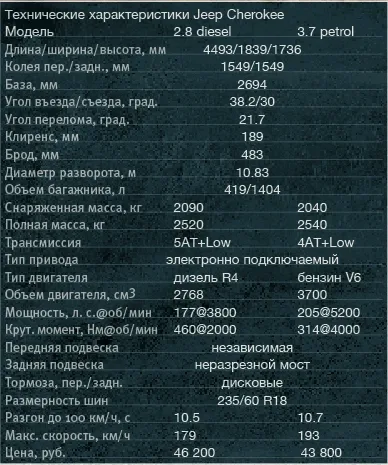
I was tormented by one question: why does someone choose the petrol Cherokee 3.7 L when there is a diesel 2.8 L nearby? After all, the latter has a 0.2-second faster acceleration to 100 km/h, a more impressive torque, and noticeably lower fuel consumption on the highway. I decided that the answer could only be found by getting behind the wheel and driving both.
THREE BOTTLES OF BEER
A year ago on Seliger, I first found myself in the new Cherokee and felt discomfort. Now I understand: I was just sitting incorrectly. In a Jeep, you can't apply the sporty canons I was taught in Audi and Mitsubishi schools. Here, you need to relax immediately upon sitting down — both body and mind, leaning back into the seat. And the petrol version fully matches that mood. It swayed steadily, and on asphalt dips at speed it even lifted off, leaving me in weightlessness. The Cherokee with the 3.7 L engine, in a relaxed state, behaved as if it had drunk three bottles of beer. The diesel version 2.8 L is much more sober. Despite being the same car, differing only in engine...
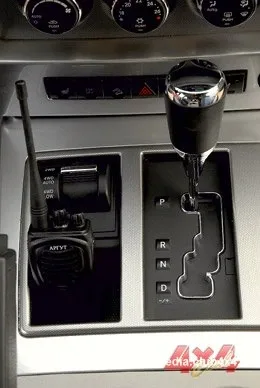
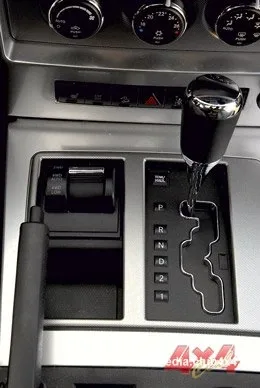
| The diesel unit works in tandem with a five-speed automatic gearbox that has a full manual mode | The petrol Cherokee is content with only a four-speed automatic without the possibility of manual shifting |
RAMBO AND A BALLOON
The petrol Cherokee is a true American. A four-speed automatic with gears stretched like the last days before payday, a calm big V6 that asks for 15 liters per 100 km on the highway. What adequate suspension can we talk about here? That would be a lie. Just as it's a lie that a bloodied Rambo buys a balloon at the end of the action movie.
The diesel Cherokee is a European. It has a five-speed automatic, acceleration to 100 km/h is 0.2 seconds faster, and diesel consumption on the highway does not exceed 9 liters. The suspension here was "tweaked" due to the heavier front end: the diesel engine is more massive than the petrol one. The only thing the 2.8 L loses in is noise: the petrol "six" runs quieter.
Differences are also visible off-road. The traction control systems work differently. In the "tipsy" Cherokee 3.7 L, the wheels brake lazily and often with delay, which is especially noticeable on sand — cross-country capability is worse.
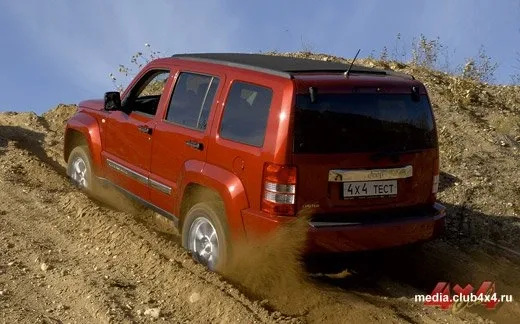
If you look into it, the petrol V6 has only one advantage — with it, the Cherokee is quieter
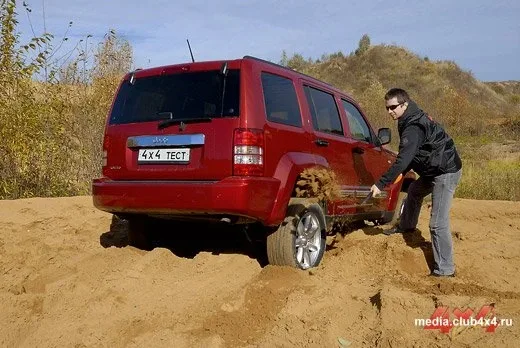
The 3.7 L version rocks heavily, and its traction control system acts softer and slower
The electronic assistant in the diesel engages clearly and understandably. The pads grab instantly, because it needs to hold much more torque: the 2.8 L has 460 Nm, while the petrol has only 314.
SNIFF THE PINES
We tested cross-country capability on sand and steep slopes. In essence, both Jeeps perform equally, but driving the diesel is more pleasant. The rocking of the petrol version, which amused on the highway, became annoying in the quarry. Only the soft top installed on the 3.7 L saved the day. Made of thick synthetic material, it opens up almost all the space above the head. For off-roading, it's an exceptional option: you can admire the pines and inhale forest aromas, and in the parking lot, fold the interior into a sleeping area and watch the clouds or stars. The only problem with this "convertible" is that on the move, passengers keep trying to stick out to the waist, and it's impossible to lure them back inside.
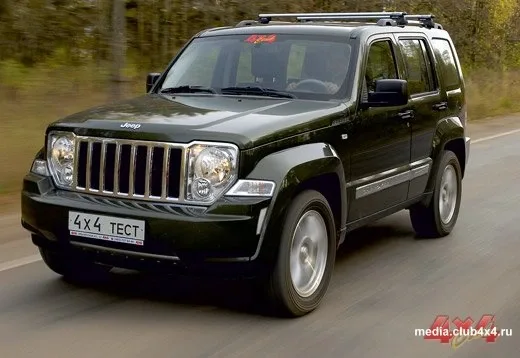
The diesel version of the Cherokee wins 0.2 seconds over the petrol one in acceleration to 100 km/h
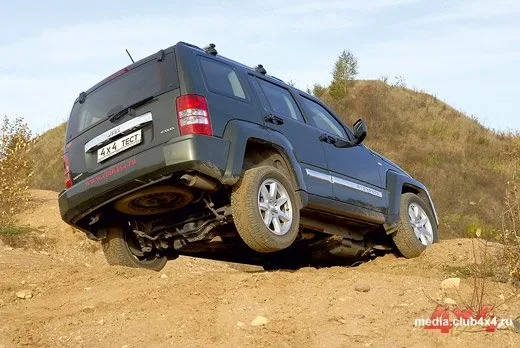
The rear suspension travel is less than you'd expect from such a brutal SUV
So is there any point in the petrol 3.7 L — expensive, voracious, sluggish, with a service interval every 6,000 kilometers on the recommended "Chrysler" mineral oil? When you can take a more modern, nimble, and torquey diesel with maintenance every 10,000 kilometers.
Probably, the 3.7 L is also needed by someone. Those who are exhausted by European "sport" and dream of relaxation. Or those who didn't have enough of $2,400 — that's exactly how much more expensive the diesel is.